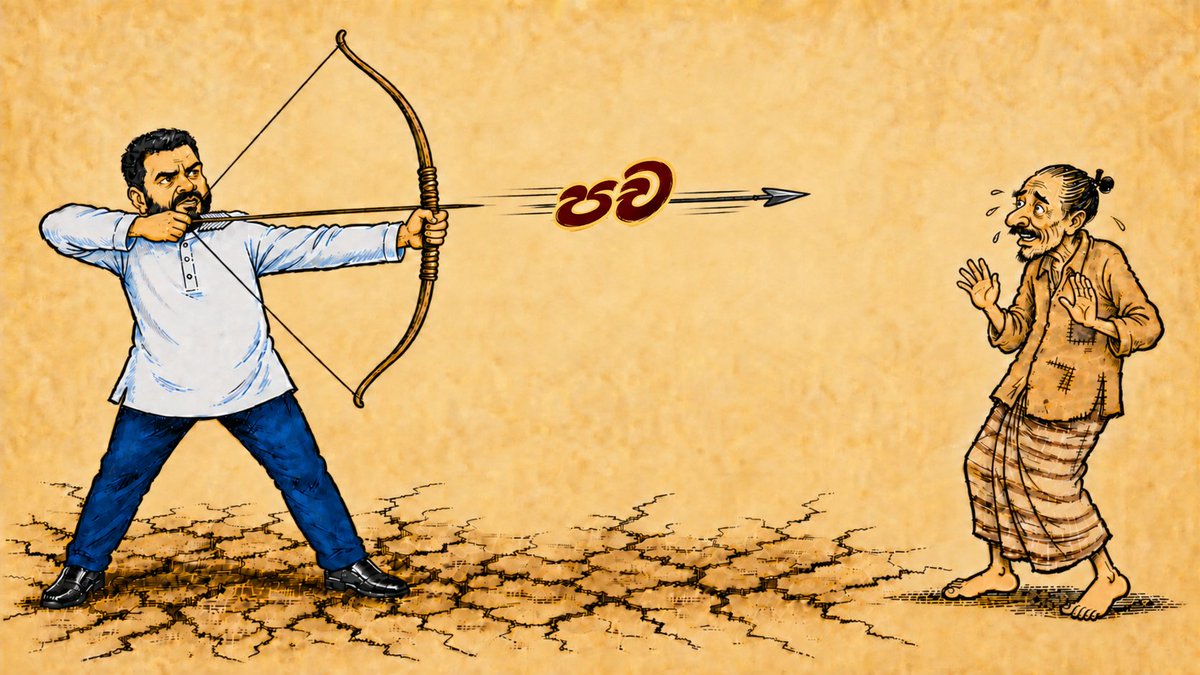
@Dailymirror_SL Sad day for the law and democracy in Sri lanka. Those holding the highest office in the judiciary got it horribly wrong. Personal interest over public good. #lka
The JVP’s Ranil-phobia has flared up again.
Like clockwork, like a fever that returns every time the government’s failures become too visible to hide, the JVP has reached for the one tool that has never failed them: blaming Ranil.
We are seeing it play out in their relentless push to jail him over the expenses from his September 2023 London visit. Instead of delivering on substantive governance, the administration has turned a dispute over state vs. personal travel funds, specifically his detour to attend his wife’s university ceremony, into their primary political crusade. By pursuing criminal charges and demanding prison time over Rs. 16.6 million in travel logistics, the JVP is using investigative agencies less for genuine anti-corruption and more as a smokescreen to distract from their own mounting policy missteps.
#SriLanka #LKA #JVP
@chamihin The international community that is still allowing the ongoing atrocities currently to continue🤔 not saying a word sbout the perpetrators of that.
A massive financial scandal has hit the agricultural sector! A complaint has been officially lodged with the Bribery Commission (CIABOC) against Agriculture Minister K.D. Lalkantha regarding an alleged Rs. 2 Billion fraud involving fertilizer distribution.
Investigations are demanded immediately. Stay tuned for more details! 🛑⚖️
#SriLanka #LKA #CorruptionSL #Lalkantha #AgricultureMinistry #BriberyCommission #NewsUpdateSL #NewsCenter
Goebbels probably could get away with lying, but Mr. President, you cannot. We fed the transcripts from your two speeches at Polonnaruwa and Anuradhapura to Claude (an AI tool) and asked it to analyze and find contradicting ideas just from those two events, not even separated by 24 hours: one at a farmers' rally in Polonnaruwa on September 12 and another at a rally in Anuradhapura shortly after.
Same President. Same government. Same "two years of progress." But apparently, not the same facts. When you compare the transcripts side by side, the numbers change, the claims shift, and the story the President tells depends entirely on which audience he is addressing.
Start with housing. In Polonnaruwa, the President told the farming community that the government is building 31,000 houses this year under various state programmes. By the time he reached Anuradhapura, that figure had nearly doubled: 35,000 houses under the Prajashakthi programme plus 25,000 for flood victims, totalling 60,000 families receiving homes this year. So which is it, Mr. President? Is the government building 31,000 houses or 60,000? Did 29,000 houses materialize out of thin air on the drive between the two cities? These are not rounding differences; this is the gap between reality and a figure fabricated to impress a new crowd.
Then there is the fertiliser subsidy, one of the most politically sensitive issues for the farming community. In Polonnaruwa, the President claimed that when the NPP took power, the subsidy was Rs. 1,000 per farmer, and that his government raised it to Rs. 3,000. It was an explicit claim: we inherited Rs. 1,000 and tripled it. Yet in Anuradhapura, the same President told the crowd that under the previous administration, the subsidy was Rs. 0 (zero) and that his government introduced the Rs. 3,000 payment from scratch. So which is it? Did the previous government give Rs. 1,000 or nothing at all? You cannot claim to have tripled an existing subsidy in one town and then claim to have created it from scratch in the next. One of these statements is false, and quite possibly both.
The oil price crisis provides another example of tailored reality. In Polonnaruwa, he asserted that crude oil rose from $65 to $105 per barrel due to Middle East tensions. In Anuradhapura, he described the same crisis with oil surging from "$60 to $70 to $110 to $125 per barrel." The numbers fluctuate because the President is not citing verified data; he is improvising figures to maximize dramatic effect. When statistics are manufactured on the fly, consistency is the first casualty.
The most revealing contradiction, however, concerns the economy itself. In Polonnaruwa, the President sounded triumphant: the economy had stabilized, Treasury revenue was at a 30-year high, the budget deficit was the lowest since 1957, and the nation was resilient. He boasted of weathering the Middle East oil shock, allocating Rs. 10,000 crore from the Treasury, and providing a Rs. 100-per-litre fuel subsidy while maintaining uninterrupted supplies. The takeaway was clear: the economy is fixed, the hardest work is behind us, and prosperity is underway.
Yet in Anuradhapura, standing before a different crowd in the rain, he struck the opposite tone: "I will tell you as President, we have NOT yet achieved economic sovereignty. We don't have that strength yet." In one speech, the economy is strong, resilient, and generating historic revenue; in the next, the country has not even achieved economic sovereignty. These two positions cannot coexist. Either the economy is strong enough to absorb global shocks and yield record returns, or it remains fragile and dependent. The President simply feeds each audience what it wants to hear: Polonnaruwa gets a success story to inspire optimism, while Anuradhapura gets sober realism to justify continued sacrifice.
The state recruitment figures do not withstand basic arithmetic either. The President announced 21,000 new public sector recruits, calling it the largest single-year intake in history. In the very next breath, he listed 23,000 teachers and 10,000 police officers as part of that intake. That amounts to 33,000 positions within an alleged total of 21,000. The parts exceed the whole. Either the overall figure is incorrect or the individual components are. A leader who cannot reconcile his own math within a single speech has little credibility lecturing the public on fiscal discipline.
In Polonnaruwa, he also claimed the government had spent "the most money ever on paddy purchasing" (Rs. 22,000 million) and guaranteed that recurring purchasing issues would end next season. Yet this is the administration whose Agriculture Minister dismissed farmer protests, whose Deputy Minister disparaged farmers, and whose promised guaranteed price of Rs. 150 per kilogram vanished upon taking office. The farmers of Polonnaruwa have heard these pledges before. They were promised Rs. 150 per kilo; instead, they received Rs. 90 from private buyers while facing production costs above Rs. 120. A guarantee from this administration is worth less than the harvest farmers are unable to sell.
Both speeches lean heavily on a single narrative frame: the "halted country." Everything, supposedly, had ground to a halt: the expressway, the airport, the canal, the hospitals, and international lending. Sri Lanka had declared it could not service its debt. This is a well-worn rhetorical device to portray the inherited situation as an unmitigated disaster so that any movement resembles triumph. Yet in Anuradhapura, the President boasted of fully funding massive infrastructure projects, including the Malwathu Oya reservoir (Rs. 4,600 crore), the Kapiti Gollewa water project (Rs. 5,200 crore), and the Kurunegala-Dambulla highway, entirely from state revenue rather than loans. If the country was thoroughly bankrupt and cut off from credit, where did this capital originate? One cannot credibly claim to have inherited a collapsed economy while simultaneously boasting of self-funding billions in mega-projects within two years. The arithmetic fails, and the narrative collapses.
This highlights the core hazard of governance by rally. When communication is restricted to partisan events where crowds applaud on cue, accountability disappears. A leader can quote a Rs. 1,000 subsidy in one district and zero in the next; proclaim economic stability to one gathering and vulnerability to another; pledge 31,000 houses here and 60,000 there; or cite $105 oil on Friday and $125 on Saturday. The assumption is that listeners will not compare the records. But the transcripts remain. When placed side by side, they reveal not a coherent vision, but opportunistic rhetoric: figures adjusted to fit the moment, contradictions masked by applause, and a standard of truth that shifts with every stop on the campaign trail.
#SriLanka #LKA #AKDLies
Under Sri Lanka's Constitution, the Supreme Court is authorized to have up to 17 judges. As of September 2026, only 13 judges sit on the bench, including the Chief Justice. Four seats are empty, and they have remained empty for over a year. The first vacancy opened in June 2025 when Justice Gamini Amarasekara retired, followed in succession by Justice S. Thurairaja, PC; Justice Kumudini Wickremasinghe; and Justice Priyantha Fernando. One by one, the seats were vacated, and one by one, President Anura Kumara Dissanayake refused to fill them.
This is not an administrative oversight. It is a deliberate choice by a President who is systematically weakening the judiciary while publicly claiming to strengthen it.
The Bar Association of Sri Lanka (BASL) has publicly condemned the President's failure to fill these vacancies, calling it "administratively irresponsible" and "deeply unfair to deserving judicial officers." The BASL warned that "the failure to make timely appointments to the Supreme Court not only affects individual judges but erodes public confidence in the judicial system as a whole." They have urged the President to act immediately, yet he has ignored them.
Consider the case of Justice Ganepola, a Senior Justice of the Court of Appeal who is fully eligible for elevation to the Supreme Court. Despite four vacant seats waiting to be filled, the President has denied him that promotion, an omission the BASL has flagged as a grave injustice. Or consider Justice Rathanapriya Gurusinghe, who retired from the Court of Appeal on September 1, 2026, after a distinguished judicial career, passed over for a Supreme Court appointment despite a formal recommendation from former Chief Justice Murdu Fernando herself. The BASL confirmed at his farewell ceremony that they were "fully aware that former Chief Justice Murdu Fernando, PC, had formally recommended Justice Gurusinghe for elevation to the Supreme Court." That recommendation was ignored. A qualified, recommended judge was permitted to retire without promotion while four Supreme Court seats sat vacant. The BASL described this as "a grave injustice," and they are right.
Now, here is where the hypocrisy becomes truly breathtaking. This same President, who refuses to fill four existing vacancies on the Supreme Court, is pushing the 22nd Amendment to the Constitution to extend the retirement age of Supreme Court judges from 65 to 67 and Court of Appeal judges from 63 to 65. His stated justification? To reduce case backlogs and improve judicial efficiency. He wants the public to believe that the solution to delays in the justice system is keeping current judges on the bench for two extra years.
Yet if judicial efficiency were genuinely his concern, why has he left four Supreme Court seats empty for over a year? Why has he left four Court of Appeal seats vacant? Why did he refuse to promote eligible, recommended judges? Filling those eight vacancies across both courts would immediately increase judicial capacity by a far greater margin than extending any retirement age. The BASL itself has pointed out this glaring contradiction. The Church of Ceylon has stated that the backlog justification is "undermined by the unfilled vacancies." And here is the most damning statistic of all: approximately 95 percent of pending cases as of June 2025 were in the District Courts and Magistrates' Courts, not in the Supreme Court or the Court of Appeal. Extending the tenure of superior court judges does virtually nothing to address the primary source of the backlog. The President's justification collapses under the weight of his own inaction.
When you leave four seats empty on a 17-member court, you do not just reduce capacity; you concentrate power. Every constitutional challenge, every fundamental rights petition, and every politically sensitive case is decided by fewer judges: individuals who can be more easily monitored, pressured, or selected for favorable bench compositions. That is precisely what was evident during the 22nd Amendment hearings, when the Chief Justice assembled a five-member bench while bypassing four senior judges, and the Bar Association's request for a full-court hearing was rejected. A full complement of 17 judges would have made such selective bench composition far more difficult. Thirteen judges makes it easy.
This is the pattern: refuse to fill vacancies to keep the bench small and manageable, then push an amendment to extend the tenure of the judges who remain, judges who are now being asked to rule on legislation that directly extends their own careers. It is not judicial reform; it is judicial capture dressed in the language of efficiency. The President does not want more judges. He does not want a stronger court. He does not want faster justice. He wants a court small enough to control and compliant enough to serve his political agenda. Every day those four seats remain empty is another day that agenda advances.
Fill the vacancies. Promote the qualified judges. Restore the Supreme Court to its full constitutional strength of 17. That is how you reduce backlogs. That is how you protect judicial independence. And that is how you honor the democratic principle that justice must be dispensed by courts strong enough to resist the power of any single individual, including the President.
#SriLanka #LKA #BASL @commonwealthsec@EUCouncil@EUCouncilPress@UNHumanRights@hrw@PMOIndia
@Dailymirror_SL A president once elected should be to the entire nation not just his party. Should respect the constitution and not controlled by the party. 🤔 agree about family politics but getting instructions from un elected party leaders is also the same.#lka
A rudimentary penetration test shows that the app’s backend, deep-link domains, and update feed are all hosted on a private commercial domain (https://t.co/2CXzuflW2k). This means NICs, GPS locations, SOS recordings, and other personal data are processed by a private vendor and not by a government-owned infrastructure. Ironically, the app’s own privacy policy states that data will not be sold or shared with third-party entities.
In a few days, President AKD and his NPP will mark two years in office. It is an anniversary that invites a simple question, one that voters everywhere eventually ask of the governments they elect with high hopes: what, precisely, has been delivered? https://t.co/vYCgUASr6Q