Stan Druckenmiller says it again…
"Anyone who says we don’t have to cut entitlements is lying. We can either cut them now or we’re going to cut them later. But if we cut them later, it’s going to be much more painful."
Rome handed out free grain to 40,000 citizens in 73 BC. By 46 BC, Julius Caesar found 320,000 people lining up for their monthly ration. That eight-fold expansion happened in under three decades, and it shows you how welfare states actually grow.
No Roman senator stood up and announced a plan to addict a third of the city to government bread. It happened incrementally, through political competition. Each magistrate who wanted votes expanded eligibility. Each expansion normalized the next one. The citizen who once considered the dole shameful eventually expected it, then demanded it, then organized politically to protect it.
This is the core mechanism free market thinkers have identified across every era: once you create a transfer program, you create a constituency for that program. Recipients vote. Administrators build careers. Grain merchants who supply the state develop a stake in keeping the contracts flowing. The political economy locks in.
Caesar, to his credit, actually cut the rolls back to 150,000 through verification audits. It was one of his more economically coherent moves, though the Senate still murdered him. His successors quietly let the numbers climb again.
What did the dole require? Massive grain imports from Sicily, Sardinia, and Egypt, organized through state logistics at state expense, funded by taxation and conquest. When the conquest revenue dried up, the obligation remained. Rome had written a check against future military success, and future military success eventually failed to arrive.
The lesson is not complicated. Distribute a benefit and you distribute dependency. Distribute dependency and you distribute political power to whoever controls the distribution. The grain dole didn't weaken Rome overnight, but it made every subsequent reform politically impossible.
“[Soviet writers of the lower classes] made the same mistake that revolutionaries continually make: ascribing the vices of the upper class to the class itself and not to humanity as a whole.”
Man who kept his boat besides his house was ordered from the city to put up a fence to hide the boat from view. So he built the fence and hired someone to paint it.
You think housing prices will keep going up because you've seen it all your life. But this is a historic anomaly that is likely to reverse soon: Prices might start shrinking in many places.
This thread is the case against investing in housing:
General $BTC market outlook update:
Supply distribution has started. Here's what I'm looking at and how it compares to previous cycles, and what might come next:
First off, the biggest story is obviously the ETFs. $IBIT has been the most succesful ETF launch in history by a wide variety of metrics, and just looking at BlackRock + Fidelity alone, they've bought 284k BTC since launch, greater than 1% of total #bitcoin supply that will ever exist.
On a net basis, including $GBTC outflows, ETFs have hoovered up ~160k BTC since launch in early January. Just massive numbers. Demand has surpassed most all initial expectations, with increasing strength into the rally ($788m of inflows from $IBIT alone yesterday amidst a -8% close from ATHs). While the bitcoin market has boomed post ETFs, nothing exists in a vacuum.
For those that have been following since before the ETF, it was clear the ground work for this rally was laid over the past couple years of bear market purgatory.
Various on-chain HODL metrics clearly showed all time levels of supply constraint. From the most simple to understand (i.e. '% of supply last moved in N+ years' most all hitting all time highs) or more advanced quantifications of HODL strength using the UTXO set, despite the +100% bounce from 2022 lows, net accumulation was on-going for much of 2023.
However, as is tradition with the ever-cyclical $BTC market, with the rise to new heights comes the distribution of coins to new entrants from the old guard.
This can clearly be seen by the change in long-term holders over the recent months. For those interested in a deeper dive on the quantification of LTHs, you can take a deeper dive here: https://t.co/9FbZj1JY6M
However, at this stage, I'd say its far from worrisome, nor by any means a red alert for bulls. New distribution (on a 30d change basis) began to occur at ~$1k in 2017 and ~$13k in 2020 during the run up to new highs, and started in early January this time around.
Here's a visual of the distribution that has begun to occur. Below displays the drawdown in supply held by long-term holders from its local two peak as a percent of circulating supply. Just the start, and likely to increase as new highs are set (if current rally is sustained).
A clear takeaway should be just how strong distribution can become during a raging bull market while price is still going parabolic.
As new forms of demand unlock from new classes of investors that realize bitcoin did not indeed die during the previous bear, while fundamentals such as liquidity and adoption have improved, unlocked supply can be overwhelmed by newfound demand for quite a while. A local peak is reached once an increasing overhang of supply exceeds newfound demand at exceedingly high prices, the exchange rate crashes, and we repeat the whole cycle of accumulation all over again.
In terms of catalyst on the horizon I am watching, there are a few obvious ones. First, it's still the early innings of ETF allocations. These passive flows from the world's largest financial institutions will continue, and are likely to grow given the immediate success of the products. Here are some of my thoughts from back in November on the impact of ETFs. All still hold true today, and admittedly my initial expectations have been far surpassed. Crazy bullish.
https://t.co/gshlNVqGtZ
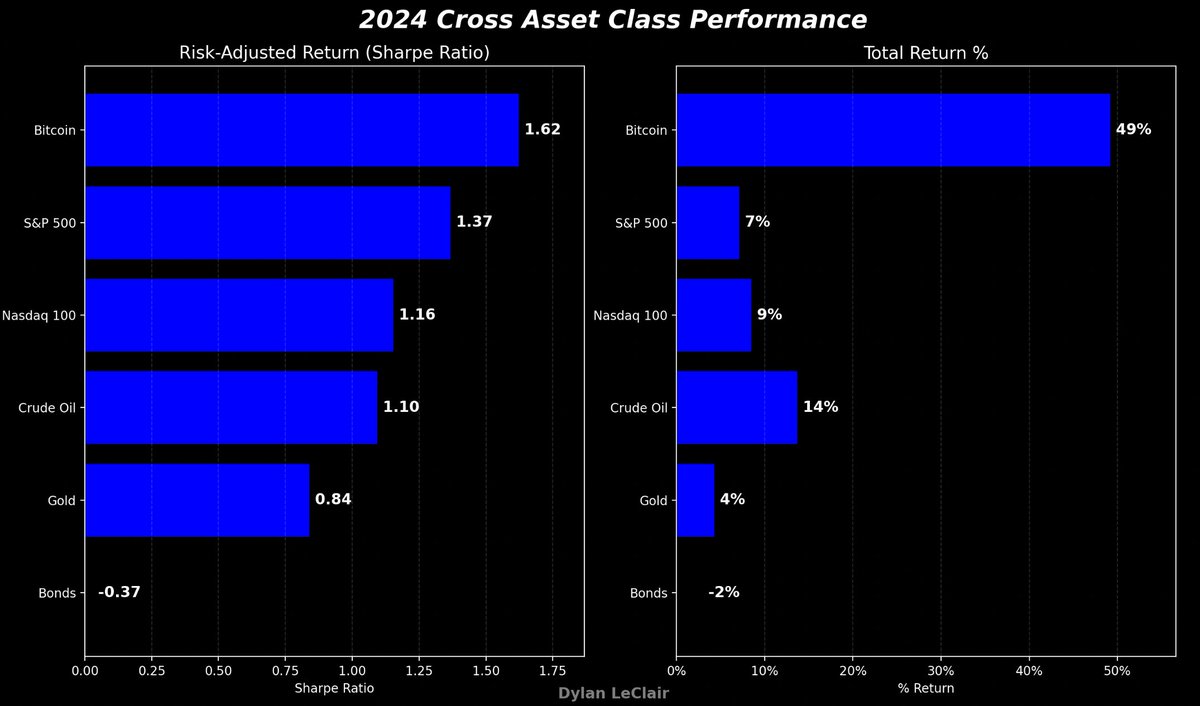
Portfolio managers and financial advisors have zero excuse to ignore the best performing asset in absolute and risk adjusted returns after the BlackRock stamp of approval and subsequent ETF rollout. You especially can't afford to ignore it when your direct industry competitors aren't ( $IBIT is currently +25% above its average volume weighted price ). There will be chasing.
Secondly, the FASB accounting rule change has massive implications that have not begun to be priced in or felt by the market. Post 2020, it was only $MSTR, $SQ, $TSLA, $COIN, and some miners with $BTC exposure in public markets, which was treated as an intangible asset.
It's only a matter of time until CFOs everywhere, with improved accounting standards for $BTC, begin to wake up. Saylor's $MSTR raised another $700m this morning at 0.625% in the convertible debt market. This is on top of already tapping the corporate debt market with a 0% convert and a 6% junk offering previously.
You could've laughed and dismissed it all you wish during the mania of 2021. Laugh they did, yet MicroStrategy is +933% from the point they adopted a bitcoin standard, and every single debt instrument issued and equity sale facility utilized to buy $BTC is in the money. There will be copycats.
While maybe not as ALL IN as Saylor's $MSTR, there WILL be copycats.
Capital markets are still mispricing this transition. Corporate speculative attacks and share dilutions to acquire $BTC will occur with increasing levels of frequency and size. This is not going away. The playbook has been vindicated. After a decade+ of ZIRP financed buybacks that decapitlize corporate balance sheets that created a zombified public sector, the pendalum is going to swing back. $BTC is the new stock buyback, most companies just haven't figured it out yet.
Lastly, Russia being kicked from SWIFT sent a clear signal to any not under the umbrella of USD hegemony. Multiple sovereign are currently mining BTC. Multiple are likely accumulating in secret currently as well.
$BTC is running it back on a global stage, but this time around with pipes built out directly into the heart of TradFi.
In summary, yes, incumbent HODLers have begun to slightly distribute, but they are currently being met by an insatiable wall of money. It's going to be a wild ride ahead.
Finally, if you found any of this interesting or valuable, consider a share. 🧡🫡
Tucker Carlson has been smeared for days. The legacy media and Democrat establishment are upset at him for simply doing his job.
Americans can handle thought-provoking conversations. We can handle dangerous thoughts or contrary ideas that don’t fit the MSM narrative. Let us decide for ourselves.