PRESS RELEASE
DEFENCE HEADQUARTERS MOURNS THE PASSING OF RETIRED MAJOR GENERAL RABE ABUBAKAR, REAFFIRMS RESOLVE TO ERADICATE TERRORISM
The Defence Headquarters regrets to announce the passing of Major General Rabe Abubakar (Retired), who tragically lost his life in captivity following his abduction.
The Armed Forces of Nigeria (AFN) convey its deepest sympathies to the Abubakar family, his colleagues and all Nigerians. Maj Gen Abubakar served the nation with distinction and held many appointments including spokesperson of various military formations as well as spokesman for the AFN as Director Defence Information. He made immense contributions to counter-insurgency operations, professional development of the AFN and numerous other commendable and outstanding impacts. His commitment to duty and to the unity of Nigeria remains a shining example for all personnel of the AFN.
The Defence Headquarters withheld public comment on his abduction in deference to ongoing rescue efforts by the AFN and sister security agencies. Every operational resource was deployed in the hope of securing his safe return.
This sad loss further strengthens the resolve of the AFN. We will remain resolute in the discharge of our constitutional mandate to defend the sovereignty and territorial integrity of Nigeria and to protect all citizens.
In response to series of unfortunate abductions across Nigeria including that of Maj Gen Abubakar, ongoing operations have since been further intensified to bring perpetrators to justice and to dismantle all terrorist networks threatening our nation.
We assure Nigerians that the Armed Forces will not relent until peace and security are restored and those responsible for terrorists activities across the nation are held to account.
SAMAILA UBA
Major General
Director Defence Information
13 June 2026
@Rise_Forge Independence Avenue, CBD Abuja. I can see the Supreme Court Building ahead. The Federal Secretariat Complex and the Ministry of Foreign Affairs to the left.
I have met a lot of people that voted Peter Obi the last time and will be voting PBAT next year.
I have also met a lot of people that voted Peter Obi last time but will sit out this election because Peter Obi hasn’t been as inspiring as he was in 2023 and they do not consider the alternatives as better.
I haven’t met a single PBAT supporter that is now supporting Peter Obi or any other candidate( this is my reality)
I believe this administration hasn’t lived up to certain hype but I cannot deny that it’s been reform minded. Helping correct structural issues that have plagued this country far too long.
For example, the recent passage of the state policing bill is by no means a mean feat. That this administration makes it look easy or don’t blow their trumpet so loudly does not diminish the huge significance of the bill and the tireless work that they put into it.
The implementation of the Nigeria Payments System Vision 2028 ( championed by CBN) is another policy that has gone under the radar(I believe we should all read about the policy) . This is one policy that will revolutionize our financial system for good. One that will birth several financial innovation and products. There is no eradication of poverty without financial inclusion and it appears CBN is on an articulated agenda towards a sustainable path.
For some of us, there are enough reasons to stick around this current administration. The alternatives aren’t as inspiring and simply do not have what it takes to out perform this current administration.
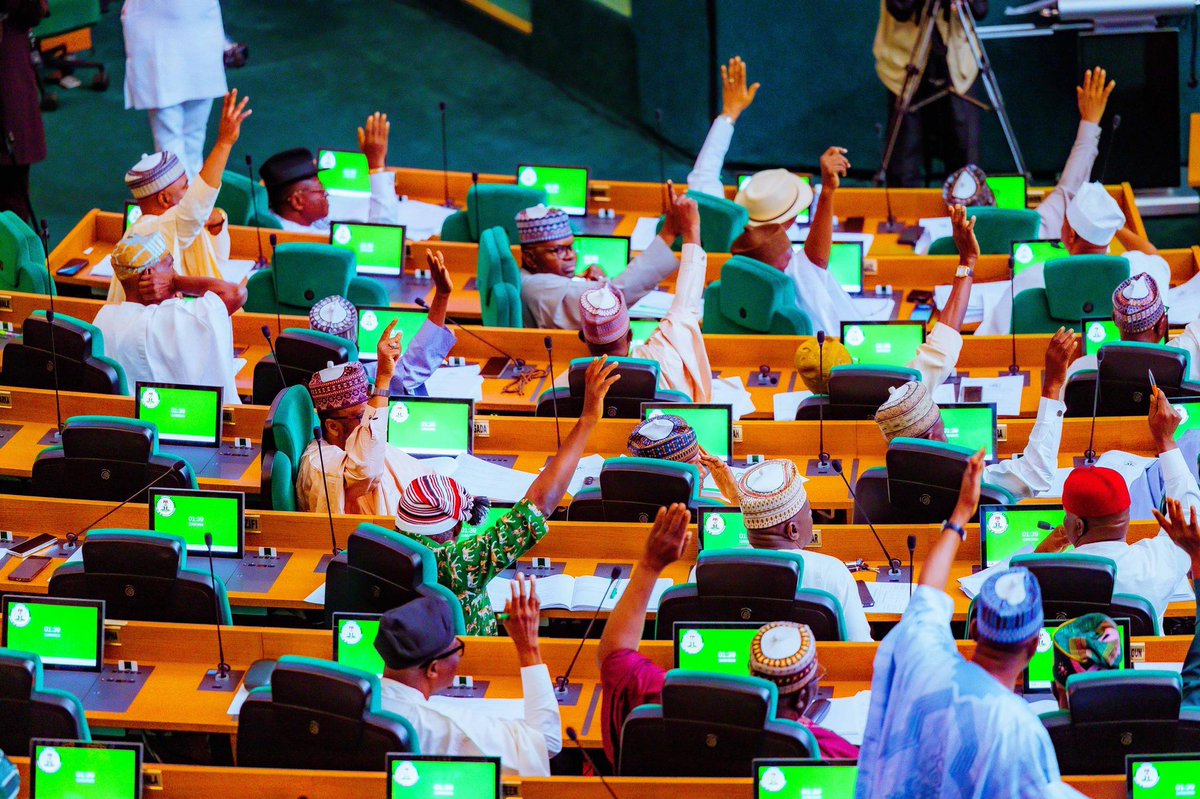
Today, the House of Representatives began consideration and voting on the Constitution Amendment Bills currently before it.
In response to the current security challenges confronting our nation, the House prioritized the legislative tool targeted to address this critical issue; the State Police Bill (HB 617), which I have the honour of sponsoring.
As Chairman of the Constitution Review Committee, I formally presented the bill to the House, emphasizing the urgent need for its consideration and passage as a critical legislative instrument to support the Executive Arm of Government in tackling the current challenges.
The bill seeks to alter the Constitution of the Federal Republic of Nigeria to establish State Police alongside the Federal Police, create State Police Service Commissions in all states of the Federation, provide a constitutional framework for the organization, administration and oversight of State Police, and strengthen community-based policing while maintaining national standards, accountability and coordinated security operations across the country.
The bill having secured the support of 289 members has now been approved by the House and will proceed to the Senate for concurrence in accordance with the constitutional amendment process.
Upon passage by the Senate and approval by not less than two-thirds of the State Houses of Assembly, the bill will be transmitted to the President for assent, paving the way for its implementation.
With the implementation of this constitutional amendment, states will be empowered to effectively police their environment in curbing the menace of insecurity, improve response times to incidents, and ensure adequate presence of security personnel within communities.
I am confident that this legislative intervention will strengthen our security architecture, ensure more safety for our communities and restore peace and stability across every part of our country.
@OfficialBenKalu Dear Deputy Speaker, we appreciate the sense of urgency with which you have treated the State Police Bill and the broader Constitutional Amendment Bills from the outset.
There's no better time to enact this important piece of legislation than now.
The Central Bank of Nigeria (CBN) has proposed a major overhaul of the regulatory framework governing financial holding companies (HOLDCOs), seeking to strengthen oversight of banking groups through tougher capital, ownership and governance requirements.
As the World Cup Begins Without Nigeria
As the World Cup begins today across three nations, I identify with our teeming football followers and urge them not to be despondent that Nigeria is not participating, despite the abundant talent in our land.
Our failure to participate on the global stage is not due to a deficit of talent; it is a direct consequence of a deficit in leadership, planning, and institutional support.
The task of building a better Nigeria rests primarily on the shoulders of the younger generation. Do not watch the World Cup with despair; rather, see it as a reminder of where Nigeria ought to be. We must move our country from being a nation of mere consumers of global entertainment to a nation of proud producers and competitors.
A new Nigeria is POssible. -PO
@OpeBee I need an Act of the National Assembly that will mandate compulsory televised Presidential Debate for presidential candidates. I want to check something.
Details of Proposed Constitutional Amendments for the Establishment of State Police and Federal Police
1. Establishment of Federal Police and State Police (New Section 214)
• Two distinct police bodies are constitutionally established:
• (a) the Federal Police
• (b) State Police (one per State, established by State law)
The National Assembly must pass an Act prescribing:
• Structure, organisation, administration, and powers of the Federal Police
• Framework and guidelines for the establishment of State Police
• State Police cannot commence operational policing until:
• Established by a Law of the State House of Assembly, and
• Certified as meeting national minimum standards (prescribed by an Act of the National Assembly)
• Transitional provision: Until a State Police becomes operational, the Federal Police continues all policing functions in that State. After commencement, the Federal Police handles federal policing functions and may provide assistance to the State Police.
2. Responsibilities and Non-Interference (Section 214)
Federal Police is responsible for:
• Maintenance of public security, public order, and security of persons/property throughout the Federation (to the extent provided by the Constitution or National Assembly Act).
• Similar functions within a State to the extent the State has legislative power under the Constitution.
Key safeguard against federal overreach (Section 214(6)):
The Federal Police shall not interfere with State Police operations or a State’s internal security affairs except in these limited cases:
• To contain serious threats where there is a complete breakdown of law and order and the State Police is unable to respond.
• When the Governor requests intervention.
• When a State Police is unable to function due to administrative, financial, or other problems.
Any such intervention requires prior approval by the National Police Council.
Federal Capital Territory (FCT): Fully under the jurisdiction and operational control of the Federal Police.
3. Leadership and Command (New Section 215)
• Federal Police: Headed by the Inspector-General of Police (IGP).
• Appointed by the President on the advice of the National Police Council, from serving members of the Federal Police.
• Subject to confirmation by the National Assembly.
• The IGP has command over the entire Federal Police, including contingents in States.
• The President (or authorised Minister) may give lawful directions on public safety and order; the IGP must comply.
• State Police: Headed by a Commissioner of Police (CP).
• Appointed by the Governor on the advice of the National Police Council, from serving members of the State Police.
• Subject to confirmation by the State House of Assembly.
• The Governor (or authorised Commissioner) may give lawful directions on public safety and order; the CP must comply.
• If the CP believes a direction is unlawful or contradicts general policing standards, the matter can be referred to the National Police Council (whose decision is final).
4. Removal of Top Officers (New Section 216)
• IGP: Removed only by the President on the recommendation of the National Police Council for specified grounds (grave misconduct, breach of Police Act/Regulations/Code of Conduct, conviction for fraud/dishonesty, bankruptcy, or mental incapacity). Requires two-thirds majority approval of the National Assembly.
• State Commissioner of Police: Removed only by the Governor on the recommendation of the National Police Council for similar grounds. Requires two-thirds majority approval of the State House of Assembly.
5. Funding Support (New Section 216A)
The Federal Government shall provide grants or aids to State Police on the recommendation of the National Police Council, subject to approval by the National Assembly.
6. Oversight Bodies
National Police Council (restructured and renamed from the old Nigeria Police Council; new composition and expanded functions in Third Schedule):
• Broad membership including: Chairman (Presidential appointee confirmed by NA), Attorney-General of the Federation, serving senior Federal Police officer, Attorneys-General of all States, retired Commissioners of Police (one per geo-political zone), representatives of NHRC, Public Complaints Commission, NLC, NBA, NUJ, and Traditional Rulers’ Councils.
• Key functions: Appointment and discipline of Federal Police officers (except IGP); recommending State top officers (CP, DCP, ACP) to Governors based on State PSC lists; supervising Federal and State Police activities (within constitutional limits); setting standards for training, intelligence, forensics; assisting State Police on request.
State Police Service Commission (new body established for each State in Third Schedule, Part II):
• Composition: Chairman (appointed by Governor, confirmed by State HA), representatives of NHRC, Public Complaints Commission, NLC, NBA, NUJ, retired Assistant Commissioners of Police (one per senatorial district), and Traditional Rulers’ Council.
• Functions: Recommending three qualified candidates for CP/DCP/ACP to the National Police Council; appointment, discipline, and removal of State Police officers below the rank of Assistant Commissioner of Police; other functions as prescribed by Constitution or National Assembly Act.
7. Legislative Framework (Second Schedule – Concurrent Legislative List)
• National Assembly may make laws on: establishment/organisation/administration/powers/duties of Federal Police; powers/duties of State Police; national minimum standards for both; policing standards, inspection, certification, complaints mechanisms, criminal information systems, inter-governmental cooperation, federal intervention, use of force, firearms, grants, and accountability.
• State Houses of Assembly may make laws for the establishment, organisation, administration, funding, and oversight of their State Police — but must comply with the Constitution and valid National Assembly Acts.
• States may set higher standards than national minimums but not lower.
• National Assembly laws cannot give federal authorities routine command, deployment, appointment, promotion, transfer, discipline, or control over State Police personnel (except for explicitly authorised federal intervention).
8. Other Related Changes
• Updates to various constitutional provisions (e.g., Sections 34, 35, 39, 42, 84, 89, 129, 153) to replace references to “Nigeria Police Force” with appropriate “Police”, “Federal Police”, or “State Police” terminology.
• Exclusive Legislative List adjustments (e.g., light arms for policing purposes; fingerprints/biometrics/forensics shared with State Police; Federal Police listed separately).
• Consequential amendments to the Third Schedule for the new bodies and their compositions/powers.
TRANS-SAHARAN GAS PIPELINE
What it Means for Nigeria's Energy Future
The Trans-Saharan Gas Pipeline, a 4,128 km long pipeline, designed to evacuate abundant gas resources from the Niger Delta in Nigeria to Algeria via Niger, with ultimate delivery of the evacuated gas in Europe. Algeria has officially launched construction of its section, Nigeria has progressed significantly with the AKK and OB3 gas pipeline projects and Niger will commence its section in 2027.