@LinkedInHelp My LinkedIn account is restricted, I lost access to my old email addresses, and every appeal link redirects back to the restriction screen. Please help me submit ID verification.I forget my first email access hence created second account do help me
https://t.co/jbBjSaKj3d
If anybody is interested in nasa space apps challenge do join in this team
Our topic is creating a health monitoring software for Astronauts in space Missions i need 4 more members
@gagan_shux It’s so fascinating how the brain and body adapt to microgravity! You made 'swimming' through air look so effortless despite Newton's laws working against you without friction. Thanks for bringing us along for the ride!.
Happy Birthday Gp Capt Shubhanshu Shukla Sir (@gagan_shux) 👨🚀 From fighter cockpits to human spaceflight, your journey is pure inspiration for every space lover. Thank you for proving the cosmos belongs to those who dare to dream! 🚀✨
@gagan_shux Spot on! The chemistry behind airglow is brilliant. Love how distinct the different gas altitudes.. look in these space captures.Really got a lot to know from this keep on sharing more such content......
@gagan_shux Phenomenal views! You’d look amazing in that suit, Sir . The future is being built right now, and India is right there at the forefront. Safest flights ahead! 🚀✨
#Gaganyaan
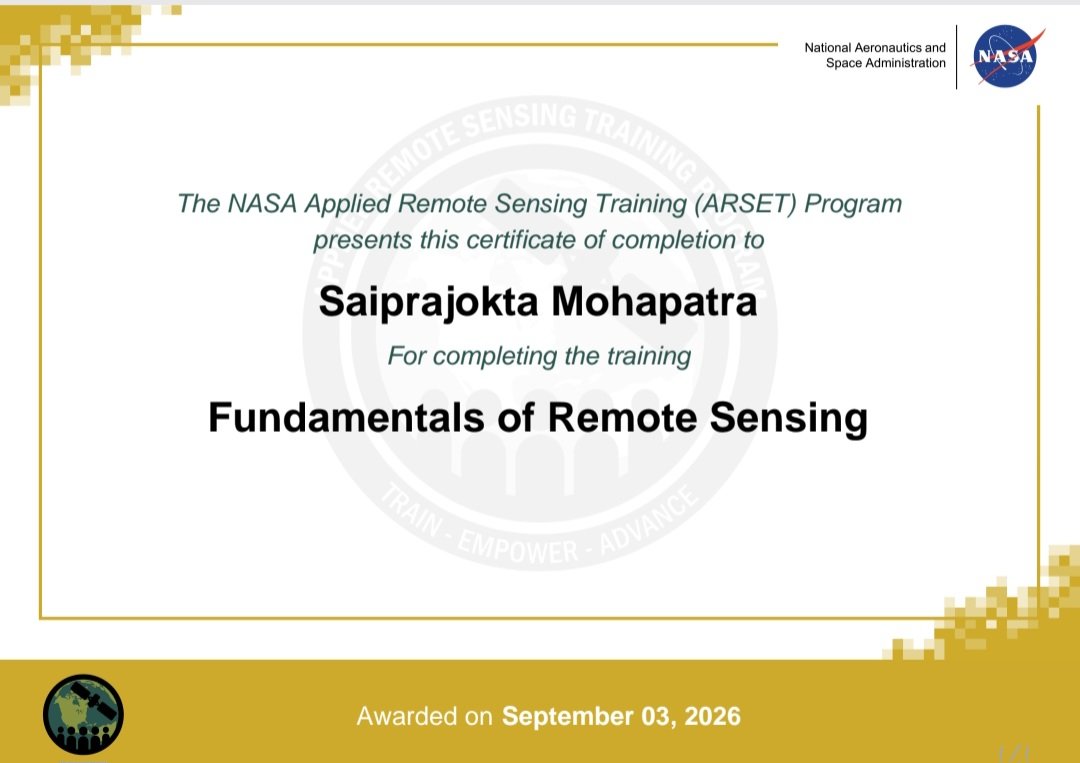
Excited to share that I have completed the Fundamentals of Remote Sensing training program offered by the NASA Applied Remote Sensing Training (ARSET) program!Through this program, I gained valuable insights into the core concepts of remote sensing...
@NASA@isro@gagan_shux
@gagan_shux Really a very innovative idea sir....Hope it will soon be done in reality and humans could be able to stay on moon and mars as they are doing on Earth....
@gagan_shux A single lunar night lasts about 14 Earth days, meaning temperatures drop to -130°C and solar power becomes useless. How will BHEEM store enough energy to keep its structural bio-heating systems active during these massive periods of complete darkness?
B.H.E.E.M. — Bharatiya Habitable Expandable Extraterrestrial Habitat.
When we returned from our training in Russia, we began the Indian leg of our astronaut training. This involved learning the systems of the launch vehicle and orbital module, along with extensive physical and spaceflight training.
But there was another, rather different, dimension to our training—academic research.
We were encouraged to pick a subject related to future space exploration, deepen our understanding of it, and, hopefully, contribute something that could be useful for India’s future space programmes.
I decided to look beyond the spacecraft we were training to fly in and think about where humans might live after we land.
My area of research was extraterrestrial habitats—the technologies and concepts that could eventually allow humans to live and work beyond Earth.
That work eventually resulted in B.H.E.E.M at the Aloke lab in @iiscbangalore.
There are enormous challenges to solve before humans can establish a sustained presence on the Moon, Mars, or other extraterrestrial destinations. From radiation and extreme temperatures to life support, energy, construction and the simple question of where do we live?
And that is precisely why we need to start thinking about it today.
If we want humans to live beyond Earth 20 years from now, the work cannot begin 20 years from now. It has to begin today.
The first step towards building a habitat on another world may not be laying its first brick.
It may simply be daring to imagine what that habitat could look like.
Details here ⬇️
https://t.co/WvXnw4g69n
#Shux #space #shubhanshushukla #india #bheem