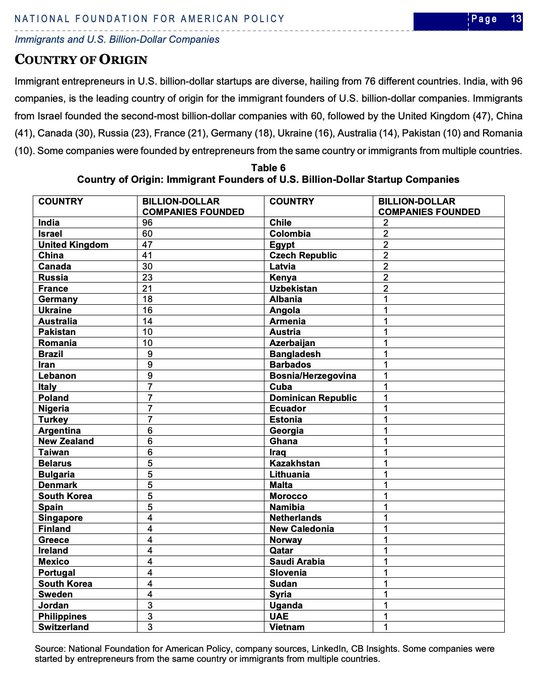
India has sent 96 people to America who started billion dollar companies. No one else is even close.
There's only about 5 million Indians in America. Almost one in 50,000 of them is a unicorn founder!
What a holy, special, beautiful people.
I will always fight for them.
Insightful WSJ piece by @DanielYergin on how it could take years before global energy flow returns back to “normal”, and yet global energy diversification is well underway:
“Overall, the Western Hemisphere now produces more oil than the Middle East did before the crisis. Canada is the world’s fourth-largest oil producer. Brazil produces four times as much oil as Venezuela; and in Guyana, where production began only seven years ago, output almost equals Venezuela’s. In Argentina’s Vaca Muerta region, shale oil production has grown sixfold since 2020. The current disruption will propel more oil and gas investment in the Western Hemisphere and Africa.
Diversification goes beyond oil and gas. Responding to the “tanker war” during the 1980s Iran-Iraq war, Saudi Arabia built variety in the form of a pipeline system that now moves 7 million barrels of oil a day west to the Red Sea. Abu Dhabi built a pipeline looping around the Strait of Hormuz and plans to double capacity by 2027. France, which once depended on oil for electric generation, now relies mainly on nuclear. Japan led the development of the LNG industry to push oil out of its electric generation. The growing scale of wind and solar adds further diversification for electric generation.”
https://t.co/ty4SpbOdKl
The Gulf states have accelerated their search for new air-defence systems after suffering from thousands of Iranian missile and UAV attacks.
South Korea, Ukraine, the United Kingdom and the United States are among those countries that have been approached by Gulf states interested in near-term acquisitions, which include interceptor missiles, interceptor UAVs, point-defence systems, radar and surface-to-air missile systems.
➡️ Read the full analysis by @albert_vidal_: https://t.co/Wu0TiYr1oo
Around 1,950 years ago in Pompeii, a weaver named Successus fell in love with a barmaid named Iris.
She did not love him back.
We know this because his rival, a man named Severus, decided to humiliate him publicly. He grabbed something sharp and carved this into a wall for the whole city to read:
"Successus the weaver loves the innkeeper's slave girl named Iris. She does not care about him at all. But he begs her to have pity on him. His rival wrote this. Goodbye."
Imagine walking to work and seeing that with your name on it.
Successus found it. And instead of letting it go, he carved his reply directly underneath:
"Envious one, why do you get in the way? Yield to a man who is better looking and being treated very unfairly."
Severus came back one more time to end it:
"I have spoken. I have written. You love Iris, but she does not love you."
Then, in 79 AD, Vesuvius erupted and buried the wall, the tavern, and the entire argument under 20 feet of ash. The thread was frozen mid-beef for almost two millennia until archaeologists dug it up and translated it.
We will never know who got the girl. We do not even know if any of the three survived.
Pompeii has over 11,000 of these inscriptions. Bar reviews. Bragging. Bad poetry. A bakery wall that says "Welcome, hungry people." Two guys fighting over a girl in the comments.
The technology changes. We do not.
Why are China's crude imports falling?
Because it bought so much discounted Russian and Iranian oil early in the Hormuz crisis
Why buy expensive oil today when it can draw the cheap oil it bought a few months ago?
#China#Oil#CrudeOil#Refining#OilMarkets#Energy #EnergySecurity #Hormuz #Gasoline #Diesel #EVs #RussianOil #IranianOil #Commodities #Macro #SupplyChains #GreatSimplification
China Suspends Delivery of Remaining 16 J-10CE Fighter Jets to Pakistan Amid Unresolved Financial Disputes | Defence News India https://t.co/H5nvijw5fq
India has been cast as the world’s back office for code and customer service. Here's a look inside Modi’s high-stakes push to build AI sovereignty, and the challenges in the way https://t.co/YNUz3gW7XZ
In this article Narges Bajoghli and I argue that the war has brought about a generational change in Iran’s leadership, bringing to the fore men with different experiences and outlook on state, society and foreign policy. This new generation is now confident that it ways has won significant strategic wins which it intends to translate not only into a new regional order but also a new domestic order and social contract with the population.
The scale of the war and it took for Iran to survive it and fore the U.S. into a stalemate has also changed Iranian society in profound way. Social grievances remain but will express themselves in this new context. We explain why pre-war ways of understanding Iran don't explain it anymore.
“The emergent Islamic Republic will remain highly authoritarian. But the categories that Western analysts have often used to describe the Islamic Republic’s various factions—hard-liner versus moderates, ideologues versus reformists—will be less accurate than ever. The new Islamic Republic’s priorities, and how it pursues them, will be shaped by the specific experiences of its two wars with the United States and Israel: the losses Iran sustained, the confidence its leadership gained, and the new social contract the fighting has made necessary and possible.”
https://t.co/RATaDcKLBK
Un reciente estudio genómico publicado en “Nature” analiza 199 genomas de poblaciones indígenas de ocho países americanos, revelando una complejidad sin precedentes en el poblamiento del continente. Los investigadores identificaron tres oleadas migratorias hacia Sudamérica: una
'Pune: A strong growth frontier for Global Capability Centres in India' - @KPMG Report
https://t.co/VBVwrkoJTX
Pune is home to 500+ GCCs, with firms from 30+ countries across 20+ industries
The city accounts for ~14% of India’s GCC units and ~9% of total GCC talent
130+ GCCs have entered or expanded in Pune since 2024, signalling accelerating momentum
Maharashtra’s GCC Policy 2025 aims to establish 400 new GCCs and create 4 lakh high-skilled jobs
Exports from Guinea’s Simandou iron ore project surged in May, six months after the first shipment to China, marking a milestone in the ramp-up of the high-grade mine that has the potential to reshape the global market https://t.co/zxOYXn85LF
People don't grasp the sheer speed and scale of Europe's decline.
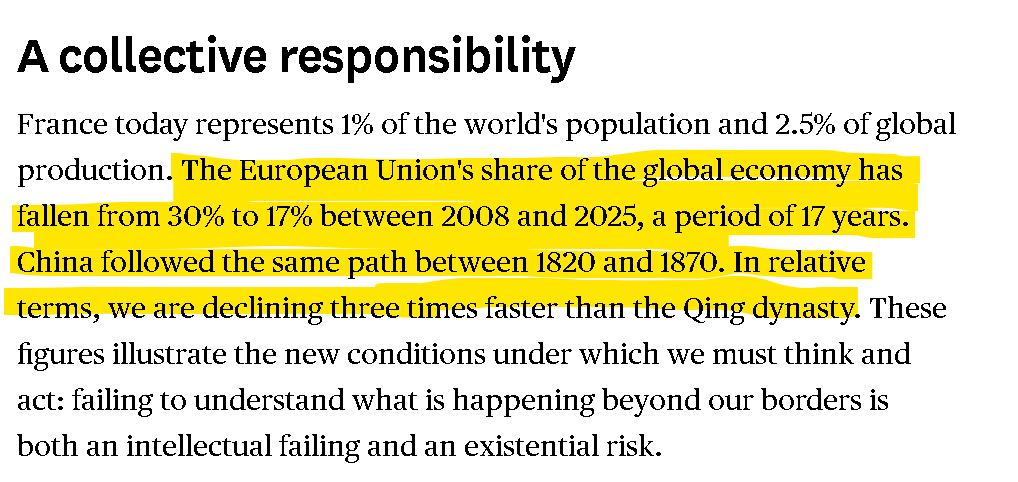
This 👇 is an extraordinary number shared by Luis Vassy, director of Sciences Po (one of France's most famous schools) in this article: https://t.co/BQbkXb2kPl
He calculated that the EU is declining 3 times faster than the Qing dynasty at the height of China's century of humiliation.
Back then, it took China 50 years to drop from 30% of world GDP to 17%, whereas it took the EU just 17 years (from 2008 to 2025).
Insane 😢 And, sadly, given the current direction and the EU's systematically suicidal policy choices (latest example: https://t.co/6EYJgdXVVo), it's just the beginning...
Every few weeks there is a debate on why India's manufacturing share isn't taking off.
Before discussing labour laws, land, logistics or social harmony, consider this:
The OECD estimates that subsidies explain 22% of market share gains for growing firms globally.
For Chinese firms, the figure is nearly 60%.
That is not a marginal advantage. It is the game.
A new OECD study covering 525 major firms across 15 industrial sectors found Chinese manufacturers receive 3–8x more government support than firms in OECD countries and substantially more than firms in countries such as India, Brazil and Indonesia.
On average, Chinese industrial subsidies were around 2.5% of annual revenue over 2005-24 and exceeded 3% of revenue in 2024. Most competing regions were below 1%.
In key sectors the numbers are even larger. Chinese semiconductor firms have at times received subsidies approaching 10% of revenue. In automobiles, Chinese firms received roughly 4x the subsidy intensity of OECD competitors. In aerospace, Chinese firms often received 2-5x more support relative to revenue.
The result is visible everywhere.
Between 2005 and 2024, China massively expanded its global share in solar panels, shipbuilding, steel and aluminium. Aluminium alone went from roughly 24% of global production to nearly 60%.
India is therefore not competing against a free market.
It is competing against one of the largest industrial subsidy systems in modern economic history: cheap capital, state banks, state-owned enterprises, tax concessions, grants and below-market financing all working toward the same objective.
Could India simply copy this model?
Probably not.
A Chinese-style manufacturing strategy ultimately means large transfers from households to industry through cheaper capital, directed lending, lower returns on savings and sustained state support. Democracies find it much harder to sustain that bargain.
The question is not "Why hasn't India become China?"
The question is:
How much manufacturing can India build while preserving democratic accountability, fiscal stability and household welfare?
Viewed from that angle, India's gains in electronics, mobile phones, renewables, defence manufacturing, rail equipment and semiconductors look less like failure and more like progress against a very strong tide.
India's defence procurement seems to be rewarding firms that assemble foreign weapons under an Indian badge.
The problem isn't just about pride or optics. In a real, evolving conflict, an industry that cannot modify its own weapons is a strategic liability. 🧵
Indian business is controlled by a small coterie of business dynasties, many of whom are linked together by marriage. It is a closed circle of elites, who function like old school zamindars.
One simply doesn’t expect these 21st century zamindars to be able to contribute to Indian economy’s growth to $20T in output. In fact, the Licence Raj orientation and manipulative, predatory mindset of many companies is a serious impediment to India’s progress.
For India to progress, these businesses have to be out-competed and neutered. The same had happened 30 years ago, when the first flush of reforms speared through and reshaped the Indian business landscape. Many of today’s corporate giants swept away blue chip names of that era - as life goes, today the challengers of that period have become like the old guard they had displaced.
The problem is barriers to entry and barriers to scaling slow down the turnover. This generation of Indians is counting on Prime Minister @narendramodi to deliver on necessary reforms, so that new entrants can once again displace the distracted, tired and corpulent incumbents who at this point can be generously described as squatters impeding the path of India’s progress. https://t.co/hY8DYmT7wP
The U.S. has proposed a new 12.5% tariff on Indian exports to US under Section 301.
But here's the surprising part: the investigation is not alleging that Indian exports are made using forced labour.
Instead, Washington is targeting India because it believes India does not do enough to block imports allegedly linked to forced labour in third countries (Read China).
This raises a fundamental question: Can the U.S. use Section 301 to force India or other countries to adopt its preferred import-control policies?
Traditionally, Section 301 has been used to address market-access barriers faced by U.S. firms abroad.
It was never intended to police what other countries import and from whom.
India should challenge both the legal basis and the scope of the investigation.
The proposed tariffs exceed U.S. WTO commitments on Bound tariffs and stretch Section 301 far beyond its original purpose.
The broader concern is that this may be part of a growing pattern of pressure India to sign the BTA through Section 301 investigations and tariff threats .
More Section 301 tariffs/actions could follow, including on alleged excess industrial capacity.
New Delhi should therefore treat the Section 301 investigations and the India–U.S. BTA negotiations as completely separate matters.
Trade agreements should be judged on their own merits, not negotiated under the shadow of tariff threats. BTA has lost all value on Feb 20, when the US Supreme Court decalred reciprocal tariffs illegal.
India should walk out of BTA like Malaysia did.
#IndiaUS #TradePolicy #Section301 #Tariffs #WTO #BTA #IndiaTrade
The US is proposing tariffs of at least 10% on imports from most major trading partners following an investigation into forced-labor practices.
Products from other major economies, including China, India, Japan, South Korea, Brazil and Switzerland, would be subject to a 12.5% levy.
https://t.co/6WvroeBBTV
Hmm....
'No Plumber In 5 Years': India Heading For A Blue-Collar Blackout
https://t.co/Njan4Euz2P
Within five years, India could face shortages of plumbers, electricians, carpenters, drivers, nurses and caregivers as richer countries aggressively recruit the workers they no longer have enough of themselves.