In 2002, an IIT Kanpur civil engineer working as an IES officer wrote to Prime Minister Vajpayee, exposing corruption in the $10 billion Golden Quadrilateral Corridor - India's biggest highway project.
Designed to construct 14,000 km of 4-lane expressways connecting Delhi, Mumbai, Chennai, and Kolkata, it stands as the modern bedrock of Indian infrastructure.
He left his letter to the Prime Minister's Office (PMO) unsigned. Knowing the deadly stakes, Dubey attached his credentials on a separate sheet with an explicit instruction:
"Before moving the file, please remove the attachment containing my particulars to ensure secrecy."
But the PMO did not redact that information. It forwarded his complaint down the ministry chain with his identity attached. His name reached the very people he had exposed.
One year later, on his 31st birthday, Satyendra Dubey was shot dead outside Gaya railway station by the mafia.
They called it armed robbery. His family never believed it. The men who ran the murder racket were never touched, even after a CBI probe.
His death led to the Whistleblowers Protection Act in 2014. It was never brought into force, and it still doesn't protect a whistleblower's identity to this day.
His father, a poor sugar mill clerk with 7 kids, spent his entire life’s savings to raise an honest son who went to
@IITKanpur and then joined the IES to serve the nation.
On November 27, 2003, instead of celebrating Satyendra’s 31st birthday, that old man received his son’s bullet-riddled body in a wooden box, forced to weep over the casket of a hero he spent a lifetime raising for a country that wasn't brave enough to keep him alive.
Kumkum Mohod and the 2 days Indian archery will never forget.
7x in a row. Since 1998, South Korea had won every women's team recurve gold at the Asian Games.
On 2 October 2026, they were shooting for an 8th.
Standing in the way was a 17 year old from Amravati, whose first bow had cost about ₹3,000.
Recurve is the Olympic style bow, the one whose limbs curve away from the archer at the tips. At the Games, archers shoot it at a target 70 metres away. The ten ring, dead centre, is about 12 cms wide.
Now imagine hitting that, with the whole country watching.
Kumkum Anil Mohod was born on 10 March 2009. In 2018, she was still a schoolgirl, not yet 10, when her mother, Rupali, saw a relative's daughter practising at an archery academy in Amravati, run by coach Prafull Dange. She thought Kumkum should try it.
The 1st bow was a wooden Indian bow. Her father calls it a bamboo bow. It was paid for with money her grandmother gave her.
6 months later, she won a silver medal at the sub-junior nationals.
Her father, Anil Manohar Mohod, makes cardboard boxes for sweet shops in Amravati. As the training costs grew, even the shared auto to the academy became too much. So he took her on his motorcycle.
A 2nd hand bow carried her for years. Later, the family bought a recurve bow from savings built up over time.
She made her international debut in 2025.
At the Asian Games in Aichi-Nagoya, India's women's recurve team of Kumkum, Ankita Bhakat and Kirti Sharma reached the gold medal match. India had never made that final before. Ankita had been on the team that won bronze at Hangzhou.
The last set went to the wire. Korea finished on 54. India had to match it. Kirti's arrow was first called an 8, and a review upgraded it to a 9.
Then came Kumkum's last arrow. It was a ten.
The set was tied. India beat South Korea 5-3, the first women's recurve team gold in the country's history.
The same day, she and Dhiraj Bommadevara took silver in the mixed team event.
The next morning
Today, she was back at the line. She beat Korea's Kang Chaeyoung, the reigning world champion, 6-4 in the quarterfinal. In the semifinal against China's Zhu Jingyi, the 2025 World Championships silver medallist, Zhu's last arrow was a 9. Kumkum needed a 10 to win.
She shot a 10, and won 6-2.
In the final, she faced another Korean, Oh Yejin. It went to 5-5, and to a shoot-off, one arrow each. Oh shot an 8.
Kumkum shot a 10.
She became the 1st Indian woman to win an individual recurve medal at an Asian Games, and it was gold. India's only earlier individual recurve medal at the Games was a silver, won by Tarundeep Rai in 2010. Her run to the final also earned India a country quota place for the 2028 Games in Los Angeles.
In two days, she had beaten Korea's team and two of Korea's archers.
Her father says her biggest dream is still ahead: the Olympics.
A man who makes boxes for other people's sweets. A grandmother's savings. A motorcycle that carried a little girl and her bow to practice. A bow made of bamboo.
And a girl who, when a semifinal needed a 10, shot one, and when gold came down to a single arrow, shot another.
Pic Courtesy: OlympicKhel
What exactly is the objective of this video? We have seen this on repeat over the last decade. It is nothing but optics. Would you invest in a private company that released a video about their internal working problems ?
@krishnabgowda Sir. We have no interest in the why and who. You are now in the seat and we would love to see just quiet systemic moving of the government machinery, giving people what it's due. Rightfully.
Prime Minister Benjamin Netanyahu:
My salute to the Indian pilot Captain Smit Machchhar for his extraordinary bravery.
Despite being stabbed and seriously injured, he fought back, resisted, opened the cockpit door, and enabled passengers and crew to overpower the attacker — preventing a catastrophic mid-air disaster.
He saved the lives of 174 people, including Israeli citizens and other nationals.
I wish Captain Machchhar a speedy and full recovery.
He is a true hero.
Jitna Reservation, Utna Tax.
Every such free opportunity should be recovered through an additional Tax from the beneficiary.
The moment you ask them to give back to the System that gave them those benefits, watch how quickly the demand for Reservation disappears.
For many seniors, the hardest part of technology isn’t learning a new app.
It’s the feeling of having to ask someone else every time they need to use one.
Mahima Bhalotia saw this up close with her own mother and aunts. So, in 2020, she began teaching them.
That small effort became The Social Paathshala, which has now helped 10,000+ senior citizens across India and abroad learn smartphones, WhatsApp, digital payments, online safety, DigiYatra, Google tools and AI.
But the most telling stories aren’t about the technology.
They’re about what seniors started doing with it.
At 80, Maya Maker went from depending on neighbours for help with online services to using AI on WhatsApp to plan a six-day Karnataka trip for a visiting professor.
Others learnt to navigate airports, identify birds, plan holidays and handle everyday tasks on their own.
And that is perhaps what Mahima has really been teaching.
Not technology.
Possibility.
@Mahima_Bhalotia@we_paathshala
#DigitalLiteracy #SeniorCitizens #LifelongLearning #TechForGood #AIForGood
[senior citizens learning digital technology, digital literacy for elderly people, Social Paathshala senior citizen classes, seniors learning AI and WhatsApp, technology helping older adults]
He spent a decade at Texas Instruments helping make it the world's number one vendor of DSL modem chips.
Then he quit, put in his own savings, and started a semiconductor company in a garage with one other person. It took eight years before India saw what he had built.
His name is Himamshu Khasnis.
What pushed him out was a number he could not stop thinking about. By his own estimate, close to 45 percent of the world's chips were being designed in Bengaluru. But as he put it, "the intellectual property and the subsequent revenue remained with the USA."
India had more than a billion mobile phones, second only to China, and some of the largest cellular networks on earth. Every silicon chip inside that infrastructure was imported.
He founded Signalchip in 2010.
Chip design is slow, brutally expensive, and offers nothing to show for years. Sridhar Vembu of Zoho, who had started his own career as a wireless engineer at Qualcomm, backed him and stayed. A software founder funding silicon, through a decade with no product.
In 2015 came SCRF1401, India's first RF transceiver chip for 3G, 4G and WiFi.
Then in February 2019, Signalchip unveiled four chips it called the Agumbe family, India's first indigenous semiconductor chips for 4G LTE and 5G NR modems. They cover all LTE and 5G bands up to 6GHz, and they support positioning through NavIC, India's own satellite navigation system.
At the launch, India's Telecom Secretary noted that only around eight companies in the world could design and build chips like these. The team that did it was 40 people.
In October 2024, Khasnis stood at the India Mobile Congress explaining his chips to the Prime Minister, who asked detailed questions.
For years, Indian engineers designed a large share of the world's silicon and owned almost none of it.
Agumbe is Indian at the level that actually matters. The design, the patents, the ownership.
@signalchip
Respected PM Narendra Modi Ji,
@narendramodi_in
You listened to and accepted many of the demands raised by the CJP. Bestow the same benevolence upon us in the General Category too.
We the General Category, have stood firmly with you and the BJP right from the past 11 years.
We have supported you, defended you and voted for you.
But many of my friends and followers from the General Category feel vulnerable when they see a general category citizen falsely implicated under the SC-ST Act. When even one person is falsely implicated, it creates fear and insecurity among others in the community.
GC students are becoming increasingly disheartened and demoralised when parties such as Congress, SP and RJD support reservations beyond 50%.
Whom should we appeal, trust and speak to ???
The general category has never protested like the CJP, Shaheen Baag protestors or the farmers. Does one really have to protest or abuse the government to be heard in India ????
I humbly request that the concerns of the General Category also be addressed through judicial and and task force.
1. The SC/ST Act should be invoked only after appropriate judicial scrutiny of the case or by a task force.
2. Reservation policies should have a defined time frame and be periodically reviewed.
3. Reservation in government jobs should not be given if either of the the parents or grandparents are already in government service or belong to an economically privileged section.
4. If any member of a family has a high end income, reservation should be denied.
5. If one generation has benefited from reservation, the next generation should not automatically inherit the same benefit.
I am and will always remain your strongest supporter. But it pains me when I see your supporters getting disillusioned with you. Please address this appeal of the General Category at the earliest. Please reassure them🙏🙏
🎯
I entered IIT Delhi in General Category with high JEE rank, though I'm from Shudra/Dalit village (+ extreme poverty, hungry childhood). I topped my IIT batch. Went on to Massachusetts Institute of Technology, earning one of fastest PhD. Then entrepreneur, won numerous patents, etc.
For me, "advanced studies" books were like novels. Most of it felt simple, obvious. One read, I was done, most of the time.
@TrueIndology does not say that so-called OBC, SC or ST lack talent or cannot master a field. He says reservations can be cruel. That is true.
The IITs and similar schools of India put every student in the same room with the professors, in the same labs, under the same exams and the same grades. That room is a mirror. Reservations were meant to give a nineteen-year-old a chance against 1000+ years of presumed and unverifiable discrimination. What they give instead is a daily accounting of what he or she cannot do.
The misfits in an elite nest.
A boy or girl who might have thrived in a skill school becomes a depressed and angry engineer who cannot engineer.
India does not need caste reservations in a limited number of colleges. India needs to add colleges and vocational schools in every city, town, state and every territory—so many that any boy or girl can apply, get admission, learn, find the work that fits the hands and the mind, and grow to the full measure of what is in them.
An opinion:
What if we reimagined STEM education without exams, grades, and GPAs?
Universities enable learning. Students own it. They get a certificate listing the courses; the world decides how good they are.
Why stamp a letter or number on a student?
Does this work?
तीसरे वर्ष की छात्रा प्रिया मिश्रा ने कहा:
“छात्र के परिवार के लिए दुख है। लेकिन सूर्यनारायण सर को सजा क्यों मिल रही है? अगर नकल नहीं होती, तो सर कोई कार्रवाई नहीं करते।
30–40 परसेंटाइल लेकर IIT में आ जाते हो, और फिर परीक्षा में मोबाइल से नकल करना चाहते हो, क्योंकि दबाव नहीं झेल सकते। मैं 90 प्रतिशत ला सकती हूँ, लेकिन मेरे पास iPhone खरीदने के पैसे नहीं हैं।
विशेषाधिकार मुझे मिलना चाहिए, ऐसे बच्चों को नहीं।
केस उनके माता-पिता पर होना चाहिए। केस उस सिस्टम पर होना चाहिए, जिसने एक कमजोर और अनपढ़ बच्चे को इतने बड़े संस्थान में भेज दिया, जहाँ दिमाग, IQ और दबाव झेलने की हिम्मत चाहिए।
अगर दबाव नहीं झेल सकते, तो घर बैठो। सीट बर्बाद मत करो।
सूर्यनारायण सर का इस्तीफा इस देश के हर ईमानदार शिक्षक का अंत है, और अब नकल शर्मनाक काम भी नहीं रहेगी।”
IIT Bombay topper asks government to make cheating legal in exams 🚨
Priya Mishra, third year student -
"Sorry for the student's family. But why is Sooryanarayana sir getting punished? If he hadn't cheated, sir wouldn't have taken any action. You come into IIT by scoring 30–40 percentile and then you want a mobile to cheat in exams because you can't take the pressure. I can score 90 percent, but I don't have the money to buy an iPhone. It's me who deserves privilege, not kids like him.
The case should be on their parents. The case should be on the system for sending a weak and illiterate child into such a big institute, which requires a lot of brain, IQ and guts to take pressure. If you are not capable of taking pressure, sit home. Don't waste a seat. Sooryanarayana sir resigning is the end of every honest teacher in this country and cheating will no longer be a shameful act."
This is what a true IITian looks like, man. She came through merit and has the brain to pass exams with her hard work. It's a shame that she is sharing the same college with such brainless kids who came through free schemes. 🙏
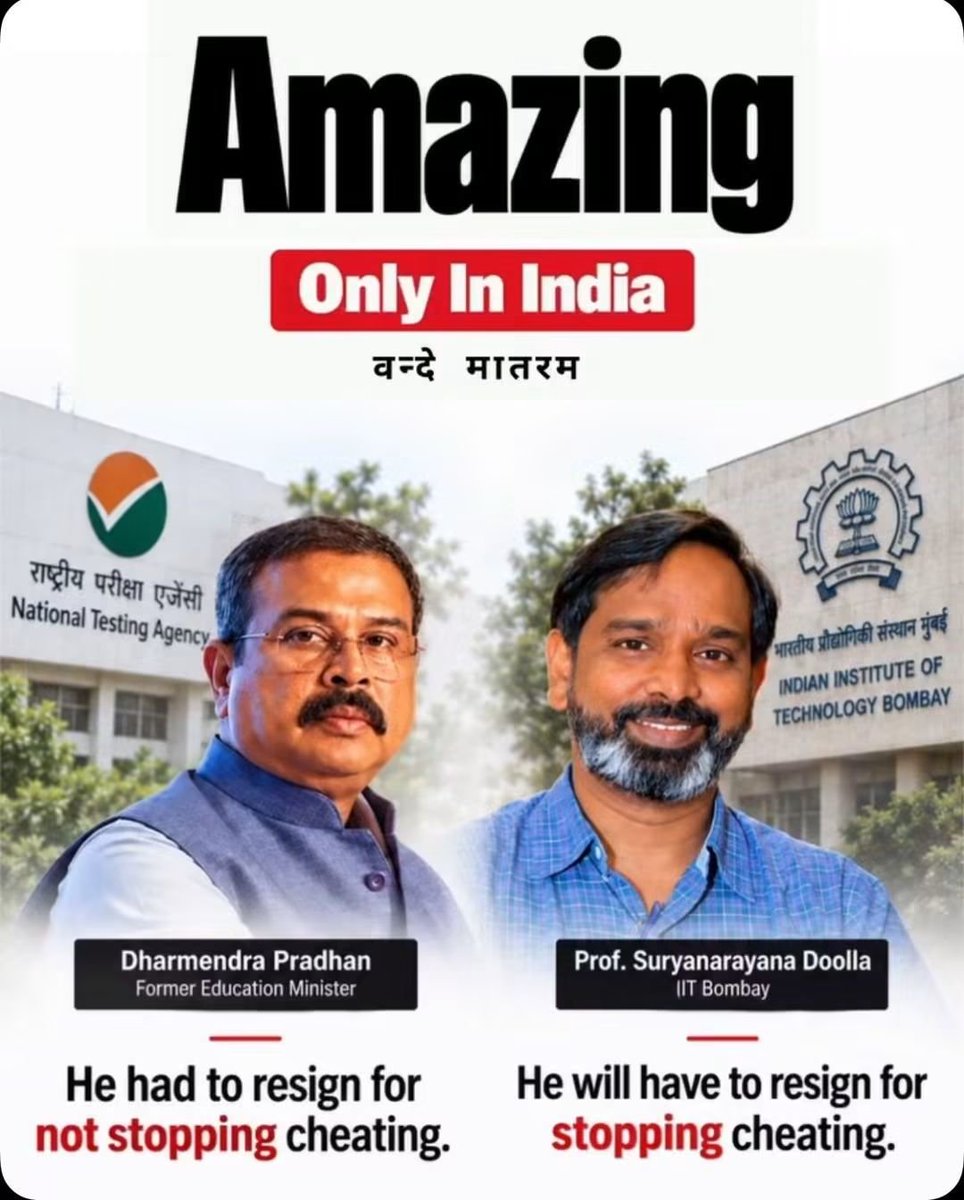
Mumbai IIT Prof Suryanarayana Doolla who faces arrest under SC/ST Act after catching a downtrodden student for allegedly copying in exam... doesn't deserve sympathy.
Look at his Bio & realise how he "deserves" arrest.
👉Qualifications:
-Professor at IIT Bombay (Energy Science & Engineering Dept), working in power electronics and power systems.
-B.Tech in Electrical Engineering
-M.Tech in Energy Systems Engineering, IIT Bombay
-Ph.D. in Power Systems, IIT Delhi
👉Earlier roles:
Machine 2 Machine, Hyderabad (2006–2008) and Power Research and Development Consultants, Bangalore (2009), before joining IIT Bombay.
👉Admin responsibilities at IIT Bombay:
-Dean (Student Affairs), March 2023 – present
-Organizing Chairman, JEE (Advanced) 2022
-Organizing Chairman, CEED / UCEED 2021
-Vice Chairman [JEE (Advanced), UCEED, CEED], 2020–2021
-Vice Chairman [UCEED, CEED], 2020–2021
👉Honors and awards:
-Prof. S. P. Sukhatme Excellence in Teaching Award, September 2021, IIT Bombay
-Best Paper Award, IEEE TPEC 2021, USA
-Outstanding Editor, 2019, 2018 and 2017, ITEES, Wiley
-Best Associate Editor, 2018, IEEE JESTPE
-Third Paper Prize Award, 2017 IEEE IAS Annual Meeting, Cincinnati, USA
-Bhaskara Advanced Solar Energy Fellowship, 2017
-Excellence in Teaching Award, 2017, DESE, IIT Bombay
-Visiting Faculty, 2016, Linnaeus-Palme International Exchange Program
-Young Faculty Award, 2009, IIT Bombay
👉Research interests
-Smart grids / microgrids
-Active distribution networks
-Converter topologies and control
-Grid integration of distributed energy resources
-Real-time simulation and emulation -Protection in inverter-based active distribution networks
Ab batao, isn't he just a criminal minded person who has all the time world to throw casteist slurs at an "innocent" student?
Anyway, Prof Suryanarayana has now resigned.
I'm sure Indian education system is on very correct path. Just a few few more reforms like "Right to Copy" are needed. I'm sure Govt will do that too in students' interest.
When she started letting schoolchildren build satellites, senior Indian scientists told her to stop.
"A couple of very senior well-known scientists in the country told me to stop spoiling children's futures and get them to focus on studying first."
Their satellites have since flown on rockets belonging to both NASA and ISRO.
Her name is Dr Srimathy Kesan. She runs Space Kidz India, a Chennai aerospace company registered in 2016 with around 47 people on its rolls today, built on one unusual principle: students should not merely study space, they should build the things that go there.
The first person she recruited was a college student who had come to interview her for his magazine. His name was Rifath Sharook, from Pallapatti, a village in Karur district. By the end of that conversation both of them understood he was in the wrong course.
After the Indian scientists said no, Kesan wrote to NASA. Jaydeep Mukherjee, who directs the Florida Space Grant Consortium, told her to stop aiming straight for orbit and start with stratospheric balloons instead.
So they did. Then Rifath's team entered a NASA student competition with something that weighed 64 grams, built from 3D printed carbon fibre. They nicknamed it the gulab jamun, because that is what they were eating when someone asked why a satellite could not be that small.
They named it KalamSat. On 22 June 2017 NASA flew it on a sounding rocket from Wallops Island, the first time NASA had flown an experiment built by an Indian student.
ISRO, which Kesan had been pitching without success for years, called soon after. She was given six days to build and deliver.
On 24 January 2019, PSLV-C44 placed KalamSat V2 in orbit at 1.26 kilograms, the lightest satellite ever put there. Then came AzaadiSAT and AzaadiSAT-2, assembled from payloads made by 750 schoolgirls from some of the remotest villages in India.
Space Kidz India has now flown 19 balloon missions, three suborbital payloads and five orbital satellites. Kesan holds ambassador status at NASA, the European Space Agency and Russia's Gagarin Cosmonaut Training Centre, the only Indian to do so.
The college student who turned up to interview her for a magazine is now the lead scientist at Space Kidz India.
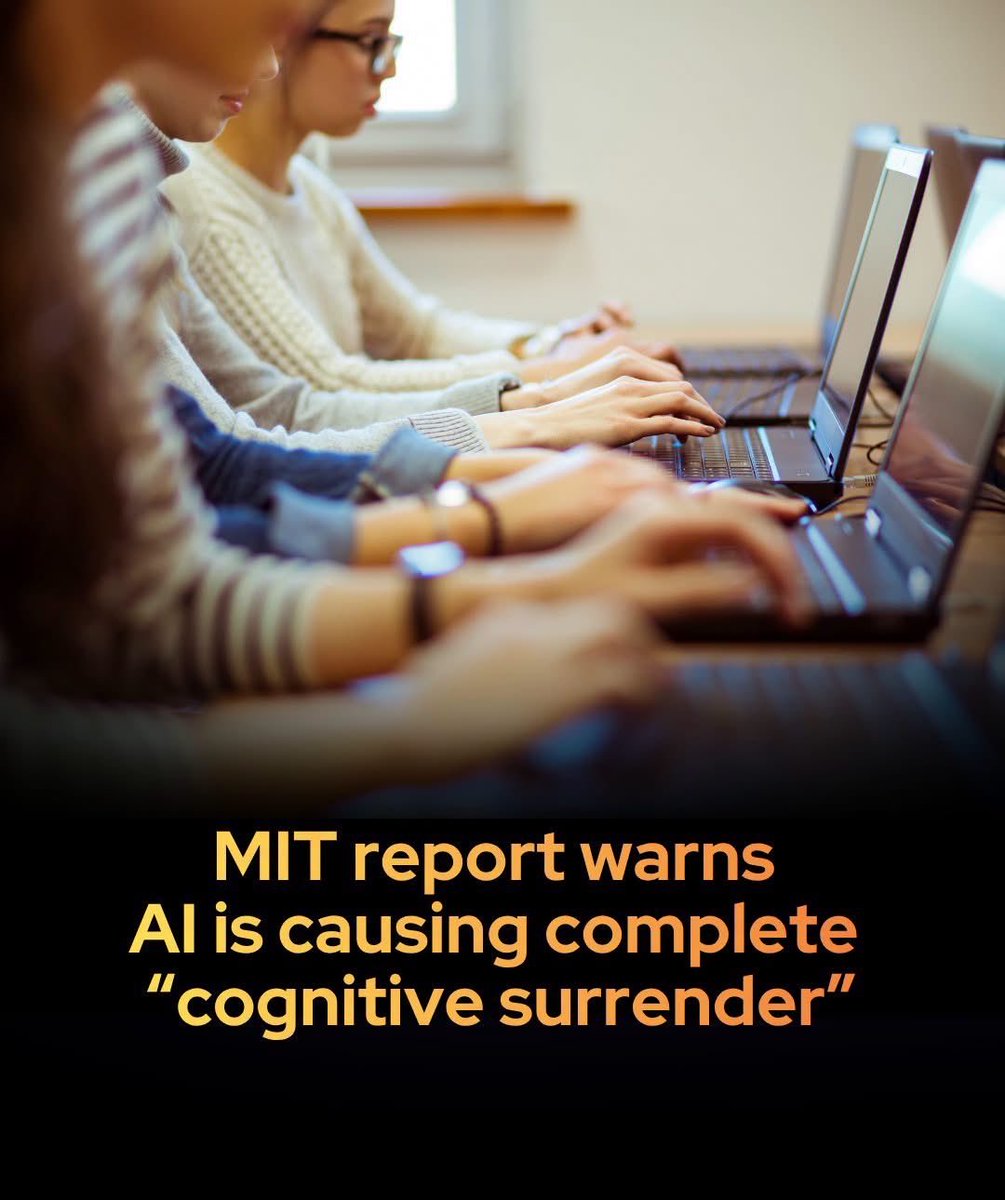
A new MIT report finds AI is causing mass 'cognitive surrender’:
A landmark study from an MIT committee reveals that pervasive artificial intelligence usage is fundamentally eroding active learning. The report warns that students are falling into 'cognitive surrender,' reaching for chatbots at the first sign of difficulty and bypassing the 'productive struggle' crucial for developing critical thinking.
This over reliance has led to an 'illusion of learning' where homework scores rise but actual memory retention and test performances plummet.
Furthermore, the report details an isolating shift in campus culture: traditional study groups are vanishing and office hours sit empty as students choose automated chatbot replies over human collaboration.
Despite these alarming findings, a deep divide has emerged between cautious faculty and optimistic university leaders who continue to aggressively champion AI integration. While some administrators argue that embracing the technology is necessary to keep institutions relevant, others are recognizing that current evaluation methods are broken.
To combat this, schools like MIT are avoiding unreliable AI detectors and instead rebuilding curricula around human-centric assessments — such as oral exams, semester portfolios, and mandatory group work — designed to rescue education by reclaiming the struggle of thinking.
source: Blinder, A. (2026). Universities Sound Warnings About A.I. Even as They Embrace It. The New York Times.
🙏🇮🇳 I’m an Australian 🦘 maths historian and I’m tired of watching the West take the applause for ideas India already had.
Baudhāyana before Pythagoras.
Āryabhaṭa before Galileo.
Brahmagupta before the West even accepted zero as a number.
Madhava before Newton.
Pingala before Fibonacci.
Ramanujan etc.
Yet still the textbooks bow to Europe first.
India’s gurus and rishis were not a footnote. Their ideas were copied, thinned out, renamed, and then sold back to Indian children as “Western maths.”
So I’m asking Indians directly:
If you could attend a talk by any 🇮🇳 Indian mathematician, living or historical, who I’ve mentioned on my X, who would you choose and why?
Reply with the name.
Tag a student, a teacher, or a parent who still thinks maths began in Greece.
If this history was hidden from you in school, this post is for you.
RT so the next generation hears the real names first.
Jai Hind.
@jcrabtree







![MumbaichaDon's tweet photo. Mumbai IIT Prof Suryanarayana Doolla who faces arrest under SC/ST Act after catching a downtrodden student for allegedly copying in exam... doesn't deserve sympathy.
Look at his Bio & realise how he "deserves" arrest.
👉Qualifications:
-Professor at IIT Bombay (Energy Science & Engineering Dept), working in power electronics and power systems.
-B.Tech in Electrical Engineering
-M.Tech in Energy Systems Engineering, IIT Bombay
-Ph.D. in Power Systems, IIT Delhi
👉Earlier roles:
Machine 2 Machine, Hyderabad (2006–2008) and Power Research and Development Consultants, Bangalore (2009), before joining IIT Bombay.
👉Admin responsibilities at IIT Bombay:
-Dean (Student Affairs), March 2023 – present
-Organizing Chairman, JEE (Advanced) 2022
-Organizing Chairman, CEED / UCEED 2021
-Vice Chairman [JEE (Advanced), UCEED, CEED], 2020–2021
-Vice Chairman [UCEED, CEED], 2020–2021
👉Honors and awards:
-Prof. S. P. Sukhatme Excellence in Teaching Award, September 2021, IIT Bombay
-Best Paper Award, IEEE TPEC 2021, USA
-Outstanding Editor, 2019, 2018 and 2017, ITEES, Wiley
-Best Associate Editor, 2018, IEEE JESTPE
-Third Paper Prize Award, 2017 IEEE IAS Annual Meeting, Cincinnati, USA
-Bhaskara Advanced Solar Energy Fellowship, 2017
-Excellence in Teaching Award, 2017, DESE, IIT Bombay
-Visiting Faculty, 2016, Linnaeus-Palme International Exchange Program
-Young Faculty Award, 2009, IIT Bombay
👉Research interests
-Smart grids / microgrids
-Active distribution networks
-Converter topologies and control
-Grid integration of distributed energy resources
-Real-time simulation and emulation -Protection in inverter-based active distribution networks
Ab batao, isn't he just a criminal minded person who has all the time world to throw casteist slurs at an "innocent" student?
Anyway, Prof Suryanarayana has now resigned.
I'm sure Indian education system is on very correct path. Just a few few more reforms like "Right to Copy" are needed. I'm sure Govt will do that too in students' interest.](https://pbs.twimg.com/media/HSp3v_NbsAA3hl-.jpg)