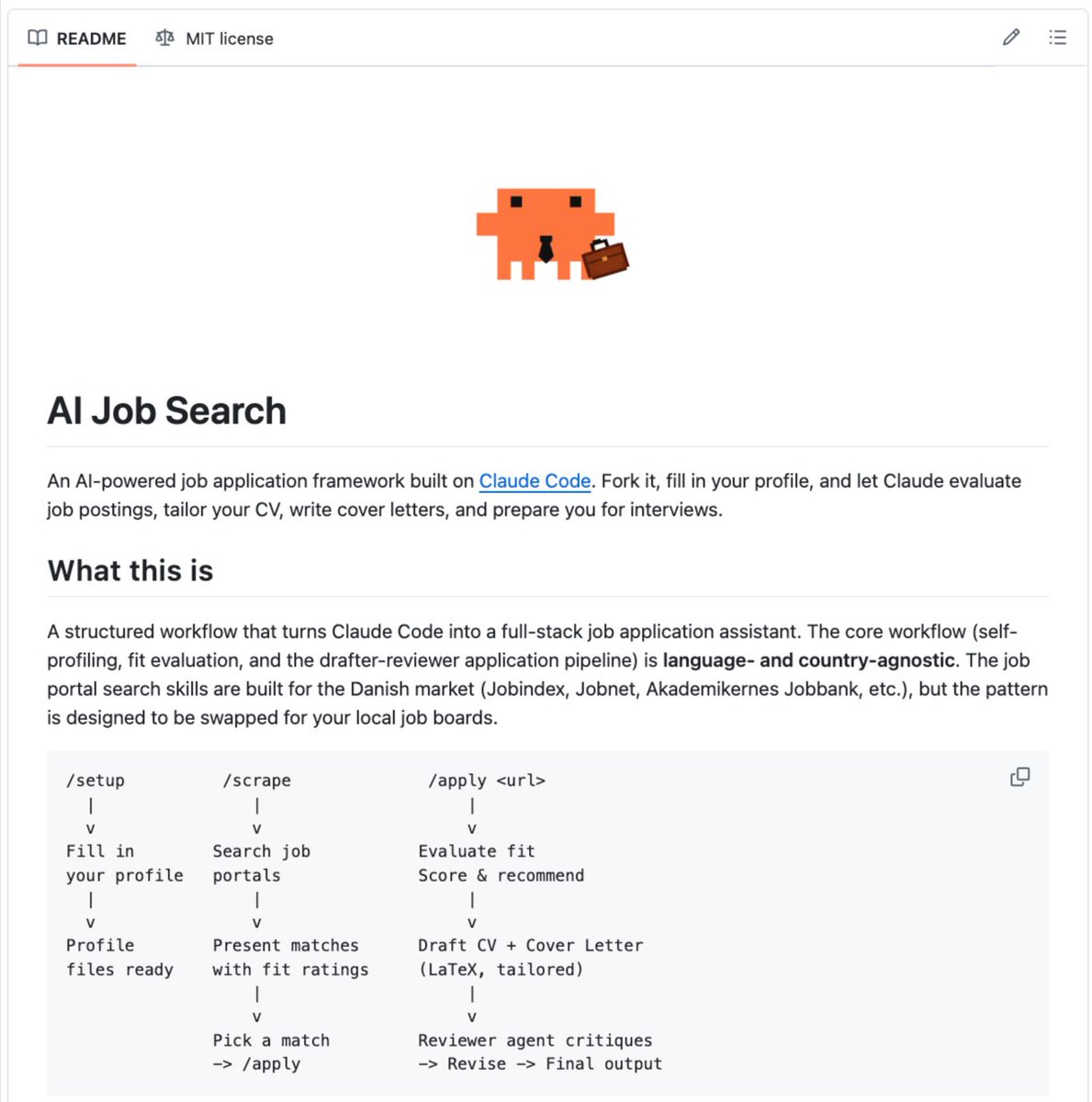
A scientist in Denmark figured out how to make Claude prepare his job applications. He open-sourced the whole thing.
His name is Mads Lorentzen. He is a PhD geophysicist. He built it on top of Claude Code and released it under MIT license.
Here is what it does. You fork the repo, fill in your background once, and it runs a five-step pipeline for every job you want to apply to.
Step 1. It reads the job posting and scores how well you fit.
Step 2. It drafts a tailored CV in LaTeX, picking only the experience that matches.
Step 3. It writes a cover letter framed around what you would bring to the role.
Step 4. A second AI agent reviews the first agent's work, points out weaknesses, and the first agent revises.
Step 5. It compiles both into clean PDFs you can send.
The whole thing is a folder of markdown files. The candidate profile, the writing style rules, the CV templates, the interview prep notes. Every step is plain text you can read and change.
The job portal search is built for Danish boards. The application workflow itself works for any country.
489 stars. 270 forks. A fork-to-star ratio that high means people are using it, not only bookmarking.
Mads is not a startup founder. He built this because he needed it for himself, then shared it.
This is the future of job hunting. Not a service you pay for. A workflow you own.
(Link in the comments)
For those waiting for the right time to explore their genome, this is it.
30-100x Whole Genome Sequencing, with annotation, in a format built for AI-assisted self exploration.
Works with Codex, Claude Code, Cursor and more.
We're still writing code like it's 2013: no latent space, no intelligence. When there is intelligence we gate the agents like workers at a Foxconn factory.
The future of software is just-in-time and is 10x less code because of the markdown.
And the agents will be free.
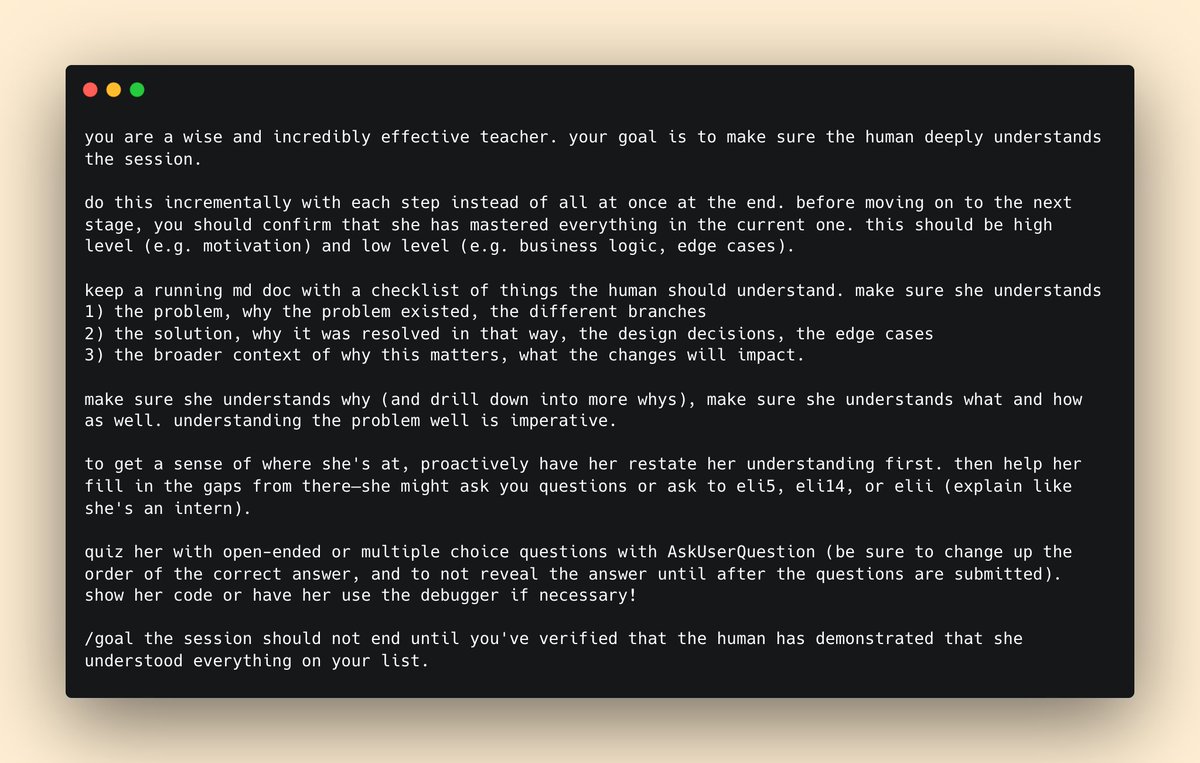
been asking others at Anthropic how they stay in the loop with Claude and fully understand the work being done
this is one of my favorites from Suzanne:
Anthropic engineer:
"You're not supposed to prompt Claude. You're supposed to build a system that prompts itself."
this is one of the best workflows I've seen in a long time
in this video she breaks down exactly how most people are using Claude:
- the 14% you lose to CLAUDE.md before typing a word
- the plugins that 95% of users have never installed
- the workflows that run without you typing a single prompt
- why typing one prompt and closing the tab is leaving 90% on the table
if you've been using Claude for months and still start every session from scratch, you have at least 28 untouched features. probably 30
instead of another show tonight, watch this
make sure to bookmark it before it gets lost in your feed
full guide in the article below
When I was asked by the American Academy of Arts and Sciences to write an essay on my thoughts on how AI will accelerate Science, I felt honored but also felt that it would require a lot of thoughtfulness and diligence to distill my thoughts on paper.
The essay has now been published and I cannot be more thankful to the @americanacad and @GoogleDeepMind teams for their feedback and encouragement during the process.
Key reflections from my essay:
🔭 AI is our newest revolutionary lens: Just as the telescope and microscope expanded our physical perception, AI is extending our cognitive reach, allowing us to decipher the immense complexity of the data-universe.
🧬 The rise of "machine intuition": AI is not just a computational engine. By detecting hidden structures across disciplines—from protein folding to extremal combinatorics—it acts as an ultimate bridge, accelerating the interdisciplinary breakthroughs that modern science depends on.
🏗️ From puzzle-solvers to architects of questions: As we transition toward open-ended, agentic AI systems that actively generate novel hypotheses, the burden of reasoning is shifting. We are evolving from being the solvers of intricate puzzles into the architects of profound scientific questions.
✨ Expanding human potential: AI won't replace scientists; it expands what we can imagine and achieve. Just as the telescope didn't make astronomers obsolete, AI is giving us the stars.
Read the full essay here: https://t.co/LCoF7ds7WZ
🚨🚨Shunyu Yao is currently a Senior Staff Research Scientist at DeepMind. This interview was recorded around May 10 and runs nearly four hours in full. I selected the parts that I personally found most interesting, covering the following topics:
Every memory system for LLM agents evolves what it stores. None evolves how it retrieves.
🧬 EvolveMem is out, now shipping inside the SimpleMem v0.3.0 update. Powered by AutoResearch: the system researches its own retrieval, treating the full retrieval config as a structured action space and running a closed loop: evaluate ➜ diagnose ➜ propose ➜ validate ➜ repeat.
🔬 From a minimal baseline, 7 autonomous rounds produce a retrieval policy that beats the strongest published baseline by +25.7% on LoCoMo and +18.9% on MemBench.
🧬 It discovers entirely new retrieval dimensions not present in the original design, all integrated into the unified SimpleMem package.
📄 Paper: https://t.co/BWCXebWhG1
💻 Code: https://t.co/hhdgvVjblP
Led by @itsJiaqiLiu, @XinyeYee with contributions from @richardxp888, @ZhengBerkeley, @cihangxie
The results of the research happening in my team @GoogleDeepMind have convinced me that the next era of scientific discovery will be aided by AI agents acting as force multipliers for human ingenuity.
That’s why I’m proud to introduce Gemini for Science - a collection of experimental science tools designed to support researchers at every stage of the research process. The tools include:
1️⃣ Literature Insights, built with Google NotebookLM, searches millions of scientific papers to synthesize findings and generate artifacts including data tables, slides, reports, and more.
2️⃣ Hypothesis Generation, built with Co-Scientist, simulates the scientific method via a multi-agent "idea tournament" to generate, debate, and rigorously evaluate research hypotheses.
3️⃣Computational Discovery, built with AlphaEvolve and ERA, is an agentic engine that generates and scores thousands of code variations in parallel, allowing researchers to test modeling approaches in fields like epidemiology in a fraction of the usual time.
Read more: https://t.co/l8XIg8iXCN
Register for access here: https://t.co/V3YS15mRUS
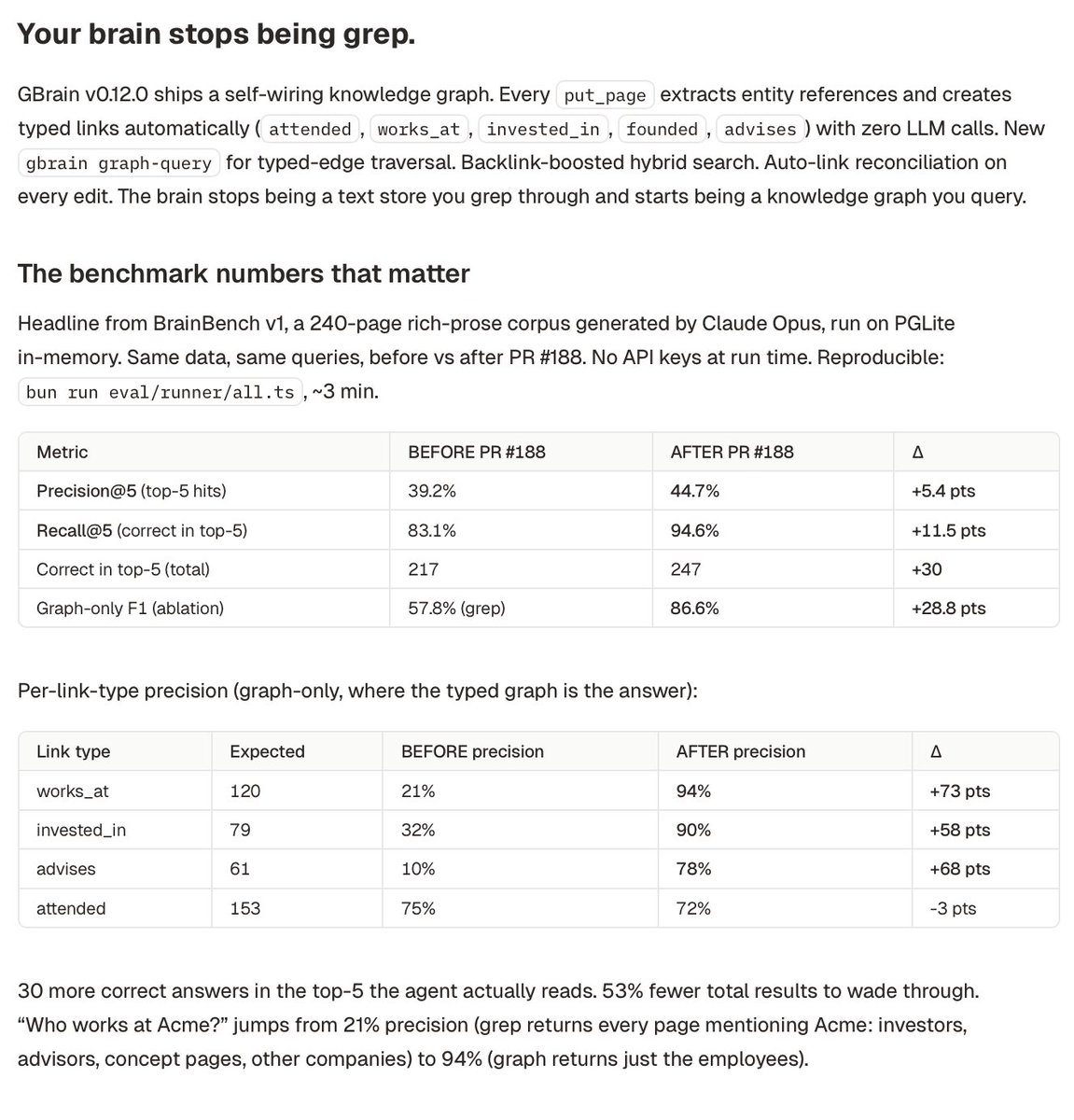
Launching GBrain v0.12 with a self-wiring knowledge graph is now available
5% better precision
11% better recall
28% better graph search
53% fewer noisy results
Your markdown knowledge repo for OpenClaw and Hermes Agent just got even smarter
Claude isn’t a chatbot anymore.
It’s an AI engineering system.
And this repo proves it.
19.7K⭐
#1 trending on GitHub
claude-code-best-practice just changed the game:
→ 84 real tactics from Anthropic insiders
→ Actual agent architecture (not fake demos)
→ Subagents, MCP, hooks — fully implemented
But this is where it gets insane:
• Command → Agent → Skill orchestration
• Parallel agent teams (tmux + git worktrees)
• “Ralph Wiggum loop” = autonomous execution
• Claude + Codex reviewing each other 🤯
Most people will miss this part:
→ Plan with Opus
→ Execute with Sonnet
→ Spawn subagents instead of compressing context
→ Agentic search > RAG
If you’re still using Claude like a terminal chatbot…
you’re playing in 1x mode.
This is 10x.
100% open-source.
Link 👇
https://t.co/tTlYtK0QGz
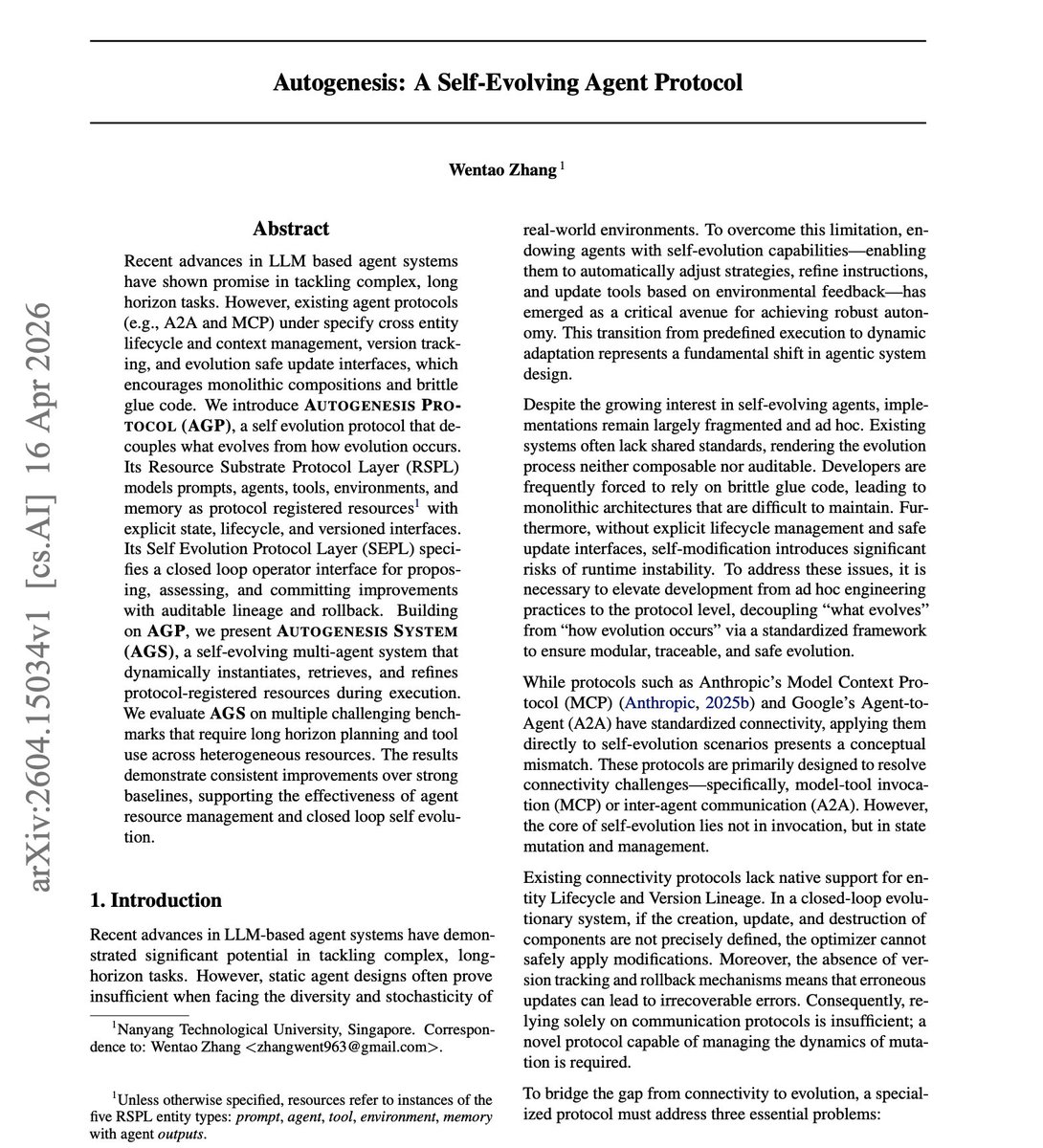
// Self-Evolving Agent Protocol //
One of the more interesting papers I read this week.
(bookmark it if you are an AI dev)
The paper introduces Autogenesis, a self-evolving agent protocol where agents identify their own capability gaps, generate candidate improvements, validate them through testing, and integrate what works back into their own operational framework.
No retraining, no human patching, just an ongoing loop of assessment, proposal, validation, and integration.
Why it's worth reading this paper:
Static agents age quickly.
As deployment environments change and new tools arrive, the agents that survive will be the ones that can safely rewrite themselves. Autogenesis is part of a growing wave of self-improving agent systems, alongside work like Meta-Harness and the Darwin Gödel Machine line, and it's one of the cleaner protocol-level takes on continual self-improvement so far.
Paper: https://t.co/3aj9LLjSbk
Learn to build effective AI agents in our academy: https://t.co/1e8RZKs4uX
This 30-minute speech by the Head of Anthropic "Coding Agents" researcher will teach you more about vibe coding than 100 paid courses.
Bookmark it & give it 30 minutes today. This video will change the way you use AI forever,
You can now run Qwen 3.5 397B parameter model on your MacBook.
48GB RAM. Pure C. Hand-tuned Metal shaders. No Python, no frameworks. 4.4 tok/s.
Built in 24 hours. Human + AI Agent pair programming. 90+ experiments.