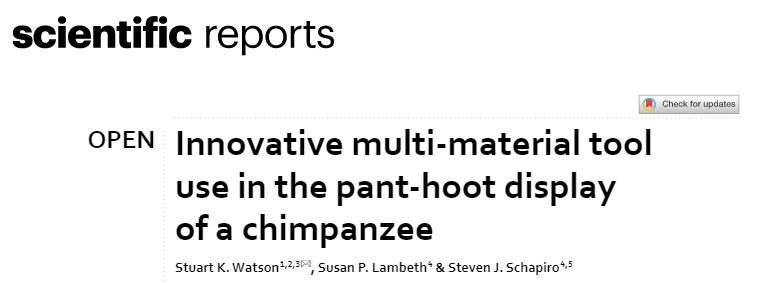
Nice example of 'multi-material tool creation'.
Though there's no need to be so careful with speculating about vocal 'voluntary control' and 'forward planning'. Unless there is some convincing evidence against their existence.
📢Our paper is out today in Scientific Reports! 🥳
In this case study, I report on observations of a captive male chimpanzee spontaneously combining two materials (hay and a feeding tub) into a 'drum' ('tub-stack') to use in pant-hoot displays.
See 🧵
https://t.co/0gL9P8N0nD
🚨Job Advert 🚨 Please retweet 😀😃
Research Associate Position (Akademische Ratsstelle auf Zeit) in the Behavioral Ecology group @LMU_Muenchen.
Fixed term (postdoc level) position, for 3 (+3) years
Application deadline: 01.12.2022
1/11
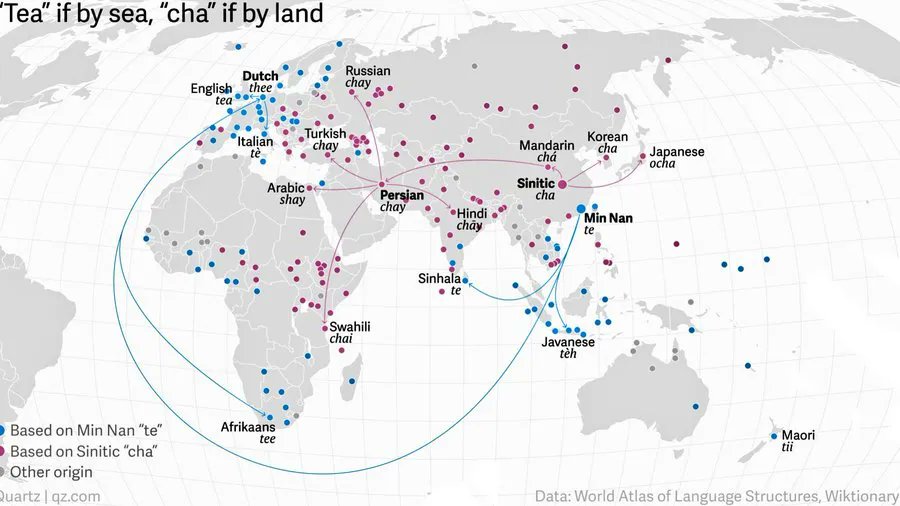
If tea spread to your country by sea you call it tea, if it spread by land you call it chai. This is because the ports of Fujian and Taiwan use the coastal pronunciation "te", whereas Mandarin uses "chá"
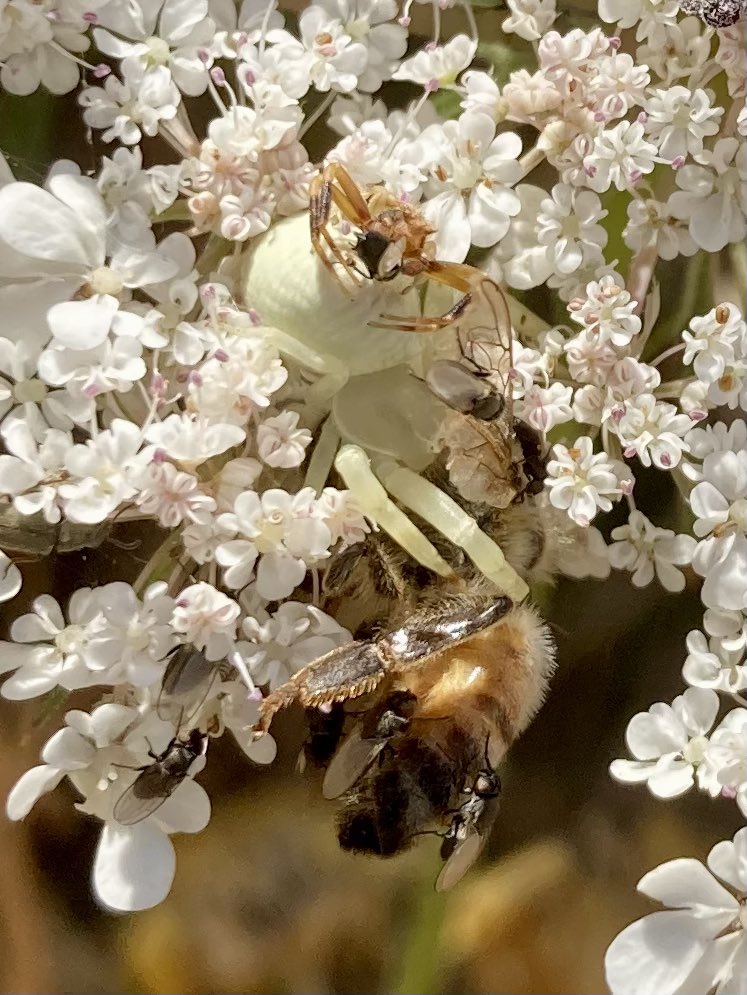
The circle of life:
A female crab #spider (Thomisus onustus?) munching a honey bee.
One of the ‘Jackal’ flies (Milichiidae sp.) who joined the meal was caught by the tiny male spider (on top of the female).
Just to make sure this point doesn't get lost: the success of instruction-finetuning highlights the *limitation* of the self-supervised language modeling objective.
That’s not completely accurate.
We’ve learned something about where enormous computing power can take us (sometimes further than we thought).
Whether the current use is a waste of resources is a different question
What cognitive capacities do AI systems have?
Anyway, replace ‘mouse’ with ‘human’, if it makes things easier. The answer would be quite the same.
(the difference between those two 🧠 vanishes in respect to the diff between them and any AI)
what cognitive capacities does a mouse have that no current AI system has?
(extra points for intelligence-related capacities with associated behavioral tests. the AI system can have a virtual/robot body if necessary. capacities like eating that require a bio-body don't count.)
@GDezecache Many examples of vocal learners come from inter-species imitation.
Some imitated humans (eg parrots, seals, elephants…). and some humans imitated back…
Hey colleagues...please help us spread the news about this open position for an assistant professor: we are hiring in Ecology, Evolution, or Behavior...or any integrative combination thereof!
“Does the chimpanzee have a theory of mind?” might be a valid scientific question.
But the 'null hypothesis' of distinction between humans and apes is scientifically illogical.
We are excited to announce a search for an assistant professor in any area of ecology! Come join us in beautiful Tucson! Apply here: https://t.co/YM3owxQLCM
@twitemp1 Yes. But the Q is who’s the supervisor? who provides ‘ground truth’? It might be, occasionally, some ‘reward system’ (and we may wish to model it as well, or at least acknowledge it).
Still, most acquired knowledge is not rewarded/reinforced, isn’t it?
Not sure about ‘self-supervision’ as brain model. imho, most learning in the brain is unsupervised (eg associative).
Supervision might appear in, eg, reward. But for computational models it is usually external (not self), even if innate and shaped by natural selection.
TETRIS FOR SCIENCE!
We need YOU to play TWO games of Tetris for a study by @dagmaradamcova and myself on skilled performance
LINK:
https://t.co/fLaYtI9qtQ
Please RT