Newton was wrong about gravity.
Einstein was incomplete.
What replaces them is stranger than both.
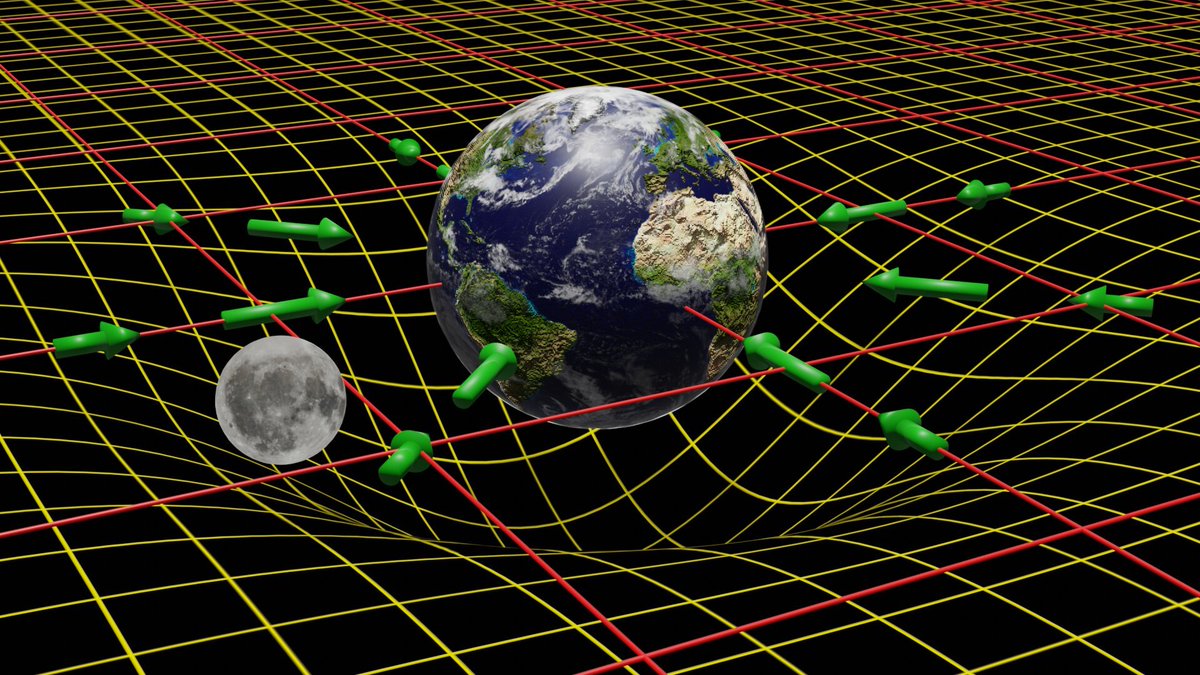
For a century, physicists have shoved gravity into the same box as electromagnetism and the nuclear forces, hoping to find a particle called a graviton, that carries it.
But, nobody has ever detected one. Every attempt to quantize gravity the way we quantized light has collapsed under its own math.
The new frameworks emerging from Queen Mary University and Physical Review X suggest we were staring at the wrong shelf the entire time.
Gravity behaves less like a force and more like pressure in a gas. An emergent statistical tendency, born from information trying to spread out.
Matter curves spacetime because the universe is running an entropy calculation, and mass is what happens when quantum information gets locally concentrated.
Gravity is like reality reorganizing itself toward states with more available microstates.
This quietly explains the deepest embarrassment in physics: why gravity is 10^40 times weaker than electromagnetism. Weak forces don't need a particle. They need a gradient. And a gradient across the entire observable universe would feel exactly as faint as gravity does.
Dark matter, dark energy, the cosmological constant and every ghost in the machine may just be entropy accounting we hadn't learned to read yet.
Building quantum computers at large scale remains a formidable challenge. Our new image gallery provides a glimpse into the ambitious efforts required to build reliable machines. https://t.co/DTZy6NAzDH
In the 20th century, a conceptual tsunami swept through physics, thanks to the ideas of Nobel Prize winner Kenneth Wilson. But the revolution didn’t reach fluids until now. https://t.co/wNNeplDm1l
The three-quark model of a proton may be elegant, but this simplicity comes with shortcomings. Physicists have known for decades that the proton is much more than three quarks. https://t.co/SU1SYg2rAh
The Navier-Stokes equations are enormously successful at predicting how fluids flow and swirl. But they fail to account for the existence of swarms of microscopic bits that make up matter. Now physicists have a new theory that does.
https://t.co/wNNeplDm1l
The mashup of a black hole and an enormous star has never been seen before and could explain the mysterious little red dots often found in deep-space images. https://t.co/MUUUMgkCCv
Is aging simply decay? Not to cell biologist Junyue Cao, who believes the process is far more orderly: “The destruction of the system is programmed at a very early stage.” https://t.co/rIhuCOjIQP
IT'S A VICTORY OF DEMOCRACY
direct democracy... straight from the streets.
It's a victory of peace, patience & persévérance.
Congratulations CJP, Gen Z of the nation and thank you all citizens for shedding fear and the fear of fear and rising up from every corner of the nation.
FROM ACCOUNTABILITY, NOW TO REFORMS
In its current form, a thermodynamic computer is basically an electrical version of a set of interconnected springs. The question is: If you give it a shake, how will the dynamics of the network evolve? https://t.co/0KDgUgnRjz