For more than two decades, @PrecisionNeuro_ co-founder Dr. Benjamin Rapoport has worked to close the gap between the engineers and scientists building BCI technology and the real-world needs of the people it’s meant to serve — along with their physicians and caregivers.
Today, our BCI tech is designed to help people living with paralysis operate digital devices using only their thoughts, restoring independence and connection for millions. And this is only the beginning. As the technology evolves, it has the potential to expand to more regions of the brain — opening new possibilities for treatment, communication, and scientific discovery.
Learn more here: https://t.co/FThBss3qjN
“It’s helpful to think about BCI as a communication tool. Like any communication device, bandwidth matters. What you can do with a 56K modem, maybe chat on AOL, is very different from what you can do with a fiber optic connection, @Netflix. It’s the same thing in BCI. Very low electrode count systems are able to enable a click on a computer mouse, maybe a few directions on a cursor. What our system is designed to enable is rich control of sophisticated applications, whether it’s photo editing, or productivity software. Our bar is really to meet and eventually exceed what people who are able bodied do with a computer or a digital device”.
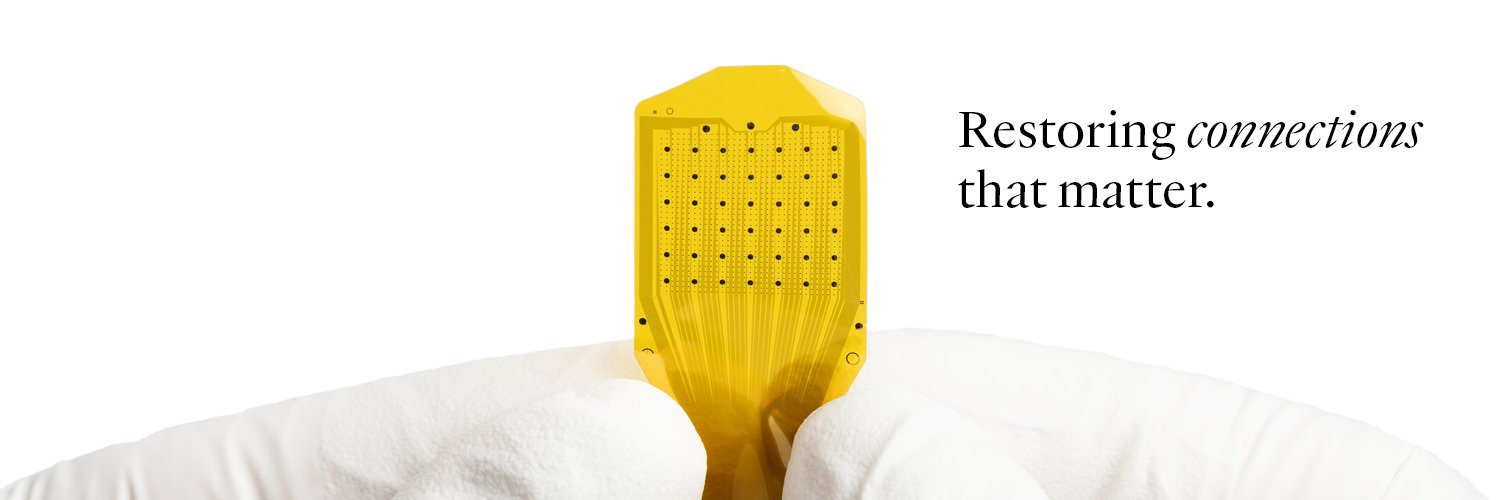
Taken from a new interview with @Cheddar, Chris Castellino sits down with @PrecisionNeuro_ CEO & Co-Founder @Michael_MagerNY for an inside look at the future of brain-computer interfaces. The feature takes viewers inside the Precision lab, offering a detailed look at how our Layer 7 BCI is designed and built — including an in-depth overview of the Layer 7 array itself and how its 1,024 electrodes work together to capture neural activity at high resolution. The conversation also explores why Precision built our own supply chain from the ground up to manufacture our BCIs — a critical step in scaling this technology for the future.
Watch below.
https://t.co/AQORBornh3
Accessibility technology is rapidly becoming everyday tech, and many of the innovations we now rely on started as tools built to expand access — from speech-to-text and predictive typing to eye tracking and captions.
@PrecisionNeuro_ 's Layer 7 is designed for real-world human impact and scalability: enabling access to the motor cortex to support people living with paralysis, while advancing toward a whole-brain interface that could transform how we understand and treat neurological conditions. Learn more about our vision here: https://t.co/ZMhBJM8X16
Brain-computer interfaces are no longer science fiction. A recent article from @Bloomberg by @IkeSwetlitz, @SarithaRai, and @AmberTongPW explores how quickly the BCI field is evolving.
One of the key themes in the piece is the contrast between brain penetrating and non-penetrating BCIs, along with the different approaches emerging companies are taking to advance the technology. The article also highlights an important milestone for Precision Neuroscience: receiving @FDA clearance in 2025 for our minimally invasive, non-penetrating BCI designed to record, monitor, and stimulate brain activity. @PrecisionNeuro_'s technology has already been implanted in close to 90 patients through clinical studies — a strong signal of how rapidly this field is advancing.
Exciting to see the conversation around BCIs shifting from “someday” to real-world impact today.
https://t.co/3uWvXmcyNv
Here is Episode 2 of my new podcast dedicated to conversations on the future of neurotech, computing, intelligence, and more.
My guest Dr. Ben Rapoport is co-founder and CSO of Precision Neuroscience (@PrecisionNeuro_), Assistant Professor of Neurosurgery at the Icahn School of Medicine at Mount Sinai, and Scientific Director at Mount Sinai. Previously, he co-founded Neuralink and Simbionics (acquired by Apple).
Precision is building a minimally invasive brain-computer interface (BCI) that reads from thousands of points on the cortex without penetrating it. The Layer 7 device is implanted through a one-millimeter slit in the skull rather than the larger borehole other approaches require. It is also fully removable.
Precision seeks to help the 5 million people living with severe paralysis in the US (including 800,000 new stroke cases per year). In March 2025, Precision received FDA clearance for a temporary wired version of the system. Over 85 patients have been implanted with and used the device in clinical studies (50 at the time of our conversation). Wireless implants are planned for 2027.
We go deep on the history of Neurotech from the 1980s to the ML inflection points that triggered Neuralink's founding, why surface ECoG was a contrarian bet that's now paying off, the path to treating paralysis and stroke at scale, and why Ben believes neural data is at the same inflection point genomic data was in 2000 — a whole class of biological problems about to become tractable as computer science problems.
Chapters
00:00:00 Introduction
00:04:39 Paralysis as a lens to understand the brain
00:05:36 The 1980s breakthrough: population encoding and the birth of BCI
00:14:36 Google Translate, ML, and the founding of Neuralink
00:23:08 What is the long-term vision of Precision Neuroscience
00:31:56 Layer 7 and why transformative technology looks impossible at first
00:50:21 The surgery: a slit in the skull, not a borehole
00:55:19 The clinical program: who are the patients
01:04:16 FDA clearance and the path to wireless implants in 2027
01:08:32 The patient population: paralysis and stroke at scale
01:16:26 Neural data as the new genomics
01:30:06 BCIs, AI, and the future of the human-machine interface
01:31:22 From medical necessity to lifestyle technology
01:40:36 Precision as a platform — and an optimistic vision
If you're interested in these kinds of discussions, subscribe to the podcast. And if there’s anyone you’d like to see or hear on the podcast, reply with your suggestions.
Full Episode 2 here and in other platforms below.
Genomics didn't just improve medicine, it turned biology into a computer science problem. @PrecisionNeuro_'s Dr. Benjamin Rapoport thinks that's what's starting to happen with the brain. The data is starting to prove him right.
Neuroscience is at the edge of an exponential.
Sequencing the first human genome cost millions and rewrote medicine. Once the code was readable, computer science could be applied to biology in entirely new ways.
Brain-computer interfaces are doing the same thing for the brain.
For the first time, BCIs are making brain activity readable at the spatial and temporal scales at which the brain operates, and generating data that modern machine learning can work with.
@PrecisionNeuro_ co-founder & CSO Ben Rapoport on the @JuanBenet Podcast >>> https://t.co/cYsOIeheA4
Precision Chief Science Officer & Co-Founder Ben Rapoport joined @ProtocolLabs founder @JuanBenet to talk about what BCIs can do right now for patients and what they signal for the future of how humans and computers interact.
https://t.co/7NOTY4VTLj
Precision's @Michael_MagerNY at #Milken2026 on @BloombergTV: "There are around 6 million people globally who are completely tetraplegic — that's an addressable market in the hundreds of billions. But the promise of brain-computer interfaces goes way beyond paralysis." Full interview below.
https://t.co/CVdmAdXtEO
The brain is the most complex interface. We're learning to read it.
Precision is partnering with @UChicagoMed to advance AI-driven sensorimotor function and neuroprosthetics research. Layer 7 has now been placed in 85+ people.
https://t.co/1V2222vGn1
Precision Neuroscience’s Layer 7 has won a 2026 Webby Award! Layer 7 was recognized in the AI in Healthcare & Life Sciences category, alongside other leading AI innovators such as @Google, @Waymo and @AnthropicAI.
@TheWebbyAwards celebrate ideas that shape culture. This milestone reflects the dedication of our team and the potential of @PrecisionNeuro_'s BCI to transform people's lives.
We're grateful for the recognition—and even more motivated for what’s ahead! #Webbys
Excited to see innovation at the forefront of #neuroscience and human health at this year’s @WestVirginiaU Public Education Collaborative "Focus Forward" conference.
@JaymeStrauss, Chief Clinical Officer at Precision Neuroscience, and Dr. @PeterKonrad12, Chair of #Neurosurgery at WVU Medicine Health Sciences, will join Dr. @ClayMarsh, Chancellor and Executive Dean of @WVUhealth Sciences, for a compelling fireside chat: “Brain-Computer Interface: The Future of Mind-Reading Biotech is Here.”
This conversation will explore how groundbreaking, first-of-its-kind clinical trials are leveraging globally unique neurotechnology to unlock new possibilities—bringing renewed hope for improved quality of life and transformative advances in human health.
Learn more about the West Virginia Public Education Collaborative conference here: https://t.co/bXApwhznVv
#FocusForwardWV #BrainComputerInterface @PrecisionNeuro_
On #NationalDoctorsDay, @PrecisionNeuro_ would like to express deep gratitude for the #Physicians who have dedicated their lives to the care of others, and especially those living with severe #NeurologicalConditions.
Your work goes far beyond medicine. It requires patience, resilience, empathy, and an unwavering commitment to your patients and their families—often through long, complex, and emotionally demanding journeys.
To the #Neurologists, #RehabilitationSpecialists,
#Neurosurgeons, and all #HealthcareProfessionals in this space: thank you for your compassion, your expertise, and your relentless pursuit of better outcomes.
#Gratitude #HealthcareHeroes #PatientCare #DoctorsDay #ThankYouDoctors #AIinHealthcare