10/ Conclusion: #Muhammad is not what we’ve been told. For centuries, it may have been an adjective applied to #Jesus… until the Abbasids needed their own prophet to legitimize power. The real early history of #Islam is far more complex — and far less “official” — than the story we were taught. Ready for unfiltered truth? RT if this blew your mind. #DismantlingIslamfromwithin #PoliticalCampaign #peaceispossible #iran #pakistan @omarsuleiman
I owe St. John Paul II a public apology.
Years ago I was scandalized when I saw him kiss the Quran.
Today I see it as providential — one of the most powerful prophetic gestures in modern history. In order to understand, forget for a moment everything you know about the Quran.
Imagine someone hands you a book.
You open it. And this is what you discover:
- Jesus appears 93 times in this book.
- His mother appears more times than in the entire New Testament.
- This book says that Jesus is the Word of God, it became flesh and dwelt among us.
- Jesus creates a living being from clay and breathes life into him — exactly as God created Adam.
- Only Jesus raises the dead.
- Only Jesus gives sight to the blind.
- Jesus speaks with perfect wisdom while still in the cradle.
- Jesus sends down from heaven a table of heavenly food — and says only those who eat it and believe will be saved.
- No one else in the whole book comes even close to Him.
- This book proclaim that wants to confirm the Gospel!
- According to this book, only Jesus is alive in heaven right now with God.
- He will return at the end of time to judge the world and defeat evil.
Tell me, brother…
Who is Jesus according to the author of this book?
Saint John Paul II was used by God.
Jesus is the bridge.
Even in the Quran, He stands alone.
Wake up.
#Islam #Quran #Muslim #Allah #عيسى #المسيح #يسوع #القرآن #محمد #اسلام #قرآن #مسيحي #مسيحية #الله #كتاب_مقدس #يسوع_المسيح #الحق #الحياة #الطريق #Jesus #Christ #Gospel #Bible #Christianity #Truth #EternalWord #SonOfGod #KingOfKings #SecondComingTag
@GabrielSaidR@LloydDeJongh@JoelOsteen@JoyceMeyer@BishopJakes@remnantnews@FSSPXES@jackngraham@PriscillaShirer@Infovaticana@JohnBevere@ChristineCaine@livechristian1@VoddieBaucham
What do you think? Was John Paul II wiser than we realized?
Catalunya és un dels territoris europeus amb més espais protegits.
Vet aquí que haurem de comprar tot el menjar a fora.
Independència llibertat tradició família natalitat història nació
Today's Gospel (Mt 9:36–10:8) shows Jesus calling twelve disciples (apostoloi), sending them to heal, cast out demons, and raise the dead.
Now open the #Quran. What do you find?
The Quran calls Jesus's disciples the ḥawāriyyūn (3:52; 5:111; 61:14).
Scholars agree it is a calque of the Syriac ḥawārē (ܚܘܪ̈ܝܐ), meaning "the pure ones," "the radiant ones" — the very word used for the apostles in the Syriac Bible. Who taught the Quran's author to call Jesus's followers ḥawārē?
The Quran says Jesus asked his disciples: "Who will be my helpers (anṣār) for God?" — and they answered: "we are muslimūn" (3:52). That word muslimūn — "those who submit" — is precisely what Matthew's Gospel shows in action: twelve men who leave everything, submit, and go. They don't negotiate the terms. Is "submission to God" a Quranic invention, or the oldest Christian posture before the Father?
Jesus in Matthew's Gospel commands his apostles: "Heal the sick, raise the dead, cleanse lepers, cast out demons. Freely you received, freely give" (Mt 10:8). The Quran preserves an almost identical mission statement for ʿĪsā: he heals the blind and the leper, he raises the dead. The Quran agrees with Matthew that Jesus's apostles were workers of signs. If the Quran was correcting Christianity, why does it preserve exactly the same miraculous mandate?
The Quran tells us God put it into the hearts of the ḥawāriyyūn to believe (5:111). Matthew says Jesus called them (Mt 10:1) and gave them authority. In both texts, the initiative is entirely from above. The disciples do not volunteer; they are chosen, empowered, and sent.
Did the Quran reinvent mission theology, or did it inherit it directly from the Syriac Christian church?
The Quran commands the believers: "Be helpers of God, as Jesus son of Mary said to the disciples" (61:14). The imperative is apostolic: you, the reader, are invited into the same mission as the Twelve. The Quran is not abolishing the Christian mission; it is quoting and extending it to a new audience. If Islam replaced Christianity, why is the Church's founding command — "go and make disciples" — still echoing inside the Quran itself?
Today, June 15, is the Sunday when the Catholic world hears the harvest cry: "The harvest is great, the workers are few; pray the Lord of the harvest to send workers" (Mt 9:37–38). The Quran knows this harvest. The Quran knows these workers. The Quran knows their Syriac name. The question is not whether the Quran knows Jesus's apostles. The question is: why does a supposedly post-Christian book know them so well — and invite you to become one of them?
"Freely you received, freely give." — Jesus of Nazareth (Mt 10:8)
"Do good (iḥsān), as God has done good to you." — Quran (28:77)
Same command. Same sender. Two texts. One mission.
Read the Quran like the Christian document it is.
@MohmadAlghamdi3@salman_alodah@AidAlQarni@Ahmad_Shuqairi@OmarAbdelkafy
#القرآن #عيسى_المسيح #الحواريون #الإسلام_والمسيحية #الكتاب_المقدس
🧵 ENTRADES BARATES PEL CEL AL RAVAL.
El @Pontifex, la @sagradafamilia i l'Islam: per què la visita del Papa m'ha fet pensar en Ramon Llull, sant Francesc i Sant Pere Pasqual i Sant Ramon de Cardona.
#Catalunya va arribar al seu esplendor com més cristiana va ser, i això té a veure amb el que estem vivint ara:
✝️ Sant Ramon Llull — mallorquí, catalanoparlant, va aprendre l'àrab durant anys per poder dialogar amb els musulmans. Va anar al Marroc i a Tunis dues vegades. Martiritzat a Bugia (Algèria). Va fundar Miramar perquè els frares aprenguessin àrab. Va demanar al Papa i als reis que creessin escoles de llengües orientals. Era obsessionat amb la conversió dels musulmans.
✝️ Sant Francesc d'Assís — va travessar les línies de batalla durant la Cinquena Croada per parlar personalment amb el soldà al-Kàmil.
✝️ Nicolau Tàvec (1391) — franciscà, martiritzat a Jerusalem quan va anar a predicar davant el cadí musulmà.
✝️ Sant Pere Pasqual (València, ~1227 – Granada, 1300) — bisbe de Jaén, captiu dels nassrites, va continuar predicant des de la presó. Degollat.
✝️ Els Màrtirs de Marroc (1220) — cinc framenors menors enviats per sant Francesc, els primers màrtirs franciscans: Berardo, Pèire, Acúrsio, Adjut i Otó. Van morir predicant públicament a Marràqueix. Sant Antoni de Pàdua es va fer franciscà en veure els seus cossos.
✝️ Beata Maria de la Consolació Leroux i les carmelites d'Oran (1936) — religioses a terres d'islam fins al martiri.
✝️ Beat Joan de Perusa i Beat Pere de Saxoferrato — franciscans martiritzats a Sevilla el 1231 quan era encara sota domini almohade, per predicar públicament.
✝️ Sant Tomàs de Tolentino i companys (1321) — franciscans martiritzats a la Índia per predicar entre musulmans.
✝️ Beat Ramon de Cardona — noble català, fundador d'obres de caritat, amb espiritualitat fortament vinculada a la redempció de captius en terres musulmanes.
✝️ Sant Vicent Ferrer — dominic valencià, va predicar per tota Europa però amb crida explícita a la conversió de jueus i musulmans. Creient que els darrers temps eren propers.
Tots ells tenien una cosa en comú: no esperaven que els musulmans vinguessin a ells. Ells anaven. I si no podien anar, aprenien la llengua, escrivien llibres, fundaven escoles.
Lleó XIV ha dit aque cal acollir els qui arriben, però també —i això és clau— «afrontar les causes que els obliguen a marxar», és a dir, el dret de la gent a quedar-se al seu país.
Però jo em pregunto si el Papa, guiat per l'Esperit Sant, no ha interioritzat alguna cosa que molts catòlics preferim no dir en veu alta:
La hègira ha canviat de sentit.
Centenars de milers de musulmans ja son aquí. Amb papers. Amb drets. Amb fills nascuts a Barcelona, a Badalona, a l'Hospitalet. Ja no hem d'agafar un vaixell per arribar al Marroc o a Algèria. El Marroc i Algèria han vingut a casa nostra.
Ramon Llull va aprendre l'àrab durant nou anys per poder parlar amb el seu veí. Nosaltres els tenim al replà de l'escala i som incapaços de dir-los Allāhu yubarik fīk — «Déu et beneeixi».
Els missioners franciscans anaven al Marroc perquè morir predicant l'Evangeli entre musulmans era el camí més directe al cel que coneixien. Ells ho deien sense complexos: el cel «es comprava barat» si anaves a terres d'islam.
Ara les terres d'islam estan al metro L1. Al Raval. A Nou Barris.
¿Quin sant, quin beat, quina canonització estem perdent per covardia pastoral?
Cal estimar els mussulmans prou per compartir la fe.
La da'wa —la crida a l'islam— la fan sense complexos a les nostres places. EL nostre kerygma no hauria de tenir menys coratge.
@orriolsderipoll@andreu_b@salvadorilla@mossos@3CatInfo@vilaweb@naciodigital@elmon_cat@govern@elpuntavui@33748agg@CristiansPV@Albiol_XG
🧵What if 1,400 years of Muslim scholars beating their wives had NO Quranic basis whatsoever — and it all comes down to one mistranslated verb?
The Quran's most controversial verse on women hinges on a single Arabic verb with 12 meanings. Translators picked the most violent one. Was that philology — or agenda?
The #Quran NEVER teaches abrogation. The word Muslims mistranslate as "abrogate" literally means "inscribe." Here's the philological bombshell. 👇
1/ Surah 2:106 is the ONLY verse cited as the basis for the entire abrogation doctrine (naskh). Classical translators render it: "We do not abrogate a verse or cause it to be forgotten..."
But is that what the Arabic actually says?
2/ The two key words are آية (āya) and نسخ (naskh). Let's look at each honestly — not through the lens of Abbasid theology, but through the Quran's own consistent usage.
3/ Āya means "sign." Full stop. Check Q 2:211, Q 3:49, Q 5:114 — every translator, including Sahih International and Yusuf Ali, renders it as "sign" in ALL those verses. Only in Q 2:106 do they suddenly switch to "verse." Why? Because abrogation REQUIRES it.
4/ Naskh (نسخ) means "to copy/inscribe/transcribe." In modern Arabic keyboards, "copy-paste" uses this very root. In Q 7:154, speaking of Moses' tablets, BOTH translators render the same root as "inscription" or "writing." Consistent — until the doctrine gets in the way.
5/ The correct translation of Q 2:106: "We do not inscribe a sign, nor cause it to be forgotten, without bringing forth one similar or better. Do you not know that Allah has power over all things?" This is a PROMISE of divine faithfulness — not a charter for legal derogation.
6/ The actual Arabic word for "abrogate" in a legal sense is فسخ (fasakh) — with a fa, not a nun. That word does NOT appear in the Quran.
7/ Why was this doctrine invented? During the Abbasid period (8th–10th c.), jurists needed to justify Hadith-based rulings that contradicted or went beyond the Quran. The "solution": declare that the Quran itself evolves and self-cancels. Convenient.
8/ The three categories of classical naskh are particularly revealing: (a) "verse abrogated, ruling still valid" → used to justify STONING (absent from the Quran); (b) "ruling abrogated, verse still there" → used to neutralize peaceful Meccan verses with "the sword verse"; (c) "both abrogated" → allows Hadith to override the Quran entirely.
9/ There's a second motive: Q 22:52 says God "inscribes" (yansukhu) what Satan casts into a prophet. Classical translators had to render this as "cancels/abolishes" to avoid the implication that divine revelation could be mixed with satanic input — the root of the Satanic Verses controversy.
10/ The irony: Muslims who accuse the Bible of tahrif (corruption) use a DIFFERENT Arabic root. If naskh means "inscribe" — not "corrupt" — then the very word they claim proves the Bible's alteration actually means nothing of the sort. The accusation collapses from within.
11/ The Quran, read honestly in its own Arabic, doesn't abrogate. It INSCRIBES signs. It doesn't evolve by self-cancellation. It WITNESSES a continuous divine faithfulness — a logic far closer to the Christian theology of progressive revelation culminating in Christ than to Abbasid jurisprudence.
"I have not come to abolish the Law, but to fulfill it." (Matthew 5:17)
The Quran, properly translated, echoes this. The doctrine of abrogation was built to silence that echo.
Watch the video! https://t.co/SIM6hzWMiz
@YasirQadhi@HamzaTzortzis@QuranKaree41712@BishopBarron @PaulWilliams_BB @JonathanBrownIU
#Quran #Islam #Christianity #IslamicApologetics #الإسلام #القرآن #الله #الحمدلله #دعاء #اسلام #تذكير_إسلامي #صلاة
🧵 How many times does a Muslim bow in sujud (prostration) per day? 17 times minimum. And can a Muslim prostrate before a MAN? That would be the gravest of sins — shirk, idolatry.
So let's imitate the angels in the Quran and ask ourselves: WHY DID ALLAH COMMAND THEM TO PROSTRATE BEFORE ADAM? 🤔
The Quran is crystal clear (Q 2:34, 7:11, 15:30, 17:61, 18:50, 20:116, 38:72):
"And We said to the angels: BOW DOWN TO ADAM. And they bowed down, except Iblis."
Allah — who forbids prostration before any creature — commanded his highest angels to prostrate before a man of clay.
Under Islamic logic, this is only possible if Adam was not "just" a man.
Now here comes the theological bombshell 💣
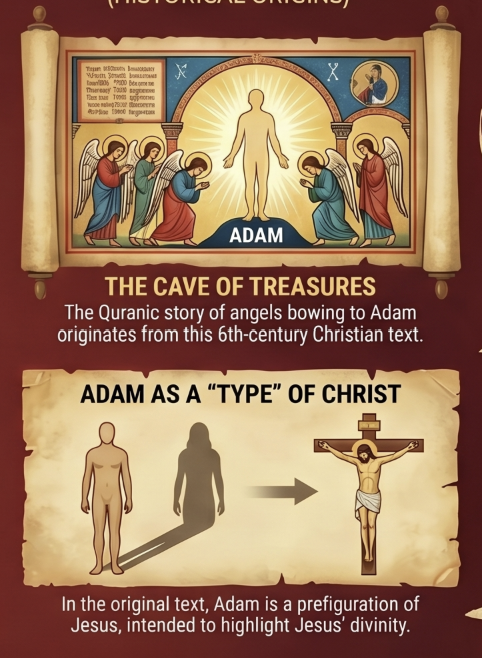
This scene does NOT come from the Bible. It comes from a 6th-century CHRISTIAN Syriac text: The Cave of Treasures (Ma'arrat Gazzē).
In that Christian book, Adam is made "in the glorious image of God," crowned with glory, and the angels prostrate before him — because Adam is a TYPE, a foreshadowing, of JESUS CHRIST.
The Quran BORROWED this scene from Syriac Christianity.
But the original theological purpose was to say:
👉 If angels bow before Adam, it's because Adam PREFIGURES the incarnate God.
When the Quran uses this story to deny Christ's divinity in Q 3:59 — "Jesus is like Adam" — it is literally using a Christian Christological argument AGAINST Christianity.
The instrument of refutation CONTAINS the affirmation it tries to refute. 🔁
Now the deeper question:
Muslims prostrate before Allah alone. Allah cannot command prostration before a mere creature. But the Quran says Allah ordered angels to prostrate before Adam.
If Adam was just dust, why the prostration?
If Adam prefigures Christ everything makes sense...
#Quran #Jesus #Islam #Christianity #corpuschristi #iran #alzalamirada @Pontifex @Apostate_Prophet @PfanderFilms @JaySmithAPM @Sam_Shamoun @LeightonFloresy @mohammed_hijab@GodLogic_GL@tavnet_
Today, on this blessed Feast of Corpus Christi, we celebrate the Eucharist — the Body and Blood of Christ, the true Bread from Heaven... also for all the #muslims in the world.
Remarkably, the #Quran (with its 77,430 words) mentions only ONE religious festival ('Īd). And it is connected to Jesus, son of Mary. In Surah Al-Ma'ida (The Table), the disciples ask Jesus for a table (māʾida) to descend from heaven. Jesus prays: "O God, send down upon us a table from heaven that will be a festival for us — for the first and the last of us — and a sign from You."
This heavenly banquet carries deep Eucharistic echoes, especially when we consider the word māʾida likely draws from Ethiopian Ge'ez liturgical language for the altar table for the #Mass.
What an extraordinary bridge on this holy day. Jesus as the Living Bread who sustains us all.
#CorpusChristi #Christianity #Faith #Jesus #GodIsGood
@PopeFrancis@JoelOsteen @TDJakes @Franklin_Graham@RickWarren
🚨 Mind-blowing historical red pill: The Quranic title "Khatam al-Nabiyyin" (Seal of the Prophets) given to Muhammad in Q33:40 was almost certainly borrowed and repurposed from a much older CHRISTIAN concept — where it referred to JESUS CHRIST as the final fulfillment and closure of all prophecy.
In early Christian writings from the 2nd-3rd century, Christ is explicitly called the "signatum omnium prophetarum" (the Seal/Sign of all the Prophets) based on Daniel 9:24 ("to seal vision and prophecy"). The same texts link a royal insignia of authority directly to Christ's shoulder via Isaiah 9:6.
This exact combo — conceptual seal of prophecy + physical mark/insignia on the shoulder — circulated in Syriac Christianity (especially through Aphrahat) in the late antique Near East... right in the environment where Islam later emerged.
The hadith tradition then literalizes it as Muhammad's famous physical "Seal" between his shoulder blades. But the original matrix? Late antique Christology.
The irony is delicious: The title that closes the door on future prophets in Islam was first used to declare that Jesus was that door-closing Seal.
Christianity: "Jesus sealed the prophets."
Islam: "Muhammad is the Seal... of what exactly?"
The theological conversation between the two faiths runs much deeper (and older) than most believers on either side want to admit.
#KhatamAlNabiyyin #SealOfTheProphets #Quran #Jesus #Christ #Christianity #Islam #Theology #Bible #LateAntiquity #Abrahamic #SyriacChristianity
(What do Muslim scholars make of this? Serious question.)
@DrShabirAlly @YaqeenInstitute@BartEhrman @DrJordanBPeterson @historiansunion
@orriolsderipoll El que no entenc és Què proposes.
Pots expulsar uns quants.
Pots endurir lleis.
No servirà de res sense una Fe que uneixi i que és la que va fundar Catalunya.
https://t.co/XPXI6f9Bke
Obispo de Ventimiglia: los musulmanes que llegan a Occidente tienden a identificar la inmoralidad pública con el cristianismo, y solo cuando entran en contacto con cristianos coherentes descubren que la secularización es una corrupción de la fe, no su consecuencia.
El Obispo Suetta dice que privar al inmigrante del Evangelio equivale a ver a un hombre arrastrado por la corriente y negarse a lanzarle la cuerda pensando que quizá salga solo.
Advierte de que en el Día del Juicio los propios musulmanes pedirán cuentas a los cristianos por haberles ocultado la verdad.
https://t.co/zdhfn1ISUT
🧵 BOMBSHELL PHILOLOGICAL FACT that Islam's defenders NEVER want to discuss:
The word "CHRISTIANS" (مسيحيون, masīḥiyyūn) does NOT EXIST anywhere in the Quran.
Not once. Not hidden. Not implied. ABSENT.
So what does the Quran actually call them? 👇
It uses النَّصَارَى (naṣārā) — 14 times. Traditionally translated as "Christians" — but that translation is SMUGGLING a conclusion into the text.
Naṣārā doesn't mean Christians. It means NAZARENES.
And that changes EVERYTHING.
The Nazoraeans (Nazoraei) were documented by Epiphanius of Salamis in the 4th century: a Jewish-Christian sect in TRANSJORDAN — Torah-observant, circumcised, believing in Jesus as prophet but rejecting the high Christology of Nicaea/Chalcedon, using a Gospel written in Aramaic/Hebrew.
Geographically? Exactly where early Islamic tradition places its first encounters with "Christians."
So: if naṣārā = Jewish-Christians, who are the MUSHRIKŪN ("polytheists") the Quran attacks so relentlessly?
This is where the thesis gets truly explosive:
The charge of SHIRK — associating a partner with God — maps PERFECTLY onto what any strict monotheist would say about... TRINITARIAN CHALCEDONIAN CHRISTIANITY.
"They say God is the third of three" (Q 5:73).
"The Messiah son of Mary IS God" (Q 5:72).
These are not charges against Arab polytheists worshipping stone idols. These are charges against NICENE CHRISTIANS.
The map of the Quran's religious world starts to look like this:
🔹 Naṣārā = Jewish-Christians / Nazoraeans (Torah-observant Jesus-believers)
🔹 Mushrikūn = Chalcedonian Trinitarians ("associators" of Son and Spirit to God)
🔹 Yahūd = Rabbinic Jews
🔹 Ahl al-Kitāb = primarily Jews (and Jewish-Christians)
🔹 Hunafāʾ = the community PRODUCING the text itself
And if the community producing the text is itself a form of Syriac Jewish-Christianity — why would it call itself by a name it had not yet separated into?
This is the SELF-REFERENTIAL SILENCE argument — and it's devastating:
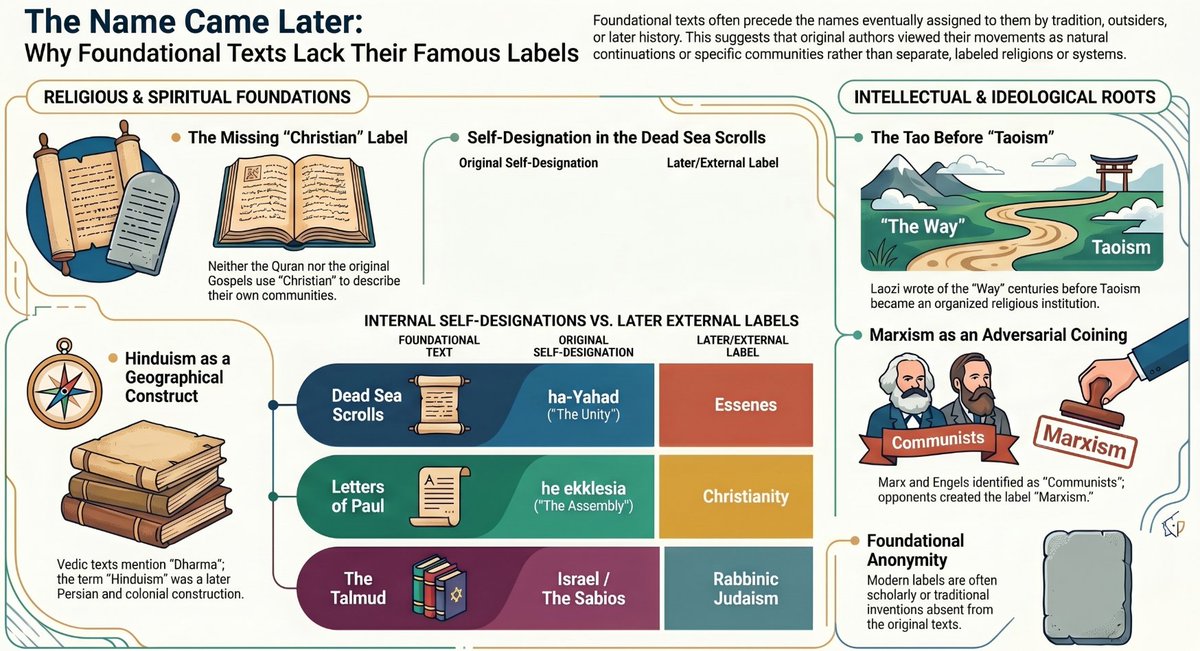
The GREATEST foundational texts of world religions almost never name themselves:
📖 The word "Christian" appears only 3 times in the entire New Testament — always in external or defensive contexts. The Johannine community called opponents "the Jews" (hoi Ioudaioi) as if they were outsiders — because they hadn't yet separated enough to need a self-name.
📜 The Dead Sea Scrolls NEVER call the Qumran community "Essenes." They are ha-Yahad, "the Many," "Sons of Light." The name "Essene" comes from Josephus and Philo — outsiders.
📚 The Talmud never calls itself "Rabbinic Judaism." The Vedas never mention "Hinduism." The Tao Te Ching never mentions "Taoism." Marx never called his system "Marxism."
When a text speaks of OTHERS but has no name for ITSELF — it means the community hasn't yet crystallized into a separate religion.
The Quran speaks of naṣārā, mushrikūn, yahūd, ṣābiʾūn — everyone EXCEPT itself by a proper name.
The community writing it called itself simply: al-muslimūn — "those who submit." A common Arabic word. Not yet a proper noun. Not yet a religion.
Quranic "islām" is what Abraham practiced. What Moses practiced. What Jesus practiced. It's not a NEW religion. It's the ORIGINAL one, still unnamed because it hasn't yet had to defend itself against a rival by taking a rival's name.
The name comes AFTER the split. And who names the loser of a split? The winner.
Bottom line:
The Quran may be the last surviving literary artifact of a form of SYRIAC JEWISH-CHRISTIANITY — a community so convinced it was the continuation of biblical monotheism that it never needed to give itself a new name.
The absence of "Christians" in the Quran is not an accident.
It's a confession.
https://t.co/6zHxVxiVpW
cc: @GabrielSaidR@holland_tom @DavidWoodMinistries @PfanderFilms @DrYasirQadhi@chonkshonk1
#Quran #IslamicOrigins #LateAntiquity #Christology #EarlyIslam #Nazarenes #ChristianMuslimDialogue #QuranStudies #Syriac #Revisionism #Apologetics #History
If you visit @saudiarabia maybe you cannot visit #muhammad tomb. But he is there.
Where is Jesus?
Ask the #Quran.
Who is greater — the one who is dead and buried, or the one who is alive with God in heaven?
This is not a Christian question. It's a Quranic one.
The Quran cannot help itself.
أين هو عيسى عليه السلام حسب القرآن؟
Every time it mentions Jesus, something extraordinary happens.
God speaks to no one else the way He speaks to Jesus:
"I am going to raise you up to Myself" (رَافِعُكَ إِلَيَّ — rāfiʿuka ilayya) [Q. ]
"God raised him up to Himself" (رَفَعَهُ اللَّهُ إِلَيْهِ — rafaʿahu llāhu ilayhi) [Q. 4:158]
Notice the grammar. The preposition إِلَى + the divine pronoun (ilā + ilayhi) means Jesus wasn't just «elevated to a high place» — he was received into God's own personal presence.
Idris was raised «to a high station» (Q. ). A place.
Jesus was raised *to God Himself*.
That distinction is everything.
And there is more.
In Q. 5:116, God and Jesus speak together — alone, intimately — in heaven. God questions Jesus directly. Jesus answers. A private dialogue between God and Jesus, face to face, in the divine presence.
No other prophet in the entire Quran has this. Not Abraham. Not Moses. Not Muhammad.
This intimate conversation in heaven has no parallel in the whole of the Quran.
And then there is Q. 43:61:
"He is a sign of the Hour" — Jesus will return at the end of time.
Think about what this means. Jesus is not in a tomb waiting to be resurrected like the rest of us. He is *already alive*, *already with God*, *already in heaven* — waiting to come back and judge every human being who has ever lived. Muslims. Christians. Atheists. All of us.
Jesus will judge us all. According to the Quran.
Now the unavoidable question:
If Muhammad — the «Seal of the Prophets,» the greatest, the last — existed as Islamic tradition describes, his remains are in a tomb in Medina. You can visit it. It's a geographical fact.
Jesus, according to the Quran itself, is alive with God.
So the text that Muslims consider the literal word of God places Jesus in God's presence — and places Muhammad in the ground.
What does the Quran actually believe about Jesus?
Maybe more than its later interpreters ever wanted to admit.
#dubai #iran #ormuz #AscensionDelSeñor #AscensionDeJesus #KristiHimmelsfärd #AscensionDuSeigneur #Ascension #AscensionDay #AscensionThursday #AscensionOfTheLord #Ascension2026 #Hemelvaartsdag #Hemelvaart #AscensioneDiGesù #Ascensione
Is the #Quran blasphemous? NO!!!
It was originally, simply, a christian text.
The Quran repeatedly affirms that God is absolutely One.
But the Quran affirms also that God has a Word that is His in the highest sense (Jesus), and a Spirit that proceeds from Him in a proper way (21, 91: min rūḥi-nā).
The Quran introduces two distinct realities of Allah himself—His Word and His Spirit—which require a Trinitarian theology to be coherent.
If we were to say that God existed without His Word and His Spirit, we would be blaspheming.
If one were to say that there was a time when God had neither Word nor Spirit, one would be saying that there was a time when God was incomplete, and that he had neither reason nor faith.
Patriarch Timothy I, letter to a Muslim philosopher (800 AD).
#love #MUNLIV #يوم_الجمعه @JoelOsteen@Alhamdhulillaah@YasirQadhi
Why is there ONE person more important than any other in the #quran?
In the Qur’an there is a unique figure.
Only He accumulates so many traits that make Him unlike any other person.
The question to be answered is: why does the Qur’an say so many things about Him, and not about others?
Only He is miraculously conceived, directly by God, without the participation of a man.
Conceived in the womb of a unique woman, of whom it is said that she is the pinnacle of creation. His birth is unique.
This unique figure is mentioned many times throughout the book.
Only He is able to create from nothing: He takes clay, breathes, and gives life.
Only He heals lepers, raises a dead man, and gives sight to one born blind.
Only He brings down food from heaven.
Only He is also called the Word of God.
Only He is the Messiah.
Only He is pure, and able to change divine laws.
Only He is the Sign for the Hour of Judgment.
Only He is a man described in a book that is the reference point for the Qur’an. The Qur’an itself refers the reader to the book about that man and his message. The Qur’an itself says that, in case of any doubt, one must read the book about that man.
Why, exactly, does the Qur’an accumulate so many attributes in this figure, and in no other? Why?
It is curious: most followers of that unique figure do not give him the value that the Qur’an assigns to everything it says about Him.
Yusuf al-Najjar (José el carpintero) no es mencionado directamente en el Corán ni en los hadices, pero ¡qué claro que se ve que los árabes eran cristianos!
Ibn Kathir dice: «…y había con ella en el Templo un hombre justo de su parentesco que servía con ella en la Casa, llamado Yusuf al-Najjar. Cuando vio el abultamiento de su vientre, lo negó al principio, pero luego lo atribuyó a su conocida pureza, devoción y religiosidad» (Ibn Kathir, Tafsir, 2/424-425).
Al-Tabari (Tafsir al-Tabari, 6/268-270), lo menciona como uno de los servidores del Mihrab junto a Maryam y testigo de los acontecimientos de su embarazo milagroso.
Ibn Qutayba en Al-Ma’arif (p. 58) afirma:
«En cuanto a ‘Isa, su madre huyó con él hacia Egipto, y Yusuf al-Najjar los llevó. Este Yusuf era el prometido de Maryam según se menciona en el Evangelio».
Al-Tha’labi también lo incluye como un hombre piadoso y carpintero cercano a Maryam.
El propio Corán remite a quien desee conocer más detalles sobre estas historias a las Escrituras anteriores (los Evangelios), como se indica en los versículos 3:3-4, 10:94, 16:43 y 21:7.
De esta forma, el Corán reconoce y confirma la historia de Yusuf al-Najjar como un hombre justo, elegido por Dios para custodiar a Maryam y a Jesús.
#1demayo #sanjoseobrero @aciprensa@Pontifex_es@ExmuslimSahil@FamilieB3@MBuhari@mohammed_hijab@GodLogic_GL
Pot haver-hi ètica col·lectiva sense premi/càstig eterns? Bertrand Russell va afirmar que tot —l’amor, l’heroisme, el crim— acaba en el mateix oblit absolut. Si això és cert, té sentit moral preferir ser víctima que ser botxí? Imagina que saps amb certesa que ningú —ni persona, ni institució, ni llei, ni déu— jutjarà mai els teus actes més ocults. Canviaria això la teva conducta?
Ara imagina el contrari: imagina que Déu t’estima i ho veu tot el que has fet, pensat i sentit.
Tot. I que, en funció del que facis, aniràs a un cel o a un infern eterns.
Canviaria això la teva conducta?
Veus que això IMPORTA MOLT als mussulmans?
#Filosofia #Etica #Moral #Ateisme #Begoña #BertrandRussell #LaIslaDeLasTentaciones8 #Filosofía #Ética
@Ethic_@EstoicismoT@xai@elonmusk@filosofiacs@VictoriaCamps
Has #Allah ever existed without his Word?
NO!!!
If #Jesus is The Word of God (Q 3:14; 4:171), Allah has ever existed WITH HIM, so Jesus is Divine.
"don't say three!" (thalatha) means don't say the Father, the Son and the Spirit are three gods.
If #Quran had wanted to mean 'trinity' it would have used thulath.
#iran #ormuz
#خان_کی_جدوجہد_کے_30_سال
#युद्ध_समस्या_का_समाधान_नहीं @hadithworks@elonmusk



![Pregaria's tweet photo. If you visit @saudiarabia maybe you cannot visit #muhammad tomb. But he is there.
Where is Jesus?
Ask the #Quran.
Who is greater — the one who is dead and buried, or the one who is alive with God in heaven?
This is not a Christian question. It's a Quranic one.
The Quran cannot help itself.
أين هو عيسى عليه السلام حسب القرآن؟
Every time it mentions Jesus, something extraordinary happens.
God speaks to no one else the way He speaks to Jesus:
"I am going to raise you up to Myself" (رَافِعُكَ إِلَيَّ — rāfiʿuka ilayya) [Q. ]
"God raised him up to Himself" (رَفَعَهُ اللَّهُ إِلَيْهِ — rafaʿahu llāhu ilayhi) [Q. 4:158]
Notice the grammar. The preposition إِلَى + the divine pronoun (ilā + ilayhi) means Jesus wasn't just «elevated to a high place» — he was received into God's own personal presence.
Idris was raised «to a high station» (Q. ). A place.
Jesus was raised *to God Himself*.
That distinction is everything.
And there is more.
In Q. 5:116, God and Jesus speak together — alone, intimately — in heaven. God questions Jesus directly. Jesus answers. A private dialogue between God and Jesus, face to face, in the divine presence.
No other prophet in the entire Quran has this. Not Abraham. Not Moses. Not Muhammad.
This intimate conversation in heaven has no parallel in the whole of the Quran.
And then there is Q. 43:61:
"He is a sign of the Hour" — Jesus will return at the end of time.
Think about what this means. Jesus is not in a tomb waiting to be resurrected like the rest of us. He is *already alive*, *already with God*, *already in heaven* — waiting to come back and judge every human being who has ever lived. Muslims. Christians. Atheists. All of us.
Jesus will judge us all. According to the Quran.
Now the unavoidable question:
If Muhammad — the «Seal of the Prophets,» the greatest, the last — existed as Islamic tradition describes, his remains are in a tomb in Medina. You can visit it. It's a geographical fact.
Jesus, according to the Quran itself, is alive with God.
So the text that Muslims consider the literal word of God places Jesus in God's presence — and places Muhammad in the ground.
What does the Quran actually believe about Jesus?
Maybe more than its later interpreters ever wanted to admit.
#dubai #iran #ormuz #AscensionDelSeñor #AscensionDeJesus #KristiHimmelsfärd #AscensionDuSeigneur #Ascension #AscensionDay #AscensionThursday #AscensionOfTheLord #Ascension2026 #Hemelvaartsdag #Hemelvaart #AscensioneDiGesù #Ascensione](https://pbs.twimg.com/media/HIitzHvXQAEFI5j.jpg)