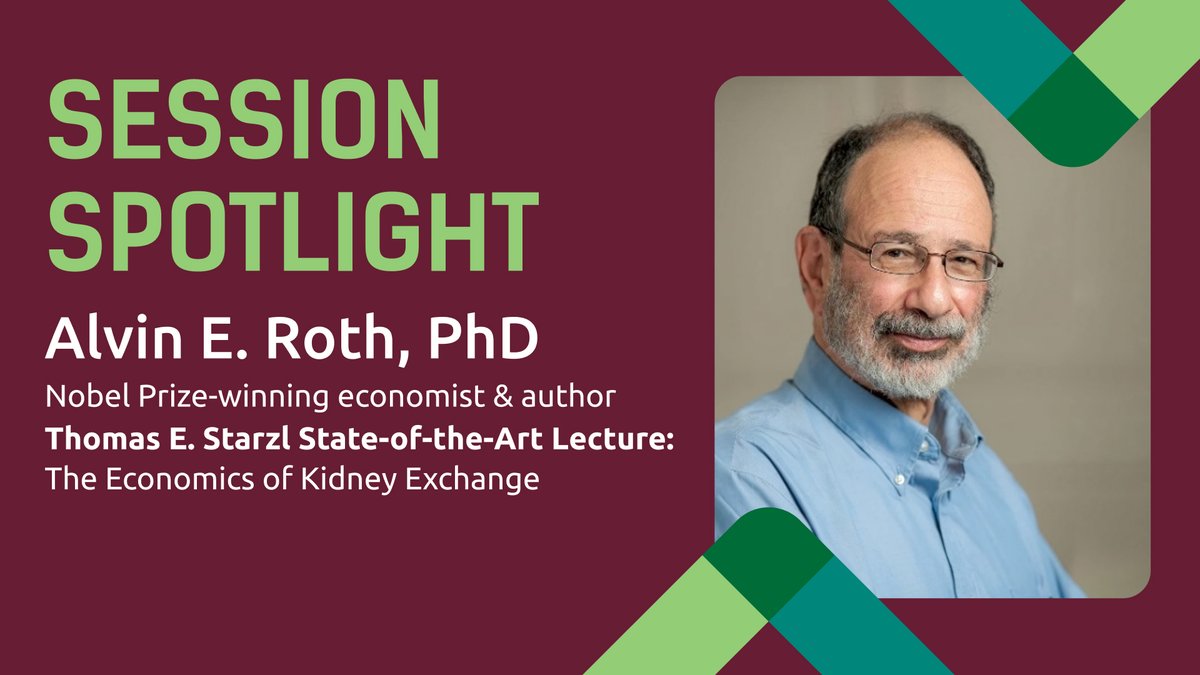
What can economics teach us about kidney exchange?
Nobel Prize winner Alvin E. Roth, PhD explores how market design shapes transplant outcomes on Sunday, June 21 at 11 AM E.T. at ATC. https://t.co/9TalhUcmTa
@AST_info, @ASTSChimera
🔥#Kidney#physiology made easy, learn it the first time. Designed to minimize the forgetting curve!
👀https://t.co/UBcVSdAyYr
✅ Short animated tutorials
✅ Multiple choice
✅ Interactive quizzes
✅ Easy navigation
✅ Immediate feedback
#NephX#USMLE#KidneyCure@ASNKidney
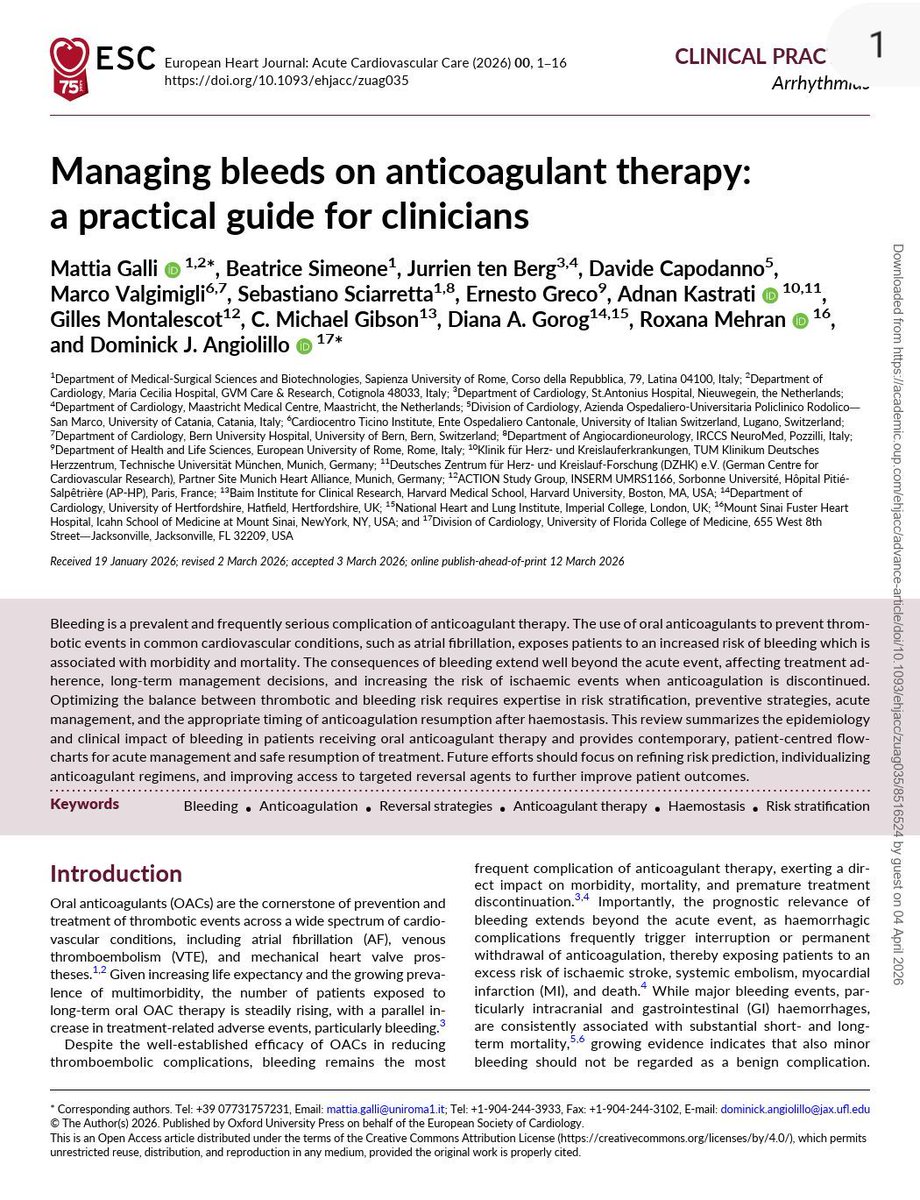
🩸 Bleeding on anticoagulation is NOT a complication… it’s a turning point
⚠️ The problem
We prescribe anticoagulants to prevent:
👉 Stroke
👉 MI
👉 VTE
But the most frequent complication is:
👉 Bleeding
And here’s the uncomfortable truth:
> Bleeding often determines prognosis more than thrombosis
🧠 Why this matters
Bleeding is NOT just an event.
It triggers:
❌ Treatment interruption
❌ Fear-driven underdosing
❌ Permanent discontinuation
👉 Leading to ↑ stroke, ↑ MI, ↑ mortality
🔥 Key clinical reality
📊 Major bleeding:
~1-3% per year
30-day mortality >15%
1-year mortality >25%
👉 That’s NOT benign
⚖️ The real battlefield
Every anticoagulated patient lives here:
👉 Thrombosis vs Bleeding
And we often focus on only one side.
🧠 What experts are telling us (ESC)
This is the new paradigm 👇
1️⃣ Risk is dynamic
Bleeding risk is highest:
👉 Early after starting anticoagulation
👉 In elderly / multimorbid patients
👉 Reassess continuously, not once
2️⃣ Not all bleeding is equal
🚨 Critical sites = high mortality:
Intracranial
GI
Retroperitoneal
Pericardial
👉 Even small volumes can kill
3️⃣ Combination therapy is dangerous
👉 OAC + antiplatelet = 2–3× ↑ bleeding
✔️ De-escalate EARLY
✔️ Avoid triple therapy when possible
4️⃣ Prevention is powerful
Simple interventions:
✔️ PPI for GI protection
✔️ Avoid NSAIDs / SSRIs when possible
✔️ Correct dosing (DOAC underdosing = worse outcomes)
👉 Most bleeding is preventable
🚨 When bleeding happens
Think in 3 steps:
🩸 1. Stabilize
Stop anticoagulant
Airway, oxygen, access
Fluids + transfusion
🧪 2. Reverse (if needed)
VKA → PCC + Vitamin K
Dabigatran → Idarucizumab
FXa inhibitors → PCC (± Andexanet)
🔎 3. Find and control the source
Endoscopy
IR embolization
Surgery
⚠️ The biggest mistake
> “Let’s stop anticoagulation and never restart”
🧠 The evidence says:
👉 NOT restarting = ↑ stroke + ↑ death
✔️ Restart early when safe
✔️ Individualize timing + dose
🔄 The future
We are moving toward:
👉 Personalized anticoagulation
👉 Dose tailoring
👉 Drug selection based on bleeding profile
🎯 Take-home message
Anticoagulation is NOT binary.
It is:
👉 A continuous balance
👉 A dynamic decision
👉 A personalized therapy
🤓 Final thought
> The goal is not to avoid bleeding
The goal is to survive both bleeding AND thrombosis
📚 Reference
Galli, M., Simeone, B., ten Berg, J., et al. (2026). European Heart Journal: Acute Cardiovascular Care.
https://t.co/dovWgN9BEu
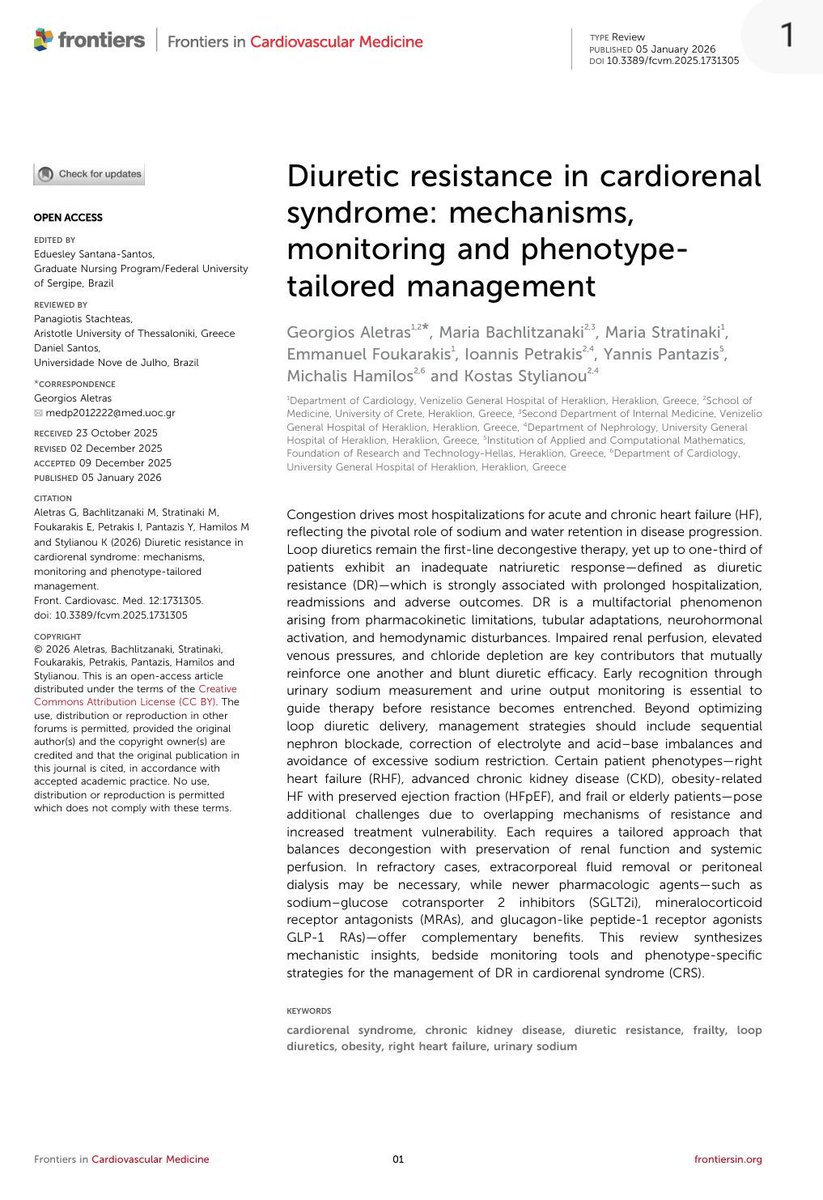
🫀 Diuretic Resistance in Cardiorenal Syndrome: Are We Treating the Wrong Target?
A recent review in Frontiers in Cardiovascular Medicine challenges a deeply ingrained paradigm in heart failure management:
👉 That congestion is simply a “fluid problem.”
In reality, diuretic resistance (DR) is not failure of therapy, it is failure of understanding physiology.
🔬 The Core Insight
Up to 1 in 3 HF patients will not respond adequately to loop diuretics.
But the mechanism is not just “insufficient dose.”
It is a multisystem adaptive response:
↓ Renal perfusion + ↑ venous congestion
Tubular remodeling (distal sodium avidity)
Neurohormonal activation (RAAS, SNS)
Chloride depletion → a neglected driver of resistance
👉 We are not dealing with “volume overload”
👉 We are dealing with a sodium-retentive, neurohormonally activated organ
⚠️ The Clinical Mistake
We still rely on:
Weight
Fluid balance
Creatinine
These are late, indirect, and often misleading markers.
Meanwhile, the kidney has already adapted.
📊 The Paradigm Shift
The paper reinforces a critical transition toward:
1. Physiology-guided monitoring
Urinary sodium (UNa) at 1-2h
Urine output kinetics
POCUS (VExUS, lung ultrasound)
2. Mechanism-based therapy
Sequential nephron blockade
Chloride repletion (not just sodium restriction)
Early combination strategies
3. Phenotype-specific management
Not all HF is the same:
Right heart failure → venous congestion-driven DR
CKD → pharmacokinetic + tubular limitations
Obesity → hidden congestion + inflammatory sodium retention
Frailty → narrow therapeutic window
👉 Same drug, different physiology, different response
🧠 The Take-Home Message
Diuretic resistance is not a pharmacologic problem.
It is a systems physiology problem.
And until we treat:
Renal perfusion
Venous congestion
Electrolyte signaling (chloride!)
Patient phenotype
👉 We will continue escalating doses…
👉 …instead of improving outcomes.
🚀 My Perspective
We are moving toward a future where:
UNa replaces weight as the primary feedback loop
POCUS becomes mandatory, not optional
If you're managing HF patients daily:
Are you still chasing urine… or understanding the kidney?
📃Reference
Aletras, G., etc al. Frontiers in Cardiovascular Medicine, 12, 1731305.
https://t.co/TP1lYp4Frt
🫀 SPORTS CARDIOLOGY: what every cardiologist should know
New review just out 👉
Exercise is medicine… but not always harmless.
⚠️ Key message:
Sudden cardiac death (SCD) in athletes is rare (~1:50,000) but often the first manifestation of underlying disease
🔍 What really matters in practice?
1. Screening works (but not perfectly)
✔️ ECG-based screening can reduce SCD by up to 90%
❗ Still misses ~20% of conditions (e.g. coronary disease, fibrosis)
2. Athlete’s heart ≠ cardiomyopathy
The biggest challenge is NOT finding disease…
👉 it’s not overcalling disease
Physiological adaptations can mimic:
HCM
DCM
ARVC
LV non-compaction
➡️ Requires multimodality approach (ECG + imaging + exercise + genetics)
3. Red flags you should never ignore 🚩
Exertional syncope
Chest pain
Family history of SCD
Abnormal ECG (TWI lateral, ST depression, Q waves)
4. CMR is your best friend
👉 Especially when ECG is abnormal
👉 Detects fibrosis and subtle cardiomyopathy
(Yes… this aligns perfectly with what we see in ACM/arrhythmogenic phenotypes 👀)
5. Exercise prescription is evolving
❌ Old approach: “stop sport”
✅ New approach: shared decision-making
Some key points:
ARVC / desmosomal variants → avoid high-intensity exercise
Low-risk HCM/DCM → may still participate
Myocarditis → no sport for ≥3 months
6. The new frontier: master athletes 🏃♂️
↑ atrial fibrillation (3–5x)
↑ coronary calcium
↑ myocardial fibrosis
👉 Long-term effects still unclear
🧠 Take-home message
Sports cardiology is not about restricting athletes.
It’s about:
✔️ Identifying risk
✔️ Avoiding misdiagnosis
✔️ Enabling safe exercise
💡 My reflection:
This is exactly where imaging + genetics + phenotype integration becomes critical — especially in early/arrhythmogenic cardiomyopathies.
https://t.co/bQFlrEKZnS