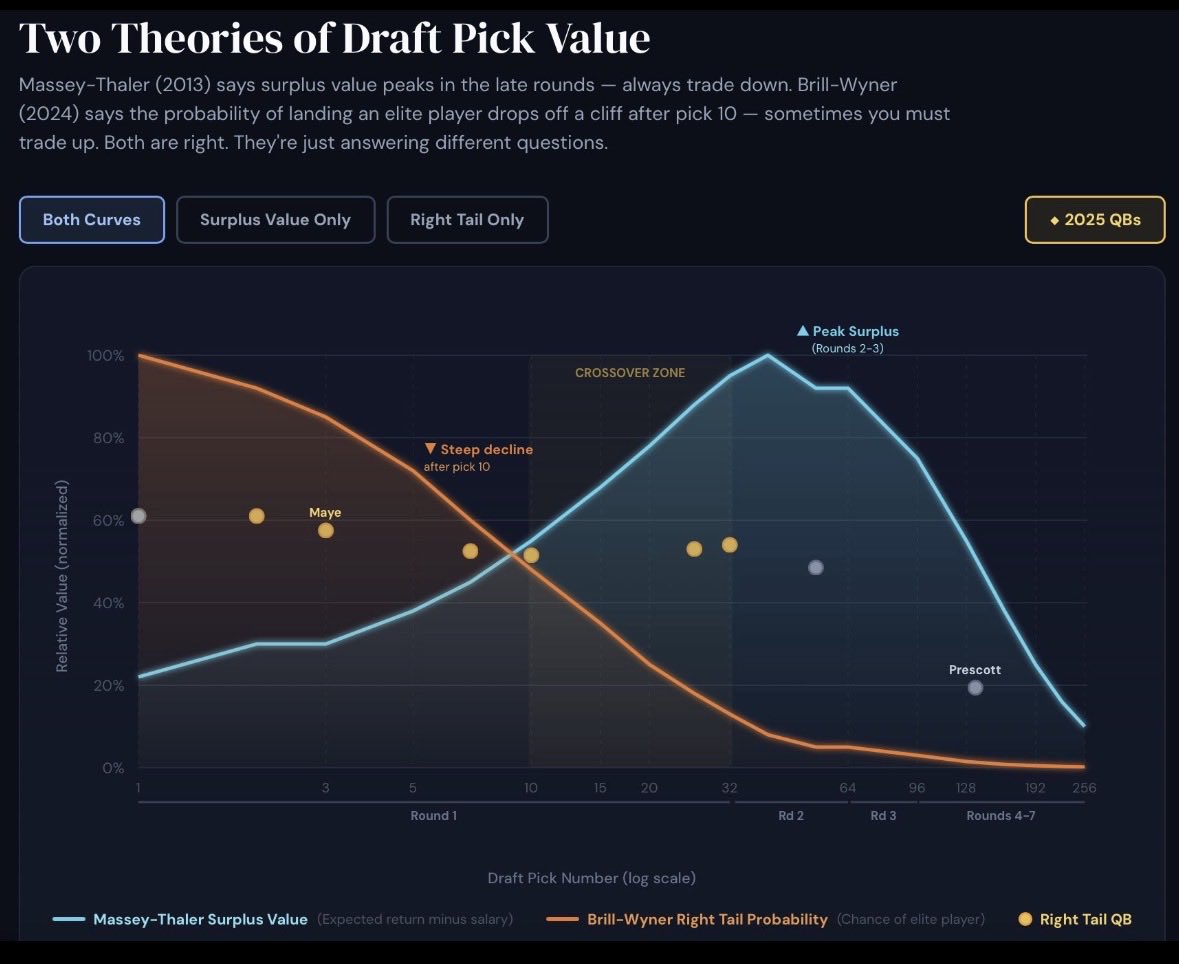
Expected Surplus Value vs. Right Tail Probability - Should NFL teams trade up in the draft?
It depends. The odds of finding a player who can transform your organization with the 1st overall pick are about 25-30%. By pick 10 that drops to 12-15%. By the end of round 1 it's 5%, at which point the odds aren't much different between pick 33 and pick 96 in terms of odds of finding a superstar.
This is why teams like the 49ers will trade massive capital for the opportunity to pick Trey Lance or the Chicago Bears trading several picks to move up one spot for Mitch Trubisky. The odds of finding that transformational player drop with every pick that goes by on Day 1 of the Draft.
If you are not moving up in the draft for a QB, Edge, or maybe OT, the data is clear, you should be trading back and accumulating as many picks between slots 25-75 as possible to create surplus expected value. This is why the best run teams consistently trade back in Round 1, despite frustrating their fans. Talent evaluation is difficult and teams should accumulate as many lottery tickets as they can once the first 15 picks have gone by.
Teams’ high priority UDFAs have their deals worked out before the end of the 6th Rd. To Andy’s point, they likely already had the guys they really wanted to round out the draft class.
The Rams are constantly trying to maximize their competitive window. From 2017 until 2020 they were maximizing for Goff while he was still on his rookie contract. After the Stafford deal, they’ve been going all in while he’s committed to playing. This is the right strategy. After Stafford retires, you’ll see a transition in strategy if there is no heir apparent at QB.
@NFLosophy
I wonder if they’re onto something here with 1st round pick arbitrage. Basically, operating on the principle that other teams over value 1st round picks & unless it’s a top 10 pick, it’s better to have a good player now than a shot at a good player in the draft.
@BookOfEli_NFL A team in the AFC east should draft him just to go up against Will Campbell twice a year. Problem solved.
The hand wringing about hand size and arm length this time of year is always entertaining.
What meetings and eventual “Top 30” Visits mean:
- the team loves the player and wants to get to know them
- the team has injury or character concerns that they want to vet
- the team has absolutely no interest in the player but wants other teams to think they do
College football needs to adopt this framework immediately.
When I applied a WAR/$-style Positional Efficiency Index to Indiana (16-0) and Wisconsin (4-8) using Penn State’s reported $13.3M football rev-share allocation as a standardized budget, the results were revealing. Both programs operated on comparable resources. Indiana generated surplus value at every position group. Wisconsin generated it at 3 of 10.
If we assume similar spending at the QB position ~$1.56M allocation, Indiana got Fernando Mendoza’s Heisman season (3,535 yds, 41 TD, 6 INT). Wisconsin got four quarterbacks combining for 1,637 yds, 9 TD, and 13 INT. That’s a ~1,300% return differential on the same investment. In baseball terms, that’s the difference between paying $1.5M for a 7-WAR starter and paying $1.5M for a replacement-level rotation arm who gets hurt in April.
The programs that will thrive under the new economic structure aren’t necessarily the ones with the biggest checkbooks. They’re the ones that build evaluation systems capable of identifying where surplus value exists in the transfer portal, which position groups offer the highest efficiency multiplier, and where a dollar spent generates compounding returns across the rest of the roster.
Sample of Wisconsin’s efficiency score is below.
MLB payroll explains just 18% of wins. Efficiency explains 80%. A smart $100M team makes the playoffs 55% of the time. A dumb $194M team? 12%. You’re 4.4× more likely to reach October by being smart than by being rich.
Explained simply: Being poor and dumb is the worst. Rich and dumb is only slightly better. Being smart is good. Being smart and rich is still the best.
MLB payroll explains just 18% of wins. Efficiency explains 80%. A smart $100M team makes the playoffs 55% of the time. A dumb $194M team? 12%. You’re 4.4× more likely to reach October by being smart than by being rich.
I wrote about this same thing for College Football. Some American sports models
would benefit greatly by following the European model. More interesting games bring more eyeballs which brings more revenue.
https://t.co/utDYnFDiiz
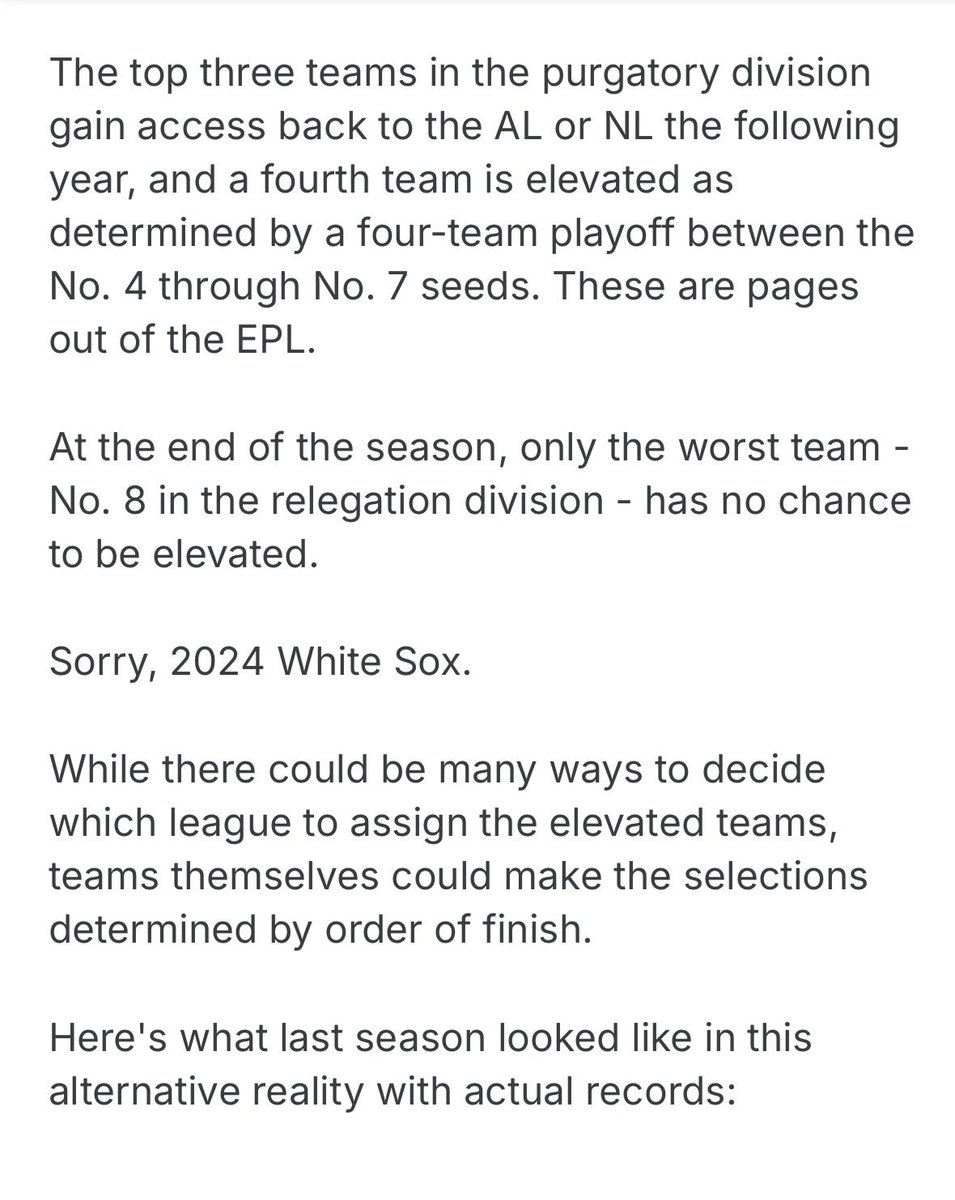
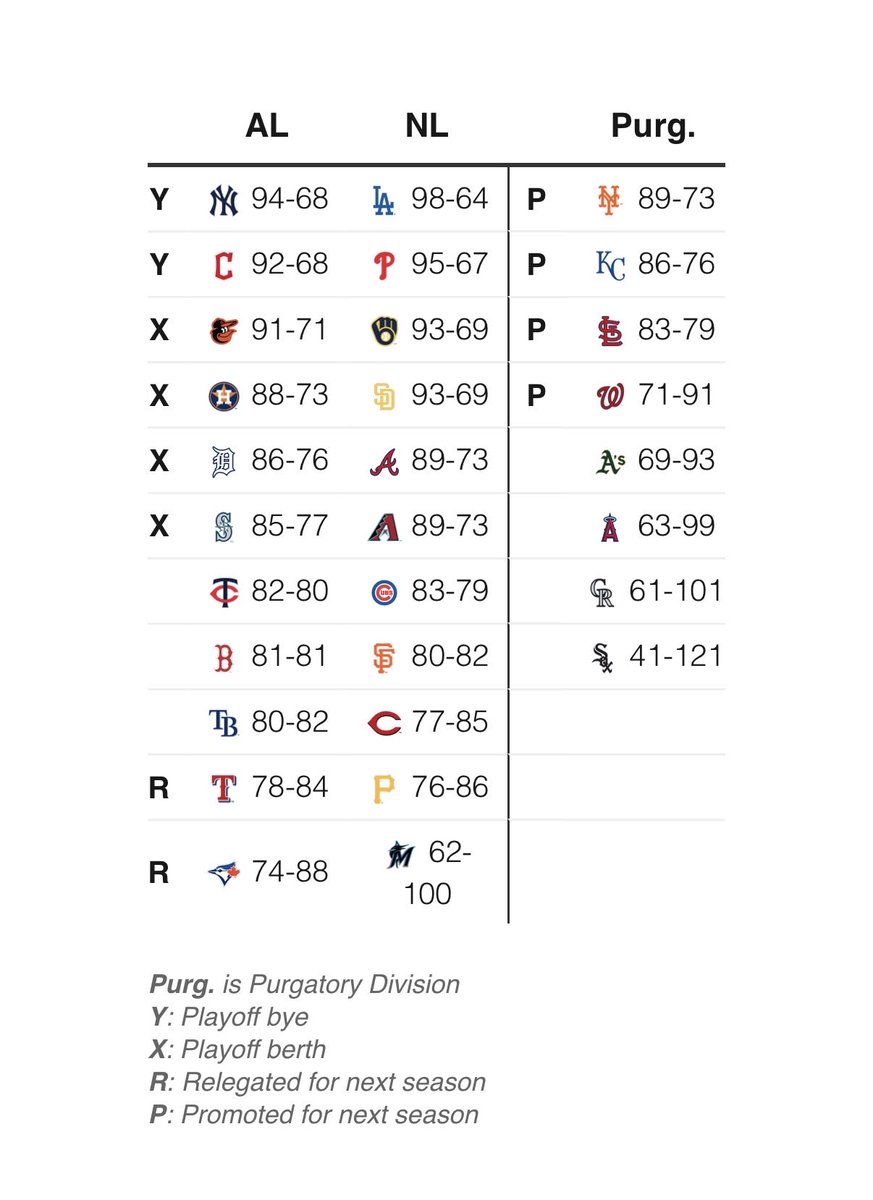
How to create incentive without a cap/floor? Hybrid relegation. Too radical to have any widespread support but it would be a lot of fun and make the massive inventory of reg. season games hold a lot more value start to finish. (wrote this a year ago based off of 2024 standings )
What fans think the NFL Combine is for:
• 40-yard dash times
• Bench press reps
• Hand size measurements
• QBs throwing in shorts with no pass rush
What the Combine is actually for:
• GMs negotiating trade packages over dinner
• Agents setting the free agency market two weeks early
• Team doctors flagging a torn labrum that drops a guy 30 picks
• Getting everyone to talk about the NFL at the end of February
The key here is depth. The Dodger model has $60 M to spend on depth, 60% of the total spend of the Marlins model. Over an 18 week season in the NFL, the Dodgers model would be able to withstand key injuries which would lead to consistent deep playoff runs.
Thought Experiment - What if the NFL had the same spending format as MLB?
Dodgers model: max spending at premium positions, fill out roster with top rookie deals - $450 M
Marlins model- do the best with salary constraints - $100 M
Who wins?
10. The 2021-22 lockout lasted 99 days and resulted in a deal that neither side loved. Mutual defection produces a suboptimal deal. This is exactly what the Prisoner's Dilemma predicts when cooperation mechanisms are weak. Likely where this is heading in 2026
MLB's competitive balance problem is a math problem.
And game theory explains exactly why it keeps happening and why the next CBA probably won't fix it.
Thread.
9. Ownership will resist all three. A salary floor threatens profitability. Earlier free agency increases labor costs. Eliminating the luxury tax removes the cooperative fiction that large market teams are being penalized for spending.