Oh wow. Wasn't expecting this notification this early as it has been 1.5 years since first submission. The experiments for revisions were extensive. A genetic basis for IBD with a robust target for drug development. And my first publication with a Google team investigator!
Free Book, Foundations of String Theory, 845 pages
https://t.co/w4rZnqof3j
Xi Yin, String theorist. Youngest full professor in Harvard history.
String theory, being our best hope for a complete description of quantum gravity and a unified theory of everything, also provides a powerful toolbox along the way for solving problems in seemingly very different subjects, such as strongly coupled quantum field theories, conformal field theory, integrable systems, algebraic geometry, hyperbolic geometry, etc. Xi Yin's research interest lies in the fundamental aspects of string theory, and what string theory can teach us about other fields in physics and mathematics.
Yin's past works involve black holes, supersymmetric bound states in string theory, conformal field theory and gauge theory in three dimensions. His current research focuses on quantum gravity in low dimensions, as well as the holographic duality between gauge theory and string theory/gravity (a.k.a. AdS/CFT correspondence).
According to social media reports, Xi Yin just left Harvard for OpenAI.
Gravitational wave astronomy is now a fully mature science
In 2016, LIGO announced their first gravitational wave detection.
10 years later, we've seen 390 events.
The field has now matured: a whole new way of doing astronomy.
https://t.co/98wXjpwE7u
I'm very sad to know that Dr. Geno Schupp has passed away yesterday. He was one of the best ecologists ever, with seminal contributions as the seed dispersal effectiveness. But not only by his work, he will be remembered by his joy of life and unique sense of humor. Rest in peace
Recipient of the Maryam Mirzakhani New Frontiers Prize (2022), Hong Wang is a leading Chinese mathematician specializing in Fourier analysis and geometric measure theory.
She earned her BS from Peking University (2011) and her PhD from MIT (2019) under Larry Guth. She is currently a professor at NYU Courant Institute and Permanent Professor at the Institut des Hautes Études Scientifiques (IHES).
Her groundbreaking work includes major advances on the restriction and local smoothing conjectures. In 2025, she co-solved the three-dimensional Kakeya conjecture with Joshua Zahl. She has also made important contributions to the Furstenberg set conjecture (in the plane).
Her achievements have earned her the Salem Prize (2025), the Ostrowski Prize (2025), the Clay Research Award (2026, joint), and the New Horizons in Mathematics Prize (2026), among others.
I'm afraid the takeaway of many non-mathematicians here is that:
1. AI is already at least as strong as humans in the technical part of mathematics (proving statements);
2. Further huge AI progress is guaranteed.
And I think both are very far from true.
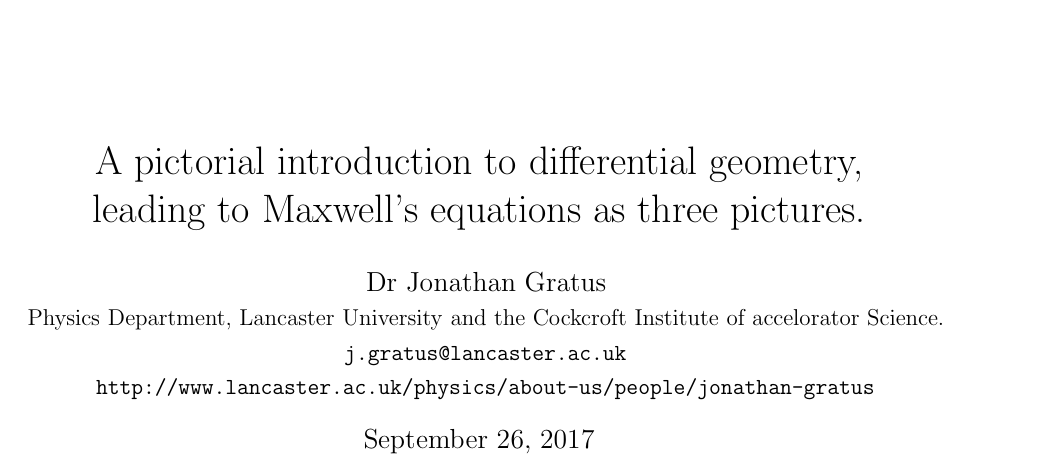
Check out this absolute master piece by Jonathan Gratus titled '' A Pictorial Introduction to Differential Geometry, Leading to Maxwell Equations in 3 Pictures'' which is available on arXiv.
To quote the author: ''When I was young, somewhere around 12, I was given a book on relativity, gravitation and cosmology. Being dyslexic I found reading the text torturous. However I really enjoyed the pictures.''
It's a short primer, full of nice figures, perfect for those who love visual examples.
CT and MRI made anatomy visible, and geometry became optimizable.
The next step may be #biology.
Because patients don’t only receive a physical dose, they experience a biological effect.
#radbio
3/n
Radiation oncology has spent decades getting extraordinarily good delivering dose precisely.
From 2D to CT-based planning, IMRT, IGRT, SBRT, and ions, the field has advanced by making something previously invisible become visible — and therefore optimizable. #medphys 2/n
Did you know that nearly half of all cancer cures involve #RadiationTherapy? and yet we're largely left out of #PrecisionMedicine discussions.
🧵 1/n: new preprint opening the door for precision radiation oncology adoption through RNAseq-based #GARD
https://t.co/iEVjgLNSd4