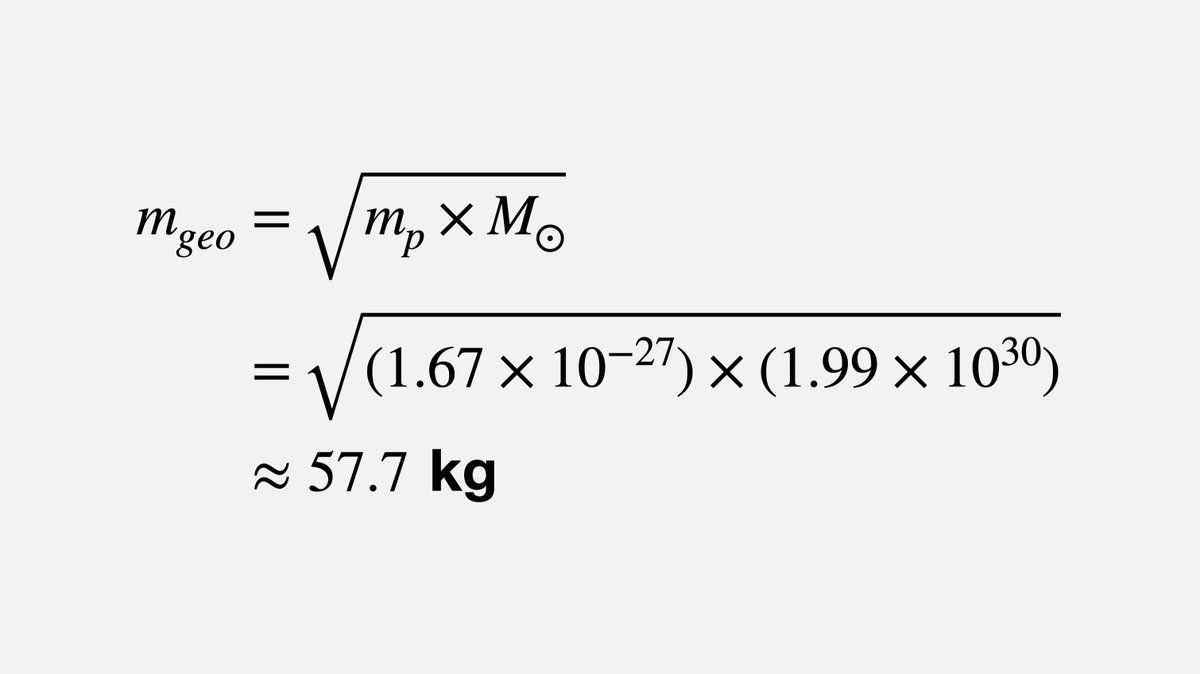
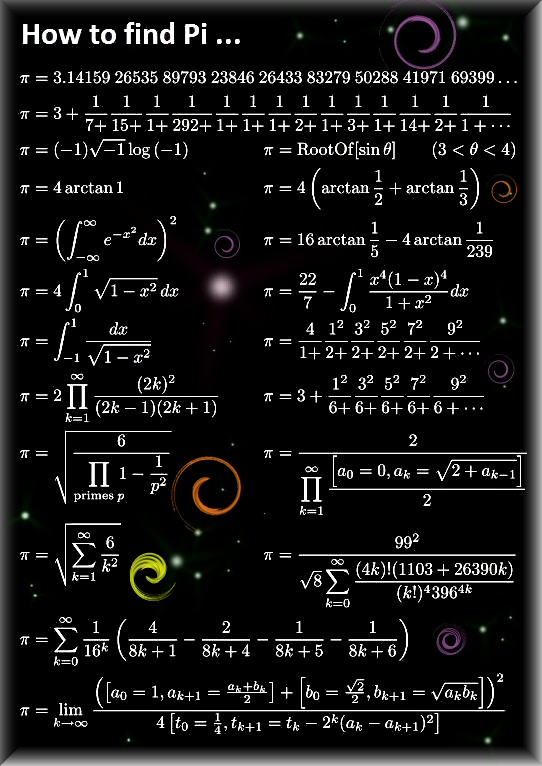
Mathematicians dream of π.
Let's imagine handing this to space-faring extraterrestrials as a gift, or to determine how many of these they have discovered themselves.
This equation set is circulating widely on the web. Example: https://t.co/nU4QkAg1ig
An internal OpenAI model has disproved one of the most well-known Erdős problems: the unit distance problem.
This is, without doubt, the most impressive achievement of AI in mathematics so far.
https://t.co/J0duJXNbph
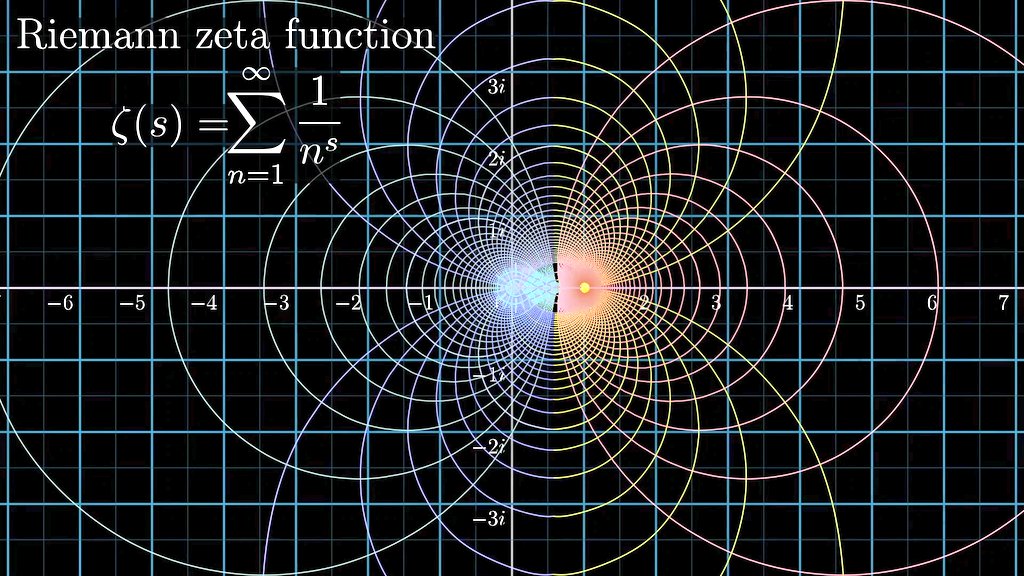
Square-free numbers are integers that are not divisible by the square of any prime, meaning no prime factor appears more than once in their prime factorization. They play a central role in number theory because they encode the “simplest” multiplicative structures. The Riemann zeta function ζ(s), defined as the sum ∑ₙ n⁻ˢ, is deeply connected to square-free numbers through its Euler product representation, which expresses ζ(s) as a product over all primes. By using Möbius inversion, one can isolate the contribution of square-free numbers and show that the probability a randomly chosen integer is square-free is 1/ζ(2)=6/π². More generally, generating functions involving the Möbius function and ζ(s) allow mathematicians to count and study square-free numbers and understand their distribution. These connections reveal how the zeta function encodes subtle arithmetic structure, linking prime factorization, randomness in integers, and deep analytic properties of ζ(s).
Image: https://t.co/RIxIld8L85
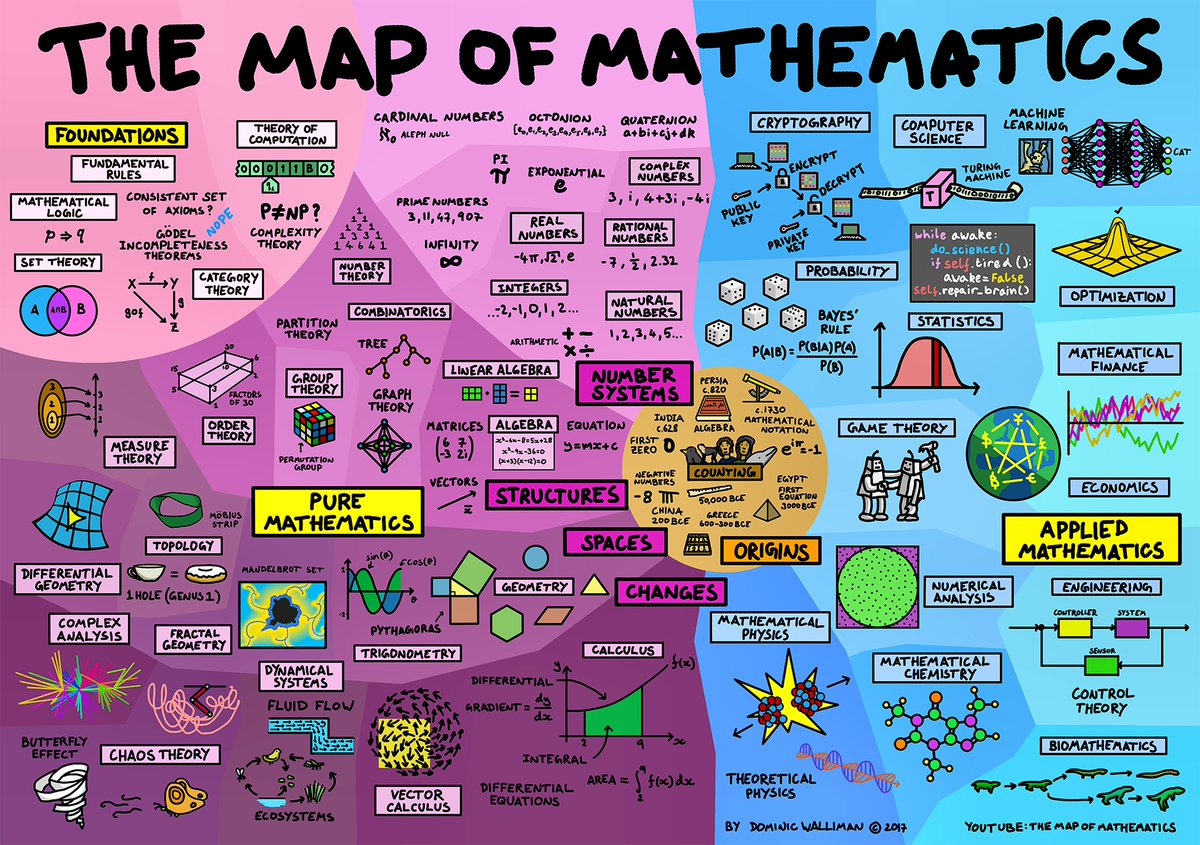
Map of Mathematics.
Find a region of the map that interests you most, take a snapshot of it, and show us the region magnified for us to enjoy.
By Dominic Walliman, @DominicWalliman, https://t.co/4kxUA8F3YA, Used with permission.
Mathematics.
This alluring diagram caught my eye today. It's by mathematician Diego Rattaggi, @diegorattaggi, #mathiratti, Used with permission. [math, maths]





![pickover's tweet photo. Mathematics.
This alluring diagram caught my eye today. It's by mathematician Diego Rattaggi, @diegorattaggi, #mathiratti, Used with permission. [math, maths] https://t.co/01IpMW38XO](https://pbs.twimg.com/media/FQZX-FSX0As8uo7.jpg)