@StanfordHAI@rajiinio The “how do you prove it?” piece may be one of the hardest parts of AI accountability. Establishing harm is one problem; establishing the causal chain between a model, the surrounding system, human decisions, and an eventual outcome is another entirely.
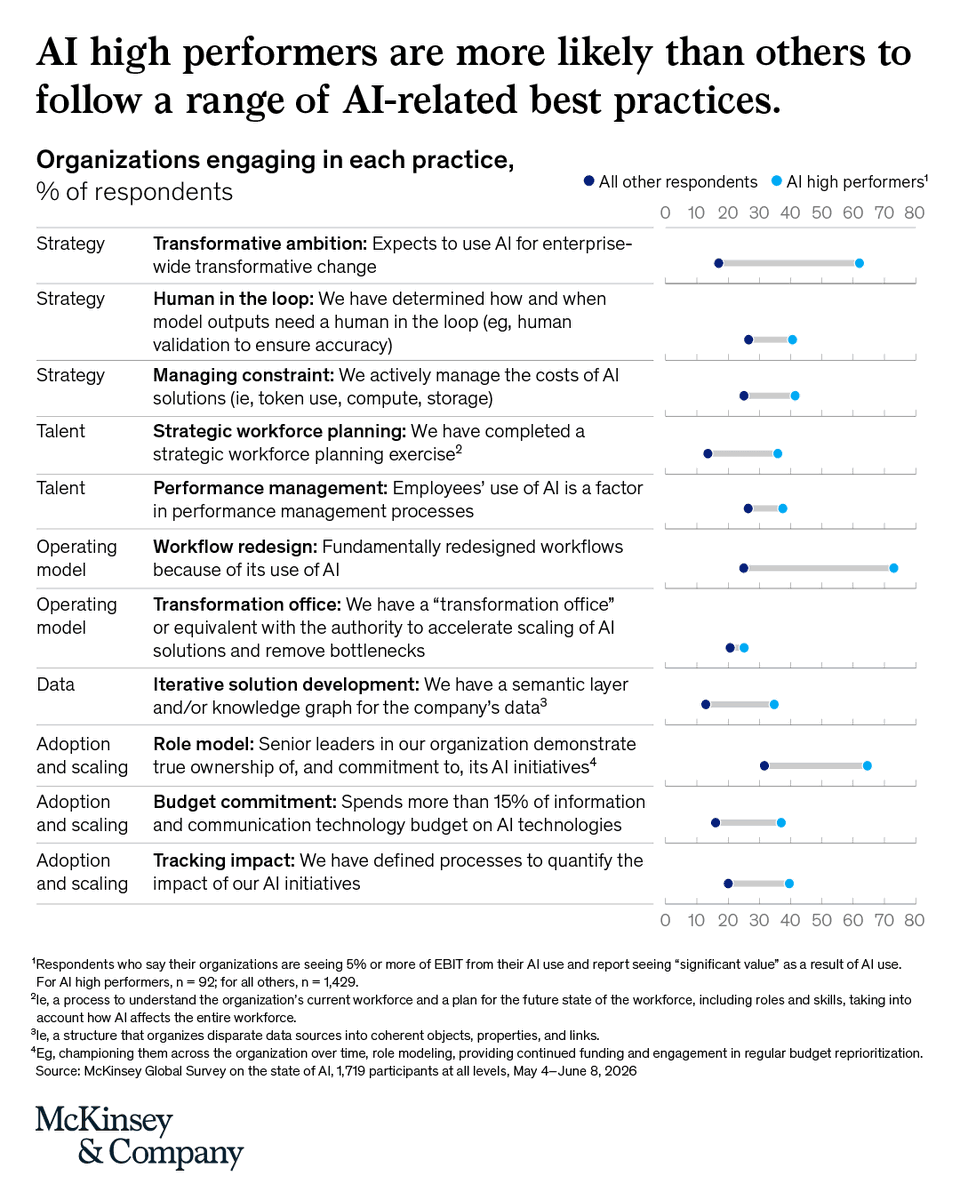
@McKinsey This is where the AI conversation gets much more interesting. Adoption is relatively easy to measure. Value is harder.
Organizations increasingly need to understand not just where AI is being used, but whether that usage is improving decisions or quality enough to justify cost.
@MITSloan This distinction feels increasingly important. The real value of AI is not removing thought from the process, but expanding what people are able to examine, test, and reason through. The risk starts when fluency of output gets mistaken for quality of judgment
Do beetroot supplements and resveratrol actually improve heart health?
In the latest PrimeStata Insights article, Dr. @Dr__Reiss, Professor of Medicine at NYU, examines whether the evidence behind popular cardiovascular supplements holds up.
https://t.co/uvgc1zKsmZ
A new issue of The Industrial-Organizational Psychologist (TIP) is now available. Many of your favorite columnists are back, as well as the editor and president both providing important insights.
Learn more: https://t.co/FqIATOvDjf
#IOPsych#SIOPSmarterWorkplace
At #EVOLVE2026 in NYC, hearing @GetCortexApp cofounders discuss the future of AI-driven software development.
How do we translate rapidly advancing AI capabilities into measurable organizational value?
Great convos and insights coming via @PrimeStata!
@emollick This may become one of the more important forms of expertise in an AI-heavy world: knowing enough about a domain to recognize when an output is merely impressive versus actually correct, useful, and defensible.
One of the downsides in AI getting so good is that it is getting harder to demonstrate its strengths and weaknesses. Yes, Astra and Fable can research and write good papers in an academic field. No, they are not as good as human (yet?), but you have to know the field to know why.
@MITSloan This distinction matters. “Faster” is relatively easy to observe. “Better” requires much more deliberate thinking about work design, employee experience, decision quality, and how success is actually measured.
Whether artificial intelligence makes jobs better, not just faster, depends on the choices employers make in deploying the technology. https://t.co/MVJZa6hTtO
AI can be widely available without being widely valuable. The difference is whether companies can turn access to the technology into changes in how work gets done—and measure whether those changes are creating value. https://t.co/8pl0UGjl8u
@McKinsey Exactly. Access is becoming commoditized. The harder questions are whether AI is changing workflows in ways that actually improve decisions, performance, and outcomes — and whether organizations are measuring those changes well enough to know.
@Nature Hybrid models make a lot of sense. Academia offers depth, independence, and long-horizon thinking; industry offers scale, implementation, and proximity to consequential decisions. Some of the most interesting work happens when those worlds stop pretending they have to be separate
@SIOPtweets If AI can score, summarize, and generate assessments, the human value shifts upstream: defining the construct, validating the inference, setting decision rules, and knowing when the model is wrong.
Assessment science may become more important, not less.
@UNESCO Important distinction. Better immediate performance is not always the same thing as better learning.
If AI helps someone produce the right answer while reducing the cognitive work needed to build the underlying skill, the metric can improve while the capability does not.
@HarvardBiz Trying to retain strong employees by limiting their options usually backfires. Development, mobility, and trust are much stronger retention mechanisms than making people feel trapped.
@APA “Rustout” is an interesting complement to burnout because low stimulation, underuse, and lack of meaningful challenge can be just as psychologically corrosive as overload. Different mechanism, similar outcome: disengagement from the work itself.
@SIOPtweets We're really looking forward to this one! We're excited to see more global connection, shared learning, and collaboration across I-O psychology. #IOPsych#GWOP
@MITSloan The embedding piece is the hard part. Giving people access to AI is not the same as redesigning workflows, decision rights, measurement, and accountability around it. The organizational system has to change too.
@emollick Huge measurement problem awaiting. If agents are changing not just outputs but the actual sequence of cognition, judgment, delegation, and revision inside work, a lot of our existing measures may be describing the old process while the underlying construct is already shifting.