This article analyses the science behind the first images of James Webb Space Telescope and entails why space is our ultimate frontier.
#JWST#JWST1stLook@NASAWebb
https://t.co/Ql7Ko4h5rv
There is a moment - quiet, almost subtle, when the engines fall silent, and the spacecraft drifts in the vastness between worlds.
No borders. No noise. No urgency.
Only a distant Earth, glowing softly in the dark.
And in that moment, one begins to understand what astronauts across generations have tried to articulate - that we were never separate from one another to begin with. That all divisions were, in some sense, temporary agreements drawn on a single shared home.
As William Anders, who captured the iconic Earthrise image, once reflected:
“We came all this way to explore the Moon, and the most important thing is that we discovered the Earth.”
And now, decades later, missions like Artemis II carry that realization forward - not as an echo of the past, but as a quiet unfolding.
From lunar orbit, Earth appeared fragile and alone - a seamless, borderless world. The photograph inspired a fresh awareness of humanity’s place in the cosmos and underscored the need for collective solutions to global environmental challenges.
“Books permit us to voyage through time, to tap the wisdom of our ancestors. The library connects us with the insight and knowledge, painfully extracted from Nature, of the greatest minds that ever were, with the best teachers, drawn from the entire planet and from all our history, to instruct us without tiring, and to inspire us to make our own contribution to the collective knowledge of the human species. I think the health of our civilization, the depth of our awareness about the underpinnings of our culture and our concern for the future can all be tested by how well we support our libraries.”
― Carl Sagan
Today, July 4, marks 13 years since the groundbreaking discovery of the Higgs boson — the long-sought particle responsible for giving mass to all elementary particles. This elusive particle was the final missing component of the Standard Model of particle physics, our most comprehensive framework for understanding the universe. The Standard Model outlines the fundamental particles that constitute all matter (including atoms) and the forces that govern their interactions.
The universe operates under four fundamental forces — gravity, electromagnetism, the weak force, and the strong force. Efforts have long been underway to unify them under a single theory.
A breakthrough in physics occurred when scientists found that electromagnetism and the weak force are aspects of a single underlying force, now called the electroweak force.
The Standard Model was developed combining electroweak theory and quantum chromodynamics (QCD). It describes elementary particles and their interactions but initially could not explain why particles have mass.
While the photon (carrier of electromagnetism) is massless, the W and Z bosons (weak force carriers) are massive, which breaks electroweak symmetry and leads to contradictions unless corrected.
To solve this, physicists proposed the Brout-Englert-Higgs mechanism, which explains how particles acquire mass through interaction with an invisible, pervasive Higgs field. The Higgs boson is the detectable quantum excitation of this field.
Initially, all particles were massless. As the universe cooled, the Higgs field formed and imparted mass to particles like W and Z bosons. The discovery of the Higgs boson at the LHC confirmed the existence of this crucial field, validating the mechanism.
"What I have done is to show that it is possible for the way the universe began to be determined by the laws of science. In that case, it would not be necessary to appeal to God to decide how the universe began. This doesn't prove that there is no God, only that God is not necessary."
- Stephen W. Hawking
"The entity we perceive as empty space is a multilayered, multicolored superconductor. What an amazing, astonishing, beautiful, breathtaking concept. Extraordinary, too."
- Frank Wilczek
The long-held belief that the Milky Way and Andromeda will collide in ~5 billion years is being challenged. A new study says there's a ~50% chance they won’t collide at all!
Using precise data from Gaia and Hubble, researchers modeled galaxy motions & found that other Local Group galaxies like M33 and the Large Magellanic Cloud (LMC) play a major role in shaping the Milky Way–Andromeda interaction.
Surprisingly, the LMC’s orbit cuts perpendicular to the Milky Way–Andromeda path, reducing the likelihood of a future merger. M33, however, tends to increase it. These competing effects make predictions tricky.
Due to uncertainties in galaxy mass, motion, and position, the future of our Local Group is far less certain than previously thought. There's now a real chance our Galaxy might never merge with Andromeda.
#MilkyWay #Andromeda #Milkomeda
Stephen Hawking showed black holes aren't truly black. Quantum fluctuations at the event horizon let particle-antiparticle pairs form — one falls in, the other escapes as Hawking radiation. Over time, this radiation causes the black hole to lose mass and eventually evaporate.
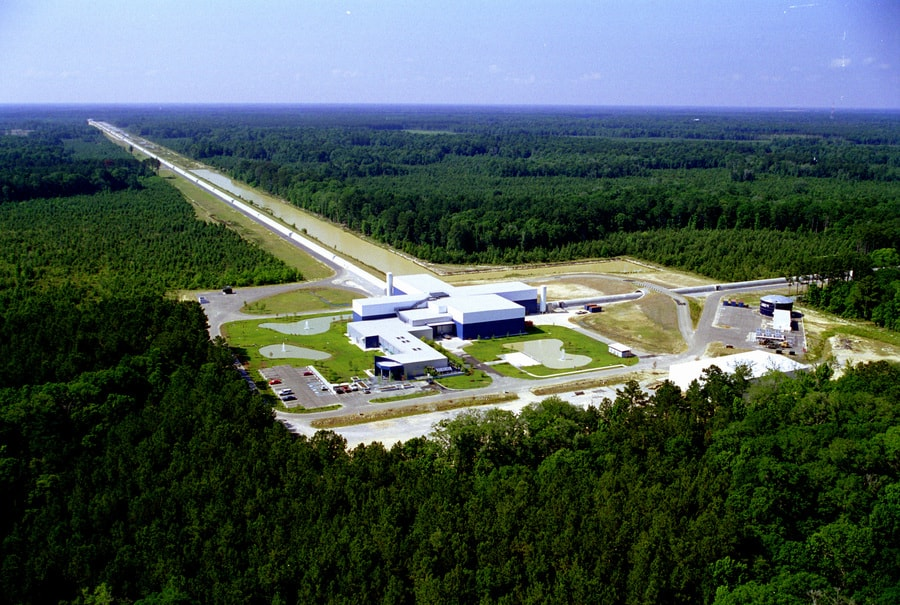
LIGO, the Laser Interferometer Gravitational-Wave Observatory, uses lasers and mirrors in 4 km-long arms to detect these minuscule spacetime ripples. It's like measuring a change smaller than a proton's width.
LIGO began operations in 2002 and underwent a major upgrade between 2010 and 2015, boosting its sensitivity to gravitational waves tenfold. This $221 million enhancement, called Advanced LIGO (aLIGO), now allows scientists to detect gravitational waves from events occurring up to 420 million light-years away from Earth.
Gravitational wave research is just beginning. Scientists aim to detect smaller events like supernovae or even echoes from the Big Bang, unlocking mysteries of our universe's origins.
#LIGO #Interferometer
In 2015, scientists detected a ripple in spacetime - moving just one quintillionth of a meter. This tiny shift confirmed Einstein's century-old prediction: gravitational waves are real.
Gravity isn't just a force pulling us down - it's the warping of spacetime by mass. Think of it like placing a heavy ball on a trampoline; the fabric curves, and objects roll towards it. That's how gravity works!
When massive objects like black holes or neutron stars collide, they send ripples through spacetime - gravitational waves. These waves travel across the universe, carrying secrets of cosmic events.
#GravitationalWaves #Spacetime
"Plants harvest sunlight, converting solar into chemical energy. We and the other animals are parasites on the plants. So, we are, all of us solar-powered. The evolution of life is driven by mutations. They are caused partly by natural radioactivity and cosmic rays, but they are both generative in the spectacular deaths of massive stars thousands of light-years distant.
Think of the sun's heat on your upturned face on a cloudless summer's day. From a hundred and fifty million kilometers away we recognize its power. What would we feel on its seething self-luminous surface or immersed in its heart of nuclear fire, and yet the Sun is an ordinary, even a mediocre star.
Our ancestors worshipped the Sun and they were far from foolish. It makes good sense to revere the Sun and the stars because we are their children."
- Carl Sagan
"I have a friend who's an artist and has sometimes taken a view which I don't agree with very well. He'll hold up a flower and say "look how beautiful it is," and I'll agree. Then he says "I as an artist can see how beautiful this is but you as a scientist take this all apart and it becomes a dull thing," and I think that he's kind of nutty.
First of all, the beauty that he sees is available to other people and to me too, I believe. Although I may not be quite as refined aesthetically as he is ... I can appreciate the beauty of a flower. At the same time, I see much more about the flower than he sees. I could imagine the cells in there, the complicated actions inside, which also have a beauty. I mean it's not just beauty at this dimension, at one centimeter; there's also beauty at smaller dimensions, the inner structure, also the processes.
The fact that the colors in the flower evolved in order to attract insects to pollinate it is interesting; it means that insects can see the color. It adds a question: does this aesthetic sense also exist in the lower forms? Why is it aesthetic? All kinds of interesting questions which the science knowledge only adds to the excitement, the mystery and the awe of a flower. It only adds. I don't understand how it subtracts."
- Richard P. Feynman