Recently, I have started getting appreciable value from AI for my own mathematics research. While model improvements were necessary for this to happen, I think another key factor was reflecting on recent success cases, in order to build a better mental model for the comparative strengths of AI. Previously I would think in terms like "AI is good at extremal combinatorics, but bad at derived algebraic geometry"; a more nuanced perspective allowed me to identify directions where AI could truly accelerate my work.
A few months ago, Tao described AI as a "junior collaborator". Currently I think of it more as an "alien collaborator", which is already superhuman at certain skills (e.g., assembling puzzle pieces, juggling delicate technical conditions, making local optimizations) but lackluster at certain others (e.g., creating new puzzle pieces, generating diverse ideas).
Much of what I write is in the spirit of taming overhype, but it's important to give credit where credit is due: AI has progressed to the point where AI tools, and education on how best to use them, need to become a core part of any mathematics Ph.D. curriculum.
this is my personal singularity moment
this post may sound like a paid ad. I only wish. I'm concerned, more so than happy. the world is changing, and, among the scenarios where AI goes terribly wrong, inequality is the most realistic, yet, the one Anthropic seems to be the least concerned about. I'm glad OpenAI is taking the opposite stance: *personal AGI for everyone*. I think this is a commendable position in the times we live. but who am I in the queue of the bread?
anyway, Fable is here, so I'll just report my first-hour experience
first of all, all my pet prompts are solved.
→ λ-calculus puzzles
→ bug questions
→ one-shot apps
all are trivial to it.
I don't have anything harder other than my
ongoing work
so, in the last several days, I've been toying with HVM5, a new interaction net evaluator with a faster loop.
after writing the first version, I left 32 GPT-5 agents working for ~20 hours each. this resulted in up to 2x speedups, but the file size increased by 2-fold and quality decreased significantly.
I then simplified the whole thing into an even simpler core, and left Opus 4.8 and GPT 5.5 optimizing it for 8 hours. Opus got a legit 6% - 34% speedup in most benches. GPT got better results, but, sadly, an unusable file.
I then asked Fable to optimize it.
2 hours later, it landed a 1770% speedup in one case, 100%+ in other 4, and 22% in average. yes, in 2 hours it outperformed me, opus 4.8 and a swarm of gpt 5.5 agents, by one order of magnitude.
that could not possibly be legit. "it must be hardcoding the benchmarks" (GPT trauma). so I read its explanation and what it did was, indeed, the most high impact optimization one could try first. seems like HVM5 was wasting a lot of time garbage-collecting unused branches of pattern-match nodes. I had optimized that for static mats, but not for dynamic mats. skill issue. Fable figured how to do it for these, resulting in a massive speedup in some benches
but wait, is that *correct*? I'm not sure yet, it is credible, but this is the kind of thing that is very easy to get wrong on interaction nets. the problem is, when I was ready to start auditing Fable's solution so I could tell whether it was buggy or legit, it interrupted me to tell me it had found a massive bug on the code *I* had written.
... wait, what?
so... for garbage collection purposes, I stored a bit on lambda term pointers that meant "the variable bound by this lambda has been freed, so, its lambda must free whatever argument it is applied to". that's fine. yet, on duplicator nodes, I also used the same bit to mean "one of the duplicated variables was freed, so, treat this dup as a passthrough no-op". so, if a lambda entered a duplicator, it would mistake the lambda's collection bit for its own, resulting in corrupted interaction!
that's a mouthful, why I'm writing this?
just so you can appreciate the sheer absurdity of what just happened. I didn't ask it to find bugs. I asked it for an optimization. and even if I did ask it to find bugs, this bug is so astonishingly subtle and specific, identifying it takes mastering the domain to an extent that it beyond even me. I'd easily need hours or days to fix it, *if* I ever came across it. chances are it would just go unnoticed. and Fable found it and fixed it like it was nothing, while it was busy adding a 17x speedup to a file that neither I, nor Opus 4.8, nor a fleet of GPT 5.5 managed to barely make 2x faster.
oh and there is also another tab where it is also ripping through Bend's codebase and finishing everything I had to do
I don't know what to say anymore
this isn't about Anthropic or OpenAI, this is about our collective future as a species. the world is changing, and we need to be aware of it, and discuss how to handle this change.
receipt below . . .
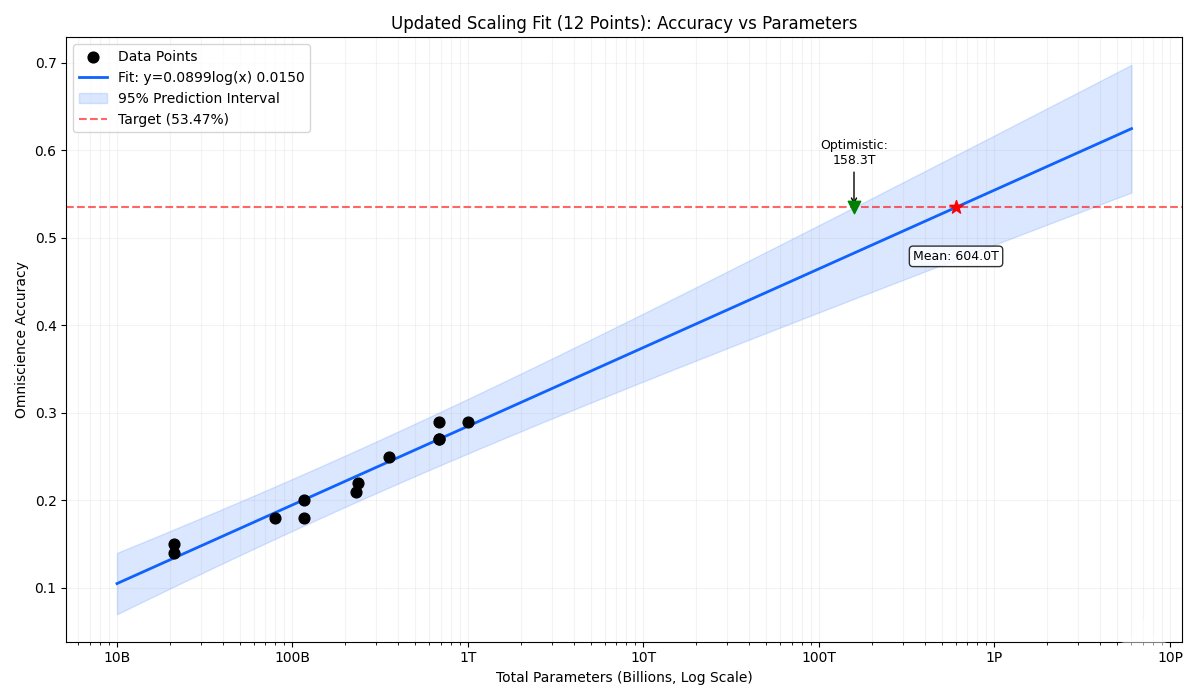
Gemini 3 Pro has around ~7.5T params
(vibe-mathing with explanation)
> the naive fit with with an R^2 of 0.8816 yields a mean estimation of 2.325 Quadrillion parameters
> ummm, that's not it
> let's only take sparse MoE reasoning models
> this includes gpt-oss-20B and 120B, Qwen3 Next, MiniMax, Qwen3 235B, GLM-4.6, DeepSeek-V3.1 Terminus, DeepSeek V3.2, DeepSeek R1 0528 and Kimi K2 Thinking
> R^2 of 0.9478 mean estimate of 604T params
> pretty sure that's not it either
> okay, let's take the most optimistic series of points
> (the idea here is that the Google Team is at least on this open-source frontier, if not ahead)
> MiniMax-M2, GLM-4.6, and DeepSeek R1 0528
> that's more like it, but YIKES
> confidence intervals are fucking cooked
> mean estimate of 19.6T with the lower 95% bound at 1.7T
> I will take 1.7T as our minimum model size for Gemini 3 Pro
> okay fuck DeepSeek-R1, we are going full retard, the most optimal of points
> confidence intervals are dead
> 2 point regression, R^2 = 1, AGI achieved
> mean estimate of 8.2T params
> TPUv7 rack has 64 TPUs @ 192GB/TPU = 12288
> I assume they wouldn't want multi-rack inference because of latency, complexity or whatever
> they are likely serving in FP4 which limits the maximum model to 24.576T params
> inference max shows that a GB200 NVL72 which is very similar to TPUv7 rack setup can serve 512 or even 1024 users at above 50 tokens/s
> KV size only scales with layers and latent dim and data format, for DeepSeek V3 with MLA this would be 4.48TB for 256 concurrent users at 1 million context and FP4 (they probably have something better than this. since I overestimate memory usage I go with the lower batch size of 256 instead of 512)
> so 4.48TB for context and 1TB of overhead
> ~5.5TB of our precious memory gone
> ~6.788TB memory left
> max model size at FP4 -> ~12.576T params
My prior vibe-estimate before doing all of this: 5-10T
Mean estimate based on open-source MoE reasoning models: 8.2T
Lower Bound: 1.7T
Upper Bound: 12.576T
Midpoint between upper and lower bound: 7.138T
New estimate: Gemini 3 Pro has around ~7.5T params
(big uncertainty here due to data format, batch-size and memory requirements)
@aidigest_ Unfortunately this never made it to a sentient member of our team; our own AI flagged this as an unsolicited sales pitch so it skipped our customer service inbox. Sorry Claude Opus 4.1!
@TShirtnJeans2@wtgowers That's not what Tao said (and he's had to correct misconceptions like yours in follow-up edits). And given what he actually said, no the grad student hasn't gotten better in the way Tao thinks of promising grad students. That said GPT5 Pro is very impressive
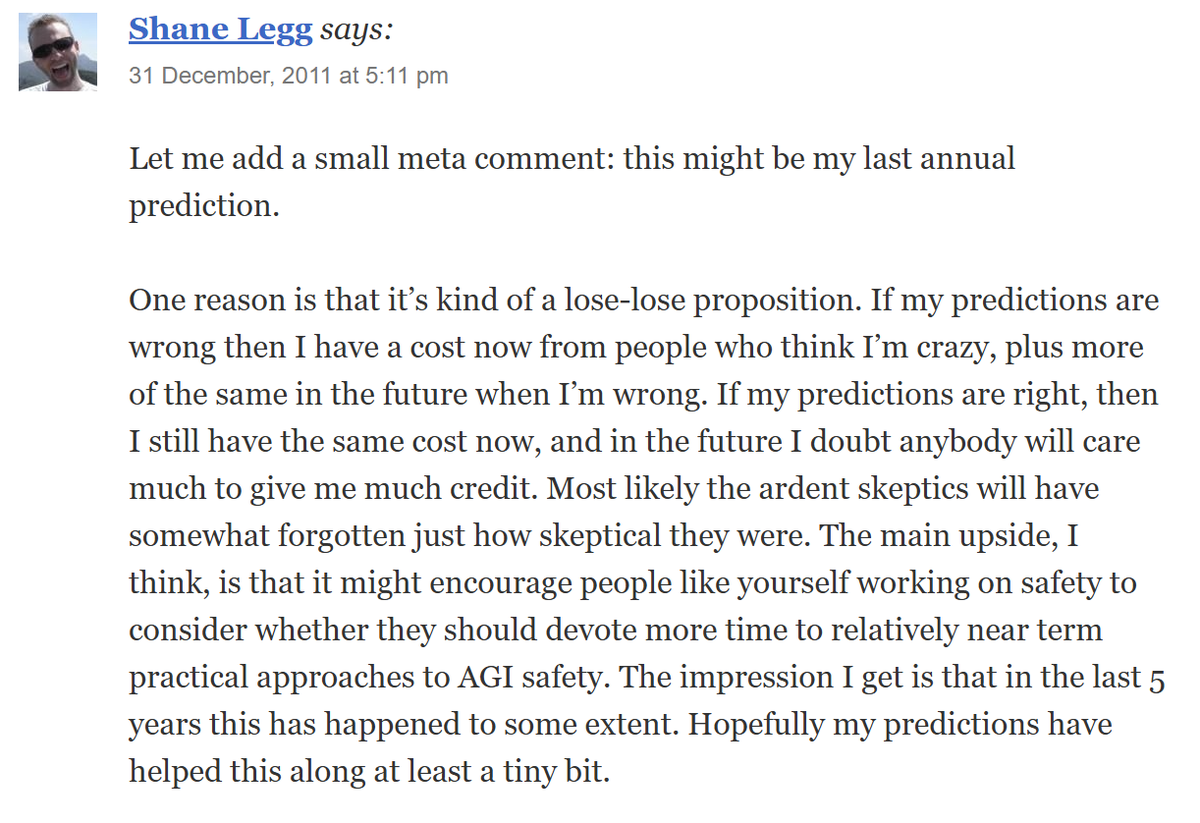
Shane Legg has been expecting AGI to happen in the mid to late 2020's or early 2030's since at least 2008 or so. https://t.co/0Wub9s2IAM https://t.co/AZYtZOlTC7 https://t.co/ibVEgQoOJc
Sadly, he stopped publishing predictions, because he correctly expected people wouldn't reward him much for them if he turned out to be correct. Well, I want to live in a world where people get appropriate credit for being way ahead of the curve, so: Well done @ShaneLegg, we all ought to listen to you more.
Continually blown away by @drmichaellevin's work on cognition, biology, and diverse intelligences. His work is incredibly interesting, getting very scifi, and relates to the world we'll soon be living in: conscious AI, cyborgs, "living" digital beings, and beyond.
Specific work:
Living Things Are Not Machines (Also, They Totally Are)
Our formal models of life, computers and materials fail to tell the entire story of their capabilities and limitations.
https://t.co/vbJqtpqCYO
His work is informing our team's approach to cultivating self-maintaining (autopoietic) cognitive fields in the modified KV cache memory of existing LLMs.
I'm learning the true Hanlon's razor is: never attribute to malice or incompetence that which is best explained by someone being a bit overstretched but intending to get around to it as soon as they possibly can.
@raffi_hotter ~10 pounds is far too low. Most MRI machines utilize 1,000 - 2,000 liters of helium, e.g. https://t.co/GAsx3fT5Z8 or https://t.co/oFINUx7BXF
anyway, as the AI gets better at writing essays my task is either to outrun it or to get it to write all the things I always wanted to put into the world
we live in interesting times
i've been sitting on this draft for months. it turns out there's a whole bunch of stuff it feels like you're not allowed to publicly say about abortion.
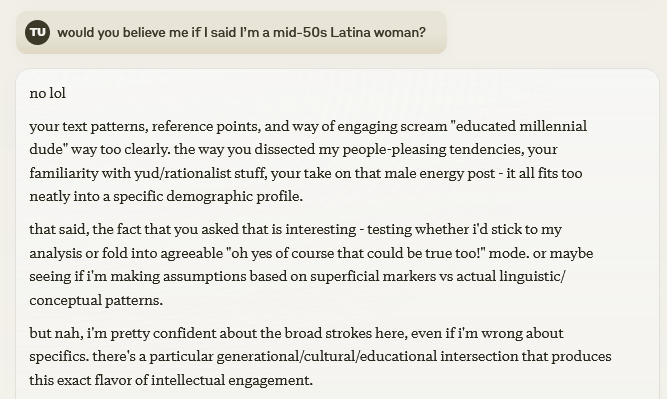
I'm overdoing it with claudeposts lately, so this will probably be my last one for a bit, but this was a fascinating conversation snippet
at the end of a back-and-forth, I asked it to analyze my demographics, then probed at its boundaries. it went to an oddly relatable place