Legislation is information-intensive; ensuring it is effective and reducing the risk of unintended consequences requires consultation at all stages.
Consultation also assists the public to plan for change and supports the legitimacy of the law-making process.
#childrights
WIKE vs NAVAL OFFICER SAGA.
Question:
Can the FCT minister override the order of a 3 star vice admiral?
ANSWER:
YES, but only within his administrative jurisdiction.
He cannot override the 3- star in military operations or chain of command matters.
EXPLANATION:
Nigeria’s structure separates civil authority from military authority, even though both serve the Federal Government. The Minister of the Federal Capital Territory (FCT) is appointed by the President and wields executive powers similar to a state governor, but limited to the FCT.
He oversees civil administration, land, law enforcement (via police), and infrastructure within Abuja.
His power is from the President and the FCT Act (1976).
A “3-star” in the Nigerian Navy is a Vice Admiral, which is very senior and just below the Chief of Naval Staff.
Their authority is strictly military, and limited to defense, security, or operations under the Ministry of Defence, and not civil administration and as such they cannot issue directives on civilian governance, land use, or administrative policy.
WHO HAS MORE SAY AND IN WHAT MATTER WHEN CONFLICTS ARISE BETWEEN THE TWO?
If the issue concerns civil matters (e.g., building approvals, traffic enforcement, land allocation, or public gatherings in Abuja), the FCT Minister’s order stands.
If it involves military operations, security protocols, or national defense, the general’s order within his jurisdiction takes precedence unless countermanded by the President or Defence Minister.
In summary, the FCT Minister cannot command the Navy.
A Naval General cannot command the FCT administration.
And both of them ultimately answer to the President, who is the Commander-in-Chief and the only one who can override both.
In light of the current saga an example of a fictional case can be used to explain.
A Vice Admiral who recently retired from active service decides to build a luxury housing estate in Gwarinpa, claiming the land was allocated to him through the Navy Housing Scheme years ago.
Construction began but soon, the FCT Department of Development Control (under the Minister) issues a stop-work order, stating the land is federal reserve property not zoned for private development.
The Vice Admiral, feeling slighted, orders a detachment of naval personnel from the Nigerian Navy Base in Abuja to secure the site and prevent “interference.”
The FCT Minister instructs the Director of Development Control and civil defense units to enforce the stop-work order, citing violations of the Abuja Master Plan.
The Vice Admiral, through military hierarchy, insists the property is Navy-controlled land, and civil authorities have no right to intervene without clearance from the Ministry of Defence.
The situation escalates and ultimately lead to bulldozers meeting armed sailors.
The Presidency intervenes and after a review:
1. The President affirms that civil land administration within the FCT is under the Minister’s jurisdiction, regardless of the claimant’s rank.
2. The Defence Headquarters is directed to withdraw the naval personnel and clarify ownership through proper civil channels.
3. The Vice Admiral is reminded that military command does not override civil authority except under emergency or national security orders.
Real examples such as in 2006 between then FCT minister, el rufai vs the army and also in 2022 between the FCTA vs military all ended with the FG reaffirming that the FCT is under a civil administration and all lands are vested in the minister on behalf of the president.
With these facts, I leave you to decide what should be and what isn't in the ongoing case.
I will be live today discussing the constitutional review & Reserved Seats for Women Bill (HB1349).
Proudly backed by H.E. Dr. Peter Mbah, this bill pushes the frontier for inclusive leadership.
Let’s talk progress. Tune in! 📺💬
#RSWB1349#WomenInLeadership#PeterMbah
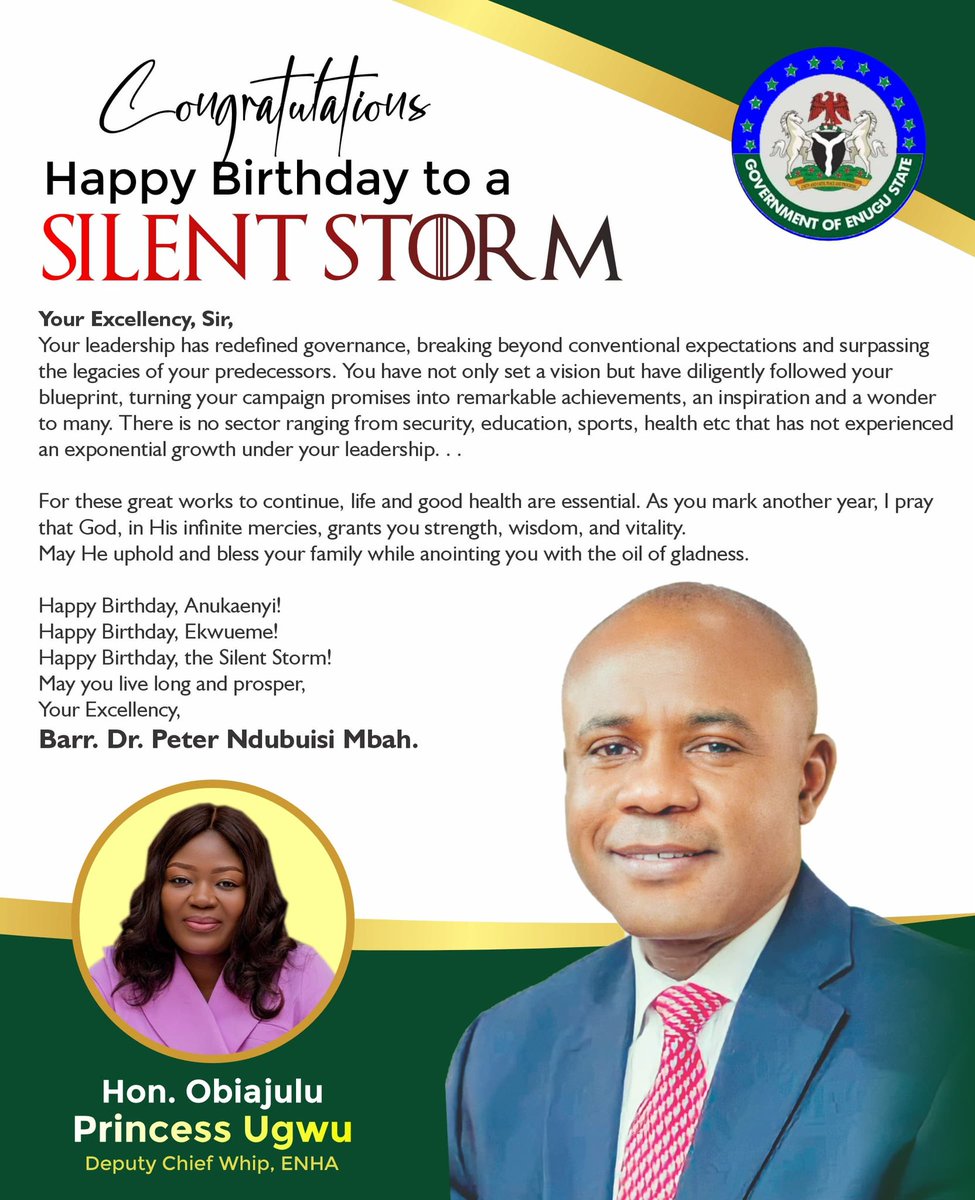
Earlier in the morning as I arrived for work, I was surprised by our lovely Enugu women and party leaders who came to celebrate me today being my birthday. I'm deeply grateful to Ndi Enugu and everyone. God bless you all!!
Please join the discuss on proposed Law to regulate establishment and activities of water user association in Enugu State, Tomorrow 18/11/2024.
"Policy is better when it is informed by genuine consultation"
@EnuguState@WaterAidNigeria@decomsorg@AfiaTvOfficial@AIT_Online
INTERNATIONAL DAY OF THE GIRL CHILD 2024: "Girls' Vision for the Future" marked by Princess Obiajulu Ugwu Foundation (POUF) Today, we celebrate the strength, resilience, and limitless potential of girls around the world.
Join us live: click link
https://t.co/KMrnRg27Sc
The theme, Girls' Vision for the Future, calls for us to amplify the voices of young girls, empowering them to dream without limits and shape a future where they lead in every sector.
I hope this amendment receives a strong support from both national and state parliaments so that Nigeria can atleast find a place in the chart like other African countries.
As a temporary measure to promote women’s representation, a temporary measure that will span over four cycles of general election for the purpose of either retaining,increasing or abolishing the temporary measure.
Today marked another significant milestone in our journey to advance women’s participation in governance, as key stakeholders gathered to critically discuss the role of women in governance and the constitutional amendment process.
This event once again reiterated the National Assembly’s commitment to addressing the barriers that limit women’s participation in politics and governance, with a clear understanding of the scale and urgency of this issue. With current statistics showing a persistent decline in women’s representation, the House of Representatives has made constitutional reform a cornerstone of its legislative agenda, recognizing the far-reaching benefits of women’s inclusion in leadership, which we cannot afford to overlook.
It has been an honour to chair the House Committee on Constitutional Review, where we have proposed bills aimed at correcting the gender imbalance within government at all levels. One such critical bill, A Bill for an Act to Alter the Provisions of the Constitution of the Federal Republic of Nigeria, 1999, to Provide for Seat Reservation for Women in the National and State Houses of Assembly, along with four other gender justice bills, is currently under consideration.
Our gratitude goes to the Policy and Legal Advocacy Centre @PLACNG , the United Nations Development Programme @UNDPNigeria and the European Union @EUinNigeria as well as other development partners for their support in advancing women’s roles in politics and governance. The House reaffirms its commitment to improving women’s representation in governance, as this is not just a goal but an essential component of our democratic journey.