Excited to announce a major performance update for Infinigen! We've overhauled various assets and systems, focusing on efficiency. Our `--performance` config reduces the average generation time of nature scenes by 8x without sacrificing any visual fidelity! 1/3
Researchers are actively improving memory for LLMs/VLMs. But are we measuring it right?
A system can score 100% by rereading the input for each question. If a human did that, we’d call it terrible memory!
We test beyond accuracy with ECC: Efficiency, Compression, Calibration. 🧵
We’ve released InFlux++, our unified data suite for training and evaluating dynamic intrinsics prediction models. See below for more info, or visit us in person at #ECCV2026!
Dynamic camera intrinsics often appear in robotics and 3D vision—yet training and evaluation data for predicting them from RGB is surprisingly rare.
Introducing InFlux++: our new real-world benchmark and synthetic training dataset for dynamic intrinsics prediction. 🧵1/6
We have released an initial Infinigen2-Flying-Indoors dataset! It provides 2000 stereo videos, 24 frames each, with ground truth for depth, flow, normals, segmentation, albedo and more. Each group of 4 trajectories provides random synchronized views of the same procedural dynamic 3D scene.
Code to replicate it will be released soon as infinigen2.0.0a2. See full youtube preview & huggingface link below ↓
We've released a preview of Infinigen 2.0 - new high quality procedural materials and scenes with an efficient and controllable Python API. See below for info!
1/ We've released Infinigen 2.0! Currently in preview. It creates indoor 3D scene files in 1min CPU time, and includes new and better materials --- all still fully procedural. Our new 2.0 design is highly efficient and allows easy control and recombination via Python APIs.
Thrilled to share that I'll be joining the University of Michigan as an Assistant Professor in Fall 2027!
My lab will work on Robot Learning, Dexterous Manipulation, Robot Foundation Models & 3D Perception. I'm looking for students to join me. Please apply and reach out.
(1/2)
Stereo depth is important in robotics, and relies heavily on synthetic data. But what actually makes for good synthetic data?
In WMGStereo, we study dataset design and discover a powerful data recipe - just 500 samples of our data can match 40k Sceneflow samples! 🧵[1/7]
Stereo depth is highly useful for robots. Meet WAFT-Stereo: #1 on ETH3D (BP-0.5), Middlebury (RMSE), and KITTI (all metrics); 61% less zero-shot ETH3D BP-0.5 error; 1.8-6.7x faster than prior SOTA. Key idea: classify disparity into bins, then iterative high-res warping.🧵1/2
Meet WAFT (Warping-Alone Field Transforms), our new optical-flow estimator. #1 on public benchmarks (Sintel & Spring), 1.3-4.1x faster than leading methods, and 2x lower memory. Key idea: replace cost volumes with high-res feature-space warping. Code and paper:👇
We tested 6 intrinsics prediction methods on InFlux. When projecting 3D points, even the best methods produced projections hundreds of pixels off.
Have a better method? Try our benchmark👇
🌐 Website: https://t.co/7cYF8MQjjk
📄 Paper: https://t.co/HFK37eocNa
💻 Github: https://t.co/YUhskRy0io
Estimating camera intrinsics from video is key to 3D reconstruction, but most methods assume they’re fixed per video. What if the camera keeps zooming and refocusing?
Meet InFlux, the first benchmark with per-frame ground truth for videos with dynamic intrinsics. 🧵1/5
To construct this mapping, we use Hollywood-grade lenses that provide reliable lens metadata. We calibrate the lenses at many settings using multi-scale board and drone targets, and extract intrinsics via Kalibr, a toolkit we modified for improved robustness and accuracy. 🧵4/5
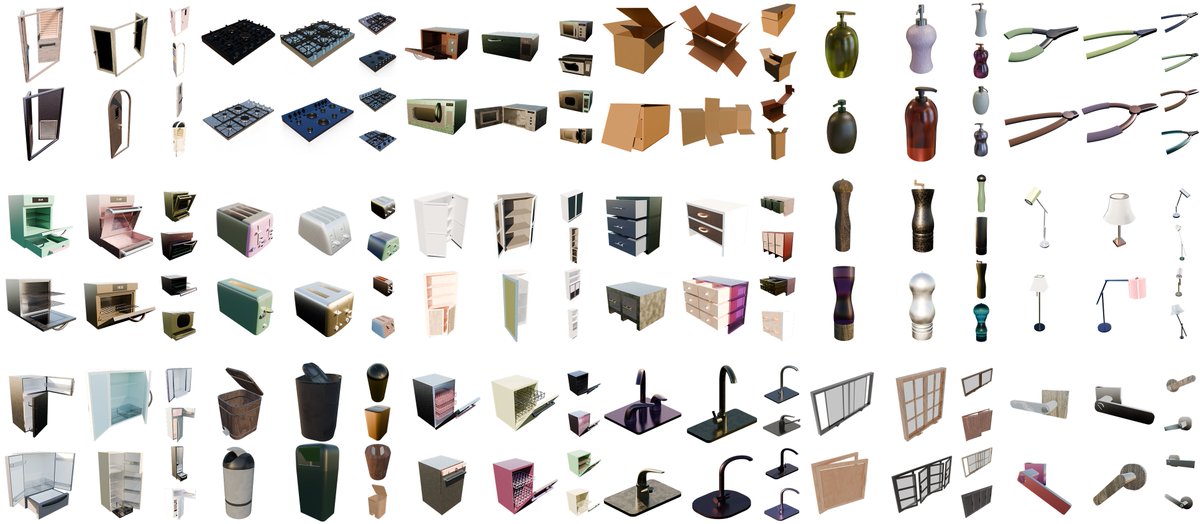
Major update to Infinigen Articulated (formerly Infinigen-Sim)! You can now generate articulated 3D objects in 18 categories, simulation ready with physics parameters and improved efficiency. Also available: 20k pre-generated objects. Download links below👇