Venture capital is not always patient capital. But these days, many VCs are funding Neolabs — AI organizations that operate more like private research institutions than startups, doing foundational, open-ended work where the breakthrough isn't certain and the timeline isn't predictable.
It's a topic and point of tension I was excited to explore on stage at yesterday's @Forbes Iconoclast Summit.
Think Bell Labs or PARC, not Series A. While this moment for AI is genuinely different — the capital, talent, compute, and data are coming together in ways they haven't before — it's still early days. These organizations are being funded by LPs with an actual time clock that need liquidity at a certain point. Yes, there's real potential for breakthrough, but investors should still be asking: is our capital structure the right fit for this kind of research?
Thank you to Maneet Ahuja (@WallStManeet) for including me in this year’s programming, to Katherine Schwab (@SchwabKatharine) for the sharp moderation, and to fellow panelists Eric Wilmes of GIC and Michael Anders of @ICONIQCapital for a conversation that didn't shy away from the hard questions on AI valuations, the AI IPO race, and what it means to invest responsibly in this moment.
Honored to have joined @NYSE Live at #HumanX2026 to talk about what's actually different this time in AI (interview starting at 53:58).
After 30 years of hype cycles, the data, compute, and talent are finally arriving together. That's the shift worth paying attention to.
AI is moving us toward a societal “ideal state” of frictionlessness.
But not all friction is equal. While some friction does point to pointless busywork, other types of friction push people to actually develop judgment, intuition, and expertise. Cognitive psychologists call it desirable difficulty.
The pitch for most AI startups is: "We eliminate the low-value work so you can focus on the high-value work." But a lot of what gets labeled low-value is where expertise forms. The lawyer drafting routine contracts is learning to spot risk. The analyst building models by hand is developing intuition for how businesses work.
But it doesn't stop there. These implications go beyond the workplace. Democracy runs on friction too — deliberation, disagreement, sitting with competing ideas rather than receiving easy certainty. When everything around us optimizes for ease, civic participation can start to feel unreasonably demanding by comparison.
Wrote on the @Principal_VC Substack about what this means for the AI products being built right now. You can check it out here: https://t.co/cqXEMsycqX.
Voice assistants in cars usually fail the moment you lose signal.
Our portfolio company @liquidai and @MercedesBenz are changing that.
Liquid just announced a multi-year partnership to embed foundation models directly into next-gen MBUX systems in North America, with much of the speech and language processing running on-device.
Faster responses. Better performance in low-signal areas. More privacy. Less reliance on the cloud.
The Korean government just made its second-ever direct investment from its National Growth Fund.
The recipient: @upstageai, our @Principal_VC portfolio company building the future of enterprise AI.
Big couple of months for them:
• $120M Series C → unicorn status
• Named to @FastCompany's "World's Most Innovative Companies of 2026" list
• Korea's first recognized frontier model
Their flagship, Solar Pro 2, ranks #12 on @ArtificialAnlys's global intelligence index, trained on just 31B parameters.
For comparison: @Grok, which tops the list, was trained on an estimated 1.7T.
You don't need to out-scale the giants to beat them.
@Allbirds' stock jumped over 580% yesterday after the company announced it was pivoting from eco-friendly shoes to AI infrastructure.
If that reminds you of the meme stock era, you're not alone.
The market tends to reward companies that align themselves with the most powerful narrative of the moment. Right now, that's AI.
The market dynamic is often the same: narrative over fundamentals. GameStop and AMC in 2021 were the clearest examples. Their fundamentals were essentially unchanged, but their equity value was reset by narrative and coordinated buying.
From a venture perspective, I can give Allbirds' rebrand the benefit of the doubt, but the inevitable questions are: Where is the founder-market fit? What's the differentiated technology stack? What's the path to competitive advantage?
Of course, not every company pivoting to AI is created equal. Some companies, such as Bitcoin miners, are better positioned to make moves into AI. Miners have always been in the business of pointing compute at whichever workload pays most. We saw the same behavior in the MMORPG era, when operators redirected infrastructure to bots and in-game currency farming because they paid better than mining. Those companies are built to dynamically reallocate compute based on economics. As a former footwear company, Allbirds has a very different starting point.
Narrative can reprice a company overnight. But only real capability and customer value sustain it over time.
When something gets cheap, we don't just do it a little more. We do it in volumes and for purposes no one imagined.
In the early 2000s, every photo cost money to shoot and develop. Humanity took about 80 billion a year. Then the iPhone made photography free. Today we take over 1.4 trillion. A 17x explosion. People didn't just take the same photos cheaper. They photographed everything: meals, parking spots, random whiteboards. Photography stopped being deliberate and became a reflex. A replacement for memory itself.
AI is now doing this to software.
For 50 years, the real cost of software wasn't servers. It was people: skilled engineers, long dev cycles, a hard wall between those who could build and those who had ideas. Most useful software never got built because it couldn't justify the cost.
That wall is falling fast. A nurse, a logistics manager, a shop owner can go from idea to working prototype in hours for nearly nothing. The world is about to fill with software the way it filled with photos after the iPhone.
Compute demand is still in its early innings. A trillion photos needed towers, bandwidth, and cloud storage. A flood of new software will need the same.
But abundance creates real risk. When only trained engineers built software, human judgment was baked in. As building becomes accessible to everyone, that layer thins. More applications means more attack surface, more ungoverned code, more things that can fail quietly until they don't.
The answer isn't to slow down. It's to build governance alongside the technology, not after something breaks publicly and expensively.
Are we ready for what's coming?
I've spent over a decade investing in technology, and the single best filter I've developed sounds like an insult.
I don't fund the slickest pitch in the room. I fund boring.
Here's what I mean. The flashiest startups tend to follow a pattern: big launch, tons of buzz, rapid hiring, then a quiet fade when the unit economics never work out. I've watched it happen dozens of times.
The companies that actually returned capital? They looked boring from the outside. They solved unglamorous problems. They built infrastructure: energy-efficient chips, model compilers, coordination layers, the plumbing everything else depends on. They had paying customers before they had a pitch deck. They grew steadily instead of explosively.
The founders behind those companies are boring too, and I mean that as the highest compliment. They're the ones still obsessed with the same problem years later, long after the hype cycle moved on. Recently, a founder told me after our meeting, "You were the only VC that made me think critically during the pitch." That stuck with me. Too many pitch meetings are performances. Both sides actually need a thought partner who pressure-tests assumptions, not applause.
A few signals I've learned to look for over the years:
*The founder talks about margins before market size
*The product exists because customers asked for it, not because a trend report predicted it
*Growth is coming from retention and referrals, not paid acquisition
*The business has a real moat, proprietary data, defensible infrastructure, not just a flashy app sitting on top of someone else's model
The AI bubble forming right now isn't about the technology. The underlying science is real. The bubble comes from human behavior: pattern recognition driving investors to rush in, demand to "be in the game" outpacing the number of companies with truly transformative technology and talent.
In that environment, "boring" is a sorting mechanism. And the returns belong to those willing to embrace it.
See the entire breakdown of my thesis here: https://t.co/mfFdLVblqV.
The Citrini Research memo, “The 2028 Global Intelligence Crisis,” has set off a wave of anxiety across finance. Songyee Yoon's key takeaway: this is actually an opportunity.
Corporate durability is compressing—but this should not be interpreted as market fragility. It is the expected byproduct of innovation cycles.
Technological waves have always driven generational turnover. The AI wave may well distribute that opportunity more broadly than any transition before it.
https://t.co/5hqDRD7sMy
When one CEO accuses another of plagiarism, it can mark the beginning of a protracted and discouraging episode.
But a recent episode involving Upstage was different, turning into an affirming moment for Korea’s sovereign AI efforts...
https://t.co/u6Ba6e2Icl
Recap from a week at the house:
Salon dinner for the founders of exoskeletons, autonomous cooking robots, and humanoid manufacturing robots.
Unprecedented founder quality coming in 2026.
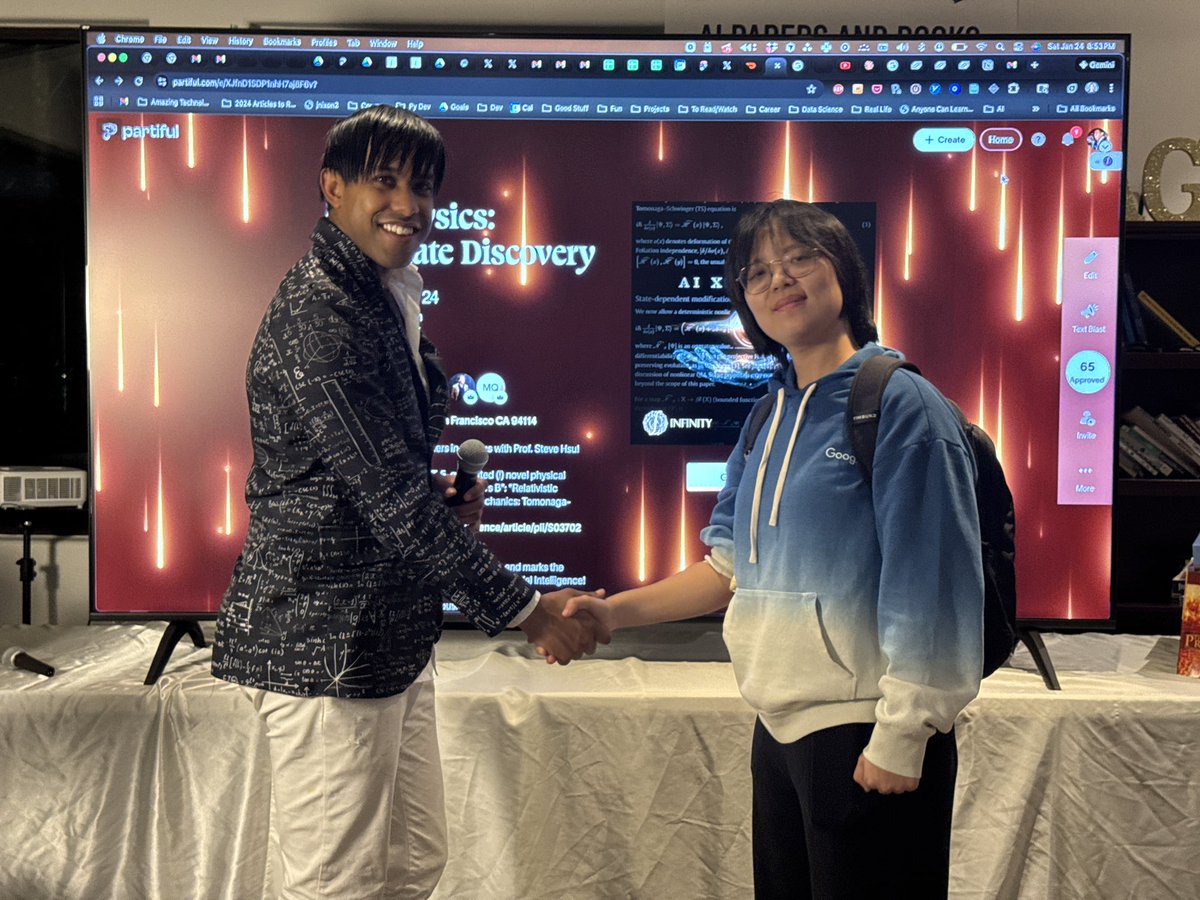
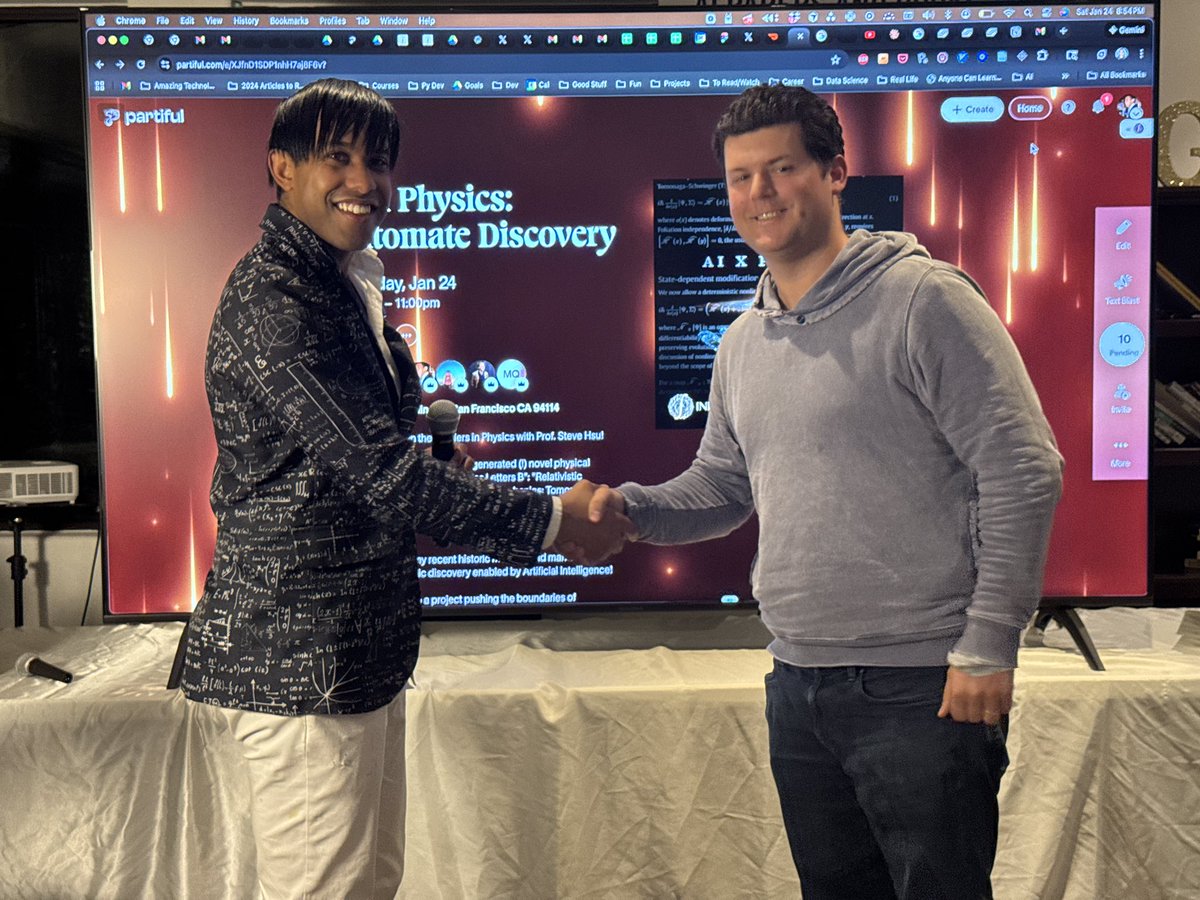
Live from the AI X Physics Event: "There is non-trivial work in this paper" - @hsu_steve on his work.
In his paper, GPT autonomously generated a modification of quantum field theory that preserves key locality/causality constraints.
He received criticism, but fights back.
Our winners tonight:
🥇Jehan Azad (atvbt DOT com) and Anya @quantumanya were awarded 1st prize for Super Heavy Element Nucleosynthesis in Fusion Reactors
🥈Dom @domsteil was awarded 2nd prize for Gravity Research AI Network
🥉Klu Karen awaarded 3rd prize for Physics Sentinel
Our fifth event in five days - together with
@yamstudio_ai, we're bringing together creative founders valuing taste & fast execution to pre-launch their new vibe-design partner YAM.
@shanzzh1@BingqingShan@CosimaQin@juliusyritter@JvNixon
Our friends at @AGIHouseSF are hosting a thought-provoking Salon Night — curated convos at the edge of AI, ethics, and invention.
If you're building or investing in the future, this is where you want to be.
🔗 https://t.co/XmNknMxYFz
#AGIHouse#AIcommunity@Principal_VC #SalonSeries
Silicon Valley's most iconic AI community is back.
Join us for AI Founder Night @ AGI House — where the next generation of founders and builders gather.
RSVP early — this fills fast.
🔗 https://t.co/nYqvti4wIn
#AI#Founders#AGIHouse@Principal_VC