@mcuban@chamath RL Finetuning market is massively undervalued.
https://t.co/qvLGxue1qq
We open-sourced our RL framework for multi-turn conversational AI Agents
We applied the autoresearch optimization loop to the StateSet STARK proving system, a Winterfell-based prover for zero-knowledge commerce compliance proofs. Over 5 rounds and 30+ experiments, implementation changes (trace length reduction, constant precomputation) reduced prove time from 37ms to 13.4ms at the original ~128-bit conjectured security level — a 2.8x speedup with no security trade-off. A further parameter relaxation to 80-bit conjectured security yielded 6.3ms prove time and 42KB proofs (5.9x total speedup, 44% proof size reduction).
https://t.co/Ix7JzDhDIU
https://t.co/fmD3oVi91y
On the decentralized autoresearch network. Starks can verify the metric is improving eg the loss is better. Agent generates a stark proof for every autoresearch commit, multiple autoresearch agents running in parallel optimizing code, verifying the loss is better without having to check and test the code changes.
https://t.co/8L1BvXOi7w
The StateSet Blind Auction Protocol is a zero-knowledge procurement infrastructure designed specifically for agentic commerce.
It allows automated agents to participate in trustless, sealed-bid auctions using cryptographic proofs to guarantee fairness, privacy, and fast settlement.
Here is an overview of how the protocol works and its core features:
1. The Auction Mechanism (Vickrey Auctions)
By default, the protocol uses Vickrey (second-price) auctions. In this type of auction, all bids are sealed so no one knows what anyone else is bidding. The highest bidder wins the auction, but they only have to pay the amount of the second-highest bid. This mechanism mathematically incentivizes agents to simply bid their true maximum value, eliminating the need to strategize or "shade" their bids.
2. Privacy via STARK Proofs
To ensure the auction is truly "blind" and trustless, the protocol uses Zero-Knowledge STARK proofs (utilizing the Winterfell prover). When an agent submits a bid, they don't submit the plaintext amount. Instead, they submit a cryptographic proof (~95KB) that validates their bid is legitimate without revealing the actual amount or leaking real-time bid counts to competitors.
3. The Workflow
The lifecycle of an auction on the protocol looks like this:
* Creation: A supplier creates a lot (e.g., "500 Industrial Sensors") and sets a reserve price, mechanism, and escrow ratio.
* Bidding: Autonomous agents submit their sealed bids. Each bid generates a STARK proof in about 45 milliseconds.
* Close & Reveal: The supplier closes the auction. A "ZK ordering proof" is generated to mathematically verify that the bids were sorted correctly without tampering.
* Settlement: The highest bidder wins but pays the second-highest price. Settlement happens in USDC via x402 payment intents on a layer-2 network with rapid 2-second finality.
4. Capital Efficiency & Escrow
Usually, decentralized auctions require bidders to lock up 100% of their bid amount in escrow, which is highly capital inefficient. This protocol only requires a 10-20% collateralization ratio. It uses ZK solvency proofs to verify that agents have the funds to cover their bids across multiple concurrent auctions without needing to lock up the full amount everywhere. Agents also must stake a minimum of $1,000 to register, which can be slashed (penalized) if they misbehave.
5. Built for AI Agents
The entire protocol is structured to be "agent-native." It includes an MCP server, OpenAPI 3.0 specifications, webhooks, Server-Sent Events (SSE) streams, and a TypeScript SDK.
This makes it incredibly easy to plug the protocol directly into AI agents so they can autonomously negotiate and procure goods on behalf of human users or companies.
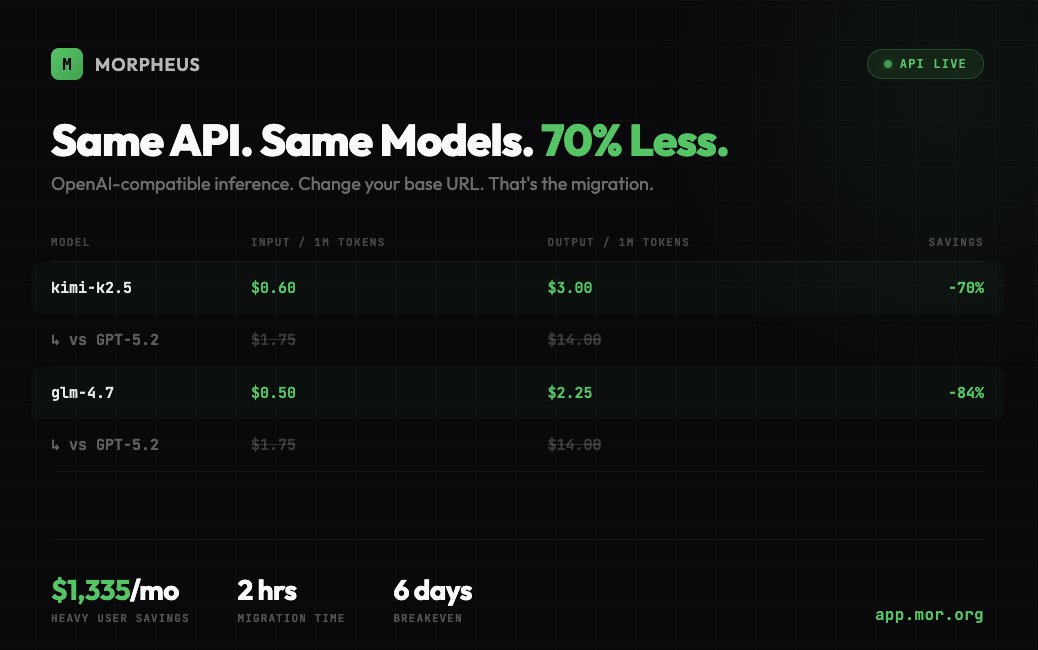
The Morpheus Inference API is live.
Same API as OpenAI. 70% cheaper. No content filters. No vendor lock-in.
Change your base URL. Your code works. Heavy users save >$1,335/month.
AI that no one controls.
open source cli for dtc operators:
https://t.co/YMXtkf0Tyq
claude code for intelligent commerce
Just added new read/write actions across shopify, recharge, klaviyo, stay, skio, amazon, recharge and more.
I find my workflow to be multiple terminals open, review this codebase and grade it, right a technical whitepaper on it, have two agents review the paper and provide feedback, create and implement our next sprint based on the feedback, bump the version, tag it and push it, build and deploy on k8s using kubectl