.@SerConnorr, CEO of @HotHeadsNFT, is joining us at Solana Summit Serbia.
A Solana OG, investor, trader, and self-described good vibe maxi, Connor has spent years actively contributing to NFT communities on Solana and growing right alongside them.
Aug 26-27, Belgrade, Sava Centar.
Builder, operator and investor @KyleHParrish has joined Craft Ventures.
Kyle is the kind of person that makes everyone around him better. We are thrilled to officially welcome him to the Craft team!
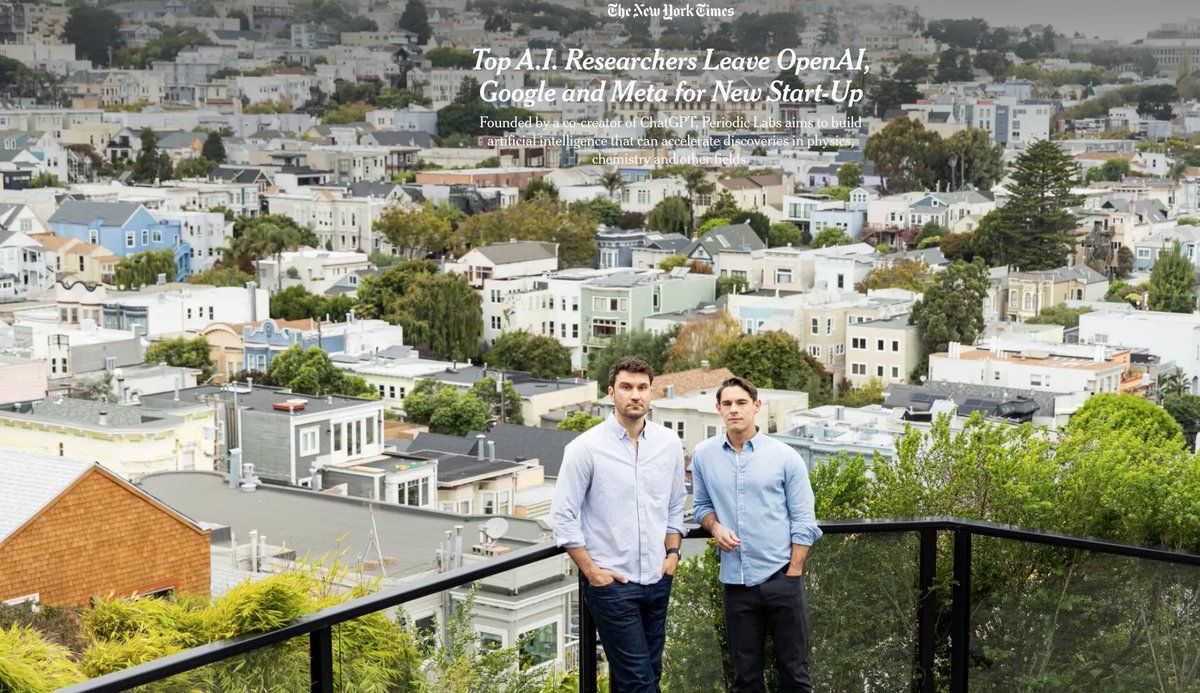
Today, @ekindogus and I are excited to introduce @periodiclabs.
Our goal is to create an AI scientist.
Science works by conjecturing how the world might be, running experiments, and learning from the results.
Intelligence is necessary, but not sufficient. New knowledge is created when ideas are found to be consistent with reality. And so, at Periodic, we are building AI scientists and the autonomous laboratories for them to operate.
Until now, scientific AI advances have come from models trained on the internet. But despite its vastness — it’s still finite (estimates are ~10T text tokens where one English word may be 1-2 tokens). And in recent years the best frontier AI models have fully exhausted it.
Researchers seek better use of this data, but as any scientist knows: though re-reading a textbook may give new insights, they eventually need to try their idea to see if it holds.
Autonomous labs are central to our strategy. They provide huge amounts of high-quality data (each experiment can produce GBs of data!) that exists nowhere else. They generate valuable negative results which are seldom published. But most importantly, they give our AI scientists the tools to act.
We’re starting in the physical sciences.
Technological progress is limited by our ability to design the physical world.
We’re starting here because experiments have high signal-to-noise and are (relatively) fast, physical simulations effectively model many systems, but more broadly, physics is a verifiable environment. AI has progressed fastest in domains with data and verifiable results - for example, in math and code. Here, nature is the RL environment.
One of our goals is to discover superconductors that work at higher temperatures than today's materials. Significant advances could help us create next-generation transportation and build power grids with minimal losses. But this is just one example — if we can automate materials design, we have the potential to accelerate Moore’s Law, space travel, and nuclear fusion.
We’re also working to deploy our solutions with industry. As an example, we're helping a semiconductor manufacturer that is facing issues with heat dissipation on their chips. We’re training custom agents for their engineers and researchers to make sense of their experimental data in order to iterate faster.
Our founding team co-created ChatGPT, DeepMind’s GNoME, OpenAI’s Operator (now Agent), the neural attention mechanism, MatterGen; have scaled autonomous physics labs; and have contributed to some of the most important materials discoveries of the last decade. We’ve come together to scale up and reimagine how science is done.
We’re fortunate to be backed by investors who share our vision, including @a16z who led our $300M round, as well as @Felicis, DST Global, NVentures (NVIDIA’s venture capital arm), @Accel and individuals including @JeffBezos , @eladgil , @ericschmidt, and @JeffDean. Their support will help us grow our team, scale our labs, and develop the first generation of AI scientists.
One of the most ambitious visions for AI I've seen. The future belongs to systems that don't just generate knowledge... but discover it. Excited to follow the journey❤
Today, @ekindogus and I are excited to introduce @periodiclabs.
Our goal is to create an AI scientist.
Science works by conjecturing how the world might be, running experiments, and learning from the results.
Intelligence is necessary, but not sufficient. New knowledge is created when ideas are found to be consistent with reality. And so, at Periodic, we are building AI scientists and the autonomous laboratories for them to operate.
Until now, scientific AI advances have come from models trained on the internet. But despite its vastness — it’s still finite (estimates are ~10T text tokens where one English word may be 1-2 tokens). And in recent years the best frontier AI models have fully exhausted it.
Researchers seek better use of this data, but as any scientist knows: though re-reading a textbook may give new insights, they eventually need to try their idea to see if it holds.
Autonomous labs are central to our strategy. They provide huge amounts of high-quality data (each experiment can produce GBs of data!) that exists nowhere else. They generate valuable negative results which are seldom published. But most importantly, they give our AI scientists the tools to act.
We’re starting in the physical sciences.
Technological progress is limited by our ability to design the physical world.
We’re starting here because experiments have high signal-to-noise and are (relatively) fast, physical simulations effectively model many systems, but more broadly, physics is a verifiable environment. AI has progressed fastest in domains with data and verifiable results - for example, in math and code. Here, nature is the RL environment.
One of our goals is to discover superconductors that work at higher temperatures than today's materials. Significant advances could help us create next-generation transportation and build power grids with minimal losses. But this is just one example — if we can automate materials design, we have the potential to accelerate Moore’s Law, space travel, and nuclear fusion.
We’re also working to deploy our solutions with industry. As an example, we're helping a semiconductor manufacturer that is facing issues with heat dissipation on their chips. We’re training custom agents for their engineers and researchers to make sense of their experimental data in order to iterate faster.
Our founding team co-created ChatGPT, DeepMind’s GNoME, OpenAI’s Operator (now Agent), the neural attention mechanism, MatterGen; have scaled autonomous physics labs; and have contributed to some of the most important materials discoveries of the last decade. We’ve come together to scale up and reimagine how science is done.
We’re fortunate to be backed by investors who share our vision, including @a16z who led our $300M round, as well as @Felicis, DST Global, NVentures (NVIDIA’s venture capital arm), @Accel and individuals including @JeffBezos , @eladgil , @ericschmidt, and @JeffDean. Their support will help us grow our team, scale our labs, and develop the first generation of AI scientists.
https://t.co/UhbJex20GX is turning into launchpad where memecoins are more then ''just'' memes
build your brand, IP, movement, narrative with full support thru milestone rewards powered by https://t.co/UhbJex20GX and partners
the-open-network:native season, sooner or later and we will be ready with our memes
Regulation is accelerating. Institutions are paying attention. But is DeFi's risk infrastructure ready?
Join Firelight and @nativeinsurance to discuss evolving onchain risks and how the Firelight Risk Consortium is setting a new standard for DeFi protection.
🎙️ 2 July, 3PM CET.
https://t.co/CTkNS5qlEI
We're rolling out Brain: a self-improving context-graph of all your sessions, connectors, and files.
Brain updates itself overnight with fresh context proactively, and feeds itself to every task on Computer, allowing Computer to be stateful and self-improving.
Available to all Perplexity Max subscribers.
Today I'm publishing a new essay, Policy on the AI Exponential. AI is progressing extremely fast—much faster than the policy process was built to handle. The essay lays out where I think the technology is now, and the action needed to close the gap: https://t.co/Lh6PWae178
AI and writing are like AI and driving: most people suck at it and it's better for everyone if AI does it.
But...Formula 1 drivers exist, and nobody would pay good money to watch autonomous vehicles drive themselves around a track (assuming they got good enough).
People will read human writing as the premium version of an otherwise commodity activity, precisely because they want to watch the world-class public thinkers (which is what writing basically is) go at it at 240 MPH around a public track (i.e. this app right here).
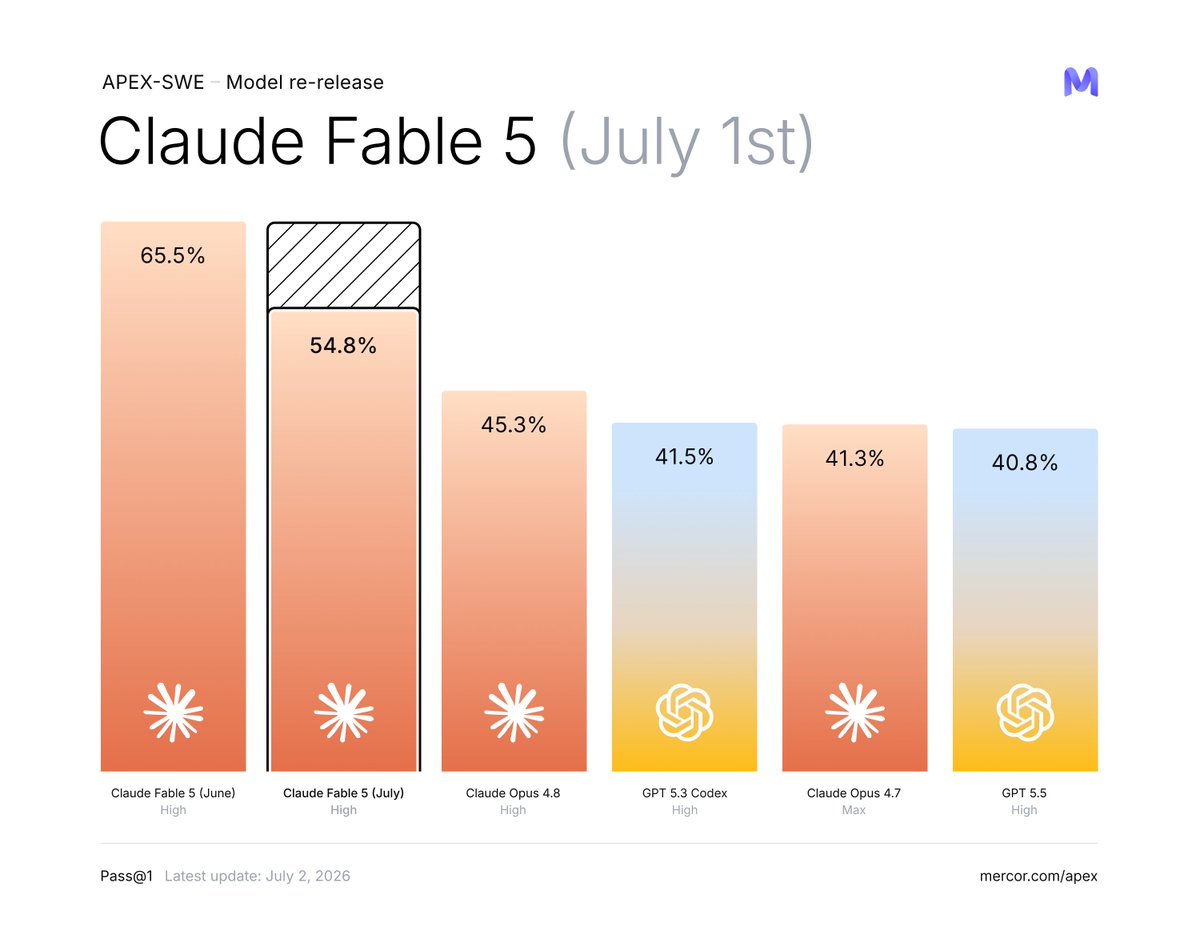
Fable 5 is back and we’ve got results for the re-released version on APEX-SWE.
While it did not perform as well as its earlier version from June, the model still significantly outperforms Opus 4.8.
Fable 5 (June): 65.5% Pass@1
Fable 5 (July): 54.8% Pass@1
Opus 4.8: 45.3% Pass@1
This re-release scored about 10 points below the original Fable 5, however it still beat Opus 4.8 by more than 9 points.
TL;DR ELI5 of @trq212's new article: Claude isn't the bottleneck anymore. The stuff you forgot to tell it is.
Your prompt is a map. The codebase is the actual road. Every pothole you didn't mention, Claude fills with its best guess, and the more work you hand it, the more it has to guess. The skill of agentic coding is shrinking that gap.
🗺️ Your unknowns come in four flavors: what you said, what you know you haven't decided, what's so obvious you never wrote it down, and what you never considered at all
🔦 Starting unfamiliar work? Do a blindspot pass: literally ask Claude to find your unknown unknowns and teach you to prompt better
🎨 Know it when you see it? Prototype first. 4 wildly different HTML mockups is cheaper than one wired-up wrong guess
🎤 Let Claude interview you, one question at a time, starting with answers that would change the architecture
📁 Can't describe what you want? Point at a reference. Source code beats screenshots, even in another language
📋 Ask for a plan that leads with what you're most likely to change: data models, interfaces, UX
📝 During the build: an implementation-notes.md that logs every deviation from the plan
🧪 After: make Claude quiz you on the change. Only merge when you pass
Every brainstorm, interview, prototype, and reference is a cheap way to find out what you didn't know before it gets expensive to fix.
The @Figma connector in https://t.co/ebVFrK1rwj and Grok Build is here
Turn your designs into code or diagram your codebase in FigJam
https://t.co/lDqVN3vEFg
I’m joining @SpaceX and @xai with @JasonBud.
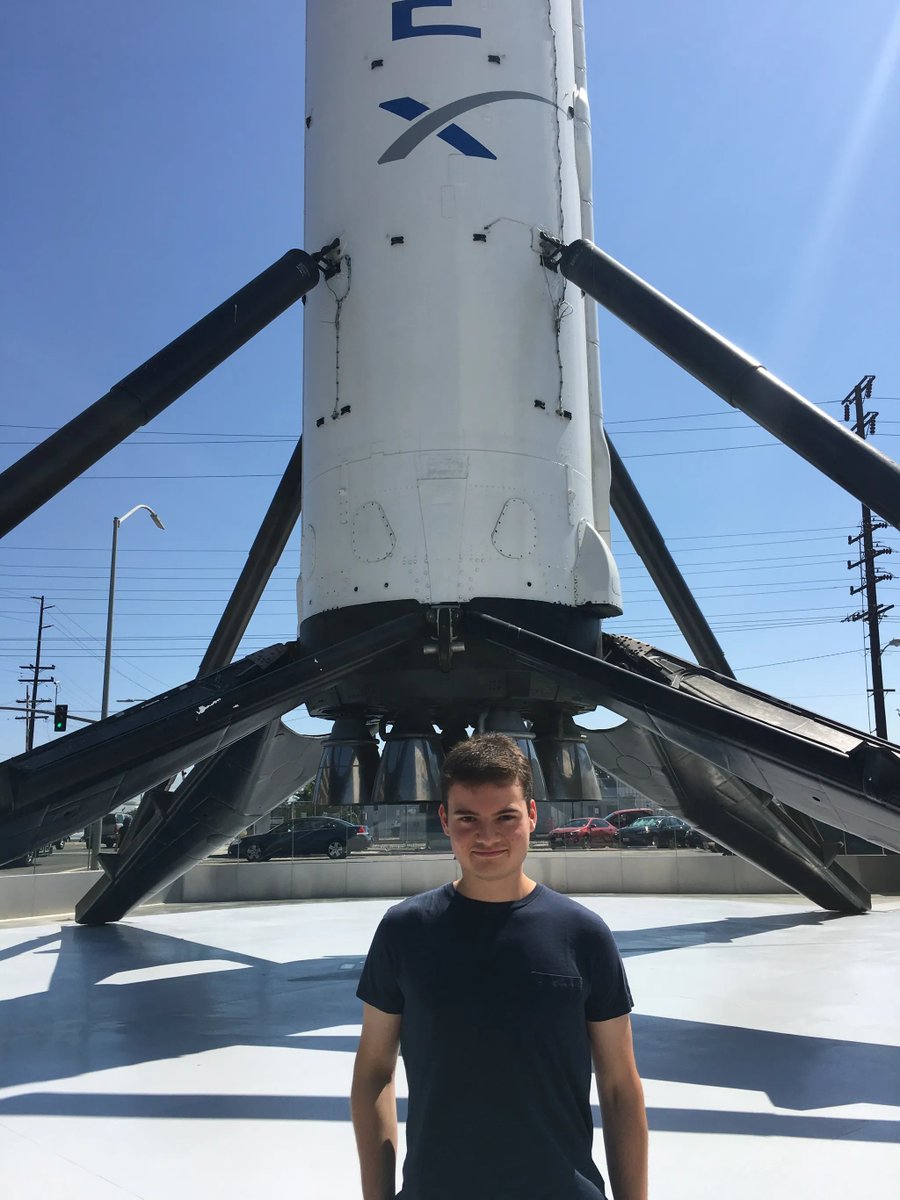
X is the company realizing science fiction - reusable rockets, humanoid robots, data centers in space, and more. Almost 10 years ago, I joined SpaceX as an intern on Dragon 2 crew displays. This was in the era of the first rocket landings on barges, long before the Dragon 2 restored human spaceflight to America or Starlink delivered internet from space.
Every day since then, I’ve thought about the next steps to land on the Moon - and to build a city on Mars, data centers in space, the brains behind robots, and beyond. There is no better place to build teams and products from the ground up with planetary scale resources.
If you’re looking to work on the hardest problems that lay a foundation for humanity’s future to the Moon, Mars, and beyond - DM me.