@C_Harwick What are your favorite works on non-Walrasian economics? I recall you have recommended Complexity and the Economy, which kind of goes in that direction.
Do you have other works you would recommend reading on the topic?
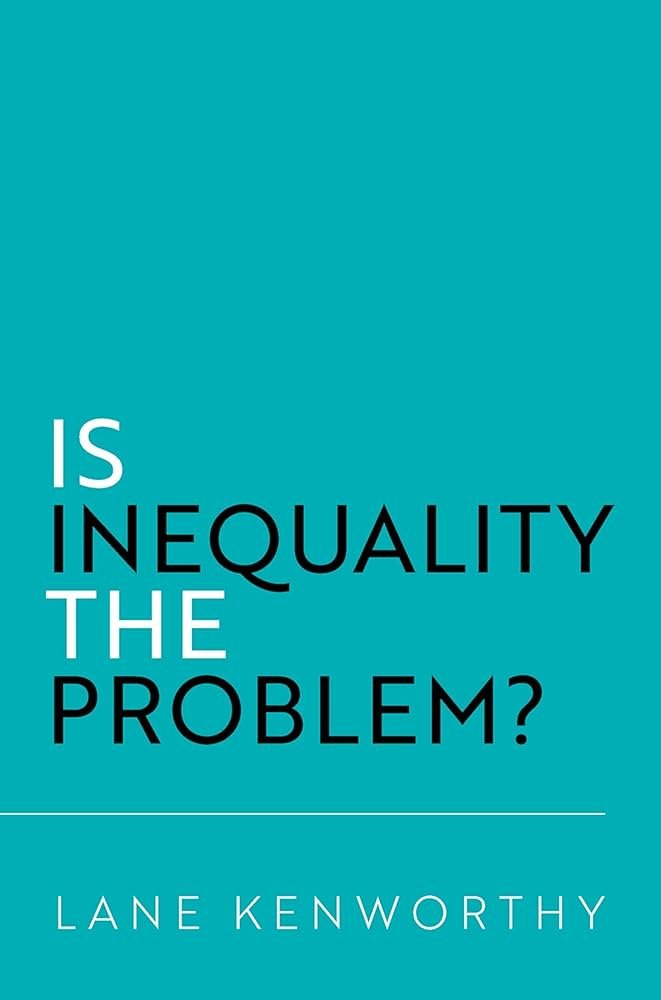
@quant_____ Perhaps "Is Inequality the Problem" by Lane Kenworthy. He argues that the impacts of inequality aren't well-grounded empirically but supports redistributionary policies for poverty-alleviating reasons.
Vincent Geloso post:
https://t.co/6fb1i4W6Hy
https://t.co/P15GgMfGR1
Finished reading this over the weekend. Decent book, worth buying and keeping.
Lane Kenworthy’s Is Inequality a Problem? leaves the reader with a fairly simple conclusion: many of the commonly asserted links between inequality and social outcomes (e.g., life expectancy, health inequality, trust, democratic institutions) rest on weak empirical foundations or, when the foundations are stronger (e.g., democracy) it is not clear whether one can say that "increasing inequality" in the last decades (debatable to a certain degree if you buy Auten and Splinter's work) explains much of people want it to explain even if there is a kernel of truth (e.g., the wealthy have more voice, its not clear if they really got more of it in the last decades).
In other words, the case that inequality broadly undermines society is much less substantiated than is often claimed. This is somewhat surprising coming from Kenworthy, who is clearly situated on the social democratic left.
In a way, however, that is precisely what makes the book compelling. Rather than relying on overstated or weak auxiliary arguments, Kenworthy narrows the case for redistribution to its strongest form: improving the condition of the poor and expanding their opportunities.
There is no attempt to “fluff” the argument with questionable claims (I think of the recent work of Julia Cagé which is interesting but ultimately unconvincing against the general pattern and probably offers no case for the cure and its promises) about wide-ranging social harms. Instead, the book suggests that if one supports redistribution, it should be on those direct grounds alone.
Whether one ultimately agrees or not, this is the most intellectually serious version of the case for redistribution. It also the hardest to engage with, precisely because it forces one to confront trade-offs and alternatives more carefully. In that sense, the book is refreshingly honest. A very decent read.
@tacitdimension What type of progressive consumption tax do you favor? The Kaldor inspired Personal Expenditure Tax or progressive tax rabates, or something else?
@StealthTax More quotes:
> Further, I would claim that, as developed by Hayek, there are many aspects of it that are non-Austrian.
> I don’t believe that to be an Austrian you have to buy into the Hayekian view of business cycles.
@StealthTax Kirzner has commented on the relation of Austrian thought and the business cycle theory:
> No, I’ve never had too much interest in the Austrian business cycle theory. I’ve never felt that the Hayekian business cycle theory was essentially Austrian.
https://t.co/qVl67390Vn
@DerHuhn1@actsmaniac It should be untaxed because capital gains taxes are quite inefficient and taxation should switch towards consumption, rather than (capital) income. These taxes disincentivize long-term savings, which is precisely what is tried to be incentivized.
I agree with the second point.
@amengden@actsmaniac I believe capital gains taxes to be quite inefficient but have to admit that, given the current tax code, having the capital income later be tax free is technically a subsidy.
I would prefer the tax system to switch towards consumption and have the capital gains be tax-free.
@actsmaniac Though, perhaps, the latter might not be the goal, given that it is politically useful to have a large portion of the population reliant on you.
That's kinda how the SPD manages to stay alive, with pensioners being (in all but name) bribed for votes.
@actsmaniac This is a step in the right direction but completely insufficient.
Only 1800€/year tax deductible and you still pay income tax for the payouts.
This is not close to being sufficient for a majority of people to be able and/or willing to take retirement into their own hands.