Oxford Railway Station should be an iconic example of British Gothic, a combination of Hogwarts, St Pancras and Lincoln Cathedral. It should be the most pictured place on Chinese social media, a place where people from far off lands come to propose https://t.co/2sqXgnaUuC
@reiseholic Der integrierte Steuersatz auf ausgeschüttete Unternehmensgewinne liegt in Deutschland bei durchschnittlich 48,5%. Das wäre von der Einkommensform noch am ehesten mit Arbeitseinkommen vergleichbar.
@Solipson@schnellenbachj@BerlinReporter Nope, derzeit rund 30%, mit etwas Variation. Auf 25% kämen wir nach den Plänen der Bundesregierung erst schrittweise in den Jahren 2028-32. https://t.co/F29sLLqkxu
Today I am posting Lecture 2 of my course on Geoeconomics at Oxford. It covers the history of the field and its open areas of research:
https://t.co/FPX74i0iEb
Since I am fond of the history of thought, I spent perhaps too many slides on it. But I have been reading about geoeconomics and grand strategy since high school. My love affair with the field began when I read Paul Kennedy’s The Rise and Fall of the Great Powers: Economic Change and Military Conflict from 1500 to 2000 in my junior year, and later, a book by two Spanish admirals that summarized the ideas of Alfred Mahan and Halford Mackinder. So I felt I could indulge myself.
I also treat the German-language tradition in detail, since it is less familiar to English-speaking readers. Carl Schmitt, for instance, has gained prominence lately, whatever one thinks of him.
One thing the slides leave out: in class, I spent a good deal of time outlining ideas for new papers. This is a growing field, and young researchers have ample scope to make substantial contributions. But those ideas, really suggestions, are harder to put on slides.
"Removing existing [building] height constraints would increase average worker welfare by 7.0% in developed economies," while reducing the physical footprint of cities.
Good synopsis on the pathbreaking work of @Ahlfeldt, Baum-Snow and Jedweb on economics of skyscrapers ⤵️.
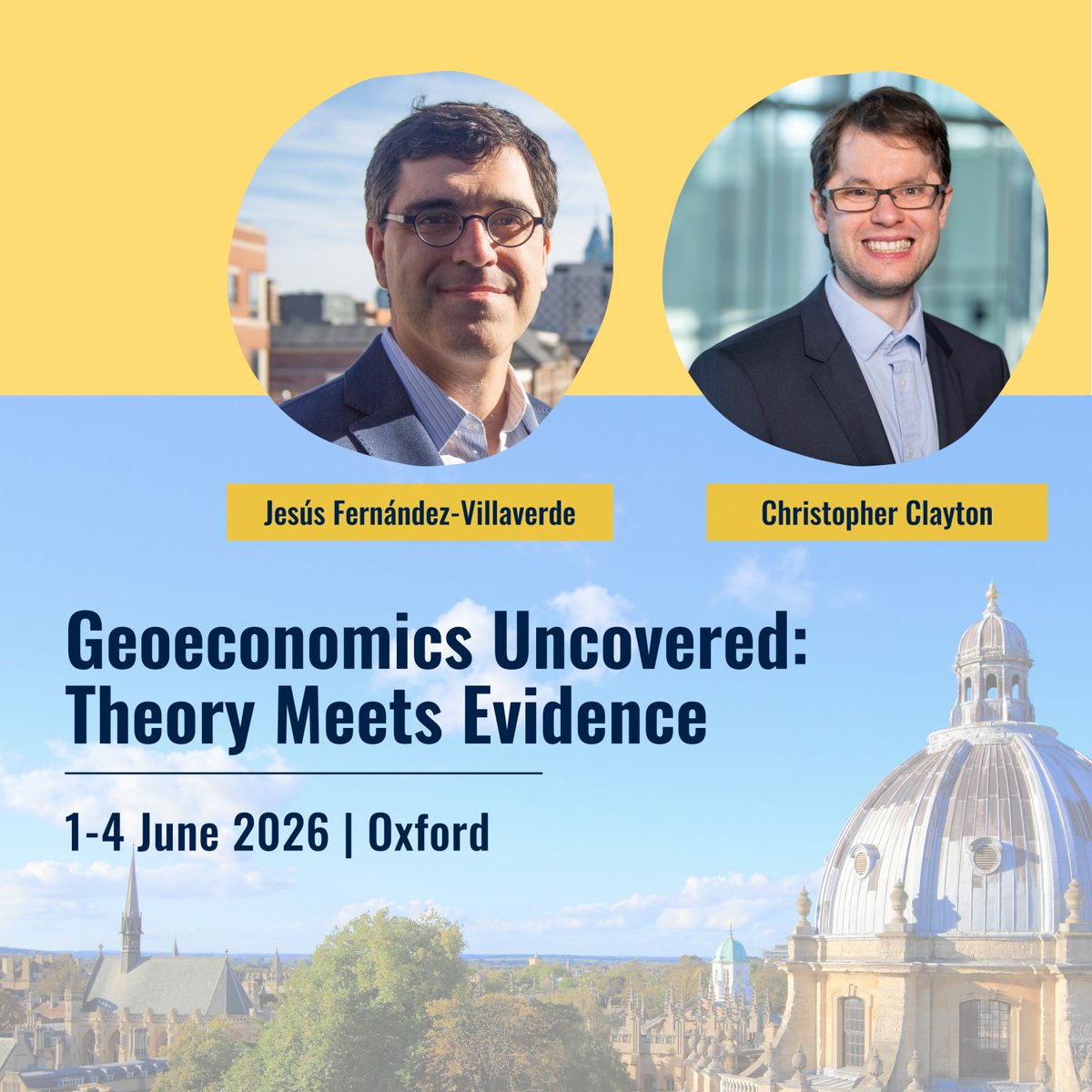
I’m excited to share that applications for the summer course “Geoeconomics Uncovered: Theory Meets Evidence,” which @chris_d_clayton and I will teach at the University of Oxford from June 1-4, 2026, are now open:
https://t.co/atlGGYGVyo
@FZanettiOxford will be the academic curator.
As the official description of the course says:
“Combining theory and empirics, the course blends conceptual lectures with applied sessions. Students will develop the tools to model geoeconomic tensions, interpret real-world data, and assess the policy implications of geopolitical shifts - ultimately engaging with the frontier of contemporary research in this rapidly evolving domain.”
The course can be fun, and Oxford is lovely in early June.
@BenRamanauskas If they must absolutely be used as some are already, still better to contract them out to a company like Sanifair to transform them into nice and proper pay toilets


![CSElmendorf's tweet photo. "Removing existing [building] height constraints would increase average worker welfare by 7.0% in developed economies," while reducing the physical footprint of cities.
Good synopsis on the pathbreaking work of @Ahlfeldt, Baum-Snow and Jedweb on economics of skyscrapers ⤵️. https://t.co/uyyljuqy0A](https://pbs.twimg.com/media/HJpy3kGboAALqH6.jpg)








![CSElmendorf's tweet photo. "Removing existing [building] height constraints would increase average worker welfare by 7.0% in developed economies," while reducing the physical footprint of cities.
Good synopsis on the pathbreaking work of @Ahlfeldt, Baum-Snow and Jedweb on economics of skyscrapers ⤵️. https://t.co/uyyljuqy0A](https://pbs.twimg.com/media/HJpzbalacAAEQAg.jpg)