For World Suicide Prevention Day (Sept 10), I'm walking 63km in Out of the Shadows to support Lifeline's suicide prevention services and help Australians in crisis. Please donate now and support my walk to change lives. https://t.co/vjHWqRvp60
Horizon 1: delivered.
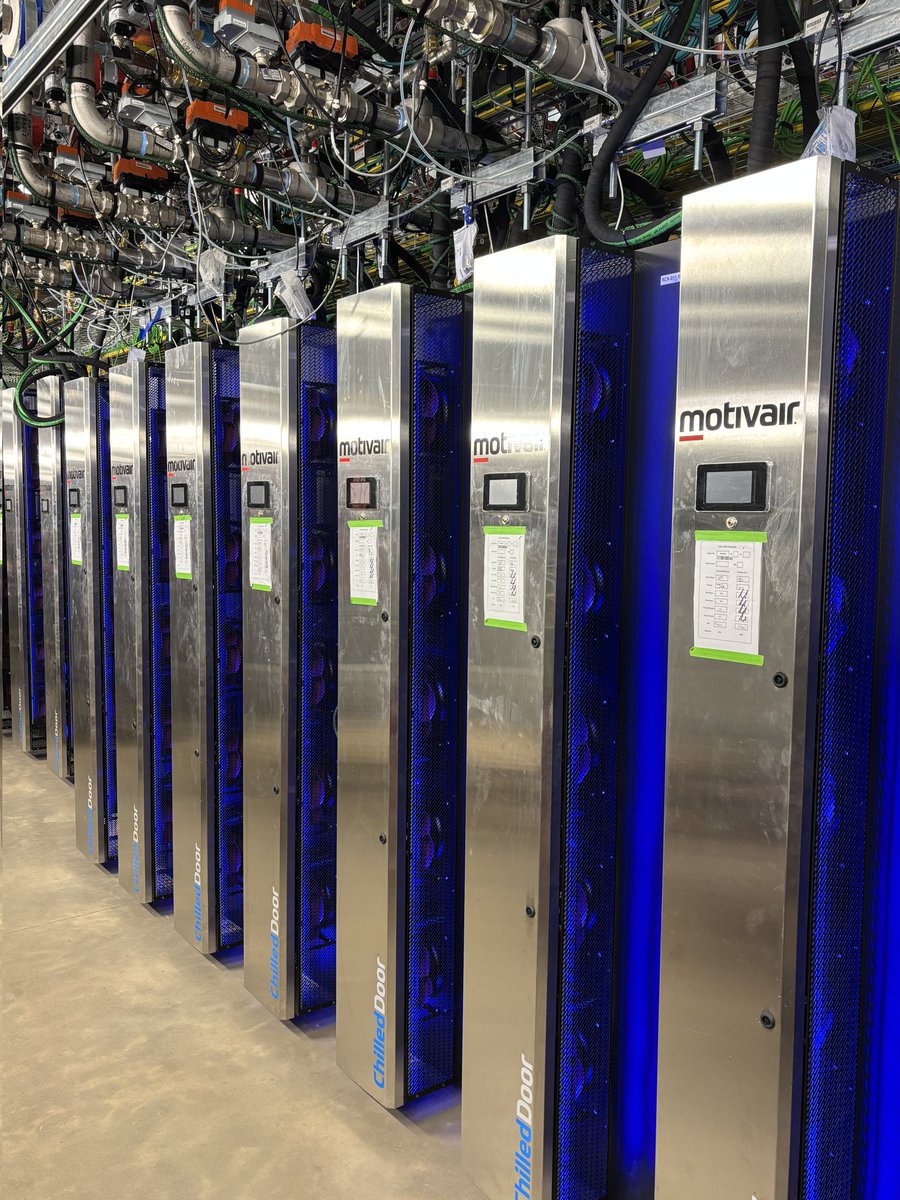
IREN has delivered Horizon 1 to Microsoft and achieved NVIDIA Exemplar Cloud status on NVIDIA GB300 NVL72.
Read more: https://t.co/ItVXSXK1V7
IREN is arguably one of the cleanest fits in the entire ecosystem — vertically integrated, energized power (now moat-protected by the Texas pause), DSX flagship, NVIDIA warrant already in place. This is a strong positive for IREN.
Sweetwater 1 is moving fast! Just five days ago @FransBakker9812 post satellite images of cranes on the ground setting up for the big build.
Today I had a chance to swing by SW1 on my way to Abilene, TX. A little over two weeks ago there was nothing erect on the west side of the road across from the substation. Now we have two structures going up and increased construction activity over the span of many acres. See the video and photos below.
I'll post periodically on SW1 and and SW2 as things develop. I may have a chance to go by Childress in mid August and will post pics and vids for you all. Follow so you get the latest on site visuals!
Long $IREN
How the New Executive Team Strengthens $IREN's Commercial Positioning
At this stage of its development, I think it is finally possible to define IREN's business model and operational boundaries more clearly. This is extremely important. The founders and core leadership of IREN truly reflect the training of Europe's top business schools. Many of the company's decisions demonstrate a deep understanding of the critical factors behind long-term corporate success. That matters enormously because it ultimately determines whether a company deserves to remain a long-term investment.
Among the outstanding companies I have studied, one common characteristic stands out: clearly defining strategic boundaries and then relentlessly deepening them. The most important thing is to focus resources on strengthening existing advantages, building a competitive moat from the very beginning, and ensuring that every subsequent decision further reinforces that moat.
IREN's real strategy is to become the ultimate neutral AI infrastructure provider. Its goal is to build an operating model that is independent of any particular AI model. Whether the eventual winners are Claude, GPT, Gemini, Kimi, Llama, or future open-source models that have yet to emerge, IREN always provides the same core capabilities: power, liquid cooling, GPU racks, networking, data center operations, orchestration, and secure isolation.
IREN is monetizing the efficiency created by the combination of this hardware and software infrastructure—not Token Revenue. It serves every model developer. Its mission is to maximize the efficiency of token production regardless of whose model generates those tokens. From my perspective, this is the core of IREN's commercial positioning.
Its partnership with NVIDIA to build the DSX ecosystem further demonstrates that IREN has chosen not to align itself with any specific model developer. Sweetwater being selected as NVIDIA's flagship DSX deployment is itself a powerful signal. DSX is not a platform for any single model; it is NVIDIA's definition of the next-generation AI Factory standard.
Within this ecosystem, NVIDIA provides the architecture, IREN operates the physical infrastructure, Mirantis delivers the open orchestration layer, and customers run their own models on top of the platform.
At no point does this architecture require IREN to own its own AI model. In fact, remaining neutral becomes its greatest competitive advantage and differentiator. No model developer wants to deploy its most valuable models on a platform that also competes directly with it in the Token business. That is true for Anthropic, OpenAI, and it will also be true for future companies such as Moonshot, DeepSeek, Kimi, and others. DSX strengthens the strategic boundary IREN has established—it does not blur it.
The acquisition of Mirantis was never about acquiring model capabilities. Instead, it was about improving hardware utilization and workload isolation. Many people immediately associate Mirantis with OpenStack or Kubernetes, but the truly important point is that it gives IREN a complete open orchestration capability. GPU resources are no longer tied to a single model; Kubernetes, OpenStack, and k0rdent can orchestrate heterogeneous GPU clusters through one unified control layer, ultimately creating a genuinely model-agnostic AI infrastructure.
Claude can run on it. GPT can run on it. Llama can run on it. Kimi can run on it.
IREN does not need to care which model wins. Its job is simply to maximize GPU utilization and optimize infrastructure efficiency.
Events like today's release of the open-source K3 model are actually positive for IREN. K3 reinforces the idea that the future will not be dominated by just two or three closed-source models. Instead, the model layer is likely to become increasingly diverse, fragmented, and open.
As a result, more enterprises will choose not to depend entirely on Azure, AWS, or Google Cloud. Instead, they will need neutral infrastructure capable of hosting many different models. Third-party GPU operators, enterprise private clouds, sovereign regional clouds, and independent AI data centers will all become important sources of demand.
The real beneficiary is not any single model. The more models that exist, the greater the need for neutral infrastructure. Therefore, K3 is not fundamentally bullish because it is open source—it is bullish because it reinforces the need for Model-Agnostic Infrastructure, which has been IREN's direction from the very beginning.
NVIDIA's philosophy has always been to "sell shovels to every gold miner." Every future model company is a potential customer.
IREN occupies exactly the same position.
The flagship DSX AI Factory that NVIDIA and IREN are building together is designed specifically for this long-term industry trend.
Over the past month, three senior executives have joined IREN. Their appointments have attracted considerable attention. They left globally recognized companies to join a startup valued at roughly $10 billion because they saw something unique that few other companies can offer—a distinctive operating environment and capabilities that are difficult to replicate.
What roles will they actually play?
Based on the positioning outlined above, each of these executives strengthens the same overarching narrative. Together, they make IREN's neutrality not just a marketing message, but a verifiable engineering capability.
Here is how I interpret their roles.
The first is Kambiz Aghili, formerly of Oracle OCI.
His most valuable experience comes from Oracle's Dedicated Region business—building cloud environments that give customers an experience nearly identical to owning their own data center while still preserving the advantages of a cloud platform.
Within IREN, this translates into turning GPU infrastructure into a true enterprise product. The company is no longer simply selling GPUs—it is selling Enterprise AI Infrastructure.
The second is Michael Nudelman, formerly with Google and CyrusOne.
He represents hyperscale data center development and execution.
His value lies in standardizing and rapidly replicating large-scale AI infrastructure, enabling campuses such as Sweetwater, Horizon, and future AI Factories to be deployed faster and more consistently.
The third is Eric Hammersley, formerly with Nutanix and NVIDIA HPC Security.
His greatest contribution is not his government background, but his expertise in security.
In the future, IREN may simultaneously serve Anthropic, OpenAI, Microsoft, NVIDIA, and many other competing AI companies. Every customer must have confidence that its model weights, proprietary data, and inference workloads cannot leak to any other tenant.
That requires verifiable physical isolation, network isolation, security auditing, and compliance systems.
Eric Hammersley completes the final missing piece of a neutral infrastructure platform.
Together, these three executives transform neutrality into an actual product.
Many companies claim to be neutral.
Customers, however, do not buy promises.
They buy systems that are verifiable, auditable, and certifiable.
Together, the three executives form a complete operating loop:
Kambiz Aghili defines the product.
Michael Nudelman delivers the engineering execution.
Eric Hammersley secures the trust boundary.
Collectively, they solve the challenge of transforming "neutral infrastructure" from a business slogan into a platform that customers can purchase, trust, and deploy over the long term.
This is a critical step toward differentiating IREN's business model.
It is also where future pricing power will originate.
Viewed through this framework, Enterprise Sovereign AI deserves more attention than Government Sovereign AI.
There has been considerable discussion about whether IREN will eventually support U.S. government AI initiatives.
At present, however, the publicly available evidence does not support that conclusion.
There is no FedRAMP authorization, no IL5 certification, no federal contract, and no government procurement announcement.
The more reasonable conclusion is that government AI remains a long-term strategic option rather than an existing business.
What already exists today—and represents a significantly larger addressable market—is the Enterprise Sovereign Cloud.
Financial institutions, healthcare providers, energy companies, and large enterprises increasingly require dedicated GPUs, dedicated networks, dedicated data environments, and dedicated security.
This market does not depend on government procurement cycles and aligns far more closely with IREN's current organizational structure, executive hires, and product roadmap.
Against the backdrop of building a neutral AI infrastructure platform, the addition of liquid-cooling expert John Gross earlier this year takes on much deeper strategic significance.
Most likely, IREN intends to make liquid cooling and high-density rack infrastructure into rapidly deployable foundational capabilities. Regardless of how the external landscape evolves, the company aims to remain hardware-agnostic.
In the future, even NVIDIA itself will inevitably face increasing competition from alternative hardware vendors.
A neutral infrastructure platform with robust isolation capabilities, however, can remain relevant for twenty or even thirty years.
This is entirely consistent with IREN's long-standing management philosophy: every capability that determines long-term competitiveness should, whenever possible, be owned internally.
Liquid cooling is therefore not viewed as an outsourced engineering service. Instead, by recruiting industry-leading talent, IREN is turning it into a core in-house capability.
This follows exactly the same path the company has already taken with land ownership, power infrastructure, substations, fiber networks, data center design, and, through the acquisition of Mirantis, software orchestration.
To summarize, this year's key executive appointments all serve one strategic objective.
Under the broader goal of building long-term neutral and isolated AI infrastructure, IREN's organizational capability has become increasingly complete:
John Gross strengthens in-house liquid cooling, high-density rack architecture, and the physical foundation of AI Factories.
Kambiz Aghili strengthens the productization of Enterprise AI Infrastructure.
Michael Nudelman strengthens hyperscale AI data center construction and replication.
Eric Hammersley strengthens security boundaries and workload isolation.
Mirantis strengthens open orchestration capabilities through Kubernetes, OpenStack, and k0rdent.
Together, these capabilities cover virtually every critical component required to build a modern AI Factory.
Compared with IREN, the strategic differences between CoreWeave and Nebius have become increasingly obvious.
Over the past six months, CoreWeave has primarily strengthened its sales organization, financial operations, and post-IPO management.
Nebius has continued expanding horizontally across multiple products while simultaneously pursuing acquisitions related to model capabilities.
Within the field of neutral AI infrastructure, however, neither company possesses the foundational characteristics required to compete.
CoreWeave's fragmented infrastructure, built largely on leased data centers, cannot realistically provide true neutrality.
Nebius aims to generate revenue directly from token services, which inherently conflicts with the concept of neutrality.
Moreover, during the past six months, neither company has announced executive hires comparable to IREN's strategic talent acquisitions.
By contrast, IREN's recent executive appointments are all concentrated on strengthening one clearly defined objective: building a neutral AI infrastructure platform.
Its strategic positioning could hardly be clearer.
IREN is reinforcing the deepest, most neutral, and least replaceable layer of the AI value chain.
As long as the AI ecosystem continues to evolve, models continue to improve, and demand for compute continues to expand, every model will ultimately need to run on infrastructure.
That is the layer IREN aspires to own: the most trusted, the most specialized, and the most neutral AI infrastructure operator.
For companies operating in emerging industries, defining a durable position within the value chain as early as possible is one of the most important strategic decisions they can make.
Although IREN has not explicitly articulated this vision to the market over the past six months, I believe the evidence increasingly points to this becoming its long-term strategic identity.
More importantly, it is becoming increasingly difficult to imagine another company replicating the entire strategy.
Once this positioning becomes widely recognized, Government Sovereign AI could become a major future opportunity as well, because there are likely to be very few companies with both the capability and the scale to deliver it.
These are the concentrated expression of IREN’s principles of optionality and flexible commercial strategy.
The management team and the Board of Directors at IREN deserve high marks.
@brianfry01@FransBakker9812@jiahanjimliu
IREN Co-Founder and Co-CEO @danroberts0101 joined the @FinancialReview AI Summit today, speaking to the growing customer demand for regionally connected capacity in Australia.
"We are blessed with these natural resources of land, renewable energy, connectivity into Asia. Let's monetise it right. Let's produce the value-add here."
Photos: Oscar Colman
Credo $CRDO - A deep dive by AI
This report is completely generated by AI. I am sharing this to show you - how easy it has become to get genuine knowledge of a business from scratch just by writing a skill that tells the AI how to present information and what to present.
Any random ticker you can research in seconds now. Of course I don't make any investment decisions based on this research but I definitely go from 0% to 60% knowledge of a business in minutes.
So here goes...
This is the best founder you've never heard of. Adam Foroughi's company prints $5 billion in cash a year with just 400 people. When his stock price dropped by 92%, he borrowed money to buy back $6 billion in stock. That bet made the company more than $60 billion. The entire C-suite is just 4 people. To this day, Adam approves every hire. This episode has the highest insight-to-minute ratio of any conversation I've had so far.
Here’s our full conversation:
0:00 The $6B Buyback That Made $60B
2:15 Borrowing Money To Buy Back Stock At A Discount
5:02 Why VCs Passed On AppLovin In 2012
9:00 From App Discovery To Ad Platform
14:45 Beating Google's AdMob With Performance Marketing
19:30 No Board For Six Years
30:12 The China Deal That Almost Blew Up
37:45 The Convertible Note Pivot And KKR
46:30 Buying Gaming Studios To Get Data
51:45 Losing Trust With Game Developers
58:20 The 2022 Crash And How He Kept His Team
1:02:00 Building An Hyper Competent & Efficient Company
1:07:25 Why Every New Hire Needs His Approval
1:19:06 The Axon 2 Inflection Point
1:21:15 One Great Engineer Now Beats A Hundred
Includes paid partnerships.
There is a lot in Dan’s latest post that the surface read misses. Going through it line by line.
This is the most direct window into how management actually thinks about $IREN’s positioning that we had.
Few things that stood out to me:
✅ The phrase “time-to-compute” in Dan’s post is the most important new framing he gave us. It’s not GPU shortage, not chip allocation, not even capital. It’s the physical lag between when demand spikes and when a gigawatt can actually come online. $IREN spent 8 years removing that lag for itself while everyone else was still mining bitcoin or waiting for the AI thesis to be obvious.
✅ The foundation you don’t control becomes the ceiling on your business. Dan’s line, and it’s the cleanest one-sentence explanation of why asset-light AI infra doesn’t work long-term. You either own the power, land, and data centers, or you’re paying someone else’s margin forever. $IREN owns. Most of the sector rents.
✅ The Layer 1 / Layer 2 / Layer 3 framing matters more than people think. Layer 1 (land, power, substations) is what closes the window on competitors. Layer 2 (GPUs, revenue) is what’s printing now. Layer 3 (Mirantis, orchestration) is what turns this from infra co into platform co, and platforms get re-rated.
✅ Pair this thread with the $3B convert closed last week and the Awaken acquisition. Dan isn’t writing for fun. He’s building the IR muscle, the brand, and the balance sheet at the same time. Capital + narrative + execution stacking in real time.
✅ Worth thinking about who in the AI stack has nowhere clean to buy compute from right now. The list of gigawatt-scale providers that aren’t also running a competing model or cloud is short. $IREN is on it.
✅ Geography is the piece nobody’s pricing in yet. Nostrum drops $IREN directly into the EU right as GDPR and the AI Act start forcing frontier labs to localize compute or lose the market. 490MW in Spain isn’t just capacity, it’s regulatory access. The Australia pipeline does the same job for APAC, with submarine fibre to Japan and Singapore putting 60% of the world’s population one hop from $IREN infra. Texas trains the model, Spain serves Europe, Australia serves Asia. Most neoclouds can’t even spell that strategy, let alone build it.
The window Dan describes only opens once in an industry’s life. He knows it. $NVDA knows it (hence the 30M share warrant). The market is still catching up.
$IREN & Anthropic: The Strategic Inevitability of a Partnership — and IREN’s Emerging Pricing Power
A:
According to the latest data, Anthropic’s compute supply is nowhere close to keeping up with its revenue growth. Dario Amodei confirmed that during the first half of 2026, the company experienced an 80x surge in revenue demand. Anthropic’s annualized revenue has now surpassed $30 billion, and the number of enterprise customers spending more than $1 million per year has grown beyond 500 — then doubled to over 1,000 within just two months.
Anthropic is currently paying xAI $15 billion per year for compute capacity under a contract that lasts until May 2029.
At the same time, Anthropic has signed multi-gigawatt TPU agreements with Google and Broadcom, with deployments expected to begin in 2027. Before this, the company had already diversified across AWS, Azure, NVIDIA GPUs, and other hardware platforms, reflecting a strategy of “matching different workloads with the most suitable chips.”
But if you look closely, Anthropic’s compute structure is filled with hidden risks and strategic poison pills.
On the surface, its four major compute supply lines appear “diversified.” In reality, the structure is extremely fragile. Every supplier involved has both the motivation and the ability to weaken — or even seriously damage — Anthropic.
Amazon is Anthropic’s largest shareholder and may provide up to 5GW of AWS compute capacity, while simultaneously competing directly with Claude through Bedrock. Every time Anthropic trains Claude, it is effectively strengthening AWS’s own competitive position.
Google provides multi-gigawatt TPU capacity, yet Gemini is one of Anthropic’s most direct rivals. Training Claude on Google’s TPUs potentially exposes model architecture and data access patterns, creating real strategic intelligence risks.
Microsoft Azure is another major compute provider, but Microsoft is deeply tied to OpenAI — Anthropic’s number one competitor. Training Claude on Azure essentially means subsidizing a rival’s infrastructure ecosystem.
Then there is xAI: both a competitor and a supplier holding a contract that can be terminated at any time. Elon Musk only needs to issue a 90-day notice to cut off the supply.
There is something deeply ironic about this whole situation. Colossus 1 is essentially a stranded asset after Musk shifted his main compute focus toward the Blackwell-powered Colossus 2. Letting Anthropic use part of that capacity is almost like casually giving Dario Amodei a drink of water to ease his desperation.
It makes Dario look like the pitiful bell-ringer Quasimodo — standing under the blazing sun while being whipped — yet still willing to pay $15 billion just to drink that water. The image feels almost humiliating in its desperation.
Put together, these four supply lines lead to one unavoidable conclusion:
Anthropic’s core compute infrastructure is entirely dependent on platforms controlled by direct competitors. This is not “multi-cloud redundancy.” It is a situation where every supply route runs through hostile territory.
B:
Now look at what IREN brings to the table:
5GW of secured global power capacity, with expansion still ongoing
Multiple gigawatt-scale sites powered directly by the grid and supported by green energy
A strategic partnership with NVIDIA to build what may become the world’s premier DSX flagship AI factory
No model business — IREN develops no AI models and does not compete with Anthropic
No strategic investment entanglements — IREN neither owns Anthropic equity nor is owned by Anthropic now.
No public cloud competition — IREN does not operate a hyperscale cloud platform and does not compete with Claude’s API business
A pure infrastructure identity: power + data centers + GPU operations + software orchestration
For Anthropic, IREN is the only truly neutral large-scale compute provider in the market.
There are five major dimensions that make IREN’s advantages almost irresistible to Anthropic — like a highly addictive drug.
Dimension One
Anthropic’s dependence on competitor-controlled compute creates a form of “replacement-cost pricing trap.”
Every unit of compute purchased from rivals comes with hidden costs:
exposure to strategic intelligence risks,
the possibility of service reductions,
weakened leverage during financing negotiations,
and potential regulatory scrutiny over “competitor-controlled training infrastructure.”
These costs may not appear on financial statements, but they are very real.
IREN’s neutral compute infrastructure eliminates these risks. Looking at the extremely expensive deal Anthropic signed with SpaceX/xAI — despite the obvious competitive toxicity — proves that Anthropic is willing to pay enormous premiums for compute access when under pressure.
Dimension Two
At the physical infrastructure level, Sweetwater’s 2GW scale creates a form of real-world irreplaceability.
Globally, there may be only one provider capable of delivering a single-site, gigawatt-scale, liquid-cooled, fully powered, DSX-certified facility by 2027–2028.
Anthropic simply has no credible “we can go elsewhere” bargaining position.
Dimension Three
Anthropic’s growth rate is dramatically faster than the timeline required to build compute infrastructure.
This mismatch between quarterly competitive pressure and multi-year infrastructure construction cycles means Anthropic cannot afford to wait. It must lock in the next 3–5 years of capacity as quickly as possible.
Again, the image of Dario as Quasimodo under the scorching sun feels strangely accurate.
Data centers are his water. Water. Water.
Dimension Four
The pressure from competing with OpenAI is so intense that Anthropic is already willing to accept terms from someone like Elon Musk.
So when a provider like IREN appears — offering enormous, high-quality capacity combined with NVIDIA-backed DSX flagship AI factory architecture — the attraction becomes overwhelming.
And if DSX significantly boosts compute efficiency, then 2GW inside a DSX environment may effectively deliver the output equivalent of 4GW or even 8GW elsewhere.
Dimension Five
IREN’s 5GW global data center pipeline stretches across the United States, Europe, and the Asia-Pacific region:
further expansion at Sweetwater,
new capacity at Kiowa,
the 490MW Nostrum project in Spain with additional gigawatt-scale development reserves,
and future Australian projects.
This physical infrastructure pipeline aligns perfectly with Anthropic’s two most urgent strategic needs over the next three years:
European regulatory compliance
Global expansion
The EU AI Act, GDPR, and data sovereignty requirements are increasingly forcing frontier AI companies to deploy local compute infrastructure inside Europe.
Anthropic can no longer rely entirely on U.S.-based cloud providers for cross-border hosting. It needs trusted, regulated infrastructure physically located within the EU.
Nostrum’s 490MW platform provides an immediate European compliance gateway, while Sweetwater serves as the primary U.S. training hub. Together, they naturally form an integrated cross-regional compute strategy.
Even more importantly, Anthropic’s future expansion into Asia-Pacific will also require local infrastructure nodes, and IREN’s Australian projects provide a future foothold there as well.
In other words, Anthropic’s entire globalization roadmap could potentially be completed through IREN’s infrastructure pipeline alone.
Taking all of this together, the potential partnership between IREN and Anthropic is no longer about “who chooses whom.”
Logically, it increasingly feels inevitable.
In fact, I believe the discussion has already shifted toward a different issue entirely:
Pricing power.
Under these conditions, IREN may gain rare leverage over contract structure negotiations, including:
higher upfront prepayment requirements,
stronger take-or-pay commitments,
dual-index pricing tied to both inflation and chip upgrades,
control over future expansion capacity options,
and even the possibility of exchanging capacity discounts for Anthropic equity participation.
Where does this bargaining power come from?
IREN’s neutrality itself carries enormous premium value for Anthropic.
That neutrality can be systematically priced into contracts.
Time pressure strengthens IREN’s leverage.
Anthropic is simultaneously squeezed by exploding demand and brutal competitive pressure.
IREN holds overwhelming advantages in data center quality, power availability, security, and stability.
IREN can satisfy three strategic needs at once:
U.S. training, European compliance, and future Asia-Pacific expansion.
This dramatically narrows Anthropic’s alternatives.
With a secured 5GW global infrastructure pipeline — and future expansion beyond that — IREN may become Anthropic’s only truly dependable global compute sovereignty provider.
That creates extraordinary leverage over both pricing and contract structure.
Finally, this may also explain why IREN no longer appears interested in signing traditional presale-style agreements like CRWV and NBIS.
With advantages like these, preselling its power capacity too early would effectively mean selling itself cheaply.
So even if IREN and Anthropic do eventually sign a deal, I believe we are likely to see a completely different kind of partnership structure — one that could reshape industry expectations.
This is my first article exploring the potential IREN & Anthropic relationship.
I plan to continue the discussion later when time allows. There are still many important topics worth analyzing, including how such a partnership might actually work in practice, NVIDIA’s potential role, and much more.
Please stay tuned.
And lastly, I’ve been extremely busy recently and haven’t had the energy to reply to everyone’s comments. Thank you for your understanding and support.
Overnight, $IREN traded almost AUD $10 billion in a single session on the NASDAQ - more than the entire @ASX's on-market daily turnover of AUD $7.5 billion.
I'll be honest. That number is humbling. But it also stings a little.
Because two and a half years ago, we were told we weren't welcome on the ASX.
The rejection was disappointing - not just for what it meant for us as a company, but for what it said about Australia's willingness to back next-generation technology at scale. We believed then, as we do now, that the future of digital infrastructure and compute deserved a place in Australian capital markets. Apparently, the feeling wasn't mutual.
But we never gave up on Australia.
We have continued to try and do business here. We have several large-scale data centre development sites across the country, and our commitment to building world-class, renewable-powered infrastructure on Australian soil has never wavered.
Australia has everything it needs to be a global leader in AI infrastructure - the land, the renewable energy, the engineering talent.
The permitting and regulatory process remains our biggest challenge - and I won't pretend otherwise. It is slow, complex, and at times deeply frustrating for a business operating at the speed that AI demands.
What it needs now is the regulatory and policy environment to not miss out on this opportunity.
But we are working through it, and when we get to the other side, we are ready to accelerate.