Sr Director AI @Microsoft !
Wealth, Health & 🇺🇸 !
Nothing I post & share constitutes financial advice
No Subscriptions /Discord groups /TG Groups/ Plans .
@StockMKTNewz Democrats are amazing at Socialism and Communism, which ultimately destroys the state. Hope they get some Intelligence or at least use AI for unbiased answers on the strategy.
Getting covered just got a lot simpler. 🤝
We've teamed up with @Prudential to make it easier for SoFi members to explore and apply for term life insurance, without ever leaving the SoFi app.
@shonohenry@OInvests Great Poke. No , They won’t and will not pursue that. Tech partnership is important and not Apparel sponsorship like adidas or Emirates .
@aravind I don’t think Marco works with deep state of Soros and left wing .
Marco is all about America first but not associated with deep state of Soros , let’s keep them seperate .
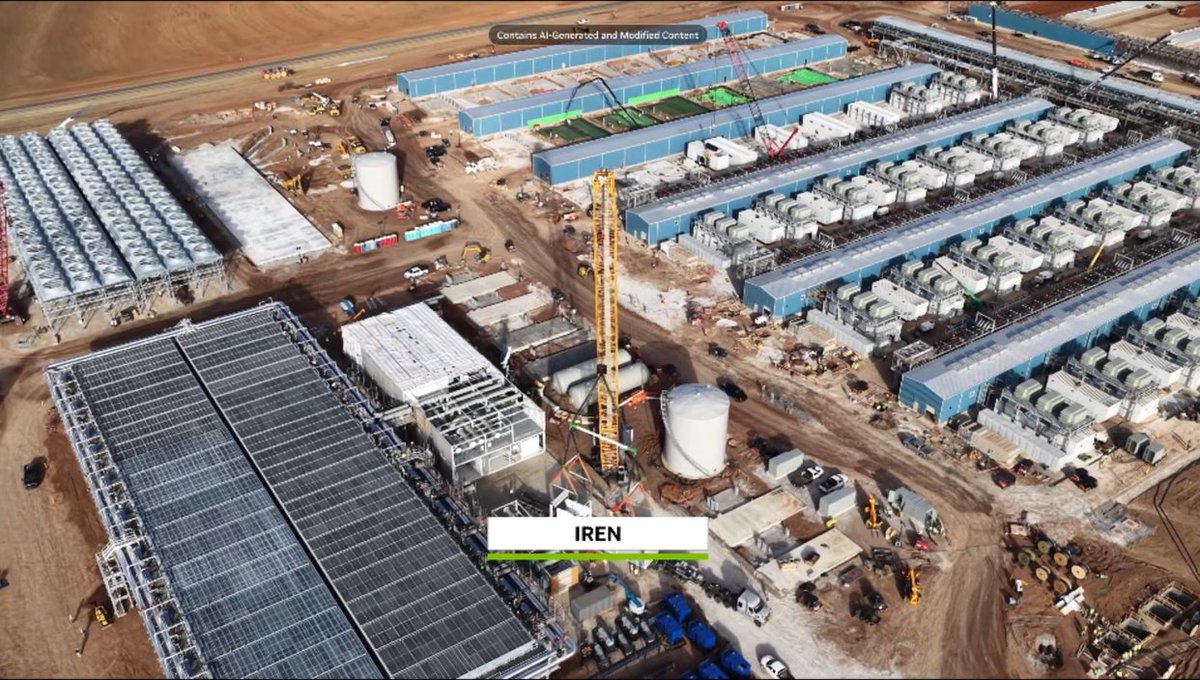
"NVIDIA DSX is full stack AI factory reference architecture, co-innovated with the world’s leading infrastructure companies."
IREN sites in Jensen Huang's #NVIDIAGTC Berlin keynote. Watch the full presentation: https://t.co/L3fRzXV7HJ
IREN is advancing sovereign AI in Europe, bringing together its European data center capacity and managed cloud services for customers seeking more choice over where their AI workloads run and how their data and infrastructure are managed.
Announced today at NVIDIA GTC Berlin, IREN has established IREN Europe and appointed Ángel Corcóstegui as Chair of the newly established board of directors.
IREN also secured the civil works license for its planned 300MW campus in Badajoz, Spain. Following the completion of its acquisition of Mirantis, IREN’s software capabilities include workload isolation and operational controls that can help customers address data residency, security and governance requirements.
Read more: https://t.co/46hRxoIDu0
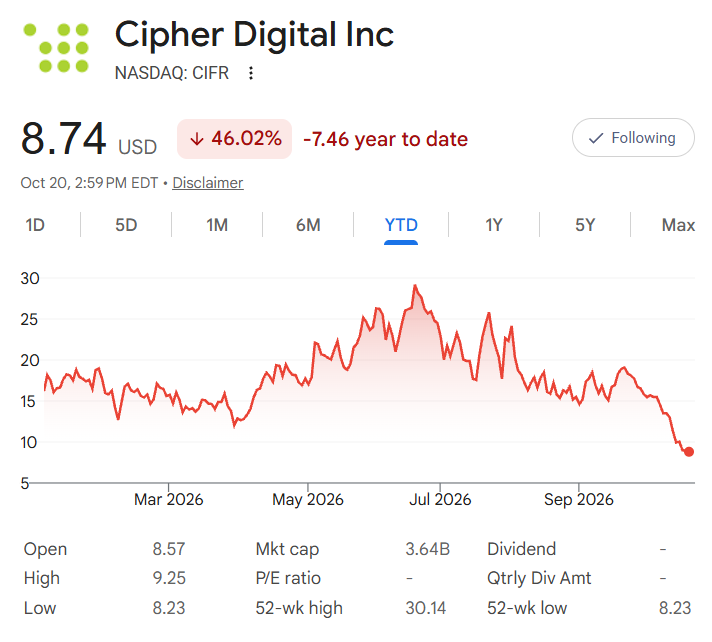
WHY $CIFR COULD BE THE BIGGEST BARGAIN IN AI INFRASTRUCTURE RIGHT NOW
I think Cipher could be emerging as one of the most interesting opportunities in the entire AI infrastructure selloff because the market has become so focused on leverage, dilution and financing risks that it's overlooking how dramatically the underlying business is transforming.
Cipher has fallen nearly 70% from its previous highs, yet the company is no longer primarily a Bitcoin miner and is increasingly becoming a large-scale AI data center developer and infrastructure landlord with approximately 5.3 GW of potential capacity across 11 projects.
That's an important distinction because unlike neoclouds that borrow billions of dollars to purchase GPUs and rent compute capacity, Cipher is developing the physical infrastructure that hyperscalers need while its tenants provide the expensive computing equipment themselves.
This means Cipher isn't directly exposed to GPU depreciation, rental pricing or the constant replacement cycles that can make the economics of compute providers so difficult to underwrite. Instead, its opportunity is increasingly tied to securing scarce power capacity, constructing data centers and generating recurring rental income through long-term agreements with some of the largest technology companies in the world.
I think investors are making the mistake of treating every leveraged AI infrastructure company as though it has the same business model, when there's an enormous difference between financing rapidly depreciating GPUs and developing infrastructure that could generate contracted cash flows for the next 15 to 20 years.
What makes the opportunity particularly compelling is that we're finally beginning to see Cipher transition from announcing enormous development pipelines into actually delivering infrastructure and collecting rent since Black Pearl has already begun generating rental income after its initial capacity was delivered ahead of schedule, while Stingray has secured approximately $810 million in project financing at a 6% coupon, covering nearly 98% of expected project costs and backed by a 15-year lease with annual rental escalators of approximately 3%.
That financing was reportedly oversubscribed by roughly eight times, which I think demonstrates that lenders remain willing to finance high-quality AI infrastructure projects when the underlying contractual economics are attractive.
Then you have Barber Lake, where the lease extension increased the contracted term from 10 to 20 years and expanded nominal contracted revenue from approximately $3.8 billion to more than $9 billion.
Across its initial leased projects, Cipher has outlined hundreds of millions of dollars in expected annualized net operating income, while its broader development pipeline provides the possibility of signing additional long-term agreements as hyperscalers continue competing for available power and data center capacity.
I think this is where investors are missing the bigger picture because we're talking about infrastructure with potentially decades of revenue visibility, and the market is increasingly valuing it as though the underlying AI investment cycle could collapse before these facilities even begin generating meaningful cash flow.
Now, I don't want to pretend the recent selloff is entirely irrational because the biggest challenge for Cipher is that securing enormous contracted revenue doesn't automatically translate into attractive returns for shareholders.
Barber Lake is probably the clearest example because the projected construction budget increased approximately 36% to 38%, pushing expected project costs toward $3 billion while reducing the estimated first-year cash NOI yield from approximately 13.5% to 14% down to 10.5%. That's a meaningful deterioration in capital efficiency, even though the contractual revenue opportunity became substantially larger.
The company also recently announced approximately $850 million in zero-coupon convertible financing alongside an exchange of existing debt for roughly 40.7 million shares, which reinforces that dilution and capital structure complexity remain legitimate concerns.
However, I think there's an important distinction between financing that becomes expensive because a business is struggling to find customers and financing used to complete infrastructure that already has long-term contractual commitments.
Raising capital at a 0% coupon in an environment where Treasury yields are above 5% is attractive financing on its face, even after accounting for future conversion risk, while project-level debt supported by tenant contracts can offer more favorable economics than unsecured corporate borrowing.
The real question is whether Cipher can consistently deliver projects at costs that generate attractive returns on the equity invested, and that's why I'm paying considerably more attention to construction spending, financing terms and cash yields than simply celebrating every additional billion dollars in announced backlog.
Ultimately, I think the potential deal-of-a-lifetime opportunity in Cipher comes from the disconnect between what investors are currently willing to pay for the business and what its infrastructure could eventually generate if management successfully executes.
At approximately $9 per share, Cipher's pro forma equity valuation is around $4.1 billion, with an indicative enterprise value of approximately $5.5 billion against roughly $686 million in projected 2027 contracted net operating income, implying a multiple of approximately 8x before accounting for corporate expenses, financing costs and additional development requirements. That certainly doesn't make the stock automatically cheap because project-level NOI isn't the same thing as free cash flow available to shareholders, but I think it illustrates how aggressively expectations have compressed relative to the company's contracted opportunities.
The bigger upside would come from successfully delivering Black Pearl, Barber Lake and Stingray while converting additional portions of its multigigawatt development pipeline into signed leases without continually diluting shareholders.
If management can demonstrate that construction costs are stabilizing, rental income is accelerating and additional projects can be financed on attractive terms, I think investors could begin valuing Cipher as a growing contracted infrastructure platform rather than a speculative former Bitcoin miner.
However, if cost overruns continue or financing requirements increase faster than the cash flows available to shareholders, the stock could remain under pressure regardless of how strong AI demand becomes.
That's why I think the next several quarters will be incredibly important because the opportunity is no longer simply about proving that hyperscalers want the capacity, but demonstrating that Cipher can deliver it economically.
My thesis is that the market may be pricing in an enormous amount of execution and financing risk at exactly the moment the company is beginning to turn its contracted infrastructure into a cash-generating business, and if that transition succeeds, I think the potential revaluation could be substantial.