İngiltere'de İsrail ordusuna gönderilmesi planlanan yaklaşık 3 milyon sterlin değerindeki askeri uyduları tahrip edip hapse giren bu iki abla serbest bırakıldı
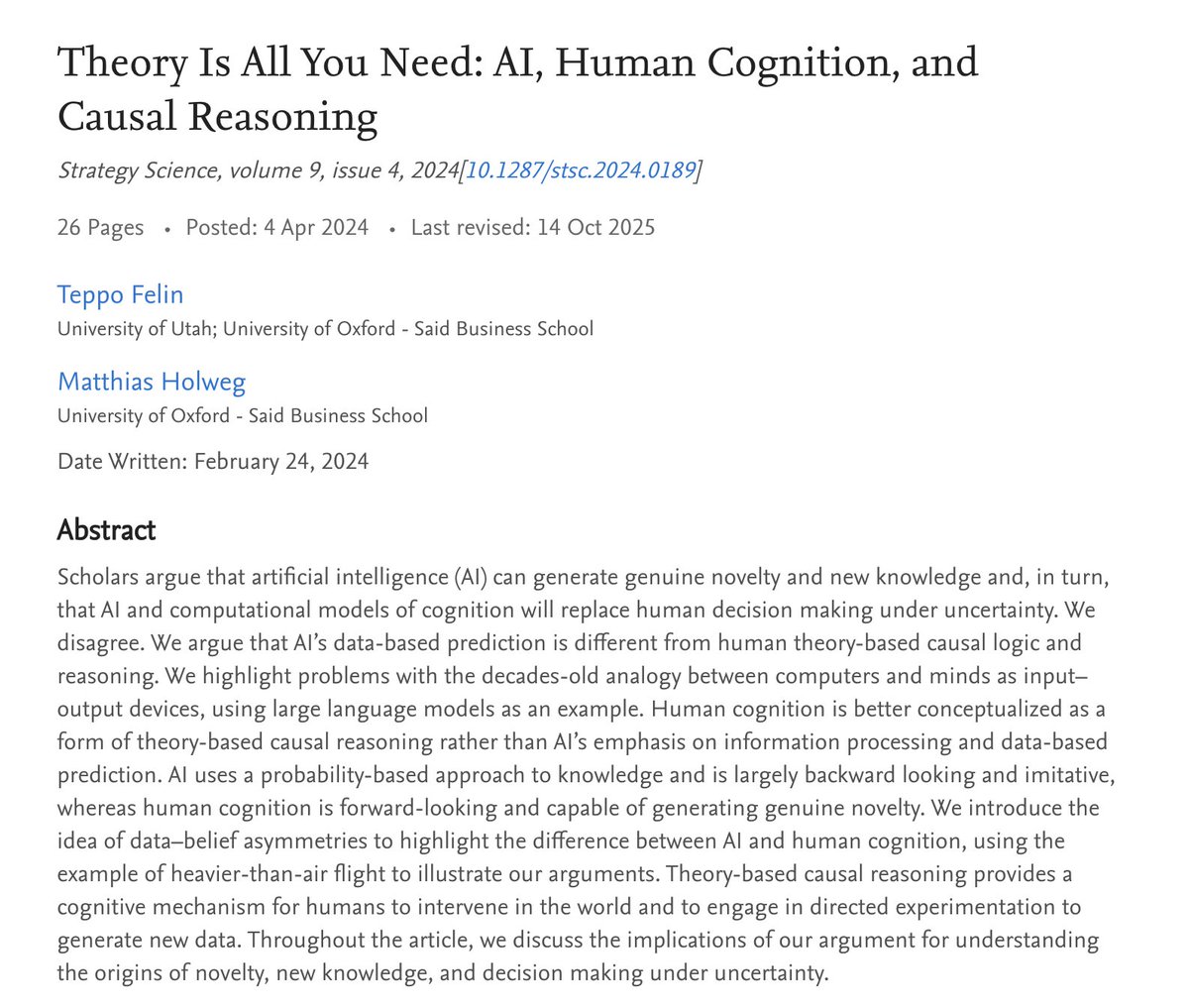
Oxford researchers argue that LLMs can never invent anything.
It is mathematically impossible.
They published a paper called “Theory Is All You Need" and it argues against the claim that computational models can generate genuine novelty or new knowledge.
They analyzed the limits of generative ai, and the results are a brutal reality check for the idea that ai will replace human decision making under uncertainty.
Here is why AI is stuck and human cognition wins:
backward-looking vs forward-looking.. llms are probability machines that look backward at existing data. human cognition is forward-looking and capable of generating genuine novelty. human cognition operates theoretically "top-down" rather than "bottom-up" from data.
the "data-belief asymmetry".. the researchers use the invention of "heavier-than-air flight" to illustrate this concept. an ai relies on data-based prediction, which is largely imitative. humans, however, use theory-based causal logic that allows them to hold beliefs that go beyond existing data.
the intervention gap.. humans don't just process information; we use theory to practically "intervene" in the world. we engage in directed experimentation to generate entirely new data. ai-based models are theory-free and place primacy on existing data and prediction.
tldr?
AI uses a probability-based approach to knowledge and ia largely imitative. It can process data and make predictions, but human cognition relies on theory-based causal reasoning.
The decades-old analogy comparing human minds and computers to mere "input-output" devices is fundamentally flawed.
OpenAI and Anthropic’s models are so magical and mystical and dangerous, they can do anything! They may even destroy the world! The only thing they can’t do, funny enough, is generate positive cash flow. And that’s where the US Taxpayer comes in!
An alternative hypothesis:
- model performance is plateauing
- compute is getting much more expensive
- AI data centers are massively unpopular
- slowing down AI development is a way to explain slowing progress, reduce spending, and try to regain some goodwill.
- This is an effort to save the IPO not humanity.
How to kill open source models in 3 simple steps:
- Create panic about frontier models.
- Have the biggest AI companies help write the “safety” rules. ← WE’RE HERE
- Make those rules so burdensome that open source can’t compete.
Art of the deal.
When companies go public they must file paperwork disclosing their financials.
Doing so would expose the massive cash burn OpenAI is using. Therefore, Sam Altman can't go public but he also has run out of money.
Enter "whistle blower" Jacob Coxon.
It made no sense how an obscure nobody got 165 million views on his first X post saying AI could kill us all. Then he was on every news station within 48 hours, scaring the public.
This was a psyop to "regulate" the AI companies... aka give them government funding to "protect the public from the dangers of AI."
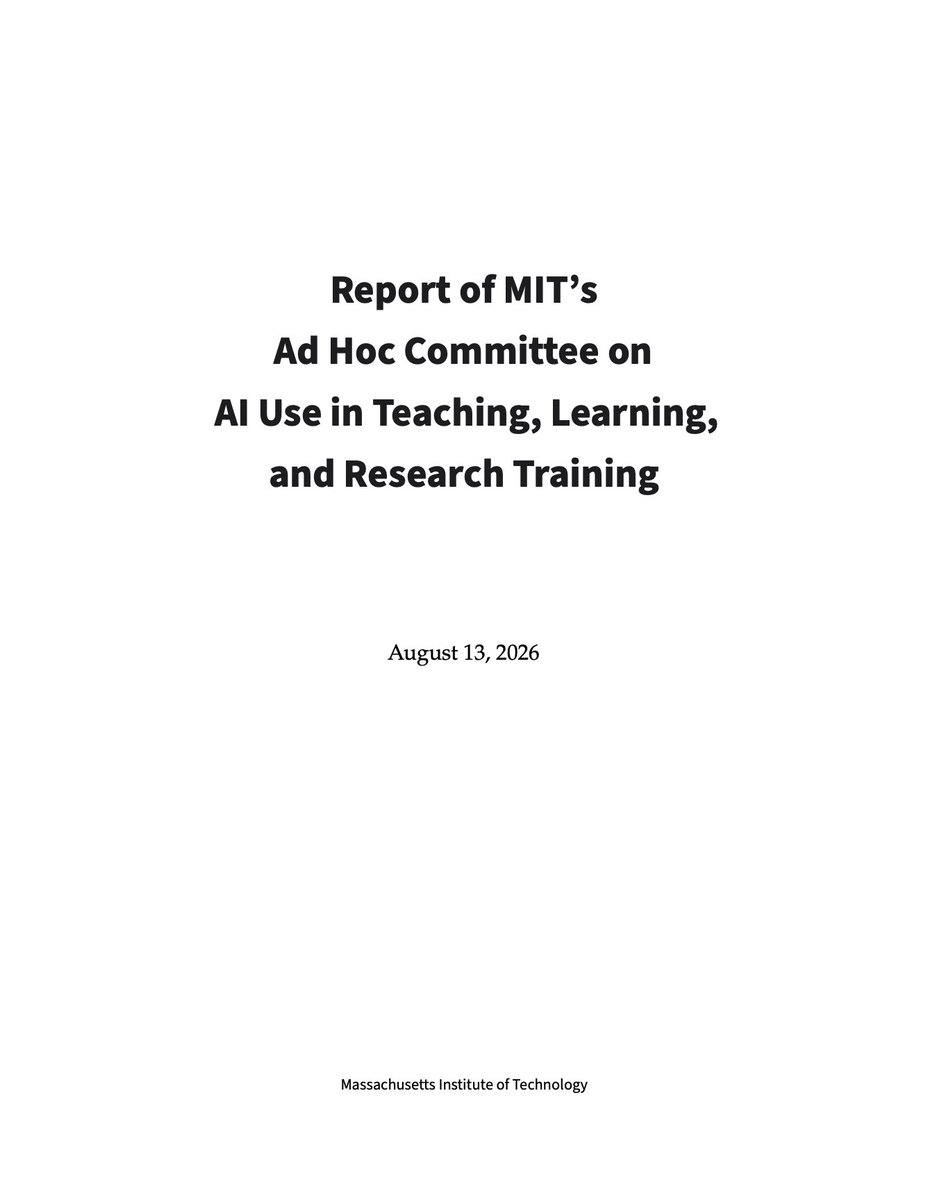
MIT published a brutally honest report on what AI is doing to students.
A committee of professors and students spent five months studying how AI changed learning on campus, and the findings read like a warning to every university on the planet.
Study groups are disappearing. Office hours are emptying out. Problem sets and take-home exams no longer prove anything, because AI can produce credible solutions to almost any written assignment in the undergraduate curriculum. Students who lean on chatbots lose mastery and confidence, and some slip into what the report calls cognitive surrender, reaching for AI at the first hint of struggle.
The numbers are rough. 46 percent of surveyed MIT undergrads use LLMs daily. 90 percent worry about their own overreliance. Undergrads who feel AI makes them replaceable now outnumber those who feel it makes them capable.
The committee's answer surprised me. They refused to fight AI with surveillance. The report calls AI detectors unreliable, says lockdown browsers feel like spying, and warns that policing students builds a classroom atmosphere of mutual distrust.
Instead, MIT wants to rebuild education around the things AI can't replace. That means oral exams, semester portfolios, in-person project work, and a required social component in every subject. The report even floats the idea of rethinking grades entirely, since without a GPA to optimize, much of the incentive to cheat with AI evaporates.
The committee warns professors against replacing undergrad research assistants with AI agents just because they're cheaper, because a university exists to grow people, not output.
The most famous tech school on earth admitted the machines broke its way of teaching. Its answer is more humans, not more software.
[1/3] A notícia que circula desde ontem de que a Inteligência Artificial Open AI teria supostamente resolvido o problema de Navier-Stokes (um problema de ponta de matemática em aberto há mais de 300 anos) parece constituir-se no primeiro caso escandaloso de plágio, roubo, [+]
Felizmente, existe a Alessandra Orofino para botar os pingos nos ii. Ouçam com atenção o corte. É do programa Calma Urgente. Faz a conexão necessária; joga luz onde era preciso iluminar.
MIT mathematically proved that AI will destroy the democracy.
A Nobel-winning MIT economist published a terrifying paper called "Automation and Repression"
As AI and automation replace human labor, wealth concentrates heavily in the hands of a tiny group of capital owners. Inequality skyrockets.
When inequality hits a critical mass, workers realize they are being crushed and the threat of a popular revolt spikes.
Faced with that threat, the ruling elite are forced to make a choice.
They can redistribute the wealth through taxes, or they can use force to keep people down.
The paper mathematically proves a dark reality: there is a direct, inescapable link between automation and political repression.
The more capital accumulates through AI, the more the elite prefer repression over redistribution.
Why? Because sharing the wealth cuts into their power. Funding a police state protects it.
It gets worse.
The authors modeled what happens when an economy starts inside a clean, stable democracy.
As automation advances and capital concentrates at the top, the math shows that the elite eventually find democracy to be a liability.
They stop supporting democratic systems. They back a coup. They install a repressive system just to protect their automated wealth.
Nobody is voting to end democracy.
The technology’s economic incentives just make authoritarian control the logical next step for survival.
Um ministro do STF pode errar, jamais ser imprudente, menos ainda irresponsável. Um integrante da Alta Corte que expõe e põe em xeque a integridade do STF, da PGR e da PF para deslocar o eixo de uma investigação com potencial de ser a maior fraude bancária e financeira da história do país, do núcleo essencial para um aspecto importante porém lateral (pior, com indícios de irregularidades procedimentais), não merece vestir a toga mais nobilíssima da República. Quando as instituições perdem, quem mais perde é o Brasil. Quem não aprendeu isso com a Lava Jato aos lavajatistas se iguala.
em dezembro faz 5 anos que fui diagnosticada com TEA. Todo mês, existe uma discussão de que adultos diagnosticados “regridem” porque descobrem o autismo, param de se esforçar e começam a usar o diagnóstico como desculpa.
Então acho que vale contar o que aconteceu comigo.
@jhonatanalmada Isso dito, o avanço é inegável. Ontem, em uma formação sobre o assunto, ouvimos vários depoimentos sobre como não se falava sobre o assunto há 20, 25 anos atrás.