Co-Chair NHS Assembly, Emeritus Prof Uni of Birmingham. Health policy and management wonk. Walking, cycling, reading, thinking. Also on [email protected]
the NHS has been in decline since 2010 because successive govts have failed to heed the warning signs of deteriorating performance https://t.co/0Lz7uUKfXf
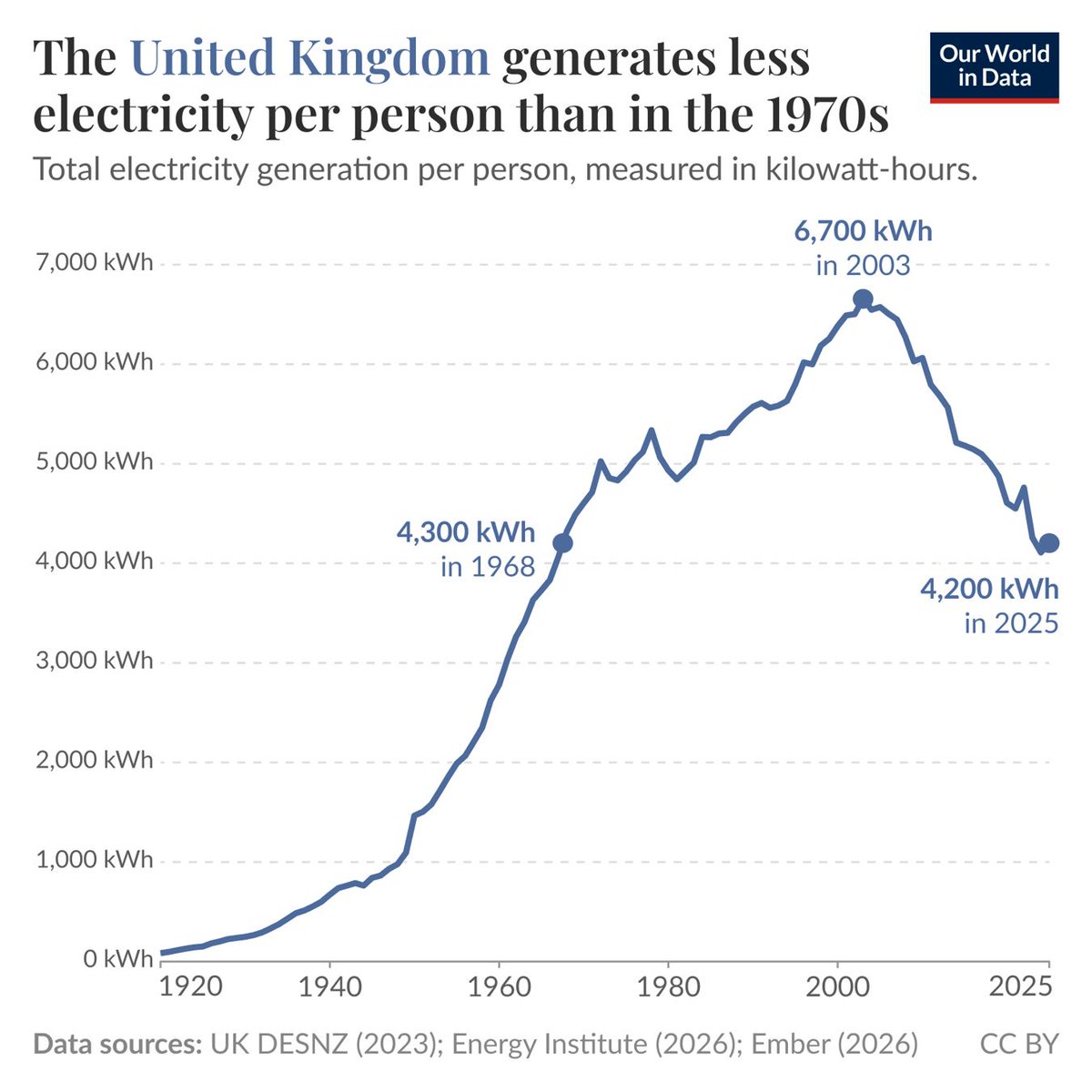
Electricity generation per person in the United Kingdom has fallen by a third from its early-2000s peak.
Globally, electricity generation per person has grown by more than 50% this century.
In the United Kingdom, things have moved in the opposite direction. Its generation per person peaked in 2003 and has fallen by more than a third since then.
You can see this in the chart, which shows generation per person since 1920. Today, levels are back to where they were in the late 1960s.
Some of that decline is a change in electricity imports, rather than demand: net imports have increased from 1% of electricity demand in 2010 to 9% in 2025. But it’s still true that the UK consumes much less electricity than it used to.
The most common explanation is deindustrialization: as the economy shifted from manufacturing to services, electricity demand fell. That’s part of the explanation, but far from all of it.
Sectoral data from the International Energy Agency confirms that electricity consumption in industry has fallen by one-quarter since 2005 (more if we calculate this per person). But residential and commercial electricity use has fallen by just as much.
Deindustrialization has reduced demand, but improvements in energy efficiency — such as the shift from incandescent to LED lightbulbs and the introduction of efficiency standards for appliances — have played an important role too.
(written by @_HannahRitchie)
Electricity generation per person in the United Kingdom has fallen by a third from its early-2000s peak.
Globally, electricity generation per person has grown by more than 50% this century.
In the United Kingdom, things have moved in the opposite direction. Its generation per person peaked in 2003 and has fallen by more than a third since then.
You can see this in the chart, which shows generation per person since 1920. Today, levels are back to where they were in the late 1960s.
Some of that decline is a change in electricity imports, rather than demand: net imports have increased from 1% of electricity demand in 2010 to 9% in 2025. But it’s still true that the UK consumes much less electricity than it used to.
The most common explanation is deindustrialization: as the economy shifted from manufacturing to services, electricity demand fell. That’s part of the explanation, but far from all of it.
Sectoral data from the International Energy Agency confirms that electricity consumption in industry has fallen by one-quarter since 2005 (more if we calculate this per person). But residential and commercial electricity use has fallen by just as much.
Deindustrialization has reduced demand, but improvements in energy efficiency — such as the shift from incandescent to LED lightbulbs and the introduction of efficiency standards for appliances — have played an important role too.
(written by @_HannahRitchie)
Replacing triple lock with a system that ensures state pension rises with earnings over time, but never rises by less than inflation, makes a lot of sense. Good.
The idea this will pay for free social care any time soon, though, is for the birds. That will mean higher taxes.
Spent much of today with Special Forces. Of all the people and capabilities I’ve met in the past couple of months, I wish I could show the public the full extent of who they are and what they do. It has made me (even more) proud to be British and of our capabilities as a country - despite the challenges.
@profchrisham@HealthFdn important to highlight predicament of health systems that ignore chronic diseases (arthritis, heart diseases, diabetes, mental health, COPD) & their interrelatedness/connections that may present with acuity, because clinics aren’t prioritized & systems focus on acuity
Recent comments by Penny Dash about how Britain could learn from India in providing “outstandingly good healthcare” at a fraction of the cost felt jarring, says Rammya Mathew, whose perception, as a second generation migrant from India, is rather different
https://t.co/impiXAuQqA
So much of the right these days just have a massive patriotism problem. This guy:
- is a tax exile (left long before this govt)
- hates his own country while complaining he doesn’t get big enough subsidies from it
- laments the hit to manufacturing driven by a Brexit he supported
@profchrisham Thanks @profchrisham
like your focus on Boards.
After a long time on boards
3 things are clear to me.
Medical and nursing directors need to be independent.
Comms and engagement leads should not be part of boards.
Non execs need time & a right to roam though the organisation.
@profchrisham Very much agree with your points Chris. I also think the relationship between the Chair and CEO is key. Their weekly one-to-one meetings should be a further opportunity for a frank discussion to test the views of NEDs expressed to the Chair.