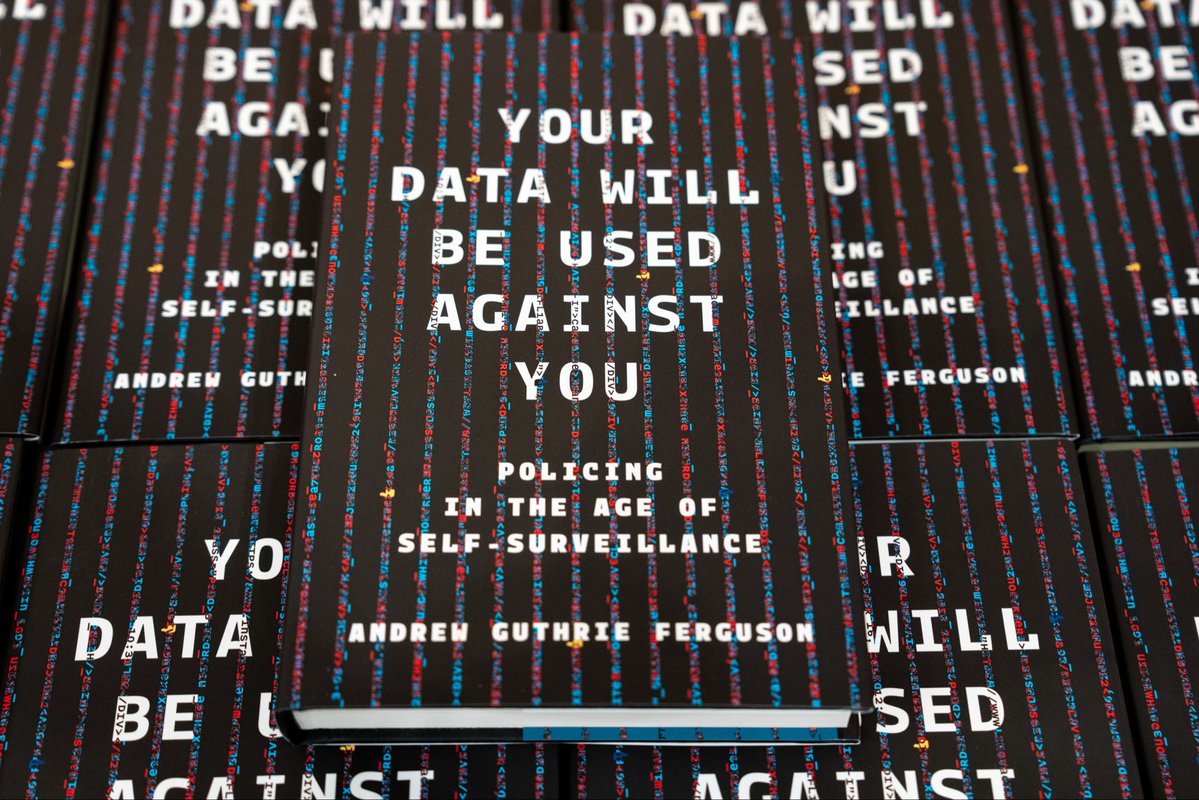
Andrew Guthrie Ferguson says transparency around surveillance technology is essential: “We should not be asking police what technologies are in use, we should know and have approved of them before our tax dollars were used to buy them.”
https://t.co/fWqa5cfztl
Do police need a warrant to access your gmail account? What local laws could restrict data tracking? How do other countries protect data privacy?
Our Q&A with legal expert Andrew Guthrie Ferguson answers these and other questions on police surveillance.
https://t.co/fWqa5cfztl
“There is nothing you do in a digital world that cannot be obtained with a judicial warrant,” says legal scholar Andrew Guthrie Ferguson. “All of it can be obtained by police seeking to prosecute you.”
https://t.co/fWqa5cfztl
@danepps Have you looked at the disclosure polices of some law journals? Dan Solove and I stumbled upon some that are pretty interesting. https://t.co/PkAl54ePfc
@PaulMSherman@daveweigel Weird ex post facto like problem because he clearly did not use super intelligence at the time, only AI. Going to get them messed up in court (although doesn’t really matter in a press release).
Yesterday, the Fifth Circuit heard oral argument in a case about whether using ALPRs (Flock and Motorola) was a Fourth Amendment "search." The gov't says "no" for two reasons. The oral argument shows there are serious problems with both arguments. 🧵
@danepps And that temptation or maybe just move to efficiency could easily impact scholars. Just wondering if anyone was talking about it. Maybe it’s a non-issue.
@danepps I have had lots of parentheticals added (unwanted by the way).
But my question is whether law review edits are going to remain untouched by AI. The temptation is real and the efficiencies are also real. Students could edit a document in a fraction of the time.
@danepps But the result could be that an author who did not use AI to draft would still be flagged by an AI scan. We have focused correctly on the need for author disclosure and perhaps not using AI to draft, (I don’t FYI), but I worry that one could still be flagged if the editors do.
@danepps Do you know if there are any conversations going on about law review editors using AI to edit accepted articles? I can imagine that across the hundreds of law reviews that there will be a temptation to use AI to fix footnotes, add parentheticals, and even edit. 1/2
Federal judge: "Freedom from persistent, dragnet-style surveillance while in public is not a foreign concept in our society & it is a reasonable expectation that society already accepts ...
Why is it the govt's business where everyone goes all the time?"
https://t.co/8euToHej68
New: a surveillance company is telling cops it wants to add facial recognition to Flock cameras. Flock doesn't do face rec, but that doesn't stop other companies doing it. "This is the way the world is going, the way the world will have to be" https://t.co/OTb4fLd4QE
As I say in my book, facial recognition and emotion/affect sensors are just an upgrade away when you build the architecture of surveillance into your city.
New: a surveillance company is telling cops it wants to add facial recognition to Flock cameras. Flock doesn't do face rec, but that doesn't stop other companies doing it. "This is the way the world is going, the way the world will have to be" https://t.co/OTb4fLd4QE