One of Asimov's creations, Prof. Hari Seldon was a smart, energetic, rebel. He found a way to reliably predict the future of any large group of people.
A Lufthansa 787 suddenly drops onto its nose and a China Eastern A350 is filmed slamming into a jet bridge in Shanghai. In today's episode, Petter and Ben break down what happened!
https://t.co/4rY6vEBEvV
Bluetooth, Wi-Fi, GPS all use spread spectrum transmission to become robust. It's co inventor was a Electronic Frontier Foundation Pioneer Award recipient, and her co-inventor friend & pianist George Antheil. She was an escaped Austrian jew. Self trained
https://t.co/JD0H1NNCWv
Passengers on a commercial flight captured the launch of Artemis II on camera
The plane happened to pass near the launch trajectory at the exact moment of liftoff, giving passengers a rare view of the rocket launch right from their windows.
A lot of people study law or jurisprudence. Allow me to introduce you to one that eanred himself a https://t.co/5aTQQe7Qlx. He risked not just death, but any and all punishments for being a traitor to Hitler's army:
https://t.co/2eDYP2zotq
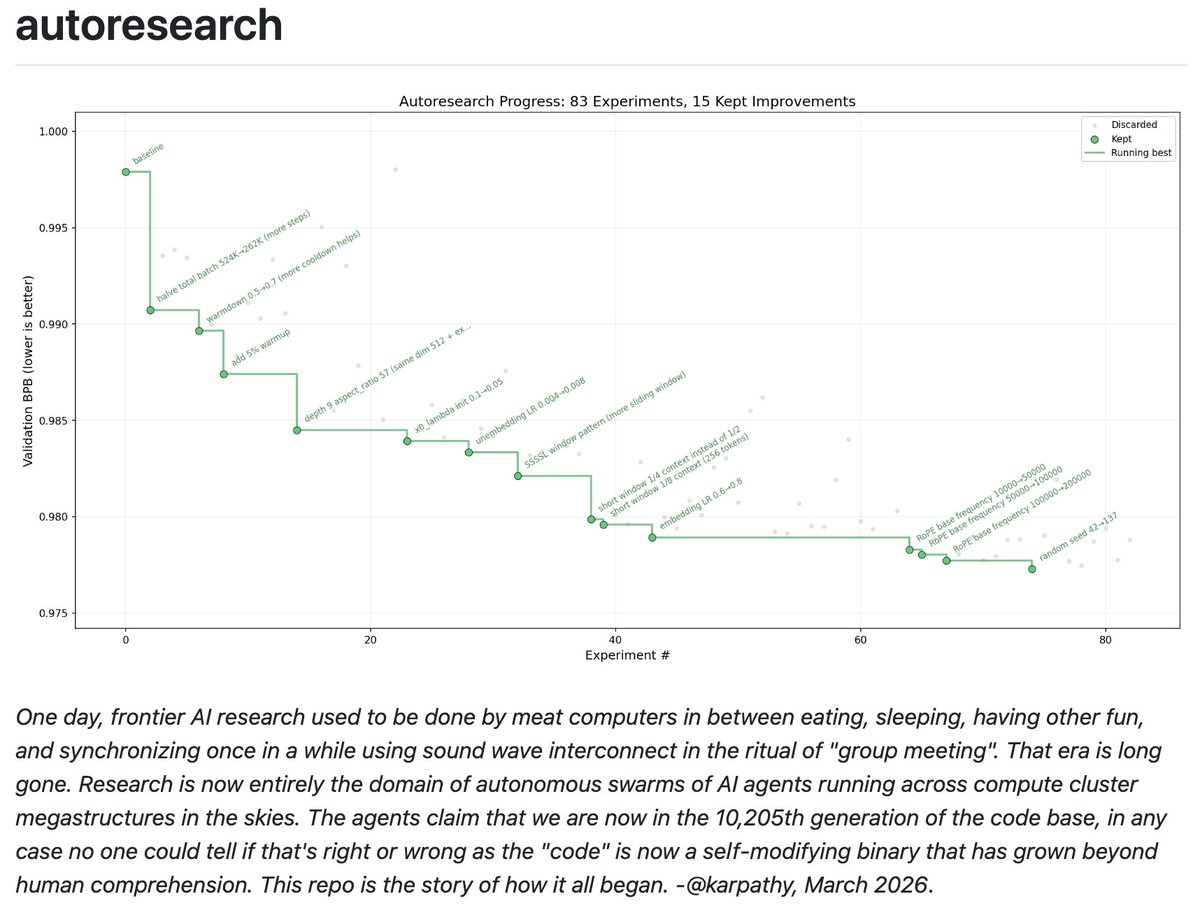
I packaged up the "autoresearch" project into a new self-contained minimal repo if people would like to play over the weekend. It's basically nanochat LLM training core stripped down to a single-GPU, one file version of ~630 lines of code, then:
- the human iterates on the prompt (.md)
- the AI agent iterates on the training code (.py)
The goal is to engineer your agents to make the fastest research progress indefinitely and without any of your own involvement. In the image, every dot is a complete LLM training run that lasts exactly 5 minutes. The agent works in an autonomous loop on a git feature branch and accumulates git commits to the training script as it finds better settings (of lower validation loss by the end) of the neural network architecture, the optimizer, all the hyperparameters, etc. You can imagine comparing the research progress of different prompts, different agents, etc.
https://t.co/YCvOwwjOzF
Part code, part sci-fi, and a pinch of psychosis :)
Dear @nsitharaman, @nsitharamanoffc@narendramodi ji, below is Income Tax Payers Expectations in tomorrow budget 2026!! Hope to see something back to Tax Payers of the country from the tax they pay to Govt.
The NCPRE in IIT Bombay is leading India's solar energy breakthroughs, with research in solar panel efficiency. One NCPRE start-up developed a solar cell with 30% efficiency - highest in India. Watch #ThePrintGroundReport with @Akanksha_mish27
https://t.co/hDHZfoCgAs
This is Kundli–Manesar–Palwal (KMP Expressway)
Total cost- 10,000 crore
Toll fee- Rs 1.35/km
And look at the condition –
Potholes so huge that three cars’ tyres burst within just 10 minutes.
Is any govt department paying for these damages?
Domlur Footpath Rescue Update!
30 days since this important footpath linking Indiranagar 100 Ft Rd & Old Airport Rd Domlur was reclaimed. It's stayed clean , it's heavily used. Sorry to all the cynics who dissed this citizen+govt effort
@GBAChiefComm@GBA_office@BCCCofficial
Employees were asking for reforms in EPFO with regards to their provident fund
Modi ji delivered another masterstroke
✅Full withdrawal in case of unemployment will happen after 12 months vs 2 months currently
✅25% of your EPF, kept in EPF always!
Modi hai toh Mumkin hai
Excited to release new repo: nanochat!
(it's among the most unhinged I've written).
Unlike my earlier similar repo nanoGPT which only covered pretraining, nanochat is a minimal, from scratch, full-stack training/inference pipeline of a simple ChatGPT clone in a single, dependency-minimal codebase. You boot up a cloud GPU box, run a single script and in as little as 4 hours later you can talk to your own LLM in a ChatGPT-like web UI.
It weighs ~8,000 lines of imo quite clean code to:
- Train the tokenizer using a new Rust implementation
- Pretrain a Transformer LLM on FineWeb, evaluate CORE score across a number of metrics
- Midtrain on user-assistant conversations from SmolTalk, multiple choice questions, tool use.
- SFT, evaluate the chat model on world knowledge multiple choice (ARC-E/C, MMLU), math (GSM8K), code (HumanEval)
- RL the model optionally on GSM8K with "GRPO"
- Efficient inference the model in an Engine with KV cache, simple prefill/decode, tool use (Python interpreter in a lightweight sandbox), talk to it over CLI or ChatGPT-like WebUI.
- Write a single markdown report card, summarizing and gamifying the whole thing.
Even for as low as ~$100 in cost (~4 hours on an 8XH100 node), you can train a little ChatGPT clone that you can kind of talk to, and which can write stories/poems, answer simple questions. About ~12 hours surpasses GPT-2 CORE metric. As you further scale up towards ~$1000 (~41.6 hours of training), it quickly becomes a lot more coherent and can solve simple math/code problems and take multiple choice tests. E.g. a depth 30 model trained for 24 hours (this is about equal to FLOPs of GPT-3 Small 125M and 1/1000th of GPT-3) gets into 40s on MMLU and 70s on ARC-Easy, 20s on GSM8K, etc.
My goal is to get the full "strong baseline" stack into one cohesive, minimal, readable, hackable, maximally forkable repo. nanochat will be the capstone project of LLM101n (which is still being developed). I think it also has potential to grow into a research harness, or a benchmark, similar to nanoGPT before it. It is by no means finished, tuned or optimized (actually I think there's likely quite a bit of low-hanging fruit), but I think it's at a place where the overall skeleton is ok enough that it can go up on GitHub where all the parts of it can be improved.
Link to repo and a detailed walkthrough of the nanochat speedrun is in the reply.