One of the main challenges that we're focused on at DCF is ambient authority in AI agents.
Every major AI coding tool today grants its agent full system permissions as a developer. Your IDE's AI assistant can read your SSH keys, your environment variables, your credentials files. If a prompt injection compromises the agent, the attacker inherits it entirely. The blast radius is significant.
The fix requires new runtime infrastructure. Hardened execution environments. Capability-based permission systems. Open networking standards. These are multi-year engineering efforts with no direct revenue model. They're exactly the kind of work we are set up to endure. It's a cornerstone of why @__Endojs__ exists and why DCF champions this work spawned from @agoric
Endo ships as open-source infrastructure that any company, any developer, any agent framework can adopt.
DM for me info.
Here's a presentation I do ocassionally for students and young professionals who are looking to stand out in a world of information overload and engage audiences in policy and academic fields. Includes strategies for content creation, marketing, and personal organization.
So today I was describing myself as from the Global South (and in fact the most southerly part, the South Island in New Zealand) - and hoo-boy, so much shouting 😠🤭
New on Scaling Theory.
I sat down with @sapinker (@Harvard) to talk about common knowledge. The difference between what you know and what everyone knows that everyone knows.
That small gap explains more than it should. Why a child can undo an emperor with a single sentence. Why dictators fall the moment the square fills up. Why nobody names the elephant in the room. Why a bank is only as sound as what we believe about one another.
Listen below:
➝ YouTube: https://t.co/1RrdQzWbdt
➝ Spotify: https://t.co/a7dWtVqi3q
➝ Apple Podcasts: https://t.co/ngeh1fwWzG
Taiwan solved tax evasion in 1951 with a trick so cheap it should embarrass every tax authority on the planet.
The problem was an all-cash economy full of small shops. A merchant pockets the cash, skips the receipt, and the sale never existed. Auditors can't catch what was never recorded, and hiring enough of them to watch every noodle stand costs more than the missing tax.
So finance chief Ren Xianqun flipped the incentive. Print a lottery number on every receipt. Draw winners every two months on live TV. Top prize today: NT$10 million, about $310K.
Suddenly the customer and the shopkeeper want opposite things. The merchant wants the sale off the books. The customer wants the ticket. And there are millions more customers than merchants. Every transaction now carries a built-in witness demanding the paper trail.
Year one, reported tax revenue jumped 75%, from NT$29 million to NT$51 million. Seventy-five years later, roughly 70% of Taiwanese still play. Convenience stores redeem the smallest NT$200 prizes at the register, so even a coffee receipt feels like a scratch card.
The elegant part is what the audit force costs. The prize pool runs about NT$7 billion a year, roughly $20 million. In exchange, the government gets 23 million unpaid auditors working every checkout line in the country, forever. No inspector general on earth delivers that coverage at that price.
Greece, Italy, Portugal, and Slovakia all copied it. The most effective compliance tool ever built looks like a game, and that's exactly why it works.
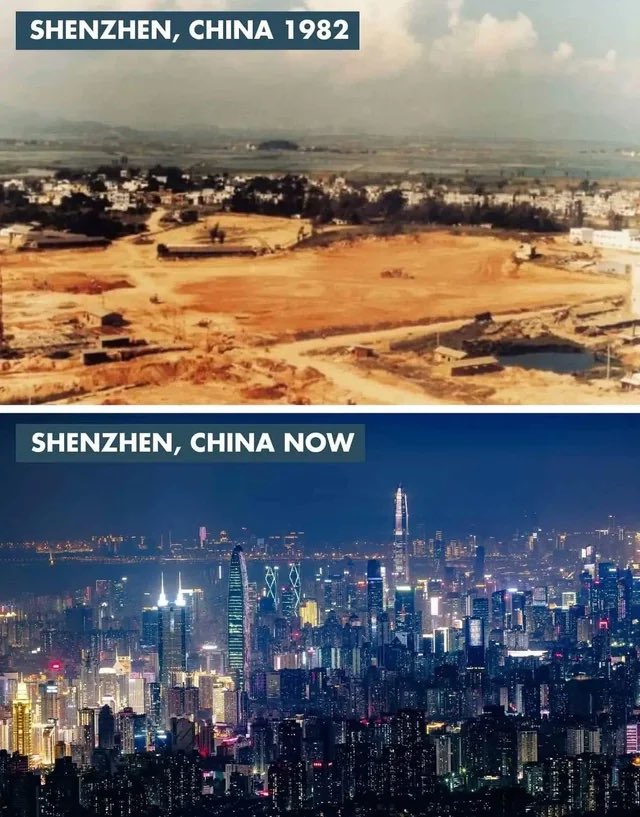
That’s genuinely insane. My “favourite” UK-China comparison is Hinkley Point C vs the city of Shenzhen.
> 1980 Shenzhen SEZ announced
> 1981 Hinkley Point C announced
Today Hinkley Point C is still incomplete with yet more delays. Unit 1 expected to come online in 2030 (I highly doubt it).
In comparison Shenzhen went from a network of fishing villages with a GDP of $37 million to a mega city with a GDP of $557 billion. It has two operational nuclear power plants.
It is genuinely hard to describe the state of Britain if you have not visited newly developed parts of the world. Practically nothing has been built in Britain in the last 50 years, it isn’t just stagnating, it’s dying.
This thread is hilarious
Nicholas Decker explains how if you take a free market innovation like insurance and allow the market to work as intended, some people whose implied expected healthcare cost is too high will be uninsurable and have to pay for their healthcare.
So instead we take the free market thing where people can choose to get insurance if it benefits them, and turn it into medical communism where money is transferred from the
healthy to the sick. But we still call it insurance!
Compulsory insurance isn't insurance, it's a tax on being healthy. It has nothing to do with insurance. It doesn't benefit you if you are forced to pay it. It doesn't merely pool risk, it transfers wealth away from where that wealth should be into some black hole.
A true free market solution would be to deregulate insurance so nobody is forced into a pool they don't want to be in.
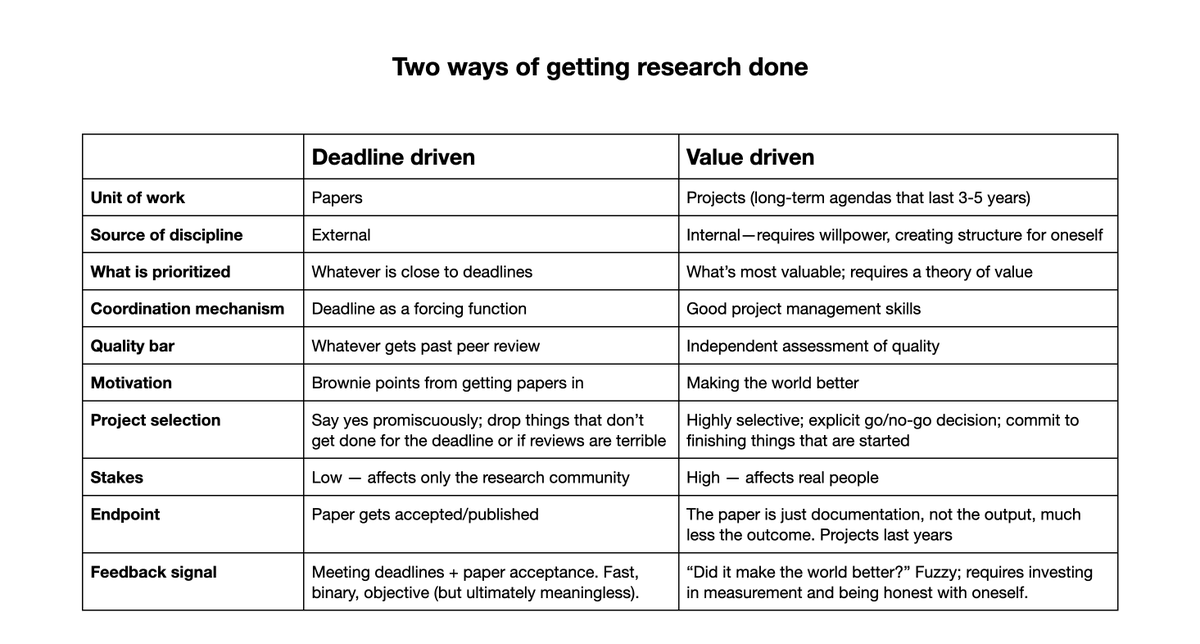
At the start of my research career I operated in a deadline-driven mode because that's what most researchers seemed to do. Gradually I discovered the value-driven way of working. I'm glad I had a supportive advisor who didn't make me chase deadlines. It took me 20 years to fully embrace the switch — it requires developing a long-term vision, willpower to create structure without deadline pressure, a theory of value, project management skills, good taste, the willingness to turn projects down, brutal honesty about whether our work is any good (even if it gets published), and a lot more. But there is no going back!
Rent Control: The Ceiling Trap!
A fabulous new website reviewing the history, economics and empirics of rent control from Friedman and Stigler through Diamond, McQuade & Qian.
https://t.co/p47rkmVCrH
@LouisCKfanpage It comes from rape, the plant, which makes oilseed rape, the seed, from which is derived rapeseed oil, the oil
How do people get through life not knowing basic agriculture and food processing?
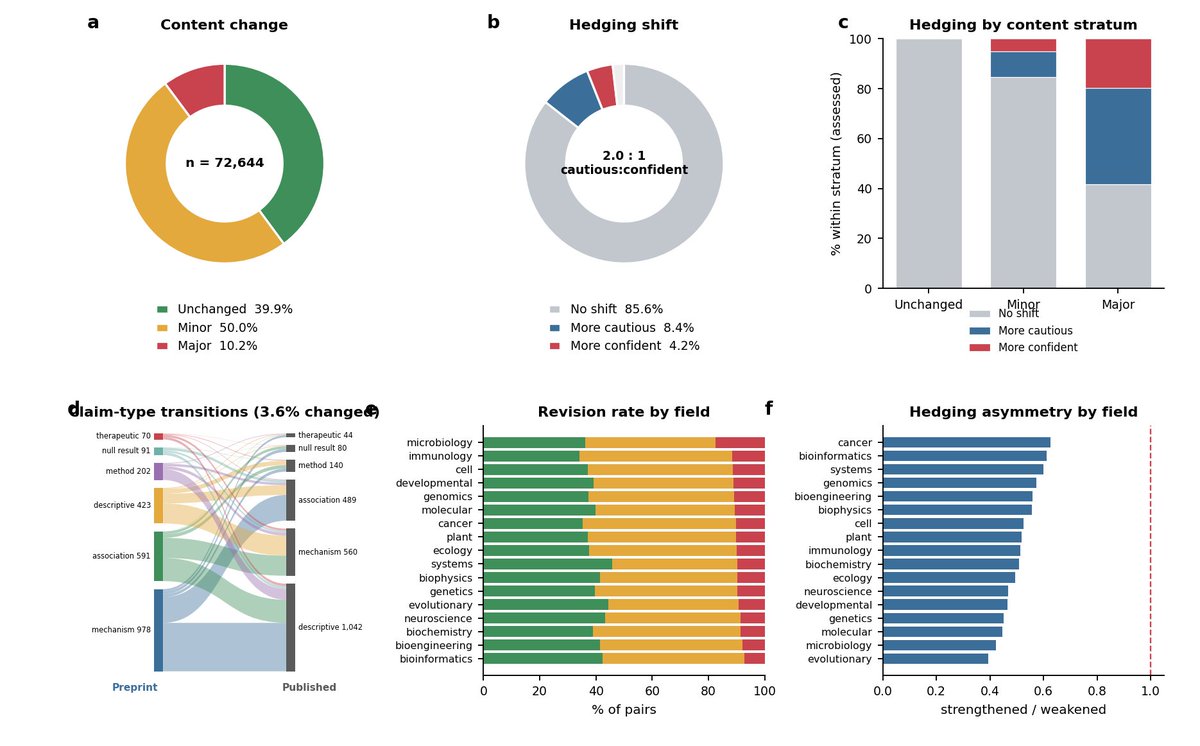
How much does a scientific claim actually change between the preprint and the final published paper?
We used a large language model to track it across all available 72,644 bioRxiv -> journal pairs from 2018 - 2025 in this new work with @HaoYin. 🧵
I'm a cardiologist. Let me tell you about the most extraordinary act of patient agency I've ever encountered.
In 2024, a tech founder named Sid Sijbrandij was told by his oncologists that they had nothing left. His osteosarcoma — an aggressive bone cancer in his spine — had returned after surgery, radiation, and chemotherapy so brutal he needed four blood transfusions to survive it. He'd exhausted every standard treatment. He wouldn't qualify for clinical trials. The implicit message: good luck.
Most people accept that verdict. Sijbrandij — co-founder of GitLab, a company worth $6.4 billion built on the principle that information should be open and transparent — decided to treat his cancer the way he'd built his company.
He went founder mode.
He quit his day job. Assembled a dream team. Hired a geneticist named Jacob Stern, formerly of 10x Genomics. And then he did something no cancer patient has ever done at this scale.
He generated 25 terabytes of his own medical data.
Whole genome sequencing. Whole exome sequencing. Bulk RNA-seq. Single-cell RNA-seq across multiple timepoints. Full-body PET/CT scans. Organoid models grown from his own tumor tissue. Immunohistochemistry. Spatial transcriptomics. Every diagnostic modality that exists — run on his specific cancer, at his specific stage, from his specific body.
Then Jacob Stern fed it all to ChatGPT