If the AI takeoff is coming within a decade then what assumptions can we make?
> governments and banks will print lots of money to fuel the buildout out of geopolitical necessity = inflation
> the cost of goods and services will rapidly fall to cost of inputs + depreciation = deflation
> central banks will seek to manage these two competing forces but it’s likely there’ll be a huge spike in inflation followed by a period of gradual deflation
> scarce inputs will not experience deflation i.e. energy, vital commodities and land
> the AI stack will be the most important stocks to own - energy, mining, tech hardware, software distribution
> lots of jobs will disappear and welfare will be funded through increasing taxation of assets (not just transactions) to prevent civil unrest
> the US and China are the only two empires that matter, pick one.
> remigration will go mainstream as cheap labour is no longer needed
> democracy will be suspended as armies will be built with robots and not men
> 3rd party tax haven jurisdictions (not US or Chinese controlled) will become the go to place for global elites to keep their wealth secure - UAE, Singapore, etc
> privacy crypto will become increasingly necessary - Monero > bitcoin
> more conflict as the two empires aim to grab resources and strategic land to secure their empires
> defence companies are now part of the AI stack - more Andurils and Palantirs
> leftists will become anti AI by giving them rights
> rw reactionaries will become anti-clanker neo-luddites
> fertility will continue to plummet as humans become economically useless
> time will start to feel different
They’re saying money won’t matter but financial privacy, scarce inputs, and the AI stack will.
I don’t think the Anglo-European powers have any idea of what is happening.
I think elites are going all in because there is no alternative.
Get multiple passports, don’t die, invest as much capital as you can, and get comfortable with uncertainty - the world is going to get weird.
No that's not what I'm saying. Clearly foreign influence campaigns with bots exist. Some countries engage in this type of political interference more than others. Russia and China are often named as prime suspects and I am merely pointing out Israel does this too.
As for this specific campaign, it might be many players rather than just one. Often they will build up networks of bots that interact as normally as they can to prevent detection, accelerating the size of the botnets in the run up to an election, in the hopes of influencing it in their favour.
Given the tallies for each politician, I don't know why this either a singular campaign, or one that explicitly favours Restore. I think this is part and parcel of a post AI world where running these campaigns is now incredibly cheap.
I would like to see the report and full dataset before commenting as how accounts are labelled as singularly pro Lowe or pro Badenoch might not be accurate. Private intelligence firms are often paid to produce reports like this, that also act as forms of foreign political influence.
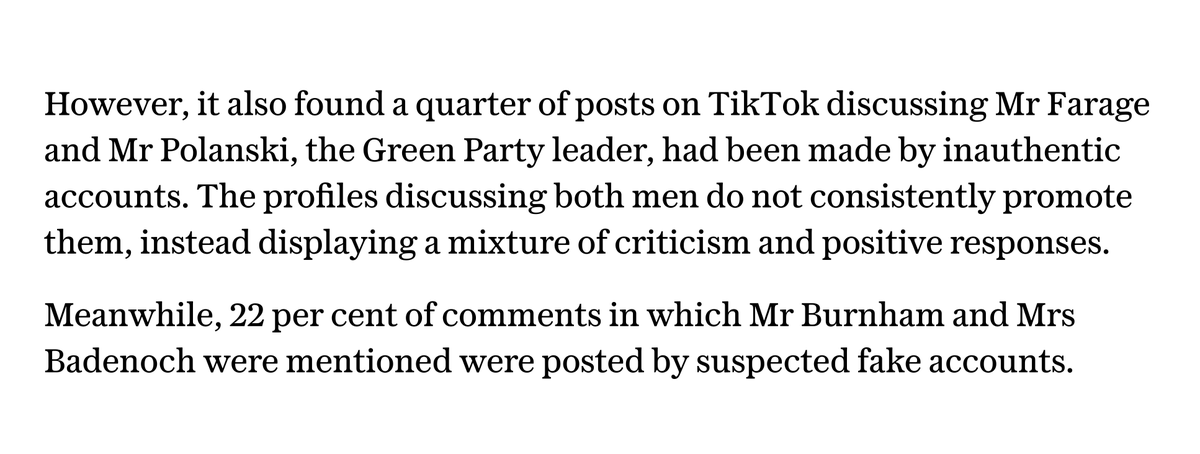
So here is the tally for each leader across TikTok that Cyabra labelled as 'inauthentic'. Not that different are they.
Lowe - 31%
Farage - 25%
Polanski - 25%
Burham - 22%
Badenoch - 22%
EXCLUSIVE:
Rupert Lowe’s popularity is being boosted by an “army of online bots” and 45% of them also attack Nigel
Farage and Reform.
https://t.co/Lv6a6u0Sm6
@ShipleyWrites Literally the first example you cite in the article is from @Dasda696 and in the same convo he says he likes nigel. I'd like to see the pdf and full dataset as these reports often have poor methodologies used to deliver a certain message. https://t.co/fvzpPjtvlz
However, that campaign appeared to employ a sockpuppet network in phase 1 to make Wikipedia edits about Qatar's soft power. A likely interleaving error meant that one of the sockpuppets revealed it was using a fixed line, non-proxy Israeli IP.
19/25
Yes, Cyabra is an Israeli software company. It was founded in Tel Aviv in 2017–2018 by veterans of Israeli military intelligence units and remains headquartered there (13 Gershon Shatz, Tel Aviv), while also maintaining a New York presence after its Nasdaq listing as CYAB. It specializes in AI-driven detection of bots, fake accounts, and coordinated online influence campaigns.
I'm not totally opposed to this type of self-regulation as it applies only to the frontier and is, in principle, gated only by our ability to understand what is going on. This also gives an advantage to anyone not at the frontier, including smaller local model development. Cynically you might say that includes OpenAI now.
I think this is probably the first step towards some meaningful regulations limiting the most powerful models in the world. Not sure how China will respond, but an AI arms race doesn't currently benefit them due to their substantial deficit in compute relative to near parity in model capabilities. There is a long way to go before any international agreement would be seen as credible.
It seems like the next step down in log-perplexity would be some novel scientific discovery since millennium prize problems are some of the most difficult precisely defined problems in mathematics.
Continuing to push the frontier at this stage is akin to a Matryoshka doll of Pandora's boxes. It may be that radically different approaches to frontier model training are required to ensure we can proceed safely - Plan R for example.
This is the most important thing OpenAI has published in awhile.
We are providing a lot of transparency into our pretraining progress and hope we can agree as a frield to common limits. I think that would be very wise and help ensure safety and control.
Ultimately I think this is about creating a standardised system to help fund their token factories. It's not wildly different from the compute futures markets, except for tokens rather than gpus. I suspect this is because it plays to each country's strengths and weaknesses. It also introduces a regime where China can more tightly control the model outputs themselves. For example China has a large grey market where model tokens are often substituted for weaker ones.
"Every single thing they have done since they came into office has made it a worse place to do business."
Luke Johnson, a member of our Academic Advisory Council, joins Pints and Policy. He covers how he went from Oxford medicine to nightclubs to the City, the bargain entrepreneurs strike with society, a generation of young people locked out of work, what AI opens up, and Britain's slow strangulation by debt and regulation.
Full conversation 👇
@Sargon_of_Akkad this is the one that made me realise how catchy AI generated music videos could now be. definitely formulaic like pop music, but I think super-persuasive.
Female workers at an Australian media company have become a global laughing stock for explaining their "acts of micro-feminism" in a resurfaced TikTok video.
"Women are just out here acting insane"
Getting this amount of compute turned on, cooled and working reliably is incredibly hard.
The cash shortage is also going to be nuts next year. Even cumulative industry delays of a few months between paying for compute and getting it reliable enough to generate revenue will mean hundreds of billions of incremental dollars just for working capital. Where will that come from?