@ryleyphysiothe1@hjluks You cannot predict rupture, and if they are asymptomatic they will not be seeking management.
Rupture is much more likely to happen in daily life when weight-bearing than during exercise
@ryleyphysiothe1@hjluks These tendons are profoundly degenerative because of load accumulation through life
Jozsa and Kannus 91 reported 66% of these tendons are asymptomatic before rupture
@LorneGoldenberg@pattiber1@hjluks The literature is really mixed and confusing, there are a lot of treatments that have little evidence
Have a look at Jason Rogers work
@hjluks@CamSwick@brian__healy Agree and the load is variable through range and often not sufficient. Load can vary day to day depending on band placement, tendons like consistent load
@MattR22933259@GregLehman@hjluks Groin pain is very complex and requires differential diagnosis and management of all contributing structures
Simple single tendon issues are not common
@RobinLarssonRPT@Dee_Wrecks@hjluks This more about compression between the restraining connective tissue and the tendon
Primary response is in the connective tissue, tendon affected secondarily
Reduce this load
@brian__healy@hjluks Energy storage and release is the highest tendon load, this is during weight-bearing athletic activity eg jumping, agility.
Loads during isometrics will not be nearly as high
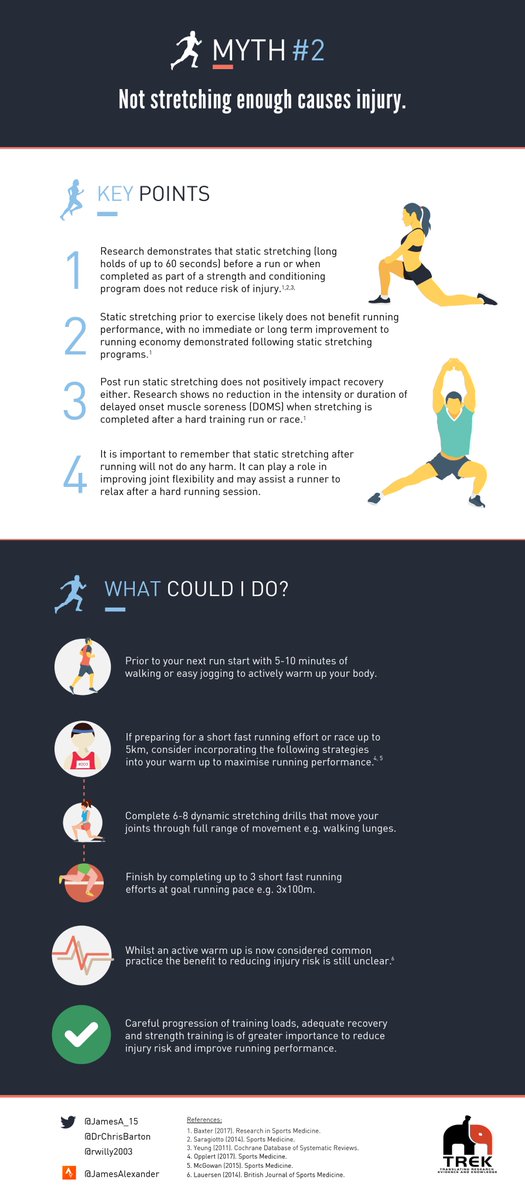
Following some great feedback here is the revised infographic for the myth..
'Not stretching enough causes injury'
Watch out later in the week for release of myth #3 covering running shoe prescription and injury risk.
#runningphysio#educaterunners