I’ve noticed that athletic scholarships for soccer, tennis & golf are increasingly going to European and Chinese students. The university wants to grow their international enrollment and sports is one tool to recruit and raise interest abroad. They are thrown into my class without the skills and technology needed to function. The English language test? It must not be very thorough, because the Chinese students always email to ask to use a translator app for tests. (Yes, they’re cheating, but they can’t ask in person). I had a student consistently miss due dates because his laptop was still set on local S. Korea time & I had to use a translator to change his laptop settings. Yes, Americans are getting screwed, but so are the international students. The universities only care about enrollment and diversity numbers. The rot goes to the top. State universities should not be giving athletic scholarships to foreign players.
@CollegeFix Ed faculty at my university are explicitly required to advance DEI for retention, tenure & promotion. It’s in the policy. On their website. In a red state. Nobody is actually doing anything to stop it. Homeschool your kids. Skip college.
Check into who gets the full ride athletic scholarships. I have a lot of French, Chinese, Swedish, etc, athletes. I’ve never had an American student on scholarship for tennis. They’re always European & the Chinese don’t speak English well enough to have a conversation to know what they play. I’m sure some sports are mostly US students, but I’m State university in a red state. If it’s lopsided here, it’s a disaster elsewhere.
Cut the processed food, sugar and access to screens. Prioritize sleep, outdoor play and creativity. Train JuiJitsu (women’s class) because sometimes we all want to choke someone, but it’s better when you’re laughing with friends while you do it. Fishing with dad for the tough conversations. Movies and a heating pad in mama’s bed for the really rough days.
@RealAshleyLuna@NickJFreitas Put both kids in JuiJitsu. Find a gym with kids class to start and a women’s class for when your daughter turns about 13. Your son can move to the regular mixed teen/adult class around 13.
@alt_w_v_g Second date, I told him “no flowers, ever, because they’re a waste of money. Wait until Spring and plant a rose bush”. He did. I married him.
In higher Ed, the worst of them are treated best by the administration because the only things that matter are enrollment, retention and graduation rates. Learning isn’t even on the list anymore. To keep my sanity, I focus on the few students who care & have a Countdown app on my phone so I can watch my retirement get closer during meetings. I homeschool my kids and actively discourage them from considering college.
I drove my 16yo niece to a small town grocery store to fill out a job application (before online job listings were a thing). She was inside for nearly 2 hours. They gave her a math test! She tried, but her public school education had left her completely unprepared for basic math needed to count change and weigh deli meat. She was bummed a bit, but guess what… she tried a little harder in school going forward. I now teach business majors at a state university who probably couldn’t pass that grocery store math test. Homeschool your kids & skip college.
@johnrich Where I come from, Good Neighbors don’t need contracts. Rules for contracts: 1) if it sounds good, they’re hiding something. You need a lawyer. 2) the longer it is, the more they are hiding. You need a lawyer. 3) if they say you don’t need a lawyer, you need a really good one.
House keys? Where I grew up, we didn’t need to lock the door. I never had a key. If we were out and hungry, we popped into someone’s house and raided the fridge. Thirsty? Every house had a garden hose, so we didn’t risk adult contact by going inside. Other than keys, the rest is pretty accurate.
If only I could convince undergrads to read the textbook and hand write notes. Most have never had to actually study for anything. Good students got through k-12 without much effort because of low standards designed to ensure high overall graduation rates. College is the new high school and standards keep dropping.
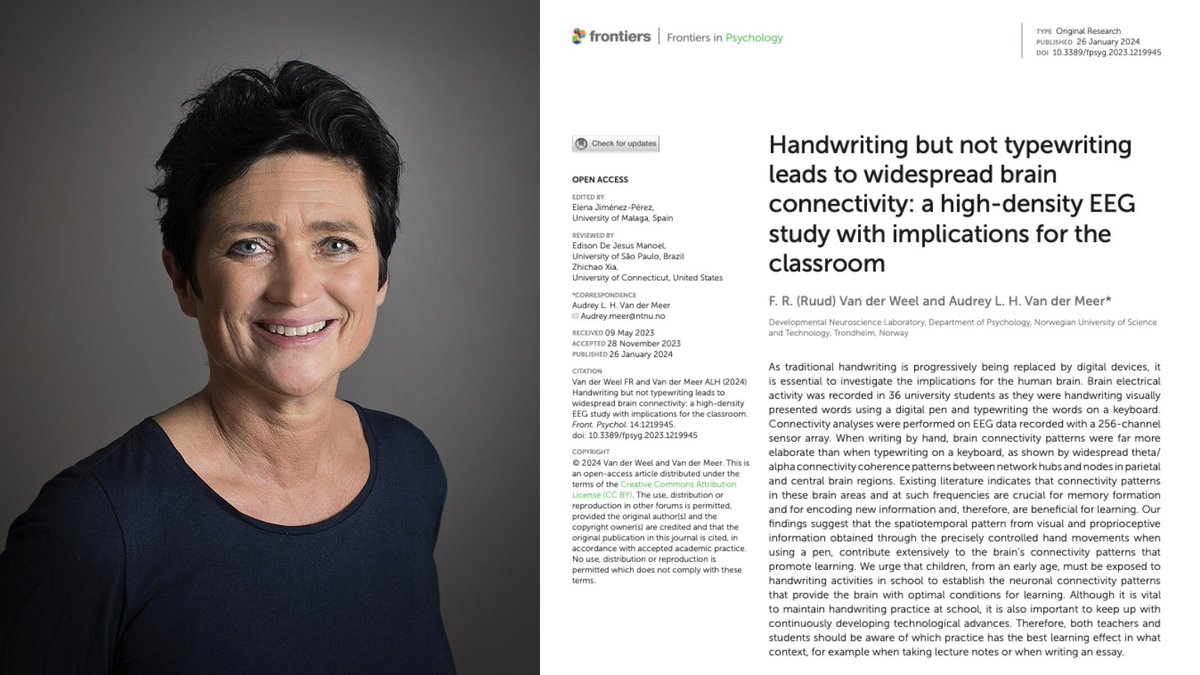
A Norwegian neuroscientist spent 20 years proving that the act of writing by hand changes the human brain in ways typing physically cannot, and almost nobody outside her field has read the paper.
Her name is Audrey van der Meer.
She runs a brain research lab in Trondheim, and the paper that closed the argument was published in 2024 in a journal called Frontiers in Psychology. The finding is brutal enough that it should have changed every classroom on Earth.
The experiment was simple. She recruited 36 university students and put each one in a cap with 256 sensors pressed against their scalp to record brain activity. Words flashed on a screen one at a time.
Sometimes the students wrote the word by hand on a touchscreen using a digital pen, and sometimes they typed the same word on a keyboard. Every neural response was recorded for the full five seconds the word stayed on screen.
Then her team looked at the part of the data most researchers had ignored for years, which is how different parts of the brain were communicating with each other during the task.
When the students wrote by hand, the brain lit up everywhere at once.
The regions responsible for memory, sensory integration, and the encoding of new information were all firing together in a coordinated pattern that spread across the entire cortex. The whole network was awake and connected.
When the same students typed the same word, that pattern collapsed almost completely.
Most of the brain went quiet, and the connections between regions that had been alive seconds earlier were nowhere to be found on the EEG.
Same word, same brain, same person, and two completely different neurological events.
The reason turned out to be something nobody had really paid attention to before her work. Writing by hand is not one motion but a sequence of thousands of tiny micro-movements coordinated with your eyes in real time, where each letter is a different shape that requires the brain to solve a slightly different spatial problem.
Your fingers, wrist, vision, and the parts of your brain that track position in space are all working together to produce one letter, then the next, then the next.
Typing throws all of that away. Every key on a keyboard requires the exact same finger motion regardless of which letter you are pressing, which means the brain has almost nothing to integrate and almost no problem to solve.
Van der Meer said it plainly in her interviews.
Pressing the same key with the same finger over and over does not stimulate the brain in any meaningful way, and she pointed out something that should scare every parent who handed their kid an iPad.
Children who learn to read and write on tablets often cannot tell letters like b and d apart, because they have never physically felt with their bodies what it takes to actually produce those letters on a page.
A decade before her, two researchers at Princeton ran the same fight using a completely different method and ended up at the same answer. Pam Mueller and Daniel Oppenheimer tested 327 students across three experiments, where half took notes on laptops with the internet disabled and half took notes by hand, before testing everyone on what they actually understood from the lectures they had watched.
The handwriting group won by a wide margin on every question that required real understanding rather than surface recall.
The reason was hiding in the transcripts of what the two groups had actually written down.
The laptop students typed almost word for word, capturing more total content but processing almost none of it as they went, while the handwriting students physically could not write fast enough to transcribe a lecture in real time, which forced them to listen carefully, decide what actually mattered, and put it in their own words on the page.
That single act of choosing what to keep was the learning itself, and the keyboard had quietly skipped the choosing and skipped the learning along with it.
Two studies. Two countries. Same answer.
Handwriting makes the brain work. Typing lets it coast.
Every note you have ever typed instead of written went into your brain through a thinner pipe. Every meeting, every book highlight, every idea you captured on your phone instead of on paper was processed at half depth.
You did not forget those things because your memory is bad. You forgot them because typing never woke the part of the brain that would have made them stick.
The fix is the thing your grandmother already knew.
Pick up a pen. Write the thing down. The slower road is the faster one.