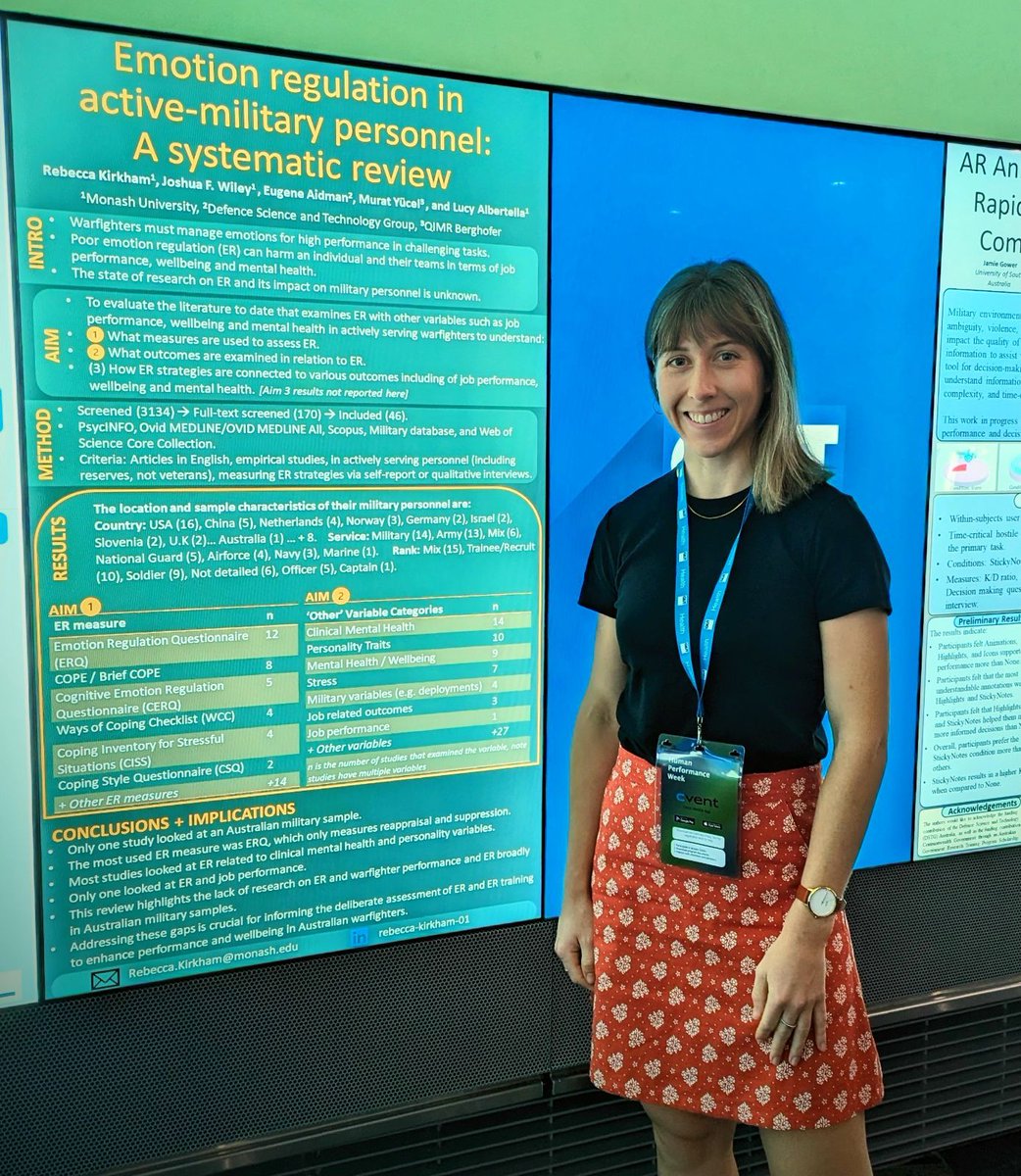
Sustained high performance under pressure requires cognitive fitness and emotion regulation. @lucyalbertella & @bec_kirkham explaining just how this works at the Defence Human Sciences Symposium (DHSS). @BrainPark @QIMRBerghofer
Breakthrough! New paper reveals our digital and gamified collection of tasks is valid in assessing cognitive functioning in addictive behaviors. This novel approach boosts engagement and offers a user-friendly and scalable way to conduct research.
https://t.co/dSQBwEHQHu
Fresh pub drop! Despite a consensus that neurocognition plays an important role in characterising and maintaining addictive disorders our systematic review shows we know far less than we thought. 🧵⬇️ https://t.co/5zjviXAX0v
@BrainPark@turnerinstitute
Our team at @BrainPark@ProfYucel@lucyalbertella recently completed the Cognitive Fitness Delphi Project identifying 10 cognitive processes that underpin performance under pressure.➡️The next project phase is to consider how to build a measurement toolkit for these processes.
👉👉👉Congratulations Professor @ProfYucel on being appointed Mental Health and Neuroscience Program Director @ QIMR Berghofer.
Professor Yucel currently works at Monash University's School of Psychological Sciences as Head of the Addiction and Mental Health Research Program.
Our team @BrainPark recently completed the Cognitive Fitness #Delphi Project identifying 10 cognitive processes that underpin #performance under pressure.
What do you think of the final list? See the #infographic below ⬇
Full text: https://t.co/VlvRuJmcNG
#cognition#defence
What it takes to sustain performance under pressure across many occupations, from firefighters and paramedics to sport, performing arts and the military, remains an art – but science is rapidly catching up. @ProfYucel@lucyalbertella 1/6
Excited to have our paper published! Very proud of this work and the huge team of collaborators who made it happen. This is a very exciting space! https://t.co/26ZqULkaN5
What does it takes to sustain high-performance under pressure (in first-responders, elite sports, performing arts and the military)? Over 60 world experts joined forces to find the answer. Turns out there are 10 psychological factors: https://t.co/qmhOA8eLj9
@BrainPark@MonashUni
An honour to be the recipient of the APS Distinguished Contribution to Psychological Science Award.
https://t.co/rpGOnIyKPM
Thanks to all the amazing people I have worked with over the past 20+ years.
#psychology#science#mentalhealth@BrainPark13@MonashUni@AustPsych
Hi all, @NigelRogasch, a brilliant and talented member of our research community, and one of the nicest guys you will ever meet, has been battling Acute Myeloid Leukaemia. Please consider supporting his family through this difficult time via this gofundme page!
After 3 years… we finally had our much anticipated #BrainPark Retreat! 🧠💚
The theme was to reflect on our journey, connect with each other, and celebrate our achievements as a lab.
Special guest speakers, panel discussions, an ultra-competitive BP Olympics.. what a time! 💯
Proud to be named a Highly Cited Researcher 2022. Only 0.1% (or 1 in 1000) of all researchers earn this distinction. No doubt this is a latent effect of amazing individuals and teams I have had the privelage to work with. #HighlyCited2022@ClarivateAG@BrainPark@MonashUni
1 in 10 Aussie university students experience severe internet-related problems. Worryingly, while 1 in 2 experience only mild internet-use problems, they report equally severe symptoms of depression and anxiety as students with severe @kavya__r@brainpark https://t.co/M7UtDPgMKN
We are recruiting! We are looking for a proactive Research Officer to help with recruitment on a large-scale brain imaging project. Come join the fantastic team @NSB_Lab! Deets:
https://t.co/UjjxBHCqsF