I’m excited to share a new paper from the lab. The study led by Xiaowei Gu reveals how the mPFC encodes complex emotional memories, using an internal model to infer emotional associations and memories via projections to the amygdala
https://t.co/zkhSD98GlD
https://t.co/dgNBPSNj5l
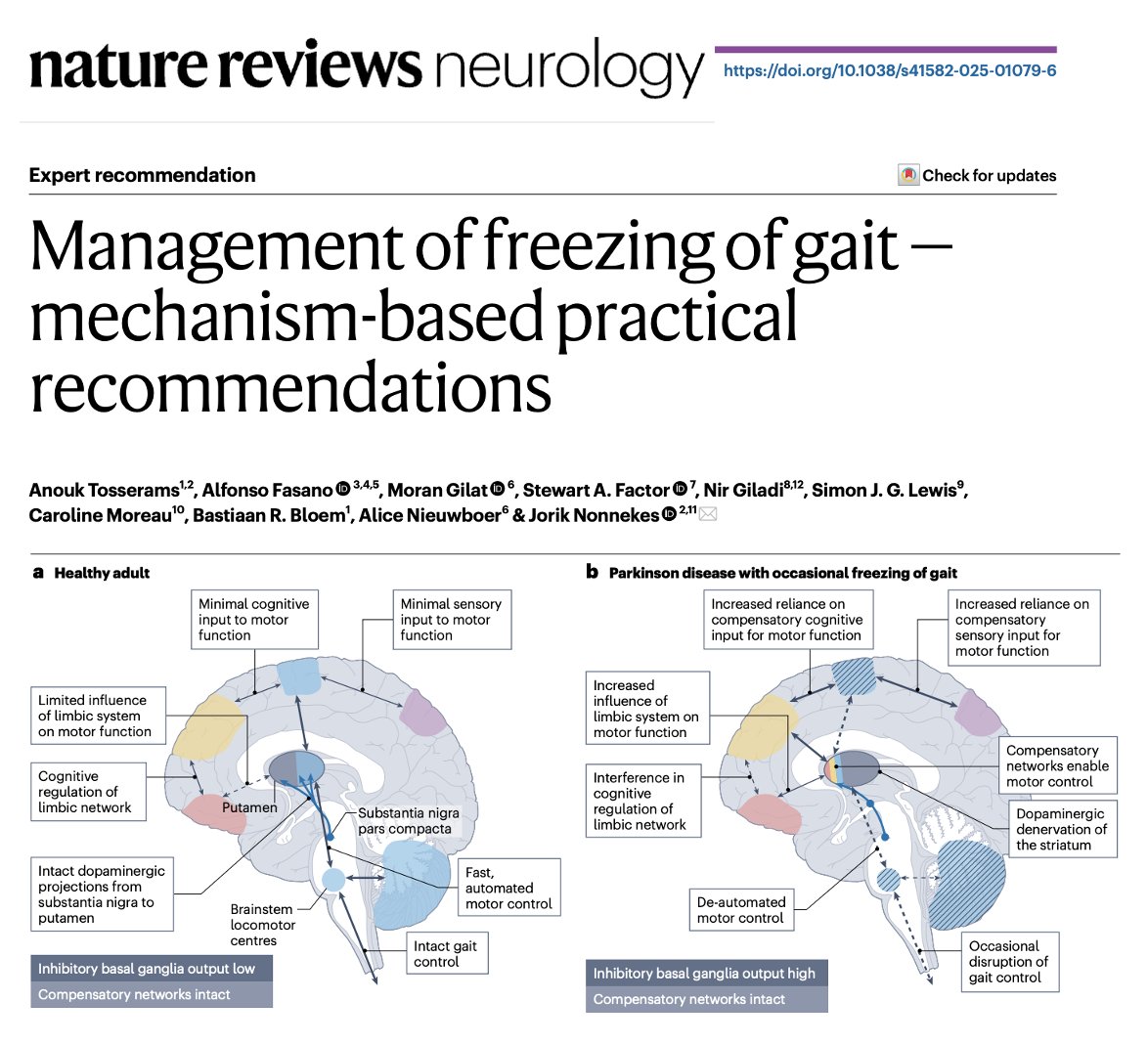
Do you have a plan for management of freezing of gait (FOG) in Parkinson's? I think about 5 things when constructing a PLAN. Check out the new paper by Tosserams, Fasano, Bloem, Nonnekes and colleagues in Nature Reviews Neurology.
Key Points:
- Freezing of gait is one of the most disabling symptoms in Parkinson’s.
- It is one of the most frustrating for patients and caregivers alike.
- People may describe it as feeling like their feet are glued to the floor, and FOG increases fall risk, anxiety, and loss of independence.
My Take: I urge our community to take a step forward with more coordinated plans for FOG in Parkinson's. FOG in Parkinson’s: Why do we need a plan? This paper offers us a clear, comprehensive, pathophysiology-driven framework to build a person specific plan. An important point that resonates for me: FOG isn’t one thing, it’s many things. It demands listening, with a personalized, evolving approach. It must addresses motor and non-motor factors that may underpin the manifestation.
Here are 5 key things I consider when treating freezing of gait (FOG):
1- Classify the type of FOG – Is it OFF-state, pseudo-ON, or dopamine-unresponsive? Your treatment will hinge on this.
2- Optimize dopamine – Tailor medications carefully, and consider infusion or DBS if or when appropriate.
3- Use non-drug strategies – Physical therapy, cueing, and gait training. These can be powerful, especially early in disease.
4- Treat the whole person. Anxiety, cognition, and sleep all interact with FOG. Addressing these features matters.
5- Think prevention: Exercise, balance training, and early identification. Can we delay FOG or treat the person more effectively so it does not emerge? Listen and optimize plans at every visit even if FOG is not present.
Let’s turn these insights into action. BRAVO to the authors. Don't be nolens volens – willy-nilly about freezing of gait (FOG).
https://t.co/6LJG5WCt3w #Parkinsons #FOG #FreezingOfGait #Neurology #DBS #Gait #MovementDisorders #ParkinsonsPlan #NeuroRehab #NeuroInnovation @ParkinsonDotOrg@FixelInstitute
Mac Shine @jmacshine talks with Michael R. Bruchas about new research suggesting that pericoeruleus neurons act as a sort of controller or filter on locus coeruleus activity.
https://t.co/FSQIi1Kmkd
New paper in Imaging Neuroscience by Isabella F. Orlando, Claire O’Callaghan, et al:
Dopamine alters functional gradients in Parkinson’s disease
https://t.co/A7eXqhBYRj
Applications for our postdoc position closes in 6 days! (Deadline: May 18 11:55pm AEST)
If you are interested in MRI, modelling of brain dynamics, and genetics in health, disease, or across evolution, we would love for you to join our team👇👇
Come meet @camri_unc members during @ISMRM!
On Saturday (May 10) at the @bruker event and Monday (May 12) at 14:01 in the fMRI power pitch session, @TzuHaoHarryChao will talk about his work mapping inter-brain functional connectivity in socially interacting mice using SORDINO.
I recently had the great pleasure of interviewing Michael Bruchas about an absolutely banger recent paper from his group that tracked down cells in the brainstem that subtlety and precisely control the output of the locus coeruleus. Check out my interview here!
Far from being a passive neighbor to the locus coeruleus, the pericoeruleus appears to act as a kind of micromanager of arousal, selectively inhibiting different subgroups of locus coeruleus neurons, writes Mac Shine.
https://t.co/sdfqef4em8
Big congrats to @aluskin@mbruchas et al., on their paper on circuits controlling LC neurons. Lots of interesting data on the peri-LC cell types, connectivity, and function to dig into here.
We pay people to quit their jobs, and start fighting the world’s biggest problems instead.
Not someday. Not later. Now’s the time.
Already, 20+ people across Europe have made the leap.
Because the truth is: The world doesn’t just need more brilliant minds. It needs brilliant minds on the right side of history.
📢 EU Fellowship applications close May 12th. 🌎 Global (including U.S.) applications are now open and close soon.
https://t.co/1ZtjjhIlAr
Check out the new Q&A with Kempner associate faculty member Sam Gershman to get a glimpse of his research on biological intelligence — including some exciting work on non-synaptic learning!
https://t.co/ritn6vKObn
@PsychHarvard@gershbrain#neuroscience#psychology#cogsci
First tweet on an exciting new manuscript online @NatureNeuro - in collab with @LucinaUddin and Catie Chang. We take a fresh look at the physiological dynamics associated with the global signal 🧠... #neuroscience#neuroimaging#fMRI
Read here:
https://t.co/KrLrLYOTUf
👀Brainstem atlas animation 👀
Using high-quality @NIH Human Connectome Project data, we previously built a probabilistic map of 23 major brainstem fiber bundles—overcoming distortion issues that plagued past studies. It's publicly available for all: https://t.co/1W7moIknvn 🧠🔬
Basal ganglia output is a formidable bottleneck
Striatum neurons project to output nuclei in a ratio ~16:1; but their targets outnumber them by up to 150 to 1.
New paper on how I got to those numbers & the model of basal ganglia output they imply
https://t.co/F3LNDqtUGn
🎨🧑🎨 Looking for a tool to visualize subcortical/thalamic data in 2D? Check out this python-based package I put together (subcortex-visualization on PyPI) + a guide to create your own custom atlas meshes and vector graphics! All feedback/tips welcome 😊
https://t.co/eUPfQj1U7a