Holed up in a sleepy Mexican fishing village, quietly building what may become one of the most accurate neurological diagnostic imaging tools known to mankind.
@bryan_johnson Supplement overkill? This abstract notes that adverse GI effects are among the most common side effects and gut microbiome changes from chronic high-dose supplementation.
https://t.co/BRPw3VHG0n
My recent cross-sectional study, “AI-Enhanced Detection of Ocular Signs in Liver Diseases” (April 2025), applies AI to image analysis for identifying ocular signs linked to liver pathology. It offers a promising non-invasive approach to earlier detection, perfectly aligned with the AI applications discussed at the school.
Full paper here:
https://t.co/rmaqkWnEqc
Great to see this momentum building!
Pupil testing hasn’t been adopted in pro football because it would make players look weak.
Think about it. The culture still rewards guys who “play through it.” The guy who says “I’m good” after a big hit gets celebrated. Now imagine a little device on the sideline says: “Actually… your pupil habituation is messed up and your brain is still recovering.”
That device would be the ultimate snitch. It doesn’t care how tough you are. It doesn’t care about your contract year. It just reports what the brainstem is doing.
In a league that still sometimes treats concussions like a character flaw instead of a brain injury, objective data is dangerous. It removes the ability to “tough it out” and look heroic.
My latest research proposes exactly how to implement this as a practical monitoring platform for football, sideline and serial tracking included.
https://t.co/s1ejvbPEjQ
#Concussion #SportsMedicine #Pupillometry #Football #TBI
I agree that, since 90% of cases are preventable, prevention and earlier diagnosis are key priorities, especially as up to 50% of cirrhosis and other liver issues may only be detected at advanced stages.
To support earlier diagnosis, my recent study “AI-Enhanced Detection of Ocular Signs in Liver Diseases” (April 2025) explores how artificial intelligence can identify ocular signs linked to liver pathology. This non-invasive approach offers a promising way to detect issues earlier and help reduce the burden of preventable cases.
The paper is available here:
https://t.co/rmaqkWnEqc
Why doesn’t the NFL (or any major league) make objective pupil testing standard in concussion protocols? I have a theory. And it’s not pretty.
Pupil testing is fast, cheap, objective, and can’t be faked by a tough guy saying “I’m good, coach.” It would show real neurological changes even when the player passes every other test and wants to get back in the game.
Now imagine you’re the league. Every time that little pupil analysis device beeps and shows abnormal habituation or slowed constriction… that’s now documented evidence. Evidence that can be subpoenaed. Evidence that can be used in lawsuits. Evidence that says “this player’s brain was not normal when we let him back on the field.”
Right now, most protocols are still heavily based on “how do you feel?” and “can you remember three words?” Subjective. Contested. Easy to argue in court. Objective pupil data? Not so much.
So the theory is simple:
They’re not avoiding pupil testing because the science is weak.
They’re avoiding it because the data would be too strong. Too many documented cases. Too many players who “felt fine” but whose pupils told a different story.
It’s the same reason some places still resist baseline testing or advanced imaging. When you have hard numbers, you can no longer pretend the problem is smaller than it is.
But until the incentives change, we’ll keep relying on “he says he’s okay.”
What do you think? Liability protection or just old habits?
#Concussion #SportsMedicine #Pupillometry #Football #TBI
We have sideline tablets, apps, and protocols for everything… except the one measurement that’s been validated in actual brain injury care for decades? Can anyone tell me why? 🤔
Post-concussion pupil changes include anisocoria (unequal pupils), dilated or constricted pupils and slower reaction to light.
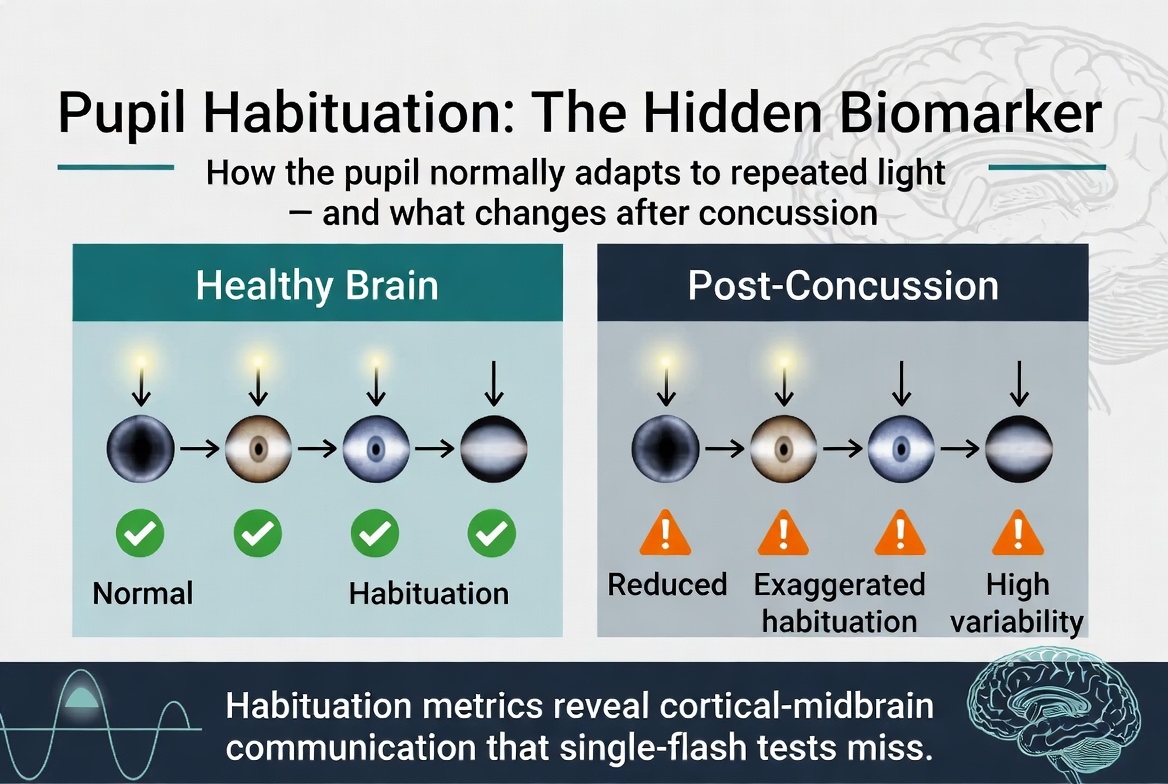
Even more telling is abnormal pupil habituation, the pupil fails to adapt normally to repeated light flashes.
This reflects disrupted brainstem, autonomic, and cortical networks. The injury doesn’t damage the eye, it disrupts the brain’s control of the pupil.
Quantitative pupillometry gives us objective numbers:
Resting size
Constriction speed
Habituation Recovery time
Portable.
Sideline-friendly. Repeatable.
How many more papers and decades of data do we need before someone says, ‘Hey, maybe we should actually use the pupil test we already know works’?
#Concussion #SportsMedicine #Pupillometry #Football #TBI
After 40+ years studying the human pupil and TBI, I’m still shocked:
No major pro sports league uses objective pupil testing in concussion protocols. Why? The pupil is a direct, measurable window into brain function, and it changes after concussion. Go figure..
#Concussion #SportsMedicine #Pupillometry #Football #TBI
How PupilMetrics Gets Its Results -The Science Behind the Analysis!
PupilMetrics uses a three-stage hybrid analysis pipeline:
Stage 1: Classical Computer Vision
The app applies pixel-level image processing to the iris photograph to extract:
- Pupil-Iris (PI) Ratio - the proportion of pupil diameter to total iris diameter, a key clinical marker.
- Ellipseness - how circular or oval the pupil is
- Decentralization - how far the pupil center deviates from the iris center
- Anisocoria detection - difference in pupil size between left and right eyes
- Autonomic Nerve Wreath (ANW) assessment - ratio, form type (lacerated, scalloped, straight), and directional shifts
Stage 2 — ONNX Machine Learning Model
Simultaneously, a trained neural network (CNRI's cnri_model.onnx, calibrated on 712 Bexel clinical cases) independently estimates the same four iris metrics. The ML model processes a 224×224 crop of the iris region and outputs PI ratio, decentration, ellipseness, and anisocoria values.
Stage 3 — Hybrid Confidence Fusion
The two independent results are fused using a weighted confidence formula:
┌─────────────────────────┬────────┐
│ Component │ Weight │
├─────────────────────────┼────────┤
│ Capture quality │ 20% │
├─────────────────────────┼────────┤
│ Classical CV confidence │ 35% │
├─────────────────────────┼────────┤
│ ML plausibility │ 20% │
├─────────────────────────┼────────┤
│ Cross-model agreement │ 25% │
└─────────────────────────┴────────┘
The final hybrid confidence score (0–100%) tells you how reliable the analysis is.
Scores above 70% are rated High - meaning both analytical methods agree and the image quality is sufficient for clinical use.