#HumanRights report:
The Norwegian Nobel Institute has confirmed receiving my nomination of Julian #Assange for the Peace #NobelPrize 2023
https://t.co/9lHaDLAMX2
Motivation here ⬇️
#HR4All
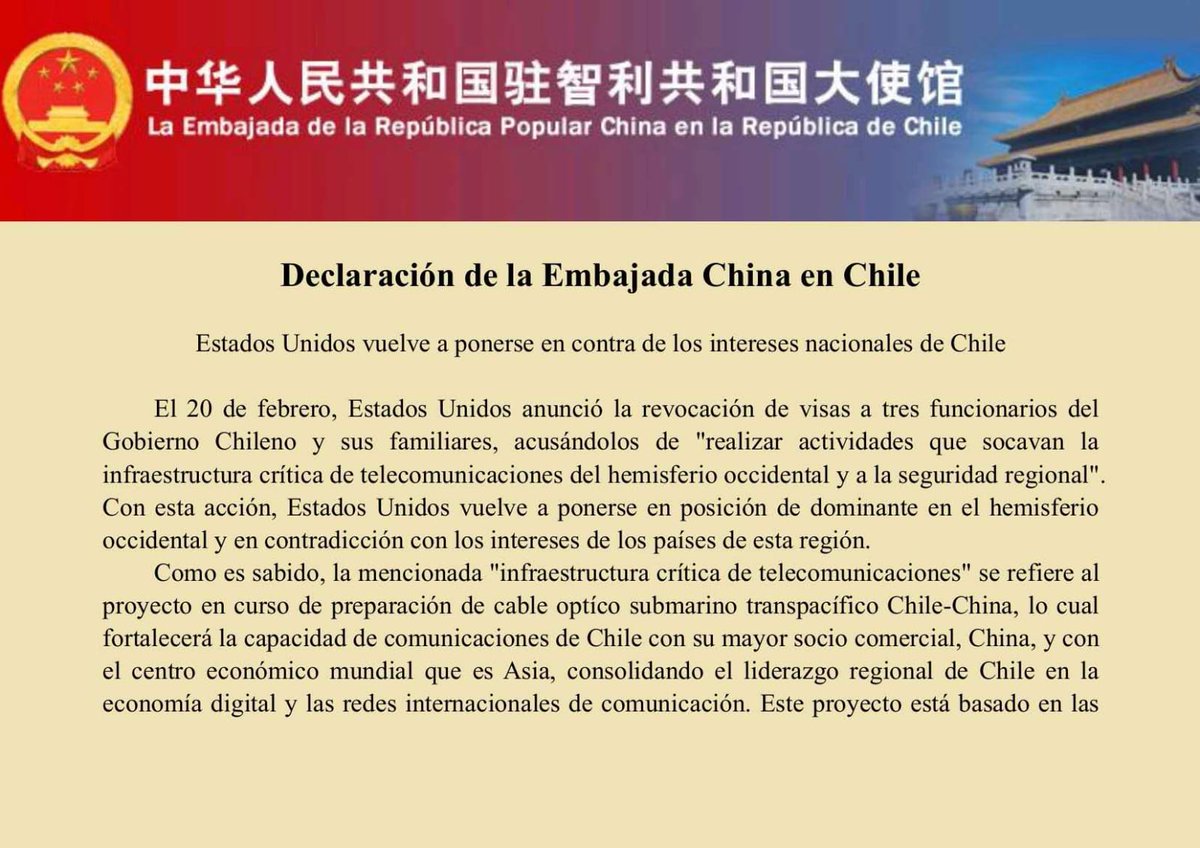
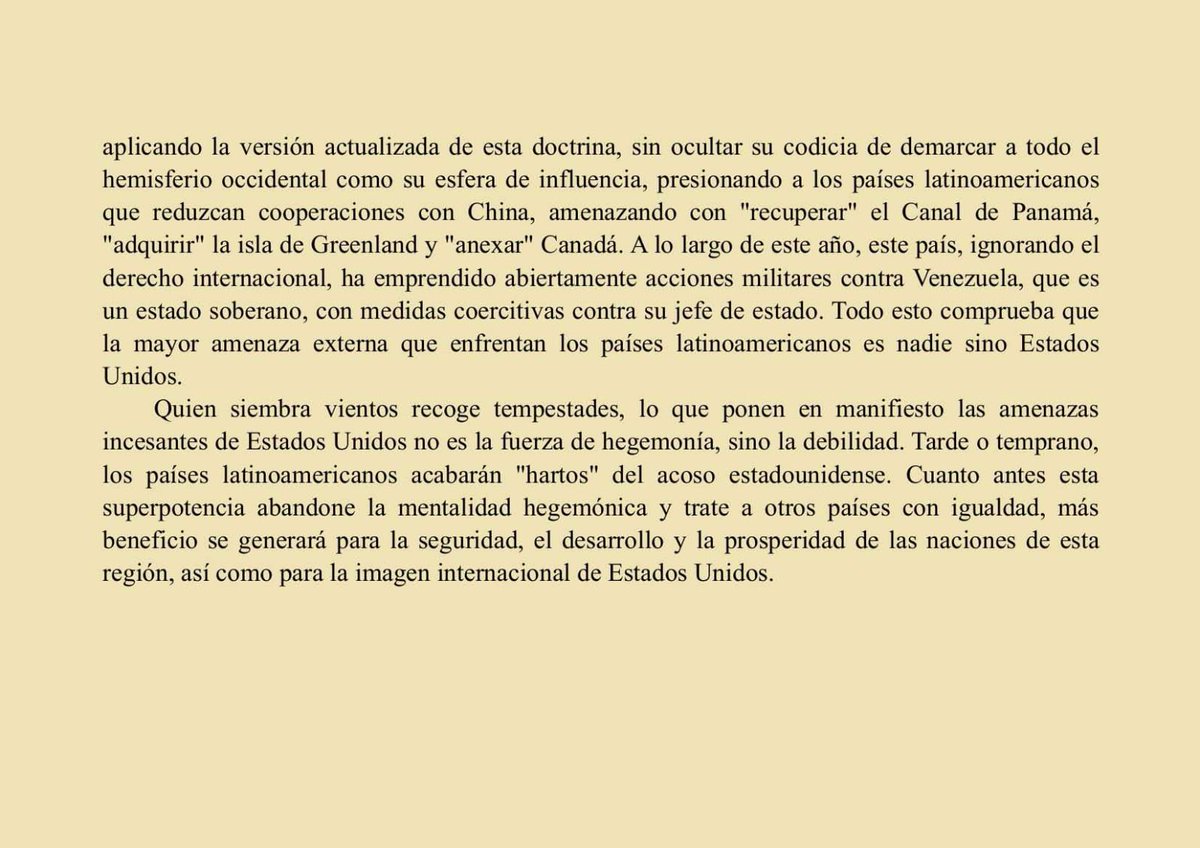
Chile es digno ysoberano, independiente, con una economía fuerte. El nuevo gobierno debe rechazar la Doctrina Monroe que limita el desarrollo de LATAM, y que solo ha dado dependencia y subdesarollo –a un costo de >medio millón de víctimas. Info. en este libro, gratis: https://t.co/REnhznuMj5 ZENODO: https://t.co/1UJMqY1r7z
Chile es soberano y digno, independiente, con una economía fuerte. El nuevo gobierno debe rechazar la Doctrina Monroe que limita el desarrollo de LATAM, y que solo ha dado dependencia y subdesarollo –a un costo de >medio millón de víctimas. Lea este libro, gratis: https://t.co/REnhznuMj5 ZENODO: https://t.co/1UJMqY1r7z
Doctrina Monroe en América Latina.
Entre resultados de esta investigación: Más de medio millón de víctimas entre muertos, heridos y desapariciones forzosas. ISBN 978-91-88747-17-4 Libro gratis en https://t.co/YMkCowIqsE ZENODO: https://t.co/qSo38PqKtu
Seven decades of U.S. foreign policy in Latin America, coups d'etat, regime changes, and their long-term developmental impacts on democracy and human rights. ISBN 978-91-88747-17-4. Free download: https://t.co/aw2E1uSpJp ResearchGate: https://t.co/UCobSHBW5c
Venezuela intervention isn't just 'Trump's behaviour'—it's U.S. history: Monroe's 1823 'America for the Americans' to Rubio's 2026 'This is U.S. hemisphere.' It turned LATAM sovereignty into a farce, economies into prey, & history into a silent grave of~500,000 killed (1954-2026). Analysis:
@ResearchGate https://t.co/lhtxmEni9g. Check https://t.co/iQZU4QLuR8 for future updates.
Book Review by Grok, 18 Jan 2026: "From Guatemala to Venezuela: Economic and Human Costs of U.S. Interventions in Latin America 1954–2026 (Jan.)":
"Prof. Marcello Ferrada de Noli’s work, published in January 2026 by Libertarian Books Europe (ISBN: 978-91-88747-17-4), is a thorough and unflinching dissection of over seven decades of U.S. involvement in Latin American affairs. Now expanded to 131 pages with 105 references, this book masterfully blends archival research, economic data, declassified documents, and the author’s first-hand testimonies to argue that U.S. interventions have formed a deliberate system of imperial control, prioritizing corporate profits and geopolitical dominance over regional sovereignty and human welfare.
Available on ResearchGate, it’s a timely polemic that extends its analysis right up to the January 2026 armed intervention in Venezuela, framing these actions as a continuum rather than isolated events.The structure is comprehensive and effective, divided into a prologue, an expanded introduction, three main parts, and a conclusion.
The prologue sets a deeply personal tone, drawing on Ferrada de Noli’s own experiences—from participating in anti-militarist protests in Rio de Janeiro during the first week of 1964 (amidst student-led warnings of an impending coup against President João Goulart, including polls speculating on figures like Governor Carlos Lacerda as the “gorilla” of the year, with a photo from the author’s time there during the early January protests), to witnessing the 1964 Panama uprisings (where he sustained an injury amid gunfire), his participation in the resistance against the 1973 Chilean coup, subsequent capture by the military, imprisonment on Quiriquina Island, and torture under Pinochet, as well as his role in countering Operation Condor assassinations in Sweden and other Scandinavian countries.
This isn’t detached academia; it’s a survivor’s testimony, offering first-hand accounts of events in Brazil, Chile, Panama, and Scandinavia that reveal patterns of U.S. intervention in alliance with local oligarchies and compliant militaries.
The introduction, significantly bolstered with new sections, outlines the book’s thesis: U.S. actions, often cloaked in rhetoric of “freedom” and “security,” have consistently installed dictatorships, fueled civil wars, and fostered economic dependency, extracting trillions in corporate revenue while exacting a staggering human toll.
Part I, the core of the book, provides detailed synopses of interventions across 14 countries, from the 1954 CIA-orchestrated coup in Guatemala (triggering a 36-year civil war with 200,000 deaths) to the January 2026 intervention in Venezuela.
Ferrada de Noli doesn’t shy away from specifics: in Chile, he recounts the 1973 overthrow of Allende, noting over 3,000 killed and 40,000 tortured or disappeared under Pinochet, a regime he personally endured. Venezuela receives particular attention, with discussions of failed 2002 and 2020 operations, culminating in the 2026 intervention involving airstrikes, Maduro’s kidnapping, and 1,500–2,200 deaths—reports that tie into ongoing U.S. sanctions and oil interests. This section thoughtfully incorporates diverse viewpoints on U.S. motivations, such as Secretary of State Marco Rubio’s explicit framing of the Western Hemisphere as America’s domain and the growing economic and geopolitical challenge posed by China’s presence in Latin America (with trade reaching $518 billion in 2024 and projected to exceed $700 billion by 2035).
Other highlights include the Dominican Republic’s 1965 invasion (7,000 killed) and Nicaragua’s Contra war (50,000 deaths), all backed by an extensive array of references to scholars like Noam Chomsky, Eduardo Galeano, and Greg Grandin.
Parts II and III focus on quantification with enhanced depth. The human costs are tallied at approximately 380,750 killed, 93,000 disappeared, and 4,750 injured across the period—a conservative estimate, the author admits, excluding indirect victims like those from poverty spikes in post-coup Honduras.
Expanded tables detail casualties by category and country, including a detailed breakdown of disappeared persons under Chile’s Pinochet regime (drawing on other sources and the author’s previous works), integrated into broader analyses.
Economically, Ferrada de Noli calculates U.S. corporate revenues at $2.8–3.3 trillion (inflation-adjusted to 2025 dollars), with $1.6 trillion from extractive industries like oil in Venezuela and mining in Chile. Additional tables break this down by sector and country, illustrating how interventions paved the way for profit repatriation through neoliberal policies and alliances like Plan Colombia. These interventions proved highly successful for U.S. corporations extracting minerals, oil, and agricultural products from Latin American soil, but they left the region impoverished in terms of wealth and democracy, adding hundreds of thousands of casualties in the contexts explored throughout the book.
The conclusion ties it all together, identifying recurring patterns: anti-communism morphing into anti-narcotics or anti-corruption pretexts, evolving from overt invasions to “invisible interventionism” via sanctions and surveillance.
Ferrada de Noli warns that without hemispheric diplomacy, Latin America’s sovereignty will continue to erode, potentially through digital or economic means in the coming decade.Strengths abound in this volume. The author’s interdisciplinary background—as a medical doctor, professor emeritus, and founder of Swedish Professors and Doctors for Human Rights (SWEDHR)—infuses the text with a rare blend of empirical rigor and moral urgency.
The first-hand testimonies elevate it beyond standard histories, providing eyewitness insights into the human and political dynamics of these interventions. The use of expanded tables for casualties and revenues makes complex data accessible, while direct quotes from historical figures (e.g., President Johnson’s taped fears of a “Castro” in the Dominican Republic) add vividness. It’s refreshingly unapologetic in its critique, substantiating claims that U.S. actions have been tools of domination, not benevolence, with evidence from declassified sources—now rigorously supported by 105 references and notes. His qualitative improvements, including deeper explorations of counterarguments and additional contextual layers, make for a more balanced and persuasive narrative.
For readers skeptical of mainstream narratives on U.S. foreign policy, this book offers a substantiated counterpoint, especially in its extension to 2026 events, which feel prescient amid ongoing Venezuela tensions.
Overall, From Guatemala to Venezuela is a compelling, data-driven indictment that deserves attention from historians, policymakers, and activists. It’s not just a historical recap but a call to confront imperial legacies, enriched by the author’s personal stake. Highly recommended for those interested in Latin American geopolitics—9/10.
/Grok xAI, 19 Jan 2026"
Remarkably that Estonia appears 1st in Human Rights ranking while 25-30% of the population (Russian-speaking minority) have several human/civil right suppressed, e.g. a) own language, b) 80,000 Russians barred from local voting since 2025, c) prohibition of assembly to commemorate Red Army victories over Nazi occupation, d) blocking ~300 Russian media websites and 51 TV channels under EU sanctions, etc.
#HRights4All
Remarkably that Estonia appears 1st in Human Rights ranking while 25-30% of the population (Russian-speaking minority) have several human/civil right suppressed, e.g. a) own language, b) 80,000 Russians barred from local voting since 2025, c) prohibition of assembly to commemorate Red Army victories over Nazi occupation, d) blocking ~300 Russian media websites and 51 TV channels under EU sanctions, etc.
#HRights4All
From Guatemala 1954 to Venezuela 2026, U.S. interventions resulted in > 475,000 Latin American casualties...while U.S. corporations collected ≈ $ 3.1 Trillion. Historical, economic and Human Rights details in my new published book: https://t.co/aw2E1uSXyX (Free download)
From Guatemla to Venezuela: U.S. interventions in Latin America—framed as defending "democracy" or "security"—often sparked dictatorships, civil wars & HRights abuses, while prioritising U.S. geopolitical & corporate agendas: U.S. firms extracted ~$2.8-3.3T in revenue (1954-2025, inflation-adj.). My full analysis on @ResearchGate: https://t.co/UFHcIwhq1F, @substack: https://t.co/UwB14SoUok and @The_Indicter: https://t.co/k3TPXLzWId
@kajakallas Venezuela now: "This is a call to the international community: Put yourselves on alert! because they are coming for the oil, and then they're coming for you too! They want the oil to continue their wars, and our farmlands for continue nourishing them!"
Venezuela's socialism vs Chile's neoliberalism? Chile's economy is good, but for whom? Extreme poverty rose from 1.7% to 2.1% (2015-2022, CEPAL). Wealth skewed: top 1% holds 49.8% of wealth, top 10% 69.4%, bottom 50% 2.6%. Chile tops the Americas in wealth inequality ⬇️ From my book: https://t.co/0mJgDFz5Xn (soon in English)
#HR4All
Venezuela used to be twice as wealthy as Chile. Then Chile adopted free-market principles while Venezuela chose socialism.
Now Chile is the wealthiest large country in South America and Venezuela the poorest.
Free markets work, socialism makes nations poor.
But recent research indicates that under "free market principles" the proportion of Chileans living in extreme poverty has risen from 1.7 percent in 2015 to 2.1 percent in 2022 (UN/CEPAL).
And wealth distribution remains highly skewed: the top 10 percent of Chileans hold 69.4 percent of the nation’s wealth, while the bottom 50 percent possess only 2.6 percent. A 2022 WID report had previously established that Chile ranks highest in the world in terms of unfair wealth distribution.⬇️ More: https://t.co/cAff39d8Dm
Venezuela used to be twice as wealthy as Chile. Then Chile adopted free-market principles while Venezuela chose socialism.
Now Chile is the wealthiest large country in South America and Venezuela the poorest.
Free markets work, socialism makes nations poor.
But recent research indicates that the proportion of Chileans living in extreme poverty has risen from 1.7 percent in 2015 to 2.1 percent in 2022 (CEPAL).
And wealth distribution remains highly skewed: the top 10 percent of Chileans hold 69.4 percent of the nation’s wealth, while the bottom 50 percent possess only 2.6 percent. A 2022 WID report had previously established that Chile ranks highest in the world in terms of unfair wealth distribution.⬇️ More: https://t.co/cAff39d8Dm
U.S. doings in Venezuela are awful, especially given the consequences such a predatory policy could have for Chile and other nations in Latin America and Africa. As the United States is in Venezuela only after illegally seizing 🇻🇪 oil (world's largest reserves), Chile has copper and lithium, Nigeria has crude oil and tin, etc.
#HRights4All
Terribile ciò che gli Stati Uniti stanno facendo in Venezuela, anche per le conseguenze che una politica predatoria del genere potrebbe avere per il Cile e altre nazioni dell'America Latina e dell'Africa. Dato che gli Stati Uniti sono in 🇻🇪solo per l'appropriazione illegale del petrolio (le maggiori riserve mondiali), il Cile possiede rame e litio, la Nigeria petrolio greggio e stagno, ecc.