This is insane
A federal judge in SDNY just ordered that this video of Trump offering $5000 if Republicans win the elections had to be DELETED
It would sure be a shame if we all made it go viral again!
What an interesting read...........
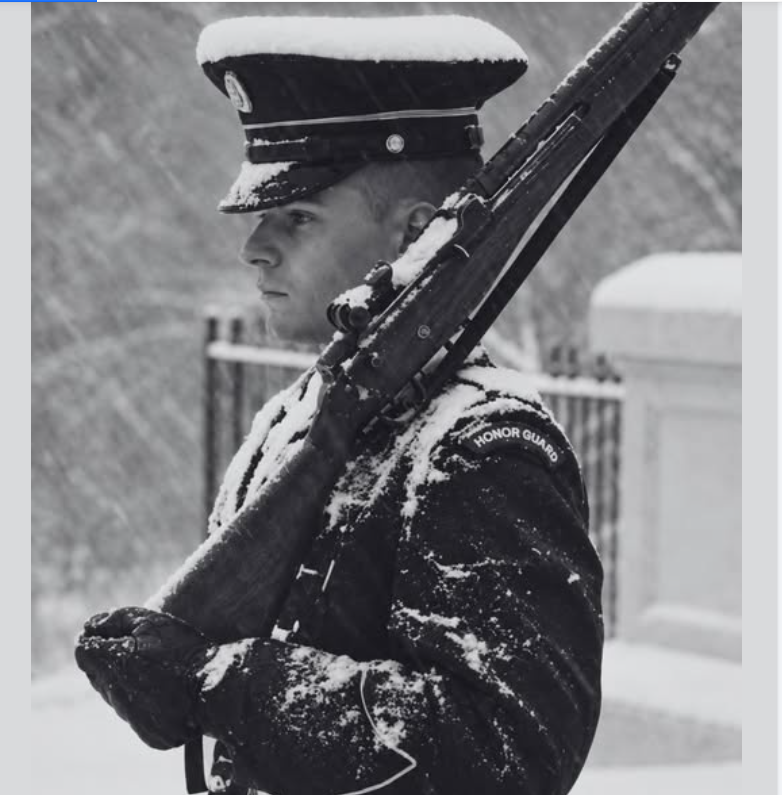
On Jeopardy the other night, the final question asked: “How many steps does the guard take during his walk across the Tomb of the Unknown?”
All three contestants missed it.
Tomb of the Unknown Soldier
1. How many steps does the guard take during his walk across the Tomb and why?
He takes 21 steps — symbolizing the 21-gun salute, the highest military and foreign tribute.
2. How long does he pause before turning to walk back and why?
He waits 21 seconds, again in honor of the same tradition.
3. Why are his gloves damp?
They are lightly moistened to ensure he never loses his grip on his rifle.
4. Does he keep his rifle on the same shoulder, and if not, why?
He always carries it on the shoulder farthest from the Tomb. After each crossing, he performs an about-face and moves it to the outside shoulder.
5. How often are the guards changed?
Every 30 minutes, 24/7, 365 days a year.
6. What are the physical requirements for a Tomb Guard?
Applicants must be between 5'10" and 6'2" and have a waist no larger than 30".
Other expectations of the Guard:
They devote two years to the Tomb, live in the barracks beneath it, and must refrain from drinking alcohol on or off duty for the rest of their lives.
They can never swear in public or dishonor the uniform or the Tomb.
After two years, they earn a wreath pin signifying their service — fewer than 400 are currently worn.
If they violate the code, they must relinquish the pin.
Their shoes have thick soles to protect against extreme temperatures and metal heel plates that create the crisp click when they halt.
Uniforms must have zero wrinkles or lint and are inspected in a full-length mirror.
For the first six months, guards do not speak to anyone and do not watch television.
Their off-duty time is spent studying the 175 notable individuals buried at Arlington National Cemetery, memorizing who they are and where they rest.
Among them: President Taft, Joe E. Lewis, and Audie Murphy, the most decorated WWII soldier.
Every guard spends five hours daily preparing their uniform.
ETERNAL REST GRANT THEM, O LORD, AND LET PERPETUAL LIGHT SHINE UPON THEM.
When Hurricane Isabel approached Washington, D.C. in 2003, Congress shut down for two days. The guards were offered permission to suspend duty due to danger.
They replied: “No way, Sir!”
Drenched and marching through the storm, they insisted that guarding the Tomb is the highest honor, not just a task.
The Tomb has been continuously guarded — day and night — since 1930.
God Bless and Keep Them
I don’t often encourage sharing posts, but I would be honored if this one reached as many people as possible. We should always feel proud of the men and women who serve, wherever they are stationed.
Duty – Honor – Country
IN GOD WE TRUST — with Herbert F Wieland.
She needed ten hours of work for a high school science project.
She gave it three hundred.
By the time seventeen-year-old Anya Pogharian entered a clinical laboratory at Héma-Québec, she was no longer carrying an ordinary science-fair experiment.
She was carrying a dialysis machine she had built herself.
The device was called the Dialysave.
The test was simple.
A standard hospital dialysis machine could filter four liters of blood in roughly two and a half hours.
Anya’s five-hundred-dollar prototype needed to prove it could do the same.
Four liters.
Real human blood.
Clinical laboratory conditions.
The Dialysave finished in twenty-five minutes.
That was the moment everything changed.
Anya’s invention had filtered the blood about six times faster than the hospital benchmark, using a machine that cost a fraction of the thirty-thousand-dollar systems commonly used in medical facilities.
She had not begun with money, a research team, or a company.
She had begun by watching patients.
A year earlier, Anya volunteered inside a Montreal dialysis unit. She saw people sitting beside large machines as blood traveled out of their bodies, through filters, and back again.
The treatment lasted hours.
Patients returned several times each week.
Afterward, many were too exhausted to do anything except go home and sleep.
Their lives were arranged around the machine.
Work.
Family.
Travel.
Freedom.
Everything depended on the next dialysis appointment.
That was what stayed with Anya.
She went home and began reading equipment manuals, engineering diagrams, and technical descriptions.
She learned that dialysis machines used pumps, tubing, valves, filters, and electronic controls.
Many of the parts were already commercially available.
So she ordered them.
Then she built a prototype on a workbench in her parents’ home.
The first version cost approximately five hundred dollars.
And it worked.
Anya entered the project in science competitions and began receiving awards and attention. News of the low-cost machine spread quickly.
Messages arrived from patients and families around the world.
People wrote from countries where dialysis was too expensive, too distant, or unavailable.
A medical company offered supplies.
Héma-Québec offered Anya an internship and the opportunity to test the device in a professional laboratory.
There, working with research director Louis Thibault, she refined the design and prepared for the decisive experiment.
They hoped the Dialysave might match the hospital machine.
They did not expect it to outperform it so dramatically.
Twenty-five minutes.
That result did not mean the machine was immediately ready for hospitals. Medical devices require years of safety testing, certification, funding, and regulatory approval.
The Dialysave has not yet reached the large-scale use Anya imagined.
But she proved something important.
A teenager, working from home with affordable components, could challenge assumptions surrounding one of medicine’s most expensive machines.
Anya did not spend three hundred hours because she wanted a better school grade.
She did it because she had watched sick people lose entire days of their lives to treatment.
She saw a machine everyone accepted as inevitable.
Then she asked whether it could be faster, smaller, and affordable.
The answer came from a laboratory filled with real human blood.
Twenty-five minutes.
Sometimes innovation begins when someone young enough to question everything refuses to accept that expensive and difficult must always mean necessary.