🕎 Reinventing Tradition: When Jewish Heritage Meets Modern Design
L'dor V'dor - From Generation to Generation.
For thousands of years, Jewish traditions, values, and cultural identity have been passed from one generation to the next.
But how do we ensure those traditions remain meaningful in an ever-changing world? And can modern design and entrepreneurship actually help preserve our connection to the past?
On this episode of @ProgressPotent1, I welcome Adam and Anna Paskow, the husband-and-wife founders of Tchotchke, a New York-based company reimagining traditional Judaica for a new generation.
What began with a simple observation about a menorah they received as a wedding gift has evolved into a creative business bringing contemporary design, vibrant colors, and a fresh perspective to Jewish ceremonial objects - from menorahs and Shabbat candlesticks to mezuzahs and beyond.
Drawing on Adam's background in industrial design and product development, and Anna's expertise in branding and business strategy, the couple is building a company at the intersection of innovation, entrepreneurship, cultural heritage, and Jewish identity.
We explore:
🔹 The entrepreneurial journey from an idea to a growing design brand;
🔹 The creative and technical challenges of reimagining centuries-old ritual objects;
🔹 How modern product design can make Jewish traditions more accessible and relevant to younger generations;
🔹 The importance of Jewish identity, cultural continuity, and family traditions in today's world;
🔹 The Jewish concept of Hiddur Mitzvah - beautifying a religious commandment - and its connection to contemporary design;
🔹 Why the objects we create today may become the treasured family heirlooms of tomorrow;
At a time when antisemitism continues to challenge Jewish communities around the world, I also think it's important to celebrate the creativity, resilience, and entrepreneurial spirit that contribute to Jewish cultural life.
Because preserving tradition doesn't necessarily mean resisting change. Sometimes, innovation is exactly what helps tradition endure.
Watch now - https://t.co/QJSSaB7IJq
🌐 Learn more about Tchotchke: https://t.co/NvtXwLJtxo
#ProgressPotentialAndPossibilities #Tchotchke #ReinventingTradition #JewishCulture #Judaica #JewishHeritage #JewishEntrepreneurs #IndustrialDesign #LDorVDor #JewishIdentity #Entrepreneurship @lyapr
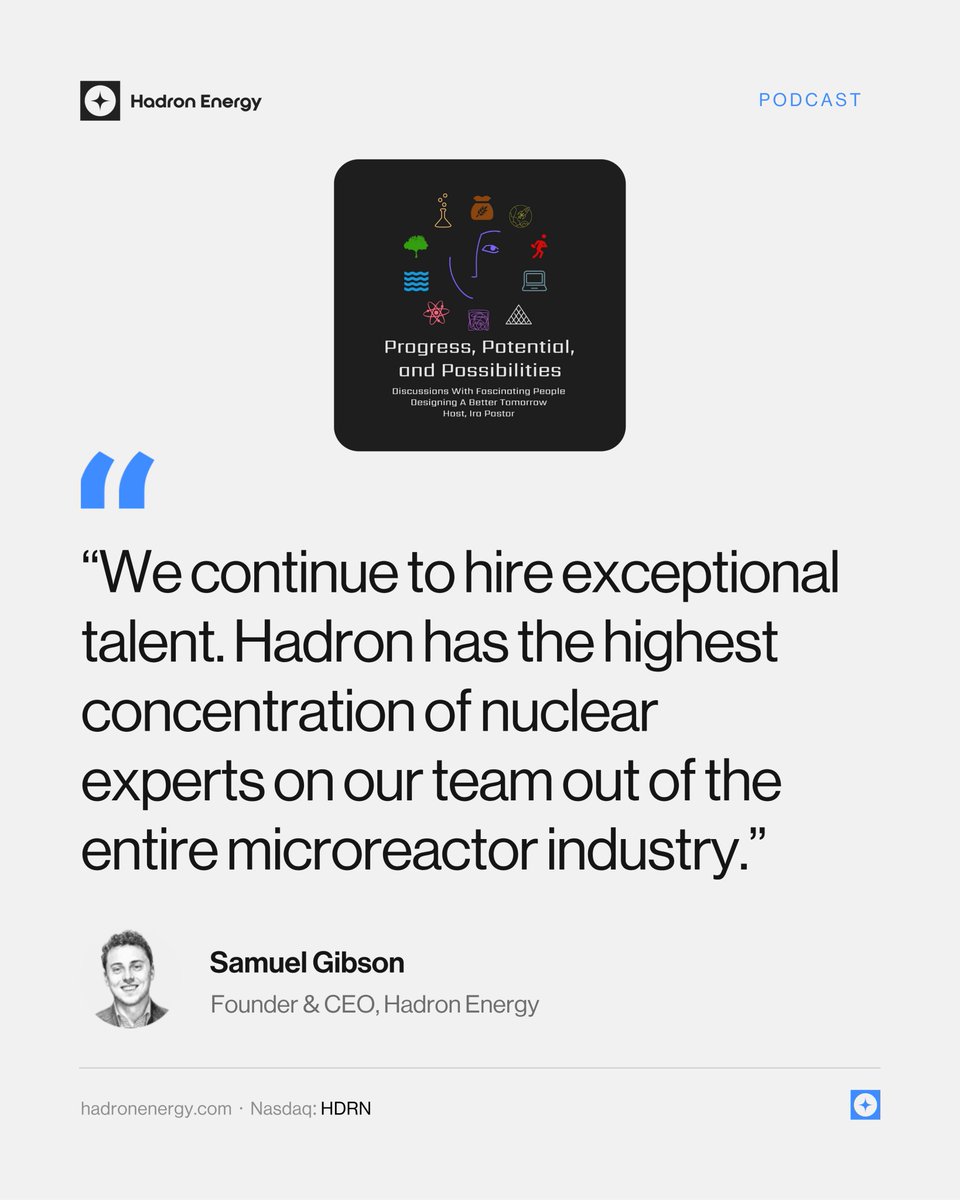
Conventional nuclear power is helpful at the utility scale, but what about the places it can’t reach? $HDRN is taking a different approach.
Hear from Founder & CEO @Samuel_Gibson_ as he dives into what separates microreactors from traditional power plants, why light-water reactors are the pragmatic bet, realities of licensing, supply chain, factory-built economics, and how nuclear can meet raising power demands.
Check out the full episode of the @ProgressPotent1 podcast with @irat1onal: https://t.co/48xBSPBqsG
To all the "accelerationists" clogging my timeline the last few weeks with:
• "AGI is basically here, stop saving for retirement"
• "All diseases will be cured by next Tuesday"
• "We're already living in the singularity"
• "We’re hitting longevity escape velocity on by 2028"
• "100% of software engineers are obsolete by Q3"
• "Humanoid robots will be doing your laundry this fall"
• "We’re entering post-scarcity abundance any day now"
Forget the hype and focus on the current clinical reality when comes to humanity's two major killers - cancer and heart disease.
Right now, we are celebrating new cancer drugs that extend progression-free survival by months.
Additionally, heart disease remains our leading killer and even when we try to look past standard-of-care towards the future, high-profile Phase 3 trial collapses like those of IL-6 and Lp(a) drugs, remind us of how far we have to go.
When our most advanced, precision interventions are hitting walls against the exact pathologies killing us today, shifting into the AI "magic in-silico drug" world isn't going to do much to stop the 100s of millions leaving this world from these two killers in the coming years
And even if this ultimate-AI spit out drug interventions for every disease known to man today, we still need:
- years to prove durable disease remissions,
- massive manufacturing capacity,
- global distribution,
and
- real-world clinical deployment.
Medicine is not just a compute problem. It’s also a time problem and an industrialization problem.
What does it really take to turn medical science into better patient care?
Developing innovative medicines is only part of the equation. Equally important is understanding how treatments work in the real world, how clinicians make decisions, how benefits and risks are evaluated, and how scientific knowledge ultimately translates into meaningful patient outcomes.
On this episode of @ProgressPotent1, I speak with Tim Holt, DNP, PhD, MBA, Regional Medical Director at @CollegiumPharma, for a fascinating conversation that takes us Beyond the Prescription.
Drawing on his diverse background in clinical nursing, advanced practice, public health regulation at the FDA, and pharmaceutical Medical Affairs, Tim brings a unique perspective to the intersection of science, medicine, and healthcare innovation.
We explore:
🧠 The science behind making better, more individualized treatment decisions;
💊 How clinicians balance medication effectiveness, safety, and the realities of everyday patient care;
🔬 The evolving role of Medical Science Liaisons in connecting clinical research, healthcare professionals, and pharmaceutical innovation;
⚕️ The expanding opportunities for nurses and nurse practitioners in research, regulatory science, Medical Affairs, and healthcare leadership;
🚀 How emerging technologies, new approaches to evidence generation, and interdisciplinary collaboration could reshape the future of medicine.
Ultimately, this conversation is about something much bigger than any single medication or disease: How do we ensure that advances in medical science translate into better decisions, better care, and better lives for patients?
#MedicalScience #HealthcareInnovation #PatientCare #ClinicalResearch #MedicalAffairs #NursingLeadership #NursePractitioner #PharmaceuticalInnovation #EvidenceBasedMedicine #PatientOutcomes #FutureOfHealthcare #ProgressPotentialAndPossibilities @RealChemistry_
What does it really take to turn medical science into better patient care?
Developing innovative medicines is only part of the equation. Equally important is understanding how treatments work in the real world, how clinicians make decisions, how benefits and risks are evaluated, and how scientific knowledge ultimately translates into meaningful patient outcomes.
On this episode of @ProgressPotent1, I speak with Tim Holt, DNP, PhD, MBA, Regional Medical Director at @CollegiumPharma, for a fascinating conversation that takes us Beyond the Prescription.
Drawing on his diverse background in clinical nursing, advanced practice, public health regulation at the FDA, and pharmaceutical Medical Affairs, Tim brings a unique perspective to the intersection of science, medicine, and healthcare innovation.
We explore:
🧠 The science behind making better, more individualized treatment decisions;
💊 How clinicians balance medication effectiveness, safety, and the realities of everyday patient care;
🔬 The evolving role of Medical Science Liaisons in connecting clinical research, healthcare professionals, and pharmaceutical innovation;
⚕️ The expanding opportunities for nurses and nurse practitioners in research, regulatory science, Medical Affairs, and healthcare leadership;
🚀 How emerging technologies, new approaches to evidence generation, and interdisciplinary collaboration could reshape the future of medicine.
Ultimately, this conversation is about something much bigger than any single medication or disease: How do we ensure that advances in medical science translate into better decisions, better care, and better lives for patients?
Watch now - https://t.co/3Nw5gx95bJ
#MedicalScience #HealthcareInnovation #PatientCare #ClinicalResearch #MedicalAffairs #NursingLeadership #NursePractitioner #PharmaceuticalInnovation #EvidenceBasedMedicine #PatientOutcomes #FutureOfHealthcare #ProgressPotentialAndPossibilities @RealChemistry_
🥊 FROM THE PPP ARCHIVES | The Human Story
Most people know Ken Shamrock as a legend of mixed martial arts.
But there's much more to his story than what happened inside the Octagon.
In this wide-ranging conversation, we explored his journey through professional fighting, faith and ministry, his work supporting wounded warriors, and his perspectives on longevity, recovery, and emerging approaches in sports medicine.
A fascinating look at resilience, reinvention, and finding purpose beyond professional competition.
🎙️ Rediscover BEYOND THE OCTAGON on Progress, Potential and Possibilities.
https://t.co/39u6bp75eJ
#KenShamrock #MMA #Longevity #Resilience
🧬 FROM THE PPP ARCHIVES | Ahead of the Curve
The mRNA revolution didn't end with COVID-19 vaccines. In many ways, it was just getting started.
In this conversation, I spoke with 2023 Nobel laureate Dr. Drew Weissman, whose pioneering work helped make mRNA vaccines possible.
We explore RNA science and its potential to transform how we prevent and treat disease.
From infectious diseases to cancer immunotherapy and emerging RNA-based medicines, the scientific possibilities are extraordinary—but so are the challenges of turning them into effective treatments.
🎙️ Revisit this conversation on Progress, Potential and Possibilities.
https://t.co/X9tbzfAnOn
#RNA #mRNA #Biotechnology #MedicalInnovation
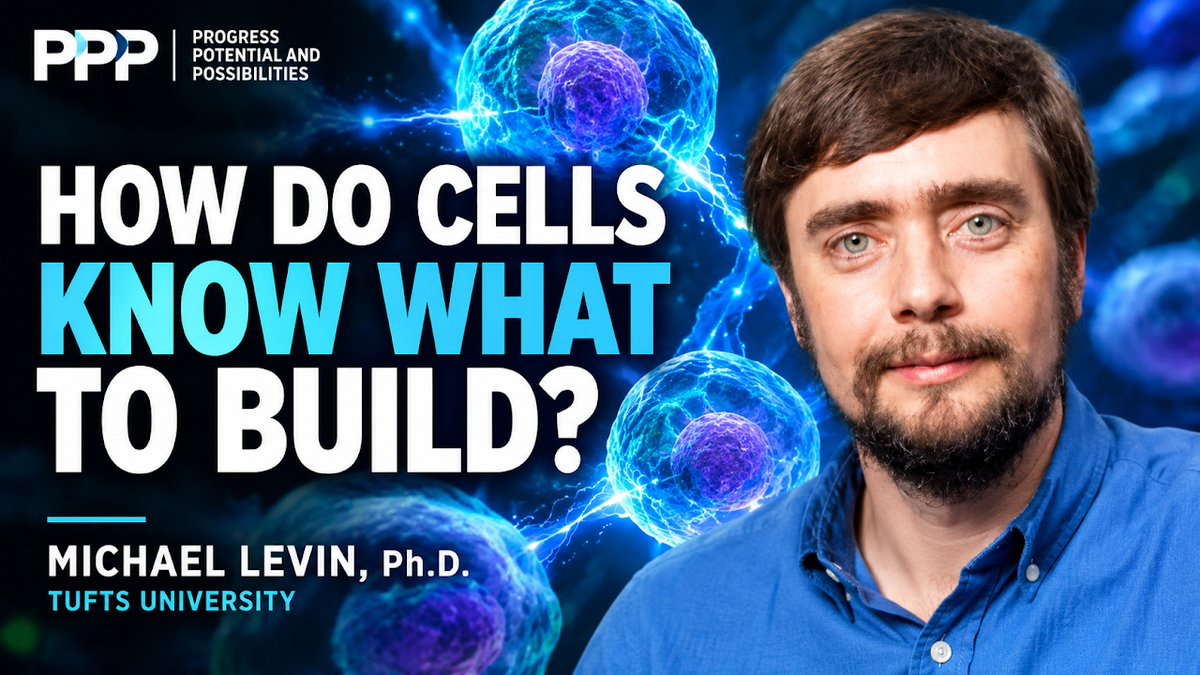
🔬 FROM THE PPP ARCHIVES | The Big Question
What if cells could be instructed to build, repair, and regenerate complex biological structures?
In this fascinating conversation, I sat down with Dr. Michael Levin of Tufts University to explore bioelectric signaling, morphogenesis, and the remarkable ways cells coordinate to create living anatomy.
Could understanding the body's bioelectric code fundamentally change regenerative medicine?
An extraordinary conversation at the intersection of developmental biology, bioengineering, and the future of medicine.
🎙️ Rediscover this episode of Progress, Potential and Possibilities.
https://t.co/Zpojzl403f
#RegenerativeMedicine #Bioelectricity #DevelopmentalBiology #PPP
⚛️ Can nuclear power go small? And could that help power the AI revolution?
AI data centers, critical infrastructure and industrial facilities all need something that is becoming increasingly valuable: reliable, around-the-clock electricity.
On this @ProgressPotent1 episode, I'm joined by @Samuel_Gibson_, Founder and CEO of @hadron_energy , to explore the company's Halo microreactor - a proposed 10-megawatt electric light-water reactor designed around an integrated, factory-oriented approach.
We discuss:
🔹 Why pursue a microreactor rather than a conventional nuclear plant?
🔹 How does a light-water reactor generate electricity, and what does its thermal output tell us?
🔹 What does “walk-away safe” actually mean - and what evidence is needed to demonstrate it?
🔹 Could factory manufacturing make nuclear power more affordable and easier to deploy?
🔹 How do uranium enrichment, fuel fabrication and America's domestic nuclear fuel supply chain affect the strategy?
🔹 What still stands between a promising design and a commercially operating reactor?
The opportunity is compelling. So are the challenges: licensing, capital requirements, fuel availability, first-of-a-kind costs and proving that the economics work.
Can a smaller nuclear reactor deliver a genuinely different energy business model?
Join us as we examine the technology, the strategy and the road to commercialization.
#NuclearEnergy #Microreactors #AIDataCenters #EnergyInnovation #ProgressPotentialAndPossibilities @CoreIR_
⚛️ Can nuclear power go small? And could that help power the AI revolution?
AI data centers, critical infrastructure and industrial facilities all need something that is becoming increasingly valuable: reliable, around-the-clock electricity.
On this @ProgressPotent1 episode, I'm joined by @Samuel_Gibson_, Founder and CEO of @hadron_energy, to explore the company's Halo microreactor - a proposed 10-megawatt electric light-water reactor designed around an integrated, factory-oriented approach.
We discuss:
🔹 Why pursue a microreactor rather than a conventional nuclear plant?
🔹 How does a light-water reactor generate electricity, and what does its thermal output tell us?
🔹 What does “walk-away safe” actually mean - and what evidence is needed to demonstrate it?
🔹 Could factory manufacturing make nuclear power more affordable and easier to deploy?
🔹 How do uranium enrichment, fuel fabrication and America's domestic nuclear fuel supply chain affect the strategy?
🔹 What still stands between a promising design and a commercially operating reactor?
The opportunity is compelling. So are the challenges: licensing, capital requirements, fuel availability, first-of-a-kind costs and proving that the economics work.
Can a smaller nuclear reactor deliver a genuinely different energy business model?
Join us as we examine the technology, the strategy and the road to commercialization.
Watch now - https://t.co/DPbXrbeiQw
#NuclearEnergy #Microreactors #AIDataCenters #EnergyInnovation #ProgressPotentialAndPossibilities @CoreIR_
🧬 HOW DO YOU BUILD A SUCCESSFUL BIOTECH COMPANY IN A WORLD THAT NEVER STOPS CHANGING?
From rapidly evolving technologies and AI to shifting regulations, payer dynamics, and the economics of drug development, building a biotech company today requires far more than promising science.
On this @ProgressPotent1 episode, I'm joined by Dr. Stella Vnook - pharmaceutical executive, biotech entrepreneur, and founder of Oral BioLife and AVIVA Ventures.
With more than 25 years of experience spanning Merck, Catalent, and multiple biotechnology ventures, Stella brings a unique perspective on what it takes to turn scientific discoveries into real-world medical innovations.
We explore:
🦷 Regenerative dentistry: @oralbiolife and their Ambrilux Dental Gel is being developed to stimulate bone regeneration in periodontal disease. How is the technology intended to work, and what evidence will be needed to demonstrate its effectiveness in humans?
🧪 The next generation of biotech: Why do promising scientific discoveries so often struggle to become successful treatments - and how can we improve the journey from laboratory to patient?
🤖 AI and drug development: Where can AI genuinely accelerate pharmaceutical innovation, and where do the hardest scientific and clinical challenges remain?
💡 The business of healthcare innovation: How do funding, commercialization, reimbursement, and patient access determine whether a medical breakthrough ultimately makes a difference?
Dr. Vnook is also being recognized by @TempleUniv School of Pharmacy - @TU_SP - with its Pharmaceutical Innovation Award as the university celebrates its 125th anniversary.
Join us for a forward-looking, evidence-focused conversation about regenerative medicine, biotechnology, and the future of healthcare.
#Biotech #Biotechnology #AIinHealthcare #DrugDevelopment #HealthcareInnovation #ProgressPotentialAndPossibilities @KafkaMediaGroup
🧬 HOW DO YOU BUILD A SUCCESSFUL BIOTECH COMPANY IN A WORLD THAT NEVER STOPS CHANGING?
From rapidly evolving technologies and AI to shifting regulations, payer dynamics, and the economics of drug development, building a biotech company today requires far more than promising science.
On this @ProgressPotent1 episode, I'm joined by Dr. Stella Vnook - pharmaceutical executive, biotech entrepreneur, and founder of Oral BioLife and AVIVA Ventures.
With more than 25 years of experience spanning Merck, Catalent, and multiple biotechnology ventures, Stella brings a unique perspective on what it takes to turn scientific discoveries into real-world medical innovations.
We explore:
🦷 Regenerative dentistry: @oralbiolife and their Ambrilux Dental Gel is being developed to stimulate bone regeneration in periodontal disease. How is the technology intended to work, and what evidence will be needed to demonstrate its effectiveness in humans?
🧪 The next generation of biotech: Why do promising scientific discoveries so often struggle to become successful treatments - and how can we improve the journey from laboratory to patient?
🤖 AI and drug development: Where can AI genuinely accelerate pharmaceutical innovation, and where do the hardest scientific and clinical challenges remain?
💡 The business of healthcare innovation: How do funding, commercialization, reimbursement, and patient access determine whether a medical breakthrough ultimately makes a difference?
Dr. Vnook is also being recognized by @TempleUniv School of Pharmacy - @TU_SP - with its Pharmaceutical Innovation Award as the university celebrates its 125th anniversary.
Join us for a forward-looking, evidence-focused conversation about regenerative medicine, biotechnology, and the future of healthcare.
Watch now - https://t.co/qSMK5Ba0sE
#Biotech #Biotechnology #AIinHealthcare #DrugDevelopment #HealthcareInnovation #ProgressPotentialAndPossibilities @KafkaMediaGroup
What happens when immunotherapy stops working?
Head and neck squamous cell carcinoma remains a difficult cancer to treat - particularly when tumors recur or progress after prior therapies.
But antibody engineering is opening some fascinating new possibilities.
On this @ProgressPotent1 episode, I’m joined by Dr. Tahamtan Ahmadi, M.D., Ph.D. - Chief Medical Officer and EVP, Head of Experimental Medicines at @Genmab , to explore the next generation of antibody therapeutics.
At the center of our conversation is petosemtamab, a bispecific antibody designed to simultaneously target EGFR and LGR5.
Why those two targets?
Because the goal isn't simply to block a cancer signal. The molecule is being engineered to potentially do several things at once - including disrupting EGFR signaling, promoting EGFR internalization and degradation through LGR5, and engaging immune-mediated tumor-cell killing.
And that's what makes this story particularly interesting:
Can antibody engineering move us beyond the traditional “one antibody, one target” paradigm?
We also discuss:
• Why head and neck cancer has historically been such a difficult therapeutic problem;
• What happens biologically when tumors progress after immunotherapy;
• Why EGFR has been such an important target - and why targeting EGFR alone hasn't solved the problem;
• What LGR5 may add to the equation;
• The Phase 2 clinical data behind petosemtamab
• The transition from later-line disease into first-line treatment;
• And what the ongoing Phase 3 trials will need to demonstrate before this approach can truly change clinical practice;
It's a fascinating look at where cancer biology, antibody engineering and clinical medicine intersect.
#HeadAndNeckCancer #CancerResearch #Oncology #Immunotherapy #AntibodyEngineering #BispecificAntibodies #Petosemtamab #Genmab @RealChemistry_
What happens when immunotherapy stops working?
Head and neck squamous cell carcinoma remains a difficult cancer to treat - particularly when tumors recur or progress after prior therapies.
But antibody engineering is opening some fascinating new possibilities.
On this @ProgressPotent1 episode, I’m joined by Dr. Tahamtan Ahmadi, M.D., Ph.D. - Chief Medical Officer and EVP, Head of Experimental Medicines at @Genmab, to explore the next generation of antibody therapeutics.
At the center of our conversation is petosemtamab, a bispecific antibody designed to simultaneously target EGFR and LGR5.
Why those two targets?
Because the goal isn't simply to block a cancer signal. The molecule is being engineered to potentially do several things at once - including disrupting EGFR signaling, promoting EGFR internalization and degradation through LGR5, and engaging immune-mediated tumor-cell killing.
And that's what makes this story particularly interesting:
Can antibody engineering move us beyond the traditional “one antibody, one target” paradigm?
We also discuss:
• Why head and neck cancer has historically been such a difficult therapeutic problem;
• What happens biologically when tumors progress after immunotherapy;
• Why EGFR has been such an important target - and why targeting EGFR alone hasn't solved the problem;
• What LGR5 may add to the equation;
• The Phase 2 clinical data behind petosemtamab
• The transition from later-line disease into first-line treatment;
• And what the ongoing Phase 3 trials will need to demonstrate before this approach can truly change clinical practice;
It's a fascinating look at where cancer biology, antibody engineering and clinical medicine intersect.
Watch now - https://t.co/5okIpBbRIx
#HeadAndNeckCancer #CancerResearch #Oncology #Immunotherapy #AntibodyEngineering #BispecificAntibodies #Petosemtamab #Genmab @RealChemistry_
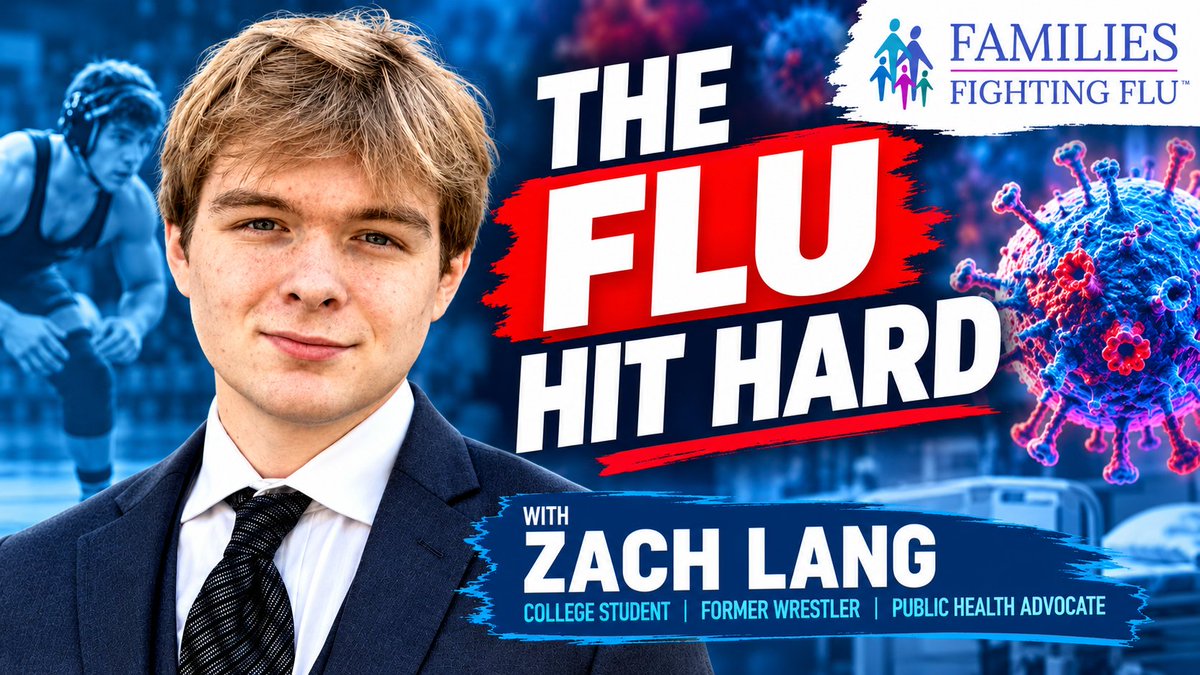
🩺 Can the flu really hospitalize a healthy 19-year-old athlete?
Zach Lang was a physically fit college student and former collegiate wrestler who thought he had a common cold. But in January 2025, he was diagnosed with Influenza A and dangerously elevated creatine kinase levels, indicating severe muscle breakdown that put his kidneys at risk.
After three days in the hospital and about a month of recovery, Zach's perspective on influenza changed dramatically.
Now a public health advocate with @famfightflu, Zach joins me on @ProgressPotent1 to share his personal experience, what he learned about the potential complications of influenza, and why he believes young, healthy people should take flu prevention seriously.
We discuss:
🦠 How a seemingly ordinary illness became a medical emergency;
🧬 Influenza A, muscle breakdown and the risk to kidney function;
🏥 Recognizing when symptoms require medical attention;
💉 Flu vaccination and what it can - and cannot - do;
🎓 Why college students and athletes shouldn't underestimate influenza;
An important conversation about influenza, prevention and the fact that being young and healthy doesn't make us invulnerable.
#Influenza #Flu #FluShot #Vaccines #PublicHealth #FluPrevention #CollegeAthletes #FamiliesFightingFlu #ProgressPotentialAndPossibilities @RealChemistry_@CSL@CSLBehring@IndianaUniv@IUBloomington
🩺 Can the flu really hospitalize a healthy 19-year-old athlete?
Zach Lang was a physically fit college student and former collegiate wrestler who thought he had a common cold. But in January 2025, he was diagnosed with Influenza A and dangerously elevated creatine kinase levels, indicating severe muscle breakdown that put his kidneys at risk.
After three days in the hospital and about a month of recovery, Zach's perspective on influenza changed dramatically.
Now a public health advocate with @famfightflu, Zach joins me on @ProgressPotent1 to share his personal experience, what he learned about the potential complications of influenza, and why he believes young, healthy people should take flu prevention seriously.
We discuss:
🦠 How a seemingly ordinary illness became a medical emergency;
🧬 Influenza A, muscle breakdown and the risk to kidney function;
🏥 Recognizing when symptoms require medical attention;
💉 Flu vaccination and what it can - and cannot - do;
🎓 Why college students and athletes shouldn't underestimate influenza;
An important conversation about influenza, prevention and the fact that being young and healthy doesn't make us invulnerable.
Watch now - https://t.co/sgxOk9u64d
#Influenza #Flu #FluShot #Vaccines #PublicHealth #FluPrevention #CollegeAthletes #FamiliesFightingFlu #ProgressPotentialAndPossibilities @RealChemistry_@CSL@CSLBehring@IndianaUniv@IUBloomington