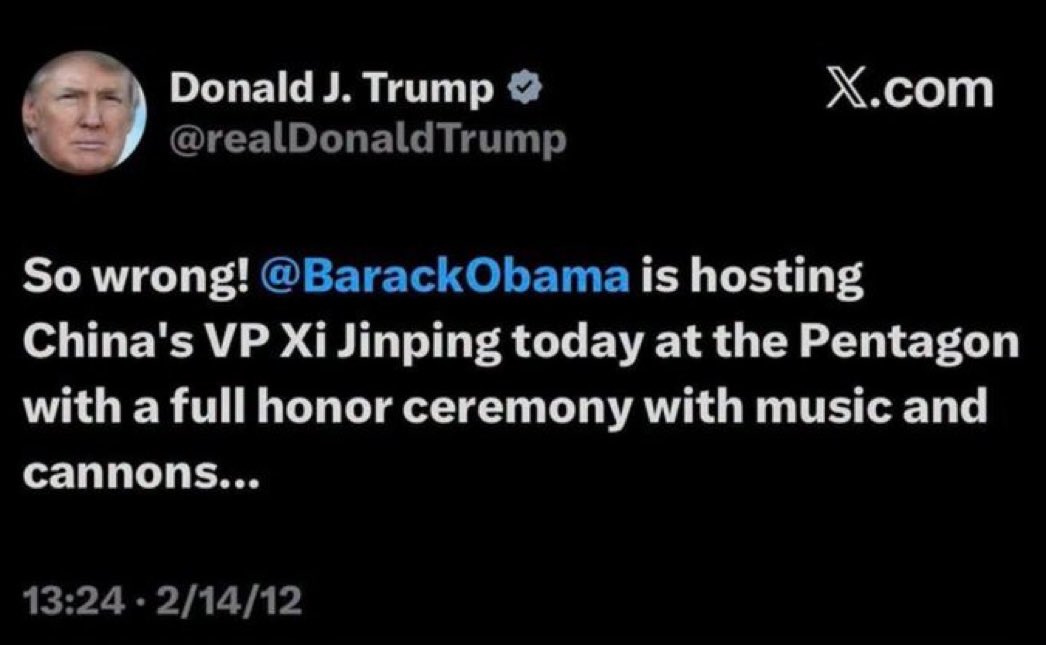
i thought this was fake when i first saw it. you're telling me that a mayor was able to do what Schumer and Jeffries combined either weren't able to do or willing to try? Humiliating. Gotta get someone else in there.
A sick kid won a meet & greet with Trump for his birthday.
Trump shamed him for not being excited enough, & wasting 5 minutes of his time.
He gave the kid a stupid adult sized campaign hat.
But sure. He called Mullins kid every day.
President Trump on Friday's FAA ground stop: "We have old equipment, broken equipment. We've been telling that to Congress... We essentially want to blow it up and put new in... We need the funding to get it done."
So let me get this straight.
2021: Biden's infrastructure law puts $5B into FAA air traffic control facilities. That means towers and buildings. It doesn't replace the decades-old copper-and-switches network that connects them.
2023: The FAA hires Verizon for $2.4B to build that replacement network. Two years later it still isn't running. Project 2025 calls for spinning air traffic control out of the FAA and privatizing it if possible.
2025: DOGE fires about 400 FAA staff, including maintenance mechanics at 18 air traffic control facilities that were already short on technicians. Musk pushes Starlink to replace Verizon. Newark's radar and radios keep going dark because of old copper wire and untested telecom links. Congress puts $12.5B toward the fix and calls it a down payment.
June 2026: Air Space Intelligence wins a 12-year FAA contract worth up to $875.9M to build SMART, an AI air traffic management system. Months earlier, ASI's PAC donated to the campaign of Duffy's son-in-law. The award was competitive. ASI's Air Force deal was sole-source.
November 10: SMART goes live at all 22 Air Route Traffic Control Centers, about 50 days after its first launch over Washington. The controllers' union says it wasn't involved in the rollout.
November 13: An update hits the private network that links every center. The network reboots and crashes, the old equipment chokes, and controllers get bad data. The result is the third nationwide ground stop in US history: more than four hours, nearly 8,000 cancellations and 10,000+ delays.
Officials blame old equipment. ASI and Duffy say SMART had nothing to do with it. DHS says it can't rule anything out. Nobody has said what the update was or who approved it. And an earlier review had already warned that this network was no longer supported and that one failure could cut off an entire region.
Anyone who has shipped software into legacy infrastructure knows the appropriate playbook:
⭐️ Map every dependency.
⭐️ Test against real failure modes.
⭐️ Run old and new in parallel.
⭐️ Roll out in stages.
⭐️ Change one major thing at a time.
⭐️ Keep a rollback you've actually tested.
⭐️ Keep the operators in the room.
I suspect a lot of newer engineers raised on vibecoding have never learned this. Prompting gets something new on screen fast, but it won't teach you how a decades-old network reacts to an update at 4pm on a Friday.
Speed is not the metric. In aviation, reliability and accountability have to be built in from day one. Bring back the adults in the room.
All planes grounded, Boats sinking, buildings collapsing, CEOs bringing the whole market down with their dicks, outlook is out.
Why did they think it was going to work?