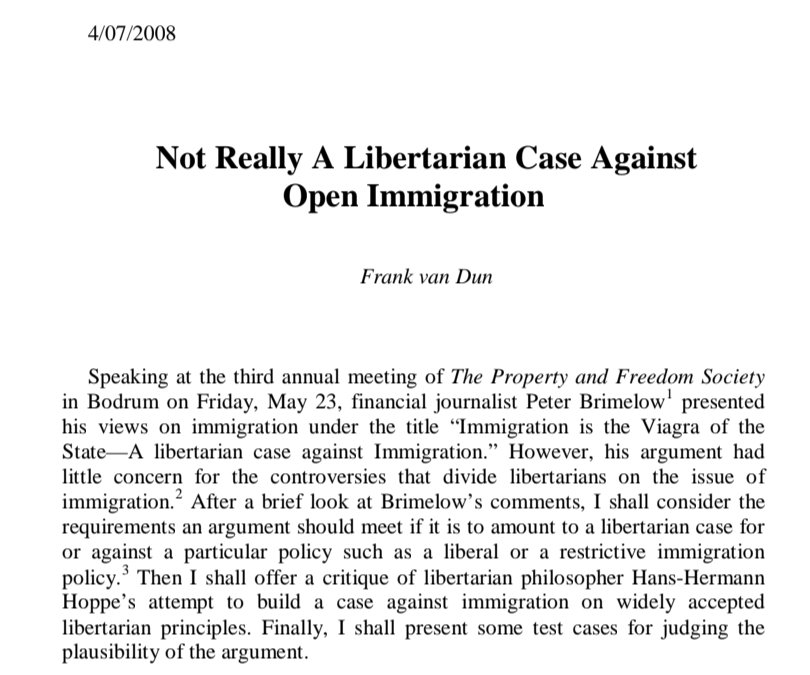
Frank van Dun debunked you and Hoppe's definitively un-libertarian anti-immigration positions in 2008. Furthermore, the Hoppean argument that state owned public property is actually owned by the taxpayers who thus have a right to restrict immigration & use of public property by immigrants has been definitively debunked by Norbert Slenzok this past year.
link to Frank Van Dun paper: https://t.co/h1BQRmvSSY
link to Norbert Slenzok paper: https://t.co/G2I9onOJmh
@WestinSmithq Watch out for this debate, I am sure it will highlight some of the issues at hand. https://t.co/1ia2vrblER though the debate will not probably discuss AE and Apel, it will probably talk about the inconsistencies at hand.
“The ideal communication community is the transcendental-pragmatic transformation and completion of Kant’s ‘kingdom of ends’. In it, every participant is recognized as an end in himself and treats every other participant as an end in himself, never merely as a means.”
Argumentation ethics is literally dealing with the transcendental-pragmatic presuppositions of argumentation. Then as the name suggests, it is also an extension of pragmatic philosophy as set out by Peirce, for here is the pragmatic maxim: "Consider what effects, that might conceivably have practical bearings, we conceive the object of our conception to have. Then, our conception of these effects is the whole of our conception of the object".
This philosophy is connected to reality, because another presupposition of discourse is action it’s self and as Hoppe explains: “Action is the bridge between the mind and reality.” And “It is only through action that we can connect our mind with reality and demonstrate that we have knowledge of it.”
“So act that you use humanity, whether in your own person or in the person of any other, always at the same time as an end, never merely as a means.”
— Immanuel Kant, Groundwork of the Metaphysics of Morals.
“Kant's efforts to justify the state proved abortive. Therefore, by virtue of the innate right to equal freedom, there exists a duty to stay in the state of nature.” — Slenzok N. & Trzcionka P. (2025).
“Kant's work is often thought to epitomize the essence of the classic liberal ideal of equal liberty under the rule of law… Kant failed to demonstrate that this ideal implies the state, understood along Weberian lines as a coercion monopoly.“ — Slenzok N. & Trzcionka P. (2025)