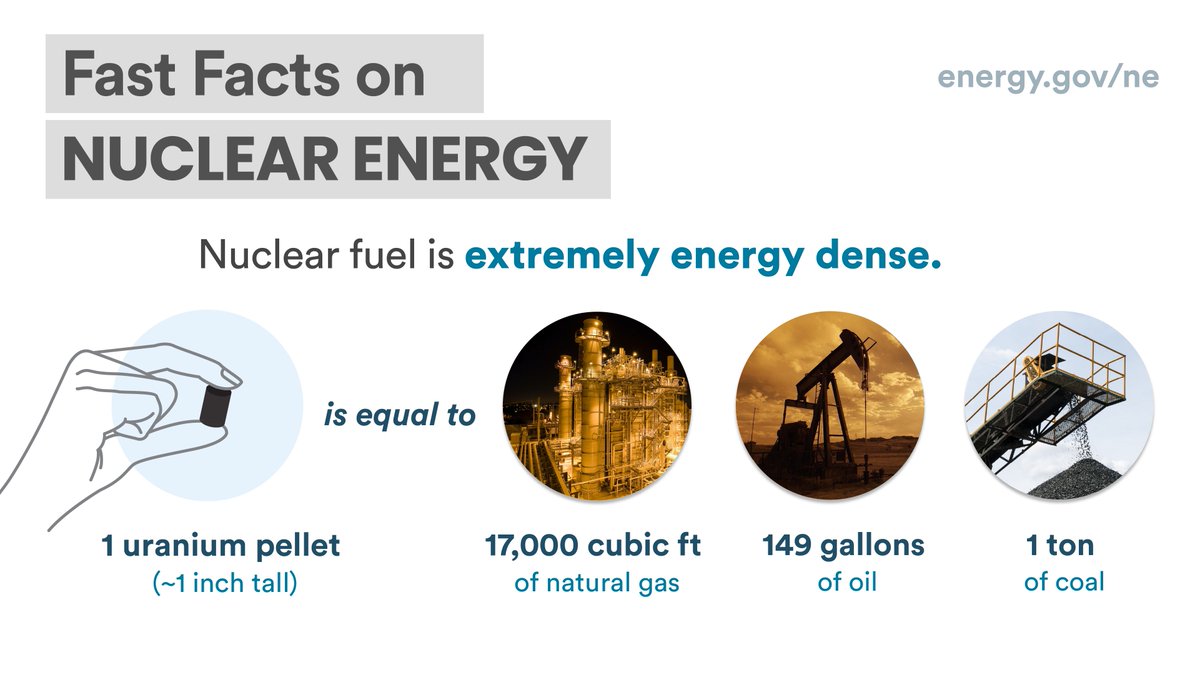
America has ~95,000 metric tons of spent nuclear fuel and more than 90% of its energy is still unused.
That’s an energy challenge and a national security opportunity. Today, we’re introducing Project Omega as we emerge from stealth.
We’re building the next generation of nuclear fuel recycling – designed for safety, proliferation resistance, and real recycling.
Join us.
https://t.co/L7LuWYsNmY
#NuclearEnergy #NationalSecurity #EnergyAbundance
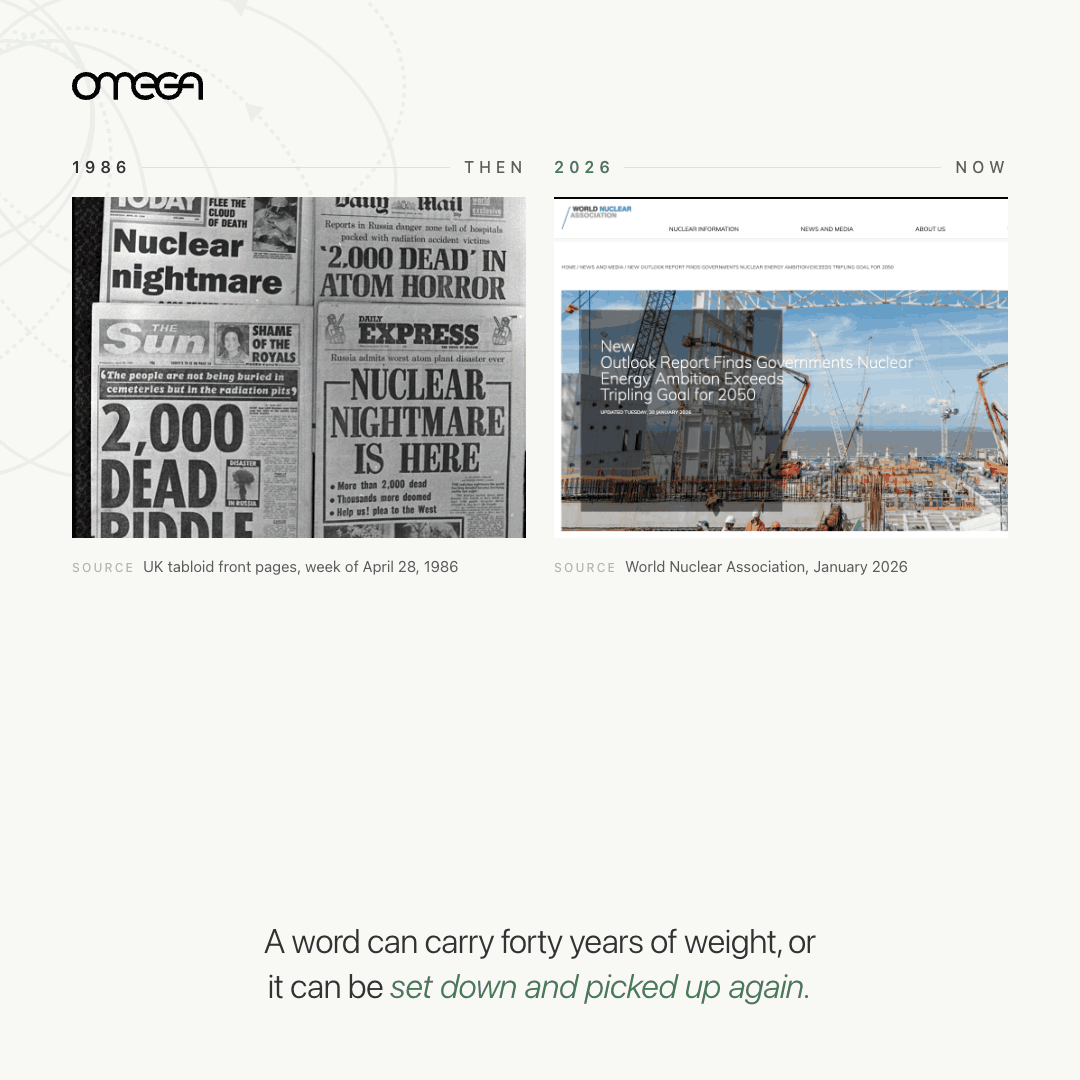
The safest and most resilient energy assets we have are nuclear - and they have the worst PR in the history of energy.
Now is the time to change that and safeguard our energy future.
Here's a write-up from @FastCompany and @UL_Standards on the panel @Greg_Lindsay, @YingShirleyMeng, Jeff Marootian, and I spoke on about the topic: https://t.co/6nmCX2sTeT
@ProjectOmegaHQ's radioisotope power systems are a game-changer for spacecraft reliability and risk management. Our new partnership with @staffsheehan and his team is an exciting step toward an interplanetary future.
We at @charter_space_ are proud to be working with some of the brightest minds in the world towards making space operations safer and more resilient, with a little bit of both nuclear and financial engineering.
And thank you to both @axios and @TomNovelly for covering this exciting story!
Reactor permitting in the United States is moving faster than it has in decades. Executive orders are fast-tracking testing and licensing, capital is flowing into new designs, and construction timelines that once looked immovable are shrinking.
Nearly all of that acceleration addresses the front half of nuclear deployment: siting, licensing, building. The fuel that will run those reactors receives a fraction of the policy attention.
That asymmetry has a predictable result. A reactor licensed in record time still waits for fuel, and a permit issued in months does nothing to shorten a fuel supply chain built over decades. Speed on the reactor side moves the constraint downstream rather than removing it.
The United States holds an answer to that constraint already on its own soil: 90,000 metric tons of used nuclear fuel (UNF) in storage, still retaining more than 90% of its original energy. If UNF was treated as the national resource it is, versus waste, this material could supply the reactors the current policy push is designed to build.
Project Omega is developing the recycling technology for that part of the cycle, working with Idaho National Laboratory to recover the parts of the waste that can be reused for fuel and isotopes for long-duration power sources. Building new reactors faster and more efficiently is critical to our national security. Outpacing our domestic fuel supply creates a new bottleneck, leaving us reliant on adversarial foreign nations for our energy. Advancing our nuclear fuel supply chain is critical to our nation’s future.
#NuclearEnergy #FuelCycle #NationalSecurity
Spacecraft like Voyager 1 & 2 and rovers on Mars are still operating thanks to radioisotope power sources. We're bringing that same persistent power to the U.S. space industry at @ProjectOmegaHQ.
Check out our work with @charter_space_ and @TomNovelly in @axios on how we extend the mission for commercial spacecraft with nuclear power:
https://t.co/TjWq9n8Mbi
Radioisotope power kept Voyager going for decades - now @staffsheehan and the @ProjectOmegaHQ team are bringing it to commercial spacecraft with @Charter_Space_. Huge win for American space! ⚡️ https://t.co/FhnSs5WJkX
We're proud to partner with @Charter_Space_ to advance the future of space exploration through reliable, long-duration power.
Together, we're exploring how @ProjectOmegahq 's radioisotope power systems can make spacecraft more resilient, extend mission life, and reduce operational risks and costs.
From powering spacecraft for decades without sunlight or recharging to enabling independently powered spacecraft "black boxes" that support anomaly recovery, this partnership opens new possibilities for safer, more reliable space missions.
Reliable power is essential to unlocking the next frontier of space exploration.
Read more: https://t.co/mP8oZoFS2H
Huge news!
We're joining forces with @ProjectOmegaHQ to explore how radioactive isotopes could keep satellites in orbit longer, insure billions in space assets, and prevent costly losses in space.
@axios' @TomNovelly has the latest.
https://t.co/r7FLkbivh1
Thanks for a sharp conversation across orbit and critical minerals during a Climate Week NYC panel hosted by @BCapitalGroup and @CerberusCapital and fellow panelists from @rivensystems and @StarCatcherInd like @rushspace.
My message: the US is sitting on roughly 100,000 metric tons of used nuclear fuel, a national resource holding fuel for reactors and isotopes that can provide power for decades.
At @ProjectOmegaHQ we're building the refinery for the nuclear century.
NASA plans to launch its first fission reactor for an interplanetary spacecraft, SR-1 Freedom, toward Mars in late 2028.
It marks a departure from decades of precedent: Voyager, New Horizons, Curiosity and Perseverance all ran on radioisotope power systems, harvesting heat from the natural decay of plutonium-238. Long-lived nuclear batteries, not reactors.
Decay power has kept spacecraft operating for decades in environments where solar panels fail and refueling is impossible. It works because of a physical fact with no substitute: nuclear material carries roughly a million times more energy per unit mass than chemical fuel.
The same physics applies on Earth. Strontium-90, a fission product found in spent nuclear fuel (SNF), generates heat through natural decay the same way plutonium-238 does aboard those spacecraft. Project Omega's first product is a small nuclear battery running on strontium-90 decay, built to power microprocessors in remote locations for years without maintenance or refueling, the kind of long-duration requirement that defines our work with DARPA.
The United States stores 90,000 metric tons of spent nuclear fuel. The material holds over 90 percent of its original energy, and it holds isotopes with a five-decade flight record powering the toughest missions humanity has attempted. What sits in storage is not a liability. It is inventory.
NASA reaching for fission beyond Earth orbit and our work recovering value from stored fuel are answers to the same question: where nuclear material already exists, put it to work.
.@ProjectOmegaHq is heading to Climate Week NYC!
The future of nuclear is about more than generating power. It’s about getting more from the fuel we already have.
At Omega, we are building the technology to recover material from used nuclear fuel--fuel for new reactors and isotopes for long-duration power for defense, space and remote infrastructure.
This week, our CEO and founder @StaffSheehan will bring that vision to two conversations about the future of energy:
1) "Energy Technologies that Change the Game: From Subsurface to Space," hosted by @BCapitalGroup and Cerberus Ventures exploring the technologies reshaping energy, resilience and space infrastructure.
2) "Nuclear Futures," hosted by @WireframeVC , @PreludeVC and @Overture_VC , will focus on what it will take to scale nuclear energy, and what becomes possible when we do. There is still time to register for this one: https://t.co/oQtN2MwakP
From closing the nuclear fuel cycle, we’re excited to share what Project Omega is building and why used nuclear fuel can become an asset for the next energy economy.
#NuclearEnergy #EnergyAbundance #NationalSecurity
Going to @FastCompany 's Innovation Festival this week in NYC?
Make sure to stop by and see @ProjectOmegaHQ 's CEO and founder, @staffsheehan, on Wednesday, September 16, 2026 at Convene Brookfield Place, for a conversation on "Powering the Future: Designing Resilient Energy Systems."
Joining him will reps from @UL_Standards@UofC #NuclearEnergy #EnergyAbundance #NationalSecurity
If you are reading this in a state with nuclear power, there is a good chance the electrons on your screen came from Russian uranium. Twenty percent of the US electrical grid is nuclear, but the vast majority of the uranium feeding those reactors comes from foreign sources.
Europe learned the hard way that relying on Russia for energy resources is not a position you want to be in. America is still in that position, but we have an answer. Through recycling of spent nuclear fuel, we can eliminate our need for Russian uranium overnight while creating good-paying jobs in America.
Energy security means little if your fuel comes from your adversary. We are closing this final gap to ensure America's enduring energy security. We are Project Omega.
Unmanned underwater vehicles let us do reconnaissance without putting service members in harm's way, and at low cost.
But they all share one problem: power.
Fuel a UUV and it eventually runs dry, leaving a stranded asset. Give it a battery and the same thing happens, because nobody is diving to the bottom of the sea to swap cells.
The vehicle is only as useful as its power source lasts.
The United States solved this problem decades ago for manned vessels.
Our submarines run on nuclear power, and that is how we have operated underwater for long periods since the 1950s.
We believe unmanned vehicles will follow the same path, just at a smaller scale. At Project Omega, we build radiovoltaic power sources from material recycled out of spent nuclear fuel. Think of an AA battery that lasts 30 years.
That is the next step for operational energy, and the applications extend well beyond the seafloor, into space and here on land.
https://t.co/VWrmeSvu2Z
@NASA plans to launch its first fission reactor for an interplanetary spacecraft, SR-1 Freedom, toward Mars in late 2028. While this will be a historic flight, the use of nuclear power in deep-space exploration is not.
From the Voyager and New Horizons probes exploring the gas giants to the Curiosity and Perseverance rovers on Mars, every spacecraft sent into deep space has relied on the decay radioisotopes to survive using heat passing through the system to create electricity. A newer conversion method, radiovoltaics, uses the same physics as solar cells, and harnesses the energy from radioisotopes. These devices will work anywhere, like traveling with your own miniature sun.
Curiosity has been driving across Mars since 2012 on the heat from decaying plutonium-238, with no refueling, no maintenance, no sun required. The Voyager probes have been running on the same physics for nearly five decades, and that physics has now carried them beyond the edge of the solar system years ago. This is not speculative technology. It is the only technology that has ever worked for deep space, proven across billions of miles.
Radioisotope systems, on the other hand, harness the decay energy generated by all radioactive sources to keep spacecraft warm in the frigid deep space and to power electronics well past the point where the sun becomes too dim for solar panels. Thanks to nuclear physics, these systems operate for decades, generating roughly a million times more energy, pound for pound, than chemical fuel.
Project Omega is demonstrating next-generation systems using alternative radioisotopes such as strontium-90. Our first device is already being designed under the DARPA Rads-to-Watts program. It is being built to power microprocessors in remote locations for years, without maintenance or refueling, and is the stepping stone that we will use to help America maintain its leadership in space.
The United States stores 90,000 metric tons of spent nuclear fuel. This material holds enough strontium-90 to power the next-generation of space exploration. By recycling our nation’s spent nuclear fuel, we can unlock an almost endless supply of the isotopes that can power the next generation of spacecraft achieving the toughest missions humanity has attempted.
NASA reaching for fission beyond Earth orbit and our work recovering value from stored fuel are answers to the same question: where nuclear material already exists, put it to work. What sits in storage inside spent nuclear fuel is not a national liability. It is a national resource, enabling us to explore new frontiers.
Including Chernobyl and Fukushima, nuclear is safer than wind and cleaner than everything
For many of us, Josh included, nuclear is also responsible for both our nice-to-haves and our life support systems
The world needs more nuclear energy
The narrative around nuclear energy in the U.S. has been shaped by misconceptions and policy failures rather than technical limitations.
In reality, nuclear power is safer than many alternatives (e.g., coal), but public perception remains skewed due to costs and scary messaging versus lives lost.
The U.S. government’s failure to uphold waste storage agreements has created logistical and legal issues, not scientific issues.
Meanwhile, strategic decisions led to dependence on foreign energy sources and challenges to our supply chain for isotope access.
Although interest in nuclear is resurging, only companies actively building infrastructure will be successful @AntaresNuclear, @AaloAtomics, @TheNuclearCo, @standardnuclear, @valaratomics, @Oklo, @generalmatter, and us at @ProjectOmegaHQ, to name a few.
Like electricity in its early days, nuclear still faces uncertainty and some fear that can be overcome through standards, education, and time.
With recent advancement with reactors and the President’s Executive Orders advancing nuclear, things are starting to change.
Be a part of the change.
Since 1957, the rules of space have largely been dictated by a single constraint: energy. For nearly 70 years, the space industry has accepted that satellites must constantly chase the sun to operate.
The physics are unyielding, the farther you get from the sun, the less viable solar power becomes. It limits your maneuverability and operational effectiveness.
We are fundamentally changing space power with small nuclear power sources. Space exploration is experiencing a massive surge in ambition, and the old energy models can no longer support the infrastructure we want to build.
Isotope powered systems completely rewire the equation by eliminating the sun-facing limitations that have restricted satellite design.
• Total Operational Freedom: No more steering spacecraft around solar alignment or losing power in orbital shadows.
• True Deep Space Viability: Scalable, reliable power that thrives whether you are in Earth's orbit or the farthest reaches of the solar system.
• Unprecedented Power Density: Delivering the high-output energy required for the next generation of space infrastructure and commercial enterprise.
Project Omega is bringing this next-generation power architecture to the market and helping unlocking the ability to explore at scale.
Kale was romaine’s sorry stepsister.
But companies like @sweetgreen redefined the product by educating people on the benefits.
I've been thinking about this as we build @ProjectOmegaHQ.
Nuclear is not an easy thing to make feel approachable. The word “nuclear” carries fifty years of cultural baggage with people picturing Chernobyl and protest signs.
The instinct is to respond with serious and technical communications that reassure people that we know what we're doing.
But 'serious' and 'technical' don't disarm fear.
Stories do. The most important marketing job we have at Project Omega isn't explaining what nuclear recycling is, but rather making people feel something positive about it. Curiosity. Optimism. Maybe even a little excitement.