For everyone hoping to better understand what high energy and materials prices mean for the health of the economy, this article is a must-read: https://t.co/x1oGQGS9Ji
China is Putin's lifeline. Without all the goods going from China to Russia directly and indirectly, there would be no war in Ukraine. Russia's invasion of Ukraine has made clear what side China stands on. It isn't the side of Western democracies and sanctity of human life...
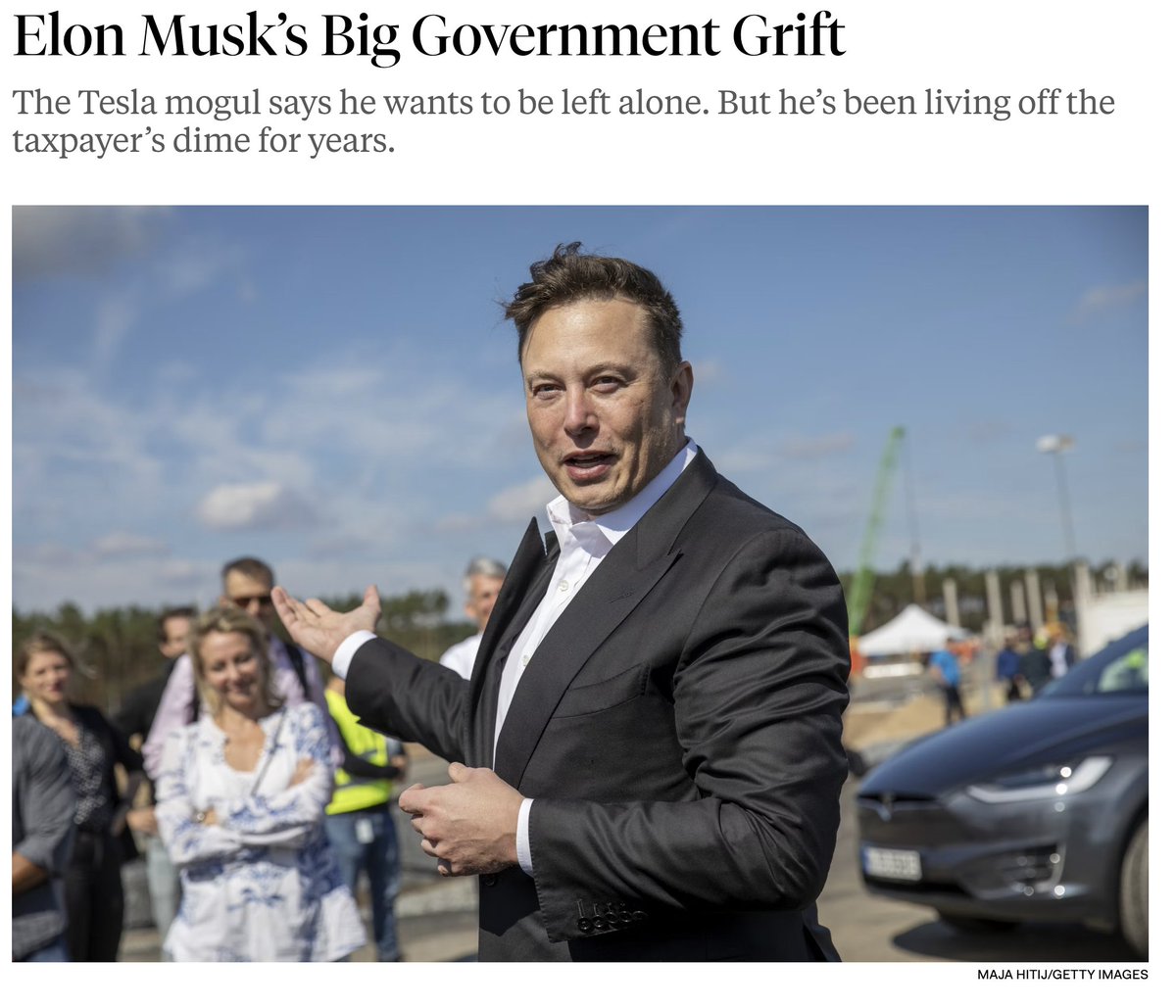
Free-market capitalism means that markets are free from regulation but does not rule out government support. In fact, government support is central to the free-market argument: the government needs to be all-in on business to think free-markets are a good idea at all.
Elon Musk says he embraces free-market capitalism. I can't think of many people more dependent on state support than him.
He's built his companies on the backs of government subsidies, public technology, tax breaks, government loans, and exclusive government contracts.
I trained as a generalist investor. I realised after a few years what many of my colleagues hadn’t: you can’t hide between a ‘generalist’ label and call it a day. True generalists are specialists in many, many areas and they never stop specialising in more and more areas.
My first job was as a mgmt consultant - my bosses told me we were smart and could solve problems their industry couldn’t, even though we were 22. I quickly learned that the people in the business knew a lot more than I ever would, and the only chance I had was to listen to and learn from them. Generalists are always going to know a lot less than others - embracing this ignorance is key to effective diligence. A 🧵:
A little knowledge is a dangerous thing; no knowledge often can be better because at least you know you don’t know anything. Here are some common mistakes I’ve noticed reading tegus transcripts or listening to calls of analysts I’ve work with in my current and prior role:
1) analysts myopically focus on the 2-3 things they think matter, often trying to box the expert into answer specific questions they need to build their model or validate / invalidate their thesis. Nuance is ignored to try to arrive at a clear yes / no. Not only is this ineffective, but it makes you come off as a jerk and is as likely to get you bad specific information as it is good specific info.
2) analysts ask the expert to predict the future (eg do you think xyz can grow 20% next year). Predicting the future is hard and we are all wrong almost all the time. Don’t make the expert do your job - get the inputs you need to make that judgement yourself.
3) analysts ask questions of experts that the expert isn’t qualified to answer, and often get strong opinions from someone with no credibility to answer them.
4) in the eagerness to get through their question list or hit on key points their boss wants the answer to, they don’t pursue tangents or off-handed comments for potential clues to issues they might not know are issues. All my best expert calls veered off script.
5) there are gradients within all of these areas - you don’t want to let an expert ramble but also don’t want to cut them off if they are about to say something interesting; you want tangible datapoints (especially on check in calls) but you also don’t want false precision. Appropriately managing these nuances on the fly takes a lot of experience and is why two people can (and often do) get totally different insights from the same person.
A few high level observations for conducting better diligence calls, especially in early stages of diligence:
1) find an “industry guide” who can answer all your stupid questions, and ask all your stupid questions. Don’t assume something unless you know it - things often don’t work they way you’d think they would logically. This guide is often a former employee, long time c-suite exec in industry, long time division head who bounced around one or several companies in your space. They also are concise, can explain complex concepts well, and will admit when they don’t know the answer to something. We will often do these as 1.5-3hr calls and learn as much as we can in the first 2-3 days of dilligence. These are industry specific, but will often include detailed discussions of business mix, customer mix, key decision makers, customer lifecycle, substitutes in addition to direct competition, price sensitivity, etc. These calls help with key issue identification outside of what we might otherwise glean from public materials.
2) ask experts the questions they are uniquely qualified to answer. Don’t ask the supply chain person about competition, but do ask them about price / cost lag, and raw material mix as a % of cogs, etc. Don’t ask head of engineering about pricing in the market but do ask about technological risks / product roadmap. This is basic but it’s surprising how often people ask questions of experts they are unlikely to know anything about - this wouldn’t be as much of a problem if experts said I don’t know, but the kind of people who conduct expert calls generally don’t like saying that. The first 10 minutes of any call we do is spent identifying exactly what the person did, what regions / segments they were involved in so we can ask them the right questions and ignore unreliable info.
3) focus as much on the qualitative as the quantitative. Most people are not nearly as quantitative as hf analysts, and if they do give you numbers there is a very highly likelihood they are remembering them wrong. We’ve found understanding the nuances of why a business is performing a it is by asking qualitative questions to better understand the business is more valuable (and more reliable) than questions meant to predict the quarter or plug into a model.
4) don’t ask data oriented questions where the data actually exists (or if it does make sure the expert is giving it to you!). Eg if you are researching anything consumer electronics oriented NPD / IDC likely have the actual data - same with Nielsen for consumer packaged goods. And remember when you get quantitative answers the person is often making up their numbers or remembering them wrong especially if they are outside a finance role.
5) quality > quantify. I’d rather do 5-6 high credibilty expert calls than 20+ that include low credibility or even worse, high conviction / low credibility contacts. You will never be sure you are right and, if you are, you’ve probably done something illegal. The search for certainty is a fools errand and is as likely to take you further from the truth vs closer to it.
6) make sure you heard the expert right! I can’t tell you how many times I’ve been on calls with a colleague and we heard 2 completely different things. I’m a big fan of summarizing back to experts what they’ve told me, at the end of a call or end of a discussion around a specific topic to make sure I am getting the right takeaway.
7) as you get questions answered to your satisfaction or as you uncover new issues, modify your question list and what you ask to focus on holes in knowledge or new concerns. Also update expert requests with new angles or titles as you learn more about the industry. This seem simple but again people are often just checking off boxes instead of thinking of dilligence as a fluid process thsr changes as you learn more.
Feel free to share / add to your favorite observations / ways of doing expert calls.
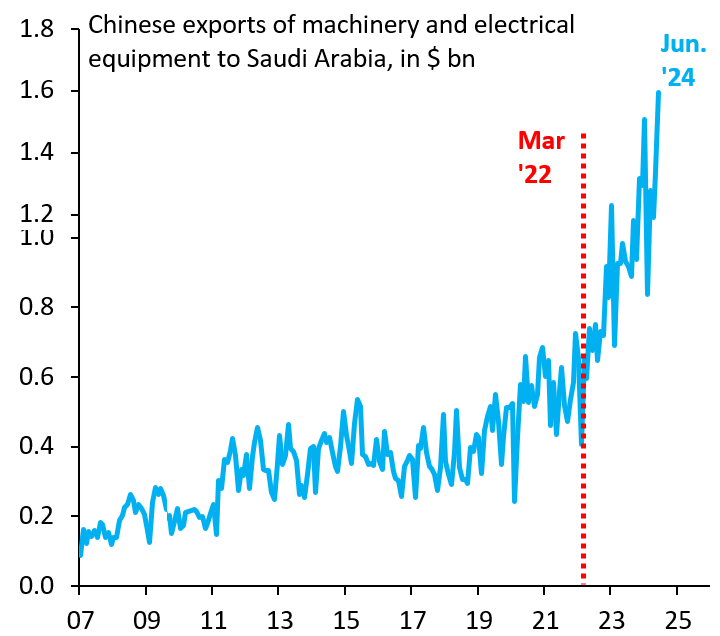
This chart suggests that a Chinese-Saudi-Arabian economic alliance has been a long time in the making. We should wonder what Saudi oil and money can do once in orbit with a Sino-Russian strategic alliance.
Russia's invasion of Ukraine kicked off a realignment of global alliances. Saudi Arabia pushed through multiple OPEC+ production cuts, helping Russia get more cash for every barrel of oil it exports. Now Saudi imports more machinery and electrical equipment from China than ever.
Reading tweets in reference to the US Republican debate suggests that the Democrats’ biggest weakness is reason. The 2024 election will be won not through reasoned argumentation or fact-checking but gut-feeling. And the gut knows no facts—only visceral emotions.
Everything we think we know about inflation and its drivers is wrong. There is another perspective: that declining inflation is a late-stage signal of a coming recession.
U.S. inflation is declining more rapidly than most expected. @robin_j_brooks, Peter R. Orszag, and William E. Murdock III highlight how the sheer size of pandemic-era supply chain disruptions helps to explain disinflation. https://t.co/Gsq1m5hWli
This is what a good metaphysic (philosophical matrix) for an investor looks like: decide what metric you want to optimise and align fully with that ideal. Size and greatness are not the same but often diametrically opposite.
So true, the larger the fund the large the fees, and the less incentive you have to actually perform.
He's even said the best marketing you can do is to stay small so you can post up great returns.
I now realise this is prob what Soros meant when he told him:
“Do you want to make money? Or do you want to leave a good track record? Which do you choose? The two aren’t the same”
If we think k about US-China/Russia relations from a US/economic perspective, Sino-Russian strategy will never make sense. That is the West’s greatest weakness, that we’re blind to strategies other than our own.
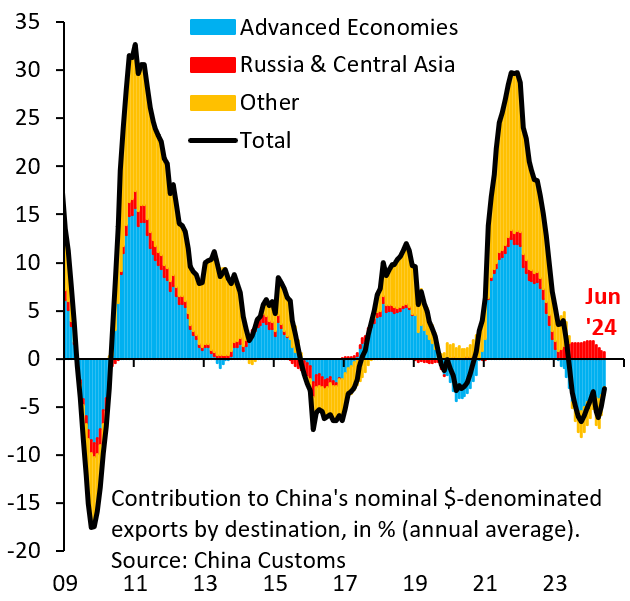
China is making really bad economic bets. China's main export markets are in the West. It is here that China's future lies, especially since it has weak domestic demand. Yet Xi thinks it's a good idea to align China with Russia (red) - a tiny economy that will only get smaller...
@BioExplorr@F_Compounders That was going to be my question too. Investing used to be a value-industry in that few were in it. Now, everyone is an investor. There is wisdom in that.
Debt trajectories will continue to steepen for as long as there is an expectation (social and cultural) that economies and tech will continue to grow. Only countries and governments that recognise and embrace 21st century “degrowth” will be motivated to reduce debt ratios.
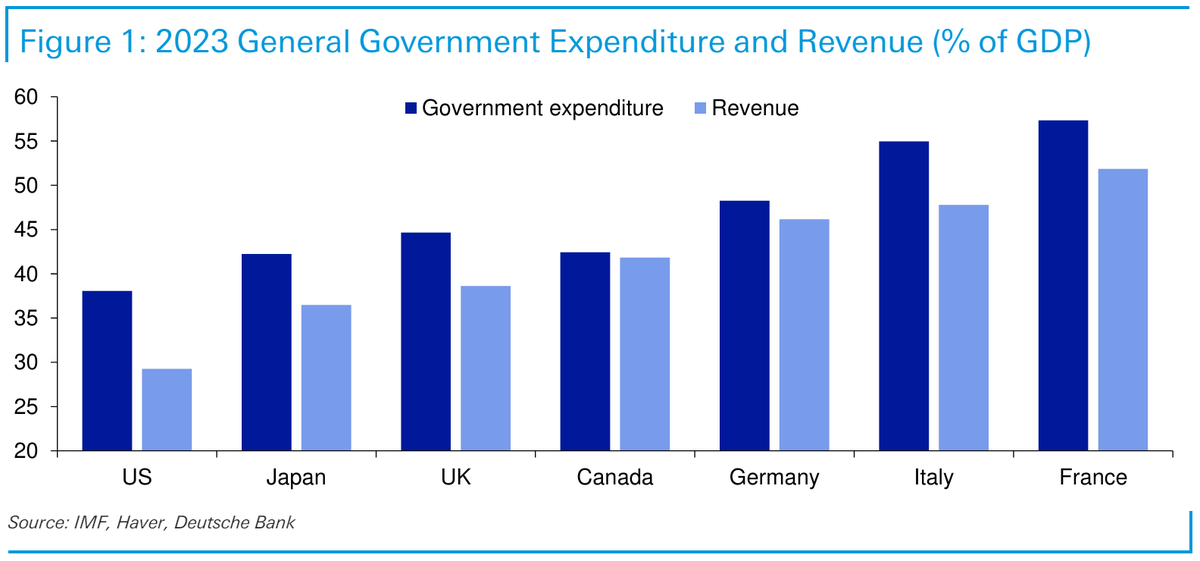
To put things into perspective: #France has one of the highest tax revenues in the world as a share of GDP, and one of the highest spending ratios. By contrast, the US has one of the lowest tax and spending ratios among the developed economies. BUT both have debt trajectories that are currently on an unsustainable path. France hasn’t had a budget surplus since 1974, and markets are concerned that there’ll be a further push towards fiscal expansion after the election. Meanwhile, the US hasn’t had a budget surplus in over 20 years, and the CBO are projecting deficits above 5% of GDP for the next decade. (via DB's Jim Reid)
The dollar is also up over the past 10 years because its stock market has been very strong over that period. Just look at what happened to the dollar after the dot com bust and the GFC and consider what’s going to happen once NVIDIA and Microsoft no longer hold the NASDAQ.
All the US Dollar doomsayers seem to be completely oblivious to what is going on in markets. Over the past 10 years, the Dollar is up 30% against the G10 (black) and 50% against EM when you exclude China (blue). There is simply no alternative to the US Dollar. Not even close...
@HoyasFan07 Agreed. But the tone of these articles is invariably about blaming the debt, rather than the behaviours that led to it. Great empires fall not because of debt-servicing but because of the convenience that got them there. It’s classic failing-incumbent behaviour.
@TonyIsHere4You@Jay_Busacca@EPBResearch Definitely. Most people have bandwidth for one main project and one side-project (hobby). Usually a family falls into the full-time (rather than hobby) category. Unfortunately, most jobs do too, creating a conflict.
@mastersinvest@breadcrumbsre You’re not going to find the weird stuff on Twitter. It’s hiding in plain sight in second hand bookstore sale-piles and everywhere else nobody is looking.
@EPBResearch@LoganMohtashami The asset-price bubble kicked into high gear. My guess RE: property would be that the difference accounts for investable and non -investable assets in the market.
@breadcrumbsre The more participants there are in financial markets, the less fair prices become. Markets have never been more popular, so prices are not fair (especially for the popular stocks).
It’s not Russia or the EU that is the problem. The problem is that nobody is true to their principles any more. Instead, everything has been surrendered to the pursuit of profit. It’s only when profit ceases to be primary that we’ll see the real moral progress against Russia.
There's now 13 EU sanctions packages on Russia and this is the reality. Russia's invasion of Ukraine has shone a light on how the EU works and it's bad. The EU doesn't need grand visions for the future. It needs people who make it transparent and accountable in the here and now.