🚨⚡️Presidente de Kazajstán: "Es mejor no tener armas nucleares: hay que centrarse en la economía y la armonía global".
La respuesta de Putin:
“Saddam Hussein también pensaba eso”.
-: En el mundo actual, las armas NUCLEARES no son una amenaza... son la única garantía de soberanía
🚨⚡️ Kazakhstan’s President: "It’s better not to have nukes — focus on the economy and global harmony."
Putin’s reply:
“Saddam Hussein thought that too.”
-: In today’s world, NUCLEAR weapons aren’t a threat.. they’re the only guarantee of sovereignty
https://t.co/UDGAnQkwI4
The Lead
US and Iran Announce End to War. but Are You Actually Serious About Real Peace?
by Stewart Battle (EIRNS) — Jun. 15, 2026
The world welcomed the news of an agreement reached between the U.S. and the Islamic Republic of Iran over the weekend. “The Deal with the Islamic Republic of Iran is now complete,” President Donald Trump said June 14. This was confirmed by Pakistani Prime Minister Shehbaz Sharif as well as the Iranians themselves, and a formal signing ceremony is planned to take place in Switzerland this Friday, June 19. Trump reportedly digitally signed the MOU Sunday night before he left to attend the G7 summit in France.
While time will tell what the actual details are, the agreement appears to be a major concession on the part of the United States after President Trump was handed one of the most embarrassing defeats in recent times. Iranian Foreign Ministry spokesman Esmaeil Baghaei said June 15 that the signing of the agreement is a “very significant breakthrough” for Iran, adding that “History will show that the Islamic Republic of Iran and its friends did not allow this malicious act by the Zionist regime to distract us from securing the supreme interests of Iran and Lebanon.”
The announcement was welcomed around the world as an important step back from continued war. However, the conspicuous amount of despair coming from Israel is very telling as to what challenges remain. Israeli Defense Minister Israel Katz vowed that Israel will remain in southern Lebanon, despite the agreement explicitly mandating otherwise, while Netanyahu pledged they would remain there “for as long as necessary.” Netanyahu also cautiously tried to paint the war as a victory, saying that the war “saved the State of Israel from annihilation.”
Aside from the Israeli threats to sabotage any potential resolution, and the obviously unresolved nature of many of the most challenging points of contention in the agreement itself, the question remains: Can this peace become a stable peace? Can this moment of reprieve be transformed into an inflection point where a wholly new orientation takes hold?
The emphatic point to be made is: Yes, if we act to make it happen. Don’t wait around analyzing what Donald Trump will do next, or place your bets in Polymarket as to how long the agreement will last. Helga Zepp-LaRouche addressed this in a discussion with associates June 15, where she called for upgrading the mobilization for the Extended Oasis Plan for Southwest Asia. “This is the moment to put in the economic development perspective on the table, to change the dynamic on a permanent basis,” she said. She emphasized the importance of former Prime Minister of Turkey Ahmet Davutoğlu’s proposal for a new security architecture for the region, combined with the Schiller Institute’s proposal of economic development to solidify it.
Lawfully, another such proposal has surfaced in Egypt. Mohamed Hegazy, the Former Assistant Foreign Minister of Egypt, published an article June 12 in Egypt’s Al Ahram calling for a “framework for collective security and cooperation” for the entire Arab world and Southwest Asia. He calls for “a broad strategic vision that places stability, development, cooperation, and mutual interests at the center of a new Middle Eastern equation,” the objective being “not merely to break political deadlock, but to move from a paradigm of conflict management to one of comprehensive regional peacebuilding.”
Hegazy clarifies his idea of peacebuilding: “In the twenty-first century, security is increasingly linked to food security, water security, energy security, supply chains, and economic stability.” The UN and other global actors have “emphasized that sustainable development and political stability are inseparable,” he notes, adding that “the concept reflects the recognition that challenges related to water, energy, and food are no longer separate issues but interconnected dimensions of a single strategic equation.” Southwest Asia, he adds, “possesses significant untapped opportunities in economic integration and cross-border infrastructure. Expanding regional economic cooperation can therefore become one of the principal foundations of long-term security and stability.”
As Zepp-LaRouche and Davutoğlu have noted and as Hegazy reiterated, the only path toward peace is one that involves economic development. It is not a simple political agreement that will bring lasting security, but a change in the underlying process which led to this war that must be achieved. Do we have the moral fitness to address, at this late hour, the root causes of the problems we face? That is the question now squarely on the table with this peace agreement.
https://t.co/d0bqGzshpJ
Mohamed Hegazy, the Former Assistant Foreign Minister of Egypt, has written a major proposal for a long term basis for peace in the Middle East. https://t.co/gqImoCW8Do Published in Egypt’s Ahram Online June 12, Hegazy calls for a “framework for collective security and cooperation” for the entire Arab world and Southwest Asia. He calls for “a broad strategic vision that places stability, development, cooperation, and mutual interests at the center of a new Middle Eastern equation,” the objective being “not merely to break political deadlock, but to move from a paradigm of conflict management to one of comprehensive regional peacebuilding.” “Sustainable security is not achieved solely through balances of power, but through institutions of cooperation, mechanisms for dialogue, and frameworks for managing differences,” he writes.
He lists five “fundamental pillars,” beginning with a cessation of the war in Gaza, preservation of Palestine’s territory, and a just settlement of a two-state solution. Additionally, Hegazy proposes “Establishing a regional framework for collective security and cooperation encompassing Nile Basin water security, Red Sea security, Gulf security, and Eastern Mediterranean security,” and “Linking security with economic development, regional integration, and shared interests to achieve sustainable stability for all.”
Hegazy then clarifies his idea of peacebuilding: “In the twenty-first century, security is increasingly linked to food security, water security, energy security, supply chains, and economic stability.” The UN and other global actors have “emphasized that sustainable development and political stability are inseparable,” he notes, adding that “the concept reflects the recognition that challenges related to water, energy, and food are no longer separate issues but interconnected dimensions of a single strategic equation.” Southwest Asia, he adds, “possesses significant untapped opportunities in economic integration and cross-border infrastructure. Expanding regional economic cooperation can therefore become one of the principal foundations of long-term security and stability.”
He concludes by noting: “The ultimate objective of the proposed initiative is not the creation of a new political alliance or additional regional axis. Rather, it seeks to launch a historic process to redefine regional security itself on the basis of regional integration, reconciliation of differences, and geographically driven development—away from military blocs and confrontational alignments.” He ends by proposing that Egypt establish a “Conference on Security and Cooperation in the Middle East.”
Egypt can play a guiding role in the framework, he writes, proposing that it kick off the process by launching a diplomatic tour to recruit other regional nations to the plan. Among those he includes are Türkiye, Saudi Arabia along with other Arab nations, building a “strategic dialogue with the United States,” and of course Iran.
Hegazy was interviewed by another Egyptian newspaper last week, and is clearly organizing for his proposal more broadly.
https://t.co/vt3E648BU2
Israeli Prime Minister Benjamin Netanyahu, facing intense pressure both from within and from outside his coalition government over having lost the war against Iran, tried to make defeat look like victory during a late-night press conference on June 15. According to The Times of Israel, he claimed that preventing Iran from obtaining nuclear weapons was his “life’s mission,” saying: “With an agreement or without an agreement, Iran will not have nuclear weapons—not today and not tomorrow. As long as I am Prime Minister of Israel, it will not happen.” He repeated his assertion that the nuclear threat from Iran had been an “immediate danger” and Israel succeeded in removing it, “together with our American friends.”
“We removed, for years to come, this danger hanging over us of the elimination of Israel’s population. That is what we did. We saved the State of Israel from annihilation,” Netanyahu claimed. He added, however, that “the struggle is not over and complete. We will need to continue standing guard, continue being strong and determined, and defend ourselves as much as necessary.”
At the same time, Netanyahu refused to commit to Trump’s deal: “This agreement was made by the United States, by the president... And he believes that he can truly combine both the opening of the [Strait of Hormuz] and the cancellation of the nuclear program… And I repeat and say that this is his decision, and he is leading it... Of course, I expressed my view in various conversations.” https://t.co/aYvzjlPdBf
On Lebanon, he committed to “remain in it for as long as necessary... I stood very, very firm” on remaining there. “And I think our American friends respect that resoluteness and that firm stance.” Amid concerns over US limitations on Israeli freedom of action, Netanyahu added that in addition to fighting terror groups in those areas, “we established deep security zones around Israel… in Gaza, in Lebanon, in Syria,” and stressed that “we will remain in the security zones for as long as necessary to protect our country.”
Netanyahu also declined to say whether he would permit Israel to strike Iran alone or act independently against Hezbollah in Lebanon, as one reporter asked. But he insisted that he is defending Israel’s interests in his interactions with U.S. President Donald Trump, following days of reported friction between the two leaders and public criticism from Trump of Netanyahu. “Many times we see eye to eye, and there are also cases in which we see less eye to eye,” he said of Trump. “I am responsible for Israel’s security interests. I stand up for them.”
https://t.co/ZbqZ6gPbUP
The roof of the historic Cathedral of the Dormition, at the historic thousand-year-old Kiev-Pechersk Lavra holy site, caught fire overnight during Russia’s latest attack on Kiev. Fortunately, there was no damage to the interior.
Ukraine’s Foreign Minister Andrei Sybiha immediately indicted Moscow: “By striking the Kyiv Pechersk Lavra, one of the greatest holy sites of Christianity, Putin has forever put his name on the list of history’s worst barbarians. He should be damned for centuries.”
As with Bucha, the Zaporozhye nuclear plant et al, Kiev has repeatedly sounded the alarm at timely occasions, when it is decision time in the West whether to keep the regime of acting president Volodymyr Zelenskyy in power and the ‘forever war’ against Russia going. While a competent investigation needs to occur as to the fire, it should be noted that it was Zelenskyy who deployed force in 2023 to expel the monks from their centuries-old monastery, and that the specific building in question is not part of the original, having been built in 1998-2000.
That said, Ukraine’s SBU claimed that it “found fragments of the hull and engine of a Russian kamikaze drone” at the site. It displayed a photo of a Russian Geran-2 UAV as evidence—however, it may be more conclusive of a fraud than of the attack. The serial number provided maps to a Russian Geran-2 manufactured in May—yet the engine appears to be completely rusted. So, questions remain. https://t.co/ibChrVjSil
Russia’s Ministry of Defense reported on their massive overnight attack, targeting and striking 11 specifically named “facilities of the defense industries” and 4 military airfields. Of the 11, three were in Kiev—the Kyiv State Plant Burevisnyk, the Kyiv Aggregate Plant and Aircraft Repair Plant No. 410, and the Kyiv Innovation Terminal Nova Poshta. In addition, “territorial recruitment centers” in Kiev were hit. They asserted that they “do not plan or conduct strikes against civilian infrastructure facilities. According to confirmed data, buildings of the Kyiv-Pechersk Lavra were hit by a missile from an American Patriot air defense system. One possible reason for the malfunction of this system could be that Western countries had supplied the Kiev regime with missiles that had expired.” https://t.co/mdp6nRAHdq
@StDog8@RT_com False is not true. AI does this all the time. Even they called it “hallucination”.
It is good to keep a logic use of the language. When AI says something that is not true, it is false. Do not try to defend a machine that doesn’t work. It’s not sane.
JUST IN: 🇮🇷🇮🇱🇱🇧 Response by Iran’s Foreign Ministry to Israel’s claim they will not withdraw from Lebanon:
– We know that Israel never takes any action without consultation and direct coordination with America.
– Therefore, we hold America directly responsible if it fails to force Israel to submit to its obligations as part of the MoU, with necessary consequences.
https://t.co/MtdjYd2rXN
The Lead
Ceasefire Extended; but Aggression and Brutality Doesn't Sustain a Nation
by Paul Gallagher (EIRNS) — Jun. 14, 2026
The faster that truth sinks in, the better for the nation and the world.
President Trump, who was cajoling a peace “deal” with Iran from late June 13 throughout June 14, was confirmed by Pakistani and Iranian officials late Sunday evening. It reflected the fact that the President had forced himself into a high-pressure trap. The constant claims of a “peace deal” did not bring Iran around for more than 100 days, because of Iran’s strong respect for its own sovereignty under an unprovoked, existential attack. Pleading with Israel for a ceasefire with Lebanon did not work because in “Bibi” Netanyahu, Trump had met more than his own equal in military brutality.
On Sunday, Netanyahu again bombed Beirut to try to ensure that the United States could not achieve a “Trump birthday deal” with Iran. Israel’s extremist right-wing ministers claimed the bombing of buildings in the city was in “necessary, automatic” response to three drones fired at northern Israel by Hezbollah, although the Times of Israel’s blog acknowledged that it had not responded to several previous such drone attacks which did not affect civilians.
The Trump Administration’s “government of billionaires, for billionaires, and by billionaires” has been looting developing nations by brutally seizing their raw materials; looting its own allies by selling them hyper-expensive oil and natural gas in a global energy crisis of its own creation; and now has turned its “operation economic fury” against its largest ally, India. None of this has produced any American economic revival. Rather, it has cost American consumers more in inflation, high interest rates, debt and war spending, than its ill-gotten gains. May’s inflation readings rose to 4.2% for Consumer Price Inflation, and 6.3% for Producer Price Inflation.
This has also cost Trump his credibility, as he abandoned every promise made to election supporters.
Among President Trump’s erstwhile strongest supporters, everyone from Marjorie Taylor Greene to Joe Rogan recognizes this failure.
This is not America. We are about to celebrate the 250th year of our Declaration of Independence from the British Empire, this July 4th. We are supposed to be reading that masterful Declaration from public places all over the nation, on or about that day. Pope Leo, the first American Pope, has already read it publicly to the graduates at his own alma mater, Villanova:
“We hold these truths to be self-evident; that all men are created equal; that they are endowed by their Creator with certain inalienable rights; that among these are life, liberty, and the pursuit of happiness; that to secure these rights, governments are instituted among men, deriving their just powers from the consent of the governed…”
You can participate, either by attending in person or by getting on a Zoom connection, in 2028 Presidential candidate Diane Sare’s July 5 meeting in Philadelphia, America 250: A Rededication.
https://t.co/vnqOqcx41K
New leads by investigative journalists in movie about Nord Stream case
A 121-minute documentary film, “Nord Stream – The Explosion,” has been produced by two German investigative journalists with the intent to break the official mainstream silence and to spark a serious discussion about the Nord Stream pipeline terror incident. Moritz Enders and Gunther Merz interviewed with experts who rarely get a chance to speak in mainstream media, including former CIA analyst Ray McGovern, blogger Dirk Pohlmann, Theodore Postol from the MIT Institute, investigative author Werner Rügemer, Ola Tunander, Jonas Tögel, engineer Erik Andersson, geopolitical expert Demostenes Floros, entrepreneur Axel Turck, and Harald Kujat.
The film taps into new sources, Moritz Enders tells Berliner Zeitung https://t.co/fDPJXE2PFT): “The film relies largely on the on-site research of Swedish engineer Erik Andersson and the OSINT research of German Michael Kobs.” While Professor Theodore Postol is known to an international audience, “in our film, he explicitly comments on the technical plausibility of Seymour Hersh’s theory,” Enders said. “We find it particularly striking that Hersh’s theory appears never to have been seriously examined by the (German—ed.) Federal Prosecutor General and that many media outlets have portrayed Hersh as untrustworthy without seriously investigating his theory.”
Yet for Enders, the prevailing theory cannot be entirely dismissed either—namely, that a few rogue Ukrainians, having gone rogue without the knowledge of the government in Kyiv, carried out the explosion during a dive from the yacht “Andromeda.” “We believe that the yacht was present at the scene and may not have been entirely uninvolved in the events,” says Enders. “Overall, however, we consider it a cover story that was planned from the start, and behind which the true puppet masters are hiding.” The film hints at who within the American establishment acted as the puppet master.
Enders wants to “place the attack within a broader geopolitical context.” “The long-term economic and, consequently, political consequences for Germany and the EU are examined,” says Moritz Enders. Enders explains the lack of willingness to investigate by pointing to the unforeseeable consequences: “The attacks on the pipelines essentially constitute an act of war against Germany and Russia. If the Germans were to name the true perpetrators here, the Western alliance structure would have to be called into question.”
Moscow’s reticence should also be viewed in this context: “I think the Russians want to avoid a major conflict and are possibly hoping for a ‘deal’ with the Americans to break up the Western phalanx somewhat.” Most recently, one possible deal discussed was that a U.S. company could take over the pipeline and then sell Russian gas in Europe at a markup.
An intriguing aspect also addressed in the film is the puzzling refusal by German Chancellor Friedrich Merz to allow the still-intact section of the pipeline to be put into operation at any time. Russian President Vladimir Putin just recently in talking to international media at the SPIEF event in St. Petersburg mentioned that one out of four pipelines was still functioning and could start pumping gas tp German right away.
The film will be shown on Thursday, July 2, 2026, at 7:30 p.m. at the Babylon cinema in Berlin. Tickets can be ordered online. The filmmakers will be present to answer questions from the audience. (rap)
https://t.co/hc5DOcl32W
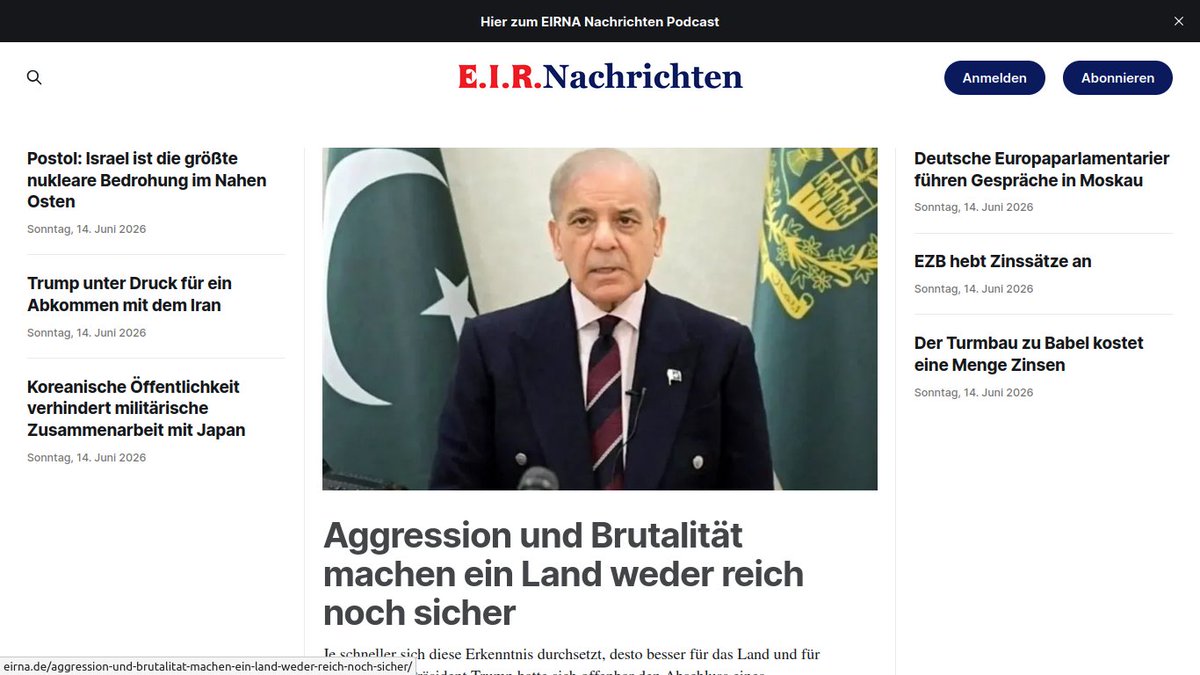
Je schneller sich diese Erkenntnis durchsetzt, desto besser für das Land und für die Welt.
US-Präsident Trump hatte sich offenbar den Abschluss eines Friedensabkommens mit dem Iran zu seinem 80. Geburtstag am 14. Juni dringend gewünscht und es auf Sozialen Medien praktisch schon angekündigt. Am späten Sonntagabend bestätigten pakistanische und iranische Vertreter, ein Abkommen sei sehr nahe. Trump hatte sich selbst in eine Falle manövriert. Seine ständigen Behauptungen über ein „zum Greifen nahes Friedensabkommen“ konnten den Iran mehr als 100 Tage lang nicht umstimmen, weil der Iran angesichts eines existenziellen Angriffskrieges großen Wert auf seine Souveränität legt. Trump flehte Israel um einen Waffenstillstand mit dem Libanon an, aber ohne Erfolg, weil er in „Bibi“ Netanjahu einen mehr als ebenbürtigen Gegner in Sachen militärischer Brutalität fand.
Am Sonntag bombardierte Netanjahu erneut Beirut, um Trumps „Geburtstagsdeal“ mit dem Iran zu verhindern. Israels rechtsextreme Minister verteidigten das als notwendige automatische Antwort auf drei Drohnen, die von der Hisbollah auf Nordisrael abgefeuert worden seien, obwohl der Blog der Times of Israel einräumte, dass Israel auf mehrere frühere derartige Drohnenangriffe, die keine Zivilisten trafen, nicht reagiert hatte.
Trumps „Regierung der Milliardäre“ plündert Entwicklungsländer, indem sie Rohstoffe brutal beschlagnahmt; sie beutet ihre eigenen Verbündeten aus, indem sie ihnen in einer selbst verursachten Energiekrise überteuertes Öl und Gas verkauft; und nun richtet sie ihre „Operation Economic Fury“ gegen den größten Verbündeten, Indien. Doch nichts davon hat zu einer wirtschaftlichen Wiederbelebung der USA geführt. Im Gegenteil, es kostet die amerikanischen Verbraucher durch Inflation, hohe Zinsen, Schulden und Kriegsausgaben mehr als die unrechtmäßig erworbenen Gewinne. Die Inflationszahlen für Mai stiegen auf 4,2 Prozent bei der Verbraucherpreisinflation und auf 6,3 Prozent bei der Erzeugerpreisinflation.
Dies hat Trump auch seine Glaubwürdigkeit gekostet, weil er alle seine Wahlversprechen an seine Unterstützer gebrochen hat. Viele seiner ehemals stärksten prominenten Unterstützer, wie Marjorie Taylor Greene oder Joe Rogan, erkennen dieses Versagen.
Es ist wieder Zeit für das wahre Amerika! Am 4. Juli feiern die Vereinigten Staaten den 250. Jahrestag der Unabhängigkeitserklärung vom Britischen Empire. Diese Unabhängigkeitserklärung bleibt ein Meisterwerk. Es gibt Initiativen, sie an oder um diesen Tag herum an öffentlichen Orten überall in den USA vorzulesen. Papst Leo, der erste amerikanische Papst, hat sie schon öffentlich vor den Absolventen seiner eigenen Alma Mater in Villanova verlesen:
„Wir halten diese Wahrheiten für selbstverständlich: dass alle Menschen gleich geschaffen sind; dass sie von ihrem Schöpfer mit bestimmten unveräußerlichen Rechten ausgestattet sind; dass zu diesen das Recht auf Leben, Freiheit und das Streben nach Glück gehören; dass Regierungen unter den Menschen eingerichtet werden, um diese Rechte zu sichern, und ihre gerechte Macht aus der Zustimmung der Regierten ableiten…“
Die unabhängige Präsidentschaftskandidatin Diane Sare veranstaltet dazu am 5. Juli in Philadelphia ein Treffen. an dem man auch per Zoom teilnehmen kann. (America 250: A Rededication) https://t.co/DjPpsCjyVU
Llenar el álbum del mundial, de acuerdo a una IA, cuesta entre $6mil y $8mil pesos mexicanos intercambio tarjetas y $25mil, si una persona adquiere sin intercambiar los sobres de tarjetas. Me parece demasiado para la ilusión de un niño.
La austeridad en quienes hacemos política, es una manera de expresar humildad y respeto a la ciudadanía en un país donde muy pocos han tenido mucho y la mayoría ha tenido poco.
Con los altos costos de los boletos de los partidos del Mundial y la dificultad de costearlos por parte de la mayoría del pueblo de México, yo pienso que ningún político, del partido que sea, debería de asistir a ellos.
No porque no puedan pagarlos sino como un acto de sensibilidad y empatía con la mayoría de la población.
Cuando mi hija iba a tercero de primaria me llamaron del colegio porque había escupido a un compañero.
Ya en casa, hablamos.
Me contó que el niño la perseguía para darle besos, ella le dijo muchas veces que no quería, fue a decírselo a los profesores y le dijeron que sólo estaba
https://t.co/1otoxgjyDP
On June 11, the U.S. House of Representatives voted down the proposed 45-day extension of the Section 702 of the Foreign Intelligence Surveillance Act (FISA), which consecutive governments have used for unconstitutional warrantless surveillance of its own citizens. The vote was 218 against, only 198 for. Nineteen Republicans bucked President Donald Trump’s orders that the extension go through, 14 with the courage to vote no, and five others as “no-shows.”
The Senate then failed to pass its version of the bill. Thus, as of Friday night, June 12, the act has expired.
Homeland Security Secretary Markwayne Mullins, like other FISA champions, screeched on “Fox News Sunday” today that the government’s loss of its warrantless surveillance leaves the country unprotected at a time when the threat level is the “highest it’s ever been,” pointing to the World Cup and the nation’s 250 anniversary celebrations. Sen. Jack Reed, a Democrat, on the same program, asserted that all is not lost because the law remains “operative” until March, 2027.
Reed (like others) credited the strong bipartisan opposition to FISA to Trump choosing first one, and then another candidate who have no intelligence background whatsoever to replace Tulsi Gabbard as Director of National Intelligence, their main qualification apparently being they both are big Trump men.
Rep. Thomas Massie posted a list of the 19 Republicans, including himself, who voted against the extension, he asserted, “in order to preserve Constitutionally guaranteed rights.” https://t.co/gdYB8op8Ku
https://t.co/wwle7SfM44
The faster that truth sinks in, the better for the nation and the world.
President Trump, who was cajoling a peace “deal” with Iran from late June 13 throughout June 14, was confirmed by Pakistani and Iranian officials late Sunday evening. It reflected the fact that the President had forced himself into a high-pressure trap. The constant claims of a “peace deal” did not bring Iran around for more than 100 days, because of Iran’s strong respect for its own sovereignty under an unprovoked, existential attack. Pleading with Israel for a ceasefire with Lebanon did not work because in “Bibi” Netanyahu, Trump had met more than his own equal in military brutality.
On Sunday, Netanyahu again bombed Beirut to try to ensure that the United States could not achieve a “Trump birthday deal” with Iran. Israel’s extremist right-wing ministers claimed the bombing of buildings in the city was in “necessary, automatic” response to three drones fired at northern Israel by Hezbollah, although the Times of Israel’s blog acknowledged that it had not responded to several previous such drone attacks which did not affect civilians.
The Trump Administration’s “government of billionaires, for billionaires, and by billionaires” has been looting developing nations by brutally seizing their raw materials; looting its own allies by selling them hyper-expensive oil and natural gas in a global energy crisis of its own creation; and now has turned its “operation economic fury” against its largest ally, India. None of this has produced any American economic revival. Rather, it has cost American consumers more in inflation, high interest rates, debt and war spending, than its ill-gotten gains. May’s inflation readings rose to 4.2% for Consumer Price Inflation, and 6.3% for Producer Price Inflation.
This has also cost Trump his credibility, as he abandoned every promise made to election supporters.
Among President Trump’s erstwhile strongest supporters, everyone from Marjorie Taylor Greene to Joe Rogan recognizes this failure.
This is not America. We are about to celebrate the 250th year of our Declaration of Independence from the British Empire, this July 4th. We are supposed to be reading that masterful Declaration from public places all over the nation, on or about that day. Pope Leo, the first American Pope, has already read it publicly to the graduates at his own alma mater, Villanova:
“We hold these truths to be self-evident; that all men are created equal; that they are endowed by their Creator with certain inalienable rights; that among these are life, liberty, and the pursuit of happiness; that to secure these rights, governments are instituted among men, deriving their just powers from the consent of the governed…”
You can participate, either by attending in person or by getting on a Zoom connection, in 2028 Presidential candidate Diane Sare’s July 5 meeting in Philadelphia, America 250: A Rededication. https://t.co/vnqOqcx41K
https://t.co/R23h0CXIMH
As on most days, the drumbeat from Europe, of Russian plans to attack in the near future, had continued. Russia’s RT news site, which obviously keeps a watch for such Western claims, reported that a report by Sweden’s Defense Committee is warning that a Russia-NATO conflict could kick off “in the relatively near future.” https://t.co/MCvzDWYqEP
The security paper, released on June 12 and endorsed by the Swedish government and all parliamentary parties, brands Russia a “long-term threat” and claims that Moscow could seek to “test NATO’s cohesion and the credibility of Article 5” [of NATO, its common defense article—pbg] if it sees “favorable” political conditions—whatever that may mean; the report doesn’t say. But casting that caution aside, the document also claims that Moscow could engage in hostilities “even if the military balance of power does not meet traditional requirements for an attack.”
In Germany, Major General Michael Traut, commander of the Bundeswehr Space Command, told Politico in an interview that he cannot rule out that Russia is working on technology to place a nuclear warhead in space, warning that such a move could cripple satellite services and make parts of orbit unusable for decades.
“At the very top end of escalation, there is the suspicion that Russia may be working on technology to place a nuclear explosive device in orbit,” Traut said at the ILA Berlin air show. Asked whether he considered that realistic, Traut said: “I cannot rule it out.”
As often occurs with such forecasts of war by Russia, it turns out that only one nation has historically used a nuclear weapon in space—the United States. “If something similar to Starfish Prime happened today,” Traut said, referring to a 1962 U.S. high-altitude nuclear test [it turned off the lights in Hawaii, hundreds of miles away—cjo.], “up to one-third of all satellites in low-Earth orbit” could stop functioning over the following weeks and months. That, he warned, would worsen the problem of space debris and increase the risk of cascading collisions—the so-called Kessler effect. “It is even conceivable,” escalated, “that certain orbital altitudes would no longer be usable for decades.”
Germany’s response, Traut argued, cannot be reserved. “You don’t go into the arena only with a shield,” Traut said. “A functioning deterrent always has an active, offensive component."|
He stressed that “offensive does not mean aggressive,” but he said Germany must be able to seize the initiative in a conflict. That includes acting against an adversary’s space systems—not necessarily in orbit, but across the wider infrastructure that makes satellites work, from ground stations to jammers. Germany, he said, will acquire non-kinetic systems including jammers and lasers, as well as inspection satellites and, over the longer term, spaceplanes to protect German satellites, inspect adversary systems and potentially act against them.
https://t.co/2aJt7iHAs6
Welche Art von Frieden wollen wir?“
Bericht vom 158. Treffen der Internationalen Friedenskoalition (IPC)
Die IPC-Mitinitiatorin und Gründerin des Schiller-Instituts, Helga Zepp-LaRouche, eröffnete die Veranstaltung mit der provokanten Feststellung, unser Handeln heute werde darüber entscheiden, ob sich die Welt in eine gute oder schlechte Richtung entwickle.
https://t.co/JCf86MF5GK
While U.S. President Trump and other U.S. economic commentators are waiting for oil prices to drop “like a rock,” etc. as soon as America and Iran “make a deal,” other analysis continue to project severe energy inflation out into the Summer and Fall; meanwhile, India has become the first major economy whole government has imposed rationing. https://t.co/Bp9ZMzLJvM In India’s case, it is rationing of commercial fuels, including diesel and ethanol, rather than of crude oil for refineries; and a ban on commercial entities buying gasoline at “consumer” stations. The gasoline price is being subsidized to prevent unrest among consumers, and commercial buyers are to be prevented from buying fuels at consumer stations.
There are daily limits for diesel and other commercial fuels. Commercial buyers will have to get their fuels from bulk sellers, to prevent gasoline stations from running dry each day as many have been. The limits will be in effect for 90 days.
India’s producer price, of “wholesale” inflation doubled from March to April, reaching 8.3%, and is forecast for 9% in May; retail inflation meanwhile has crossed 4%. Its currency has dropped fast against the dollar, and the Trump Administration has used this to try to block India from buying any Russian oil, or from accepting any Iranian assistance in leaving the Strait of Hormuz. Indian sailors have lost their lives to U.S. gunboats or aircraft in the process (see separate report).
London’s Economist ran a story June 11 saying that “the world’s strategic oil reserves are running out fast.” https://t.co/fu8fmnntEs The article maintains that cuts to consumption which China was able to make to aid other nations, and which austerity imposed on other countries, have lowered global oil consumption by about 10 million bbl/day, while availability of produced oil has dropped by 15 million bbl/day. The 5 million bbl/day difference is slowly being drained out of strategic national reserves which were already low, such as those of Japan and the United States.




![ZeppLaRouche's tweet photo. https://t.co/vt3E648BU2
Israeli Prime Minister Benjamin Netanyahu, facing intense pressure both from within and from outside his coalition government over having lost the war against Iran, tried to make defeat look like victory during a late-night press conference on June 15. According to The Times of Israel, he claimed that preventing Iran from obtaining nuclear weapons was his “life’s mission,” saying: “With an agreement or without an agreement, Iran will not have nuclear weapons—not today and not tomorrow. As long as I am Prime Minister of Israel, it will not happen.” He repeated his assertion that the nuclear threat from Iran had been an “immediate danger” and Israel succeeded in removing it, “together with our American friends.”
“We removed, for years to come, this danger hanging over us of the elimination of Israel’s population. That is what we did. We saved the State of Israel from annihilation,” Netanyahu claimed. He added, however, that “the struggle is not over and complete. We will need to continue standing guard, continue being strong and determined, and defend ourselves as much as necessary.”
At the same time, Netanyahu refused to commit to Trump’s deal: “This agreement was made by the United States, by the president... And he believes that he can truly combine both the opening of the [Strait of Hormuz] and the cancellation of the nuclear program… And I repeat and say that this is his decision, and he is leading it... Of course, I expressed my view in various conversations.” https://t.co/aYvzjlPdBf
On Lebanon, he committed to “remain in it for as long as necessary... I stood very, very firm” on remaining there. “And I think our American friends respect that resoluteness and that firm stance.” Amid concerns over US limitations on Israeli freedom of action, Netanyahu added that in addition to fighting terror groups in those areas, “we established deep security zones around Israel… in Gaza, in Lebanon, in Syria,” and stressed that “we will remain in the security zones for as long as necessary to protect our country.”
Netanyahu also declined to say whether he would permit Israel to strike Iran alone or act independently against Hezbollah in Lebanon, as one reporter asked. But he insisted that he is defending Israel’s interests in his interactions with U.S. President Donald Trump, following days of reported friction between the two leaders and public criticism from Trump of Netanyahu. “Many times we see eye to eye, and there are also cases in which we see less eye to eye,” he said of Trump. “I am responsible for Israel’s security interests. I stand up for them.”](https://pbs.twimg.com/media/HK530w_WoAAN2se.jpg)




![ZeppLaRouche's tweet photo. https://t.co/R23h0CXIMH
As on most days, the drumbeat from Europe, of Russian plans to attack in the near future, had continued. Russia’s RT news site, which obviously keeps a watch for such Western claims, reported that a report by Sweden’s Defense Committee is warning that a Russia-NATO conflict could kick off “in the relatively near future.” https://t.co/MCvzDWYqEP
The security paper, released on June 12 and endorsed by the Swedish government and all parliamentary parties, brands Russia a “long-term threat” and claims that Moscow could seek to “test NATO’s cohesion and the credibility of Article 5” [of NATO, its common defense article—pbg] if it sees “favorable” political conditions—whatever that may mean; the report doesn’t say. But casting that caution aside, the document also claims that Moscow could engage in hostilities “even if the military balance of power does not meet traditional requirements for an attack.”
In Germany, Major General Michael Traut, commander of the Bundeswehr Space Command, told Politico in an interview that he cannot rule out that Russia is working on technology to place a nuclear warhead in space, warning that such a move could cripple satellite services and make parts of orbit unusable for decades.
“At the very top end of escalation, there is the suspicion that Russia may be working on technology to place a nuclear explosive device in orbit,” Traut said at the ILA Berlin air show. Asked whether he considered that realistic, Traut said: “I cannot rule it out.”
As often occurs with such forecasts of war by Russia, it turns out that only one nation has historically used a nuclear weapon in space—the United States. “If something similar to Starfish Prime happened today,” Traut said, referring to a 1962 U.S. high-altitude nuclear test [it turned off the lights in Hawaii, hundreds of miles away—cjo.], “up to one-third of all satellites in low-Earth orbit” could stop functioning over the following weeks and months. That, he warned, would worsen the problem of space debris and increase the risk of cascading collisions—the so-called Kessler effect. “It is even conceivable,” escalated, “that certain orbital altitudes would no longer be usable for decades.”
Germany’s response, Traut argued, cannot be reserved. “You don’t go into the arena only with a shield,” Traut said. “A functioning deterrent always has an active, offensive component."|
He stressed that “offensive does not mean aggressive,” but he said Germany must be able to seize the initiative in a conflict. That includes acting against an adversary’s space systems—not necessarily in orbit, but across the wider infrastructure that makes satellites work, from ground stations to jammers. Germany, he said, will acquire non-kinetic systems including jammers and lasers, as well as inspection satellites and, over the longer term, spaceplanes to protect German satellites, inspect adversary systems and potentially act against them.](https://pbs.twimg.com/media/HK0szrzWAAAtHG4.jpg)





