He was on the losing side of history. He knew it before he buckled on his armor.
His name was Hector, firstborn son of King Priam, commander of all the Trojan forces. The war had been grinding for nearly ten years by the time Homer's Iliad opens, with Greek ships still beached on the shore, the city walls still holding, and tens of thousands of men who had mostly forgotten why they came.
Hector remembered. It was his brother Paris who had started this, who had taken the Spartan queen and brought a war back with her. The weight of that mistake fell on Hector every day, in armor.
He is not an easy figure to mythologize. Homer gives him a wife, Andromache, who begs him to come inside the walls and stop fighting. A son, young Astyanax, so frightened by his father's crested battle helmet that Hector had to remove it just to hold him. That moment at the Scaean Gates is among the oldest family scenes in Western literature, and one of the most quietly devastating.
Then Achilles came back.
The death of his companion Patroclus had broken something in Achilles, and now he moved through the Trojan lines with a focused fury Troy could not answer. Hector's allies fell back. His men withdrew inside the walls. And Hector was left alone outside the gates.
Homer tells us he nearly ran. That as Achilles closed the distance, Hector's nerve gave way and he fled three full circuits around Troy's walls before stopping. Some ancient readers took this as weakness. It wasn't. It was a man catching up to a decision he had already made.
He turned. He fought. He lost.
Achilles killed him in single combat, then tied his body to a chariot and dragged it around the walls, in full view of the city, while his father Priam watched from the battlements.
But Homer does not end there with the winner. The Iliad closes on grief, on old King Priam crossing enemy lines in the dark to beg for his son's body, and on Achilles, moved by something he had not expected to feel, handing it back.
Three thousand years of readers have lived with that image.
The warrior who held the line knowing the war was already lost.
The father who took off his helmet so his son would not cry.
The commander who had every reason to retreat, and stayed.
That is not how Homer describes a villain. That is how Homer describes a man worth mourning.
In medieval Europe, Hector was ranked first among the Nine Worthies, the traditional roster of history's greatest warriors that also included King Arthur, Charlemagne, and Alexander the Great. The man who lost at Troy, placed above all of them.
#archaeohistories
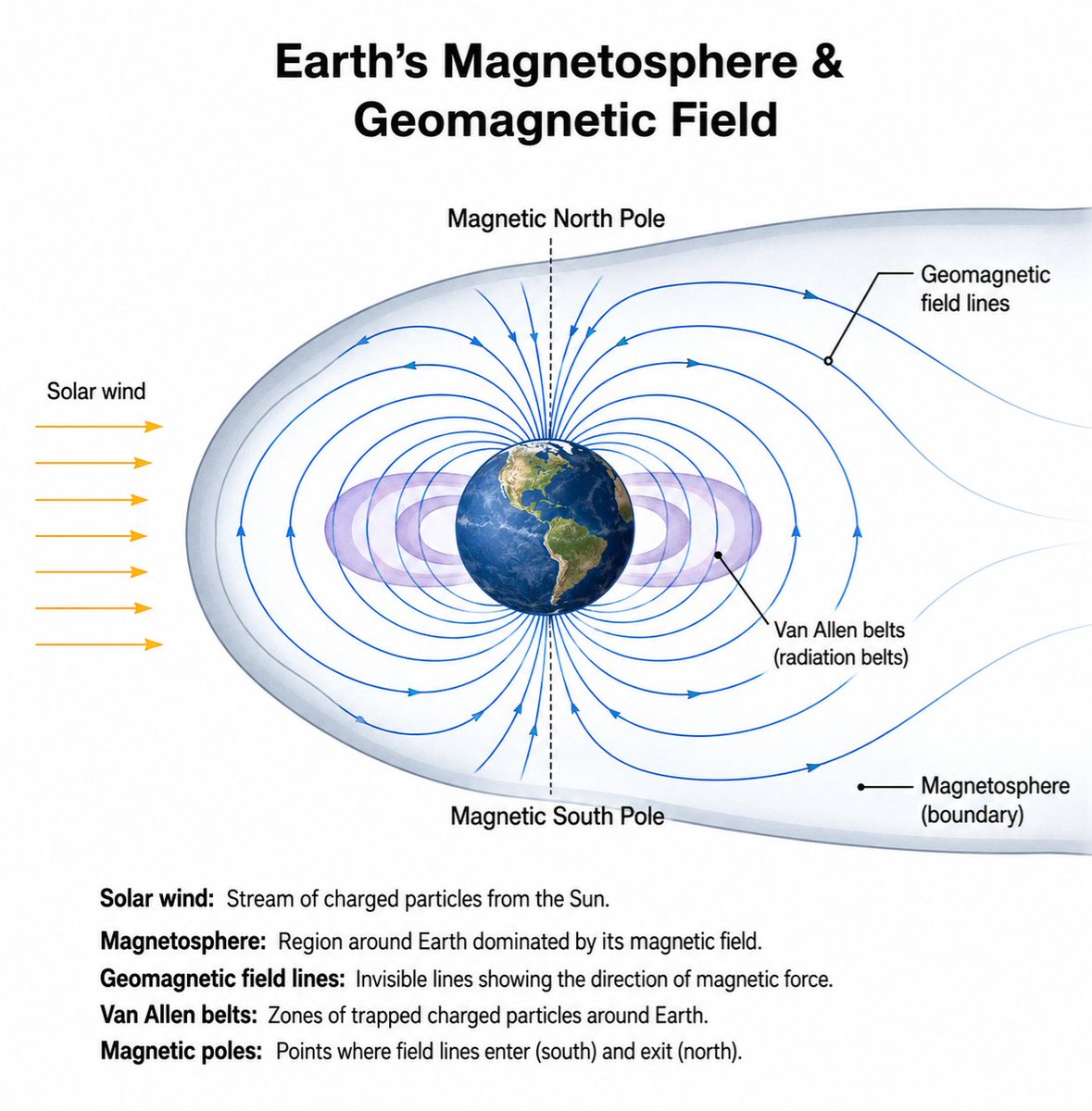
Earth is surrounded by an invisible force field that makes life possible.
Known as the magnetosphere, it stretches far beyond our atmosphere and acts as a shield against the constant stream of charged particles coming from the Sun. Without it, our atmosphere would be far more vulnerable to erosion, satellites would face greater radiation exposure, and technology on Earth would be at much higher risk.
The blue lines in this diagram represent Earth’s geomagnetic field, while the rings around the planet are the Van Allen radiation belts where energetic particles become trapped.
We often hear that modern artificial intelligence is modeled directly after the human brain. A groundbreaking new study published in Nature Machine Intelligence reveals that this comparison might be entirely an illusion.
For years, computer scientists tested AI by observing if its programming could accurately predict biological brain activity. Because the AI often succeeded, experts assumed these intelligent systems processed visual information the exact same way we do. Recently, researchers flipped the script with a brilliant new diagnostic test called reverse predictivity.
Instead of asking if the machine could predict the brain, they asked if biological brain activity could predict the internal workings of the artificial model. The answer was a resounding no.
The research proved that artificial intelligence relies on massive computational shortcuts to reach a conclusion. While an AI program might recognize an object just as quickly as a human, the hidden steps it takes to arrive at that answer are completely alien to nature. To ensure this was a machine issue, scientists compared the brain activity of different primates. Those biological minds mirrored each other perfectly, proving the disconnect is completely unique to computers.
This discovery represents a massive leap forward for both neuroscience and technology. By identifying the exact moments where artificial intelligence diverges from natural biology, researchers can finally begin designing next-generation systems that truly replicate human cognition, rather than just imitating the final result.
Citation: Muzellec, S., Kar, K. Reverse predictivity for bidirectional comparison of neural networks and biological brains. Nat Mach Intell 8, 474–488 (2026). DOI: 10.1038/s42256-026-01204-0
⚛️ LIFE’S BIGGEST MYSTERY MAY COME FROM QUANTUM PHYSICS
Scientists think the reason all life on Earth twists the same way could be linked to the tiny quantum spin of electrons.
A new theory suggests these invisible quantum effects may have guided the first molecules of life billions of years ago, forcing biology to choose one direction — and every living thing since then followed the same pattern.
Even stranger? Alien life could possibly twist the opposite way.
Source: Proceedings of the National Academy of Sciences. Proceedings of the National Academy of Sciences. Quantum electron spin and the origin of biological handedness.
Quantum mechanics has long challenged our understanding of reality by replacing certainty with probability. Central to this field is the concept of the wave function, a mathematical tool that describes every possible state a particle can inhabit.
Modern physicists are now expanding this principle to the entire cosmos, proposing a single wave function of the universe that encodes every configuration of matter, energy, and spacetime. However, a startling realization is emerging: even if we could identify the possible mathematical descriptions of our universe, we might never be able to prove which one actually defines our existence.
The obstacle lies in our perspective as internal observers. Because we are part of the system we are trying to measure, we lack the external vantage point required to gather enough information to distinguish between competing quantum descriptions of reality. This creates a permanent horizon of knowledge where certain aspects of the cosmos remain mathematically shielded from scientific confirmation. Ultimately, this suggests that the universe contains a fundamental limit to discovery, ensuring that the deepest secrets of reality remain forever out of reach, regardless of how advanced our technology or theories become.
source: New Scientist. (2026). The Universe May Be Hiding a Fundamentally Unknowable Quantum Secret. New Scientist.
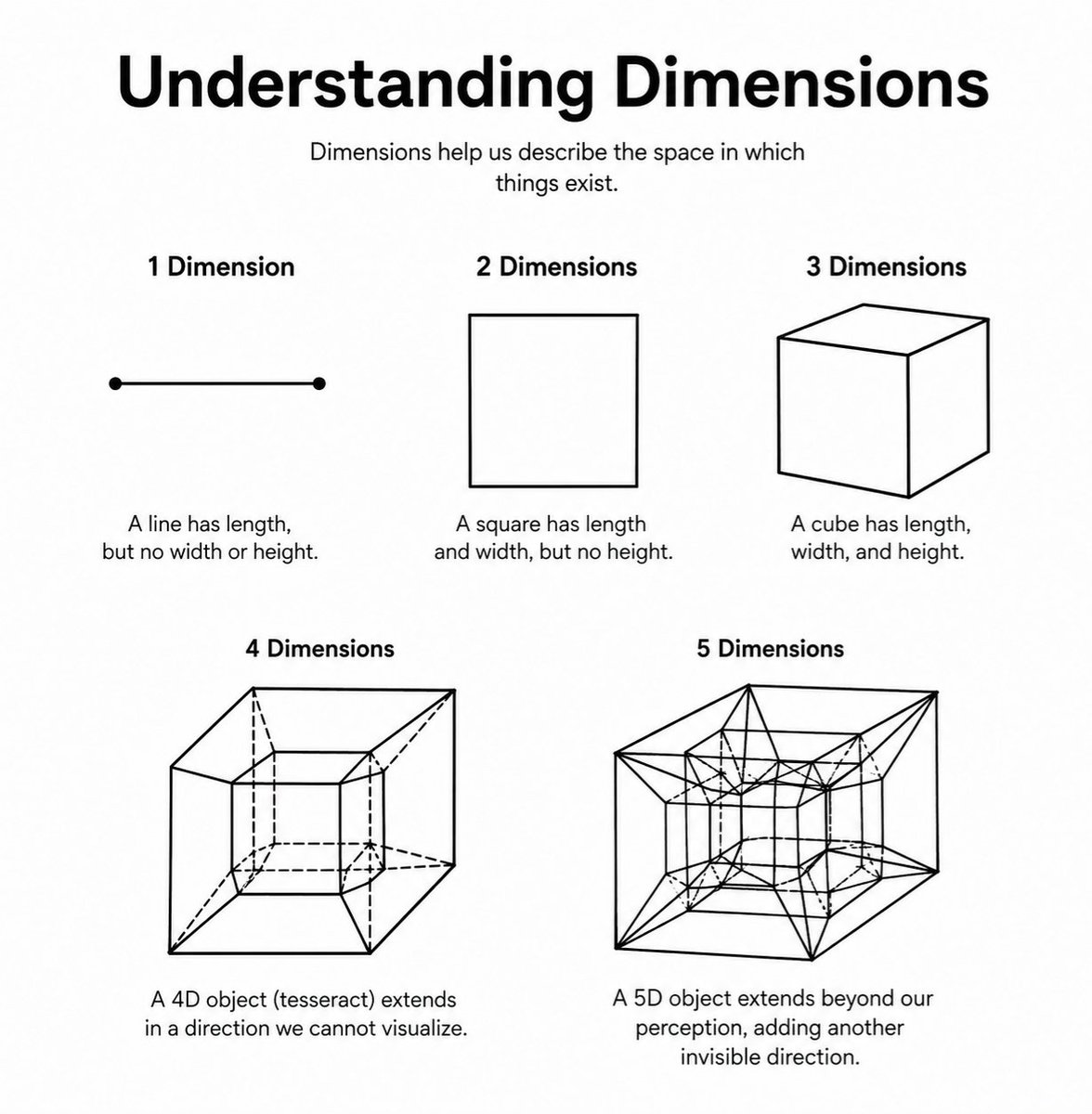
Every dimension adds a completely new direction. That's what makes higher dimensions so hard to imagine.
• 1D: A line with only length. No width or height.
• 2D: A flat shape with length and width. Think of a square drawn on paper.
• 3D: An object with length, width, and height. Everything we see and interact with exists in three spatial dimensions.
• 4D: Represented mathematically by a tesseract, the four dimensional analogue of a cube. It adds a fourth spatial dimension beyond what humans can directly visualize.
• 5D: A five dimensional hypercube (5 cube or penteract) extends the same pattern by adding yet another spatial dimension. Like 4D, it can only be represented through lower dimensional projections.
Every new dimension is created by extending the previous one in a direction perpendicular to all the dimensions before it. Mathematics allows us to study these higher dimensions even though we cannot directly see them.
It began, they say, in the dead of night....
On the evening of July 18, 64 AD, a sudden bloom of fire rose from the Circus Maximus, crackling up from the wooden stalls and bursting into a wind-fed inferno. Rome—ancient, dense, combustible—was a city of close quarters and narrow alleys. Within hours, flames leapt from one insula to the next, devouring shops, temples, shrines, and homes. The night sky glowed orange over the Palatine. Panic spread faster than the fire. By morning, the Eternal City was wrapped in a crown of smoke and screaming. The Tiber shimmered with reflections of flame. Women clutched children.
For six days, it burned.
The cause, as ever, remains a riddle wrapped in politics and paranoia. Some whispered of accident—a cooking fire gone wrong, a lightning strike, the gods’ wrath. Others blamed arson. Tacitus, no friend of the ruling regime, confessed that no one really knew.
But still, suspicion swirled around one man: the emperor. Nero.
At the time of the blaze, he was said to be in Antium, some thirty miles away, though that did little to quell the rumors. Had he ordered the city torched to clear space for grander visions? Had he really mounted a private stage and strummed his lyre while Rome turned to ash?
Here enters one of history’s most stubborn myths: that Nero “fiddled while Rome burned.” Fiddles didn’t exist. Nor, say most historians, did the moment. The story was almost certainly crafted after the fact, shaped by hatred and sharpened by time. Yet the truth does little to exonerate him. Whatever his innocence in starting the fire, Nero wasted no time seizing upon its aftermath. In the heart of the destruction, he saw opportunity and open real estate. He ordered the construction of a colossal new palace—the Domus Aurea, the Golden House—a pleasure dome of gardens, pools, and vaulted halls, with a towering bronze statue of himself as the sun god looming over the ruins.
Worse still, he needed a scapegoat.
To deflect suspicion, Nero turned to a strange and unloved sect—the Christians. They were a tiny and mostly invisible group in Rome at the time, viewed as seditious and dangerously un-Roman. He blamed them for the fire and unleashed a persecution so grotesque it stunned even hardened Roman sensibilities. Tacitus records that some were sewn into animal skins and torn apart by dogs; others were dipped in pitch and set alight to serve as human torches in Nero’s gardens. It was not justice. It was theater.
In the centuries that followed, Nero’s name curdled into something darker than infamy—it became a cipher for evil itself. Many biblical scholars believe that when the Book of Revelation speaks of a Beast whose number is 666, it is speaking in code of Nero. The numerals, rendered in Hebrew, spell out “Neron Caesar.”
To the early Christians, who had watched their brothers and sisters crucified, torn apart, or burned alive under his orders, Nero was not merely a tyrant—he was the embodiment of Antichrist. He had wielded the imperial crown like a butcher’s knife, ruled not with justice but with terror, and turned a city’s suffering into a stage for his vanity. Long after his death, whispers persisted that he had never truly died, that he would one day return. In the apocalyptic imagination of Rome’s victims, Nero was not just an emperor. He was the Beast.
#archaeohistories
🌊 Unearthed from the Deep: The Lost Sphinx of Heracleion
Lying silently on the seabed for centuries, this Sphinx once stood in the ancient city of Heracleion—a place long believed to be only legend. Carved around the 2nd century BC, it vanished beneath the Mediterranean as the city slowly sank, taking its secrets with it.
Rediscovered in 1999, the statue now rests in the Maritime Museum of Alexandria, offering a haunting glimpse into Egypt’s forgotten coastal world and the mysteries swallowed by the sea.
This is the only way giant boulders could have been transported thousands of miles in the past. It's also why we find mixed graveyards of marine and land animals in Alaska, and why Antarctica is a forbidden zone.
This reality was confirmed in the 1940s. Einstein knew about it, and everything the mainstream narrative has come up with since the 1970s has been intended to hide this event.
Humanity is not over 300,000 years old only to have created civilization in the last 4,000 years. Civilization is cyclically reset, and the elites are building doomsday bunkers.
Herodotus wrote that the Thracians were the most numerous people after the Indians, and that united under one ruler they would be invincible.
They never united.
The proof lies in a Bulgarian field. A tomb near Topolovgrad holds a Thracian aristocrat from the early 1st century AD, buried with his horse, his gold, and his weapons, a nobleman of an unconquerable people who spent his career serving in the army of Rome.
Divided, the invincible became auxiliaries. Their princes rode for the empire, took its pay and its land grants, and were buried with its blessing.
Herodotus diagnosed it four centuries in advance. Unity was the one treasure the tombs never contain.
More than a century ago, Friedrich Nietzsche diagnosed the spiritual sickness that now defines much of modern Western culture: the elevation of victimhood, the celebration of weakness and the pursuit of comfort above all else.
He watched the rise of what he called slave morality: a value system that turns traditional virtues on their head. Strength becomes oppression. Resilience becomes insensitivity. Self-overcoming is replaced by grievance and demands for protection. In this inverted morality, the highest status often goes to those who can most convincingly present themselves as victims.
Nietzsche was especially scornful of the “last man”: the small, comfortable creature who wants only security, entertainment and an easy life, while fleeing anything difficult or dangerous. For Nietzsche, struggle was not a misfortune to be abolished, but the necessary condition for greatness, meaning and self-creation. Without resistance, there can be no real growth.
He would have seen the modern welfare state as the perfect institutional expression of this decline. By shielding people from the consequences of their actions and removing the need for personal responsibility, it has done the opposite of not liberating us, instead creating populations that are materially secure but spiritually hollow, dependent on the state rather than on their own strength and initiative.
A society that places comfort above all else and awards the highest status to victimhood does not create better people; it creates weaker, more resentful ones who have lost the very capacity to live fully. This was Nietzsche’s warning. Is anyone listening?
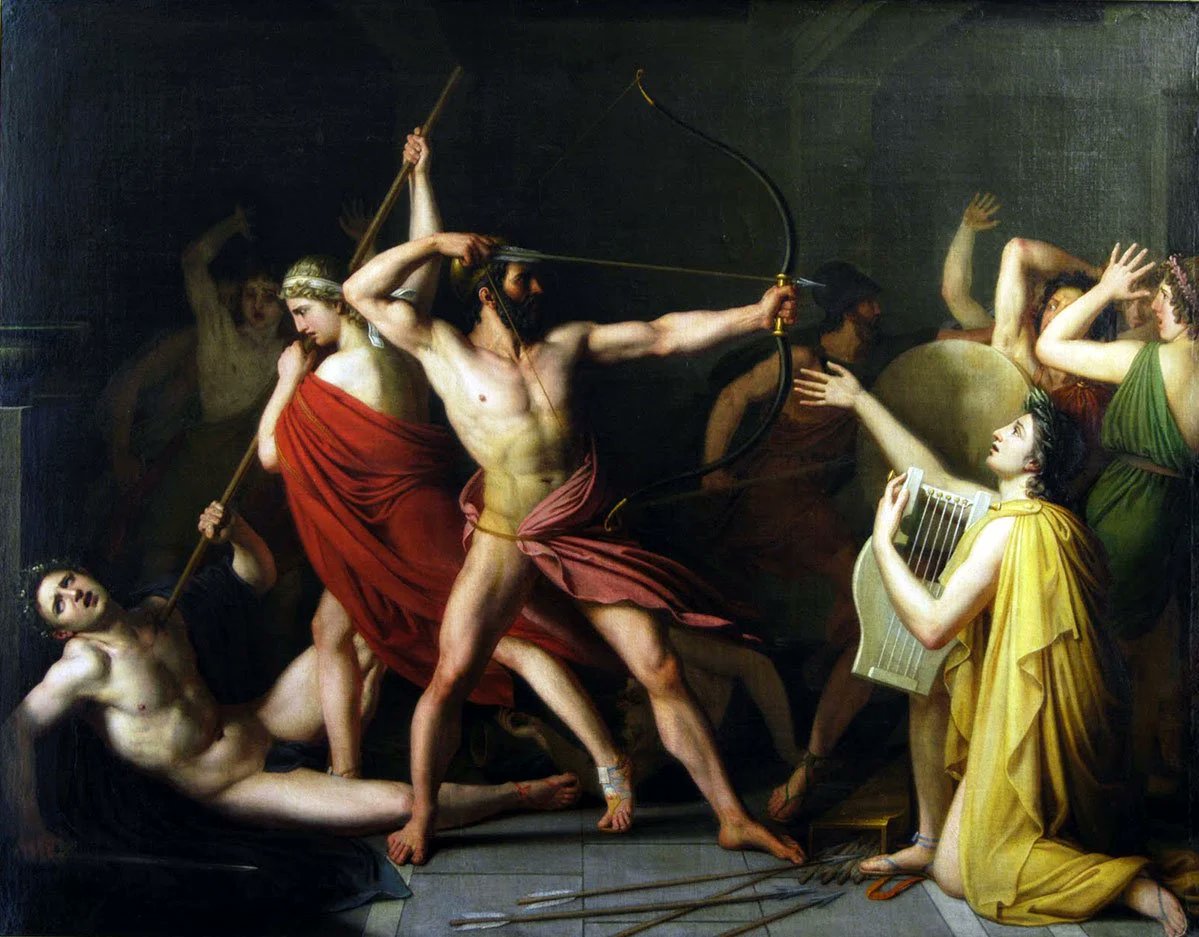
There are some powerful secrets and symbols in the Odyssey that you can only understand if you speak Greek. The Odyssey, apart from being a literary work, also conceals a profound philosophy that most people are unaware of, not intentionally, but because this philosophy cannot be fully understood in the English language; it can only be grasped in Greek, thanks to the richness of its philology and the etymology of its words. The three most important suitors who die are Antinous, Eurymachus, and Amphinomus. In English, these names mean nothing, but in the Greek language, they carry great significance due to Homer's deliberate choice of them.
The name Antinous means the one who opposes rational arguments, the irrational one ('anti' + 'nous' = mind/intellect). Antinous is the first to speak, the most irreverent of all, and the first to be killed. Odysseus reveals his true self, he has changed after ten years fighting at Troy and another ten struggling against the seas. The first trial he faces upon his return is a war within his own mind, his reason. That is why Homer creates Antinous as his first enemy: the one who fights against logic, according to his name. Odysseus triumphs over him.
Next comes Eurymachus. He is warlike but also two-faced. His name means the broad, great fighter ('eurys' = wide/broad + 'machites' = fighter). Eurymachus puts Odysseus in a dilemma and tries to shift the blame onto Antinous. He personifies discord and duplicity, a man without morals, capable of anything to avoid punishment. Yet Odysseus overcomes this obstacle as well, which symbolizes moral superiority. He does not yield, and his mind is not poisoned.
Third is Amphinomus. His name means the one who distorts the law ('amphi' = around/both sides + 'nomos' = law). He is the most compassionate of the suitors. Amphinomus tries twice to discourage the other suitors from murdering Telemachus. Odysseus even tries to warn Amphinomus to leave the house before the final battle. Nevertheless, Amphinomus stays and dies along with the others.
Through this, Odysseus, and by extension Homer, teaches us that in life, sacrifices are required, even when they demand that we show no compassion when the goal is more important and serves a greater purpose that will improve things overall. These are sacrifices that most people, even brave and heroic ones, cannot make.
That is why there are many people, but few are truly heroes.
Homer Pavlos
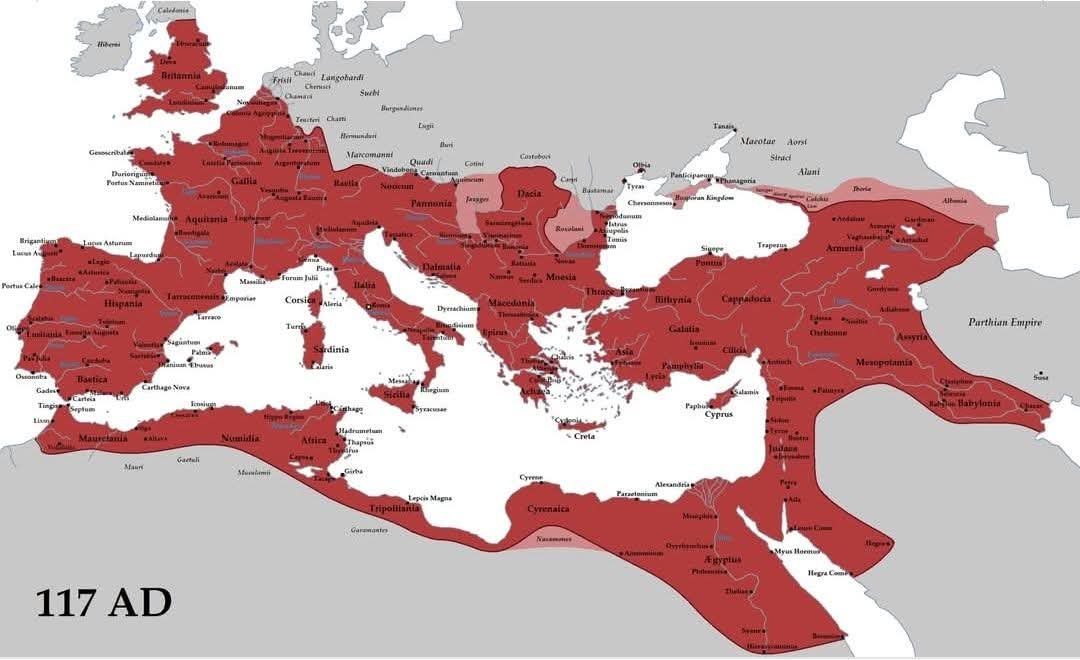
The Roman Empire reached its peak—in terms of both territorial expansion and economic power—under the reign of Emperor Trajan, around 117 AD....
At that time, the empire's borders spanned nearly 6 million square kilometers, encompassing much of Europe, North Africa, and the Middle East. The new provinces conquered by Trajan: Armenia, Assyria and Mesopotamia were already de facto lost by the Romans back to the Parthians.
(5,957,000 km² of territory with a population of approximately 60,000,000 inhabitants)
#drthehistories
Quantum mechanics is built on concepts including
- Superposition, where systems exist in multiple states simultaneously.
- Entanglement, which correlates distant particles
- Wave-particle duality for the dual behavior of matter and light
- Tunneling through barriers
- Uncertainty principle limiting measurement precision
- Quantization of energy levels
- Particle spin as intrinsic angular momentum
- Hilbert space as the state space
- Virtual particles in field theory.
It powers quantum computing algorithms and enables secure quantum cryptography.
⚛️ Scientists Found a State Beyond 0 and 1
For centuries, computers followed one simple rule: information is either **zero or one**. But quantum particles follow a stranger path.
In the quantum world, particles can exist in a state called **superposition**, holding multiple possibilities at once until measured. This discovery is opening the door to a new kind of computing that could change technology forever.
The universe may not think in black and white—it may use a completely different logic.
Source:
Nielsen, M. A., & Chuang, I. L. *Quantum Computation and Quantum Information*. Cambridge University Press.
Japan just built a quantum computer where every single piece, hardware and software, is homegrown, and then let the world log into it from a browser.
The machine went live at the University of Osaka's quantum center, built with RIKEN and a group of Japanese companies. What makes it different is not raw power. It is independence. Quantum computers normally depend on a handful of foreign suppliers for their most exotic parts, especially the dilution refrigerator that chills the chip. Japan replaced those imports with domestic alternatives and wrote the entire software stack itself, from front end to back end, released as open source.
That last part matters more than the headline suggests. Access to quantum hardware has mostly meant renting time from a few giant corporations. An open-source toolchain means researchers anywhere can see how the machine is actually driven instead of poking a black box.
Now the honest part, because a claim like this deserves it. Cloud access to quantum computers is not new. IBM opened a five-qubit processor to the public back in 2016, and today several companies let anyone run jobs on real quantum hardware. Japan's earlier machines were restricted to domestic non-commercial research. What is genuinely new here is a complete national quantum stack, built end to end, opened up rather than locked down.
And the physics inside is still the strangest thing humans have ever engineered. The chip sits in that gold chandelier you see in the image, cooled to a few thousandths of a degree above absolute zero, colder than deep space. At that temperature, circuits stop behaving like circuits and start behaving like quantum objects, holding states that are neither one nor zero until you look.
We are not at the point where these machines break encryption or redesign drugs. Today's quantum computers make errors constantly and need armies of qubits to correct them.
But this is what the beginning of an industry looks like. Not a finished product. A machine anyone can log into and learn on.
If you had one hour on a quantum computer, what would you try to solve?
Soviet General Georgy Zhukov on holiday in Sochi, 1950s. Having overseen many of the USSR's most important strategic victories during World War II, Zhukov was one of only two people in history to receive the title Hero of the Soviet Union a record four times.
Marshal Georgy Zhukov was the Soviet Union's most celebrated military commander of World War II. He played a decisive role in the defense of Moscow in 1941, helped plan the encirclement of the German Sixth Army at Stalingrad, directed the Soviet victory at the Battle of Kursk, and commanded the final assault on Berlin in 1945. On May 8, 1945, it was Zhukov who accepted Nazi Germany's unconditional surrender on behalf of the Soviet Union in Berlin.
Despite his immense popularity, Zhukov's success made Joseph Stalin suspicious. After the war, Stalin removed him from Moscow and reassigned him to relatively unimportant regional military commands, fearing the marshal's growing public prestige. Following Stalin's death in 1953, Zhukov returned to prominence, helping arrest Lavrentiy Beria and later serving as Minister of Defense from 1955 to 1957 before being dismissed by Nikita Khrushchev.
Zhukov was one of only two people to receive the title Hero of the Soviet Union four times. The other was Leonid Brezhnev, whose four awards were widely viewed as politically motivated, while Zhukov's were earned for his wartime leadership and military achievements.
#archaeohistories
On this day in 1203 a blind man in his nineties stood at the prow of a war galley and shamed a crusader fleet into storming the walls of Constantinople. The Fourth Crusade was supposed to be sailing for Egypt. Instead, broke and buried in debt to Venice, it had been steered to the greatest Christian city on earth to put a pretender on the Byzantine throne.
The man doing the steering was Enrico Dandolo, the Doge of Venice, somewhere around ninety years old and blind for decades. When the assault on the sea walls stalled because no galley captain wanted to beach his ship in the open under those towers, Dandolo ordered his own crew to run him aground and carry him onto the sand holding the banner of Saint Mark. Villehardouin, who was there, wrote that the other captains were so ashamed at the sight that every one of them drove for shore.
The Venetians took a stretch of wall and set fires that burned deep into the city. That night Emperor Alexios III grabbed what treasure he could carry and ran, abandoning his capital, his wife and his empire. It looked like a win for the crusade. It was worse than that. The whole arrangement collapsed within months, and in April 1204 the crusaders came back and sacked Constantinople itself, something the Byzantines never forgave and the empire never really survived.
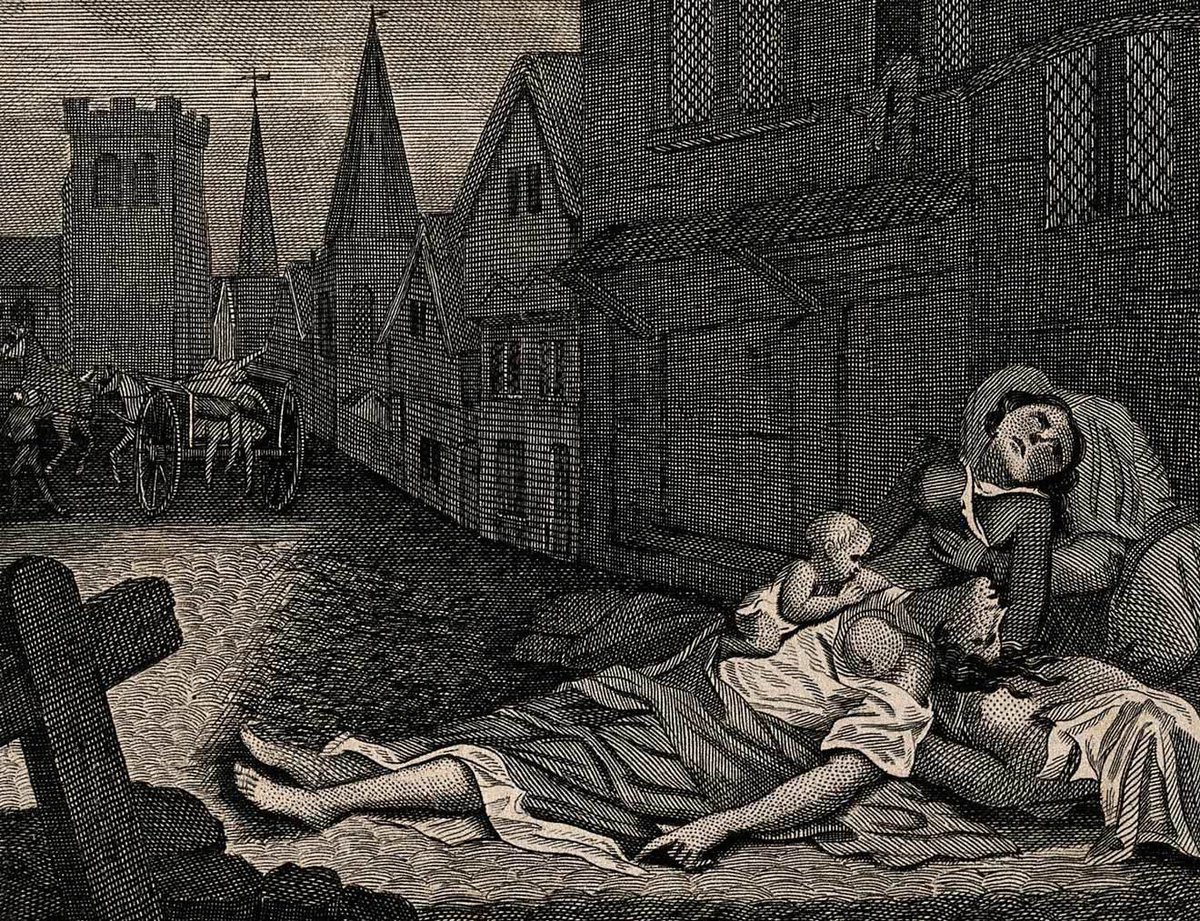
The Black Death of the 14th Century AD, was one of the deadliest pandemics in human history, killing up to half of Europe’s population. Genetic studies show that certain immune‑system variants, especially in the ERAP2 gene, gave some people a survival advantage.
ERAP2 helps the body present pieces of invading pathogens to immune cells, and during the plague, individuals with a specific ERAP2 variant mounted stronger defenses against Yersinia pestis, the bacterium responsible for the Black Death. Those who carried this variant were more likely to survive and pass it on to future generations.
But evolution is a trade‑off. The same ERAP2 variant that once protected people from a medieval pandemic appears to make the immune system too reactive in modern environments.
Today, researchers have linked this variant to a higher risk of autoimmune disorders, including Crohn’s disease, where the immune system mistakenly attacks the body’s own tissues. In a world without constant plague exposure, the hyper‑vigilant immune response that once saved lives can become harmful.
This discovery highlights how historical events can shape the genetic landscape of modern populations. The Black Death exerted enormous evolutionary pressure, rapidly increasing the frequency of protective genes like ERAP2.
Centuries later, those same genes persist but in a world with different diseases, diets, and environments, their effects have changed. It’s a striking example of how ancient survival mechanisms can echo into the present, influencing human health long after the original threat has disappeared.
One overlooked detail is how fast the ERAP2 gene shifted in European populations after the Black Death. Geneticists found that the protective variant increased in frequency within just a few generations, an unusually rapid evolutionary change. That speed suggests the plague acted as one of the strongest selective pressures in human history, reshaping immune genes so dramatically that its effects are still visible in modern DNA, long after the original threat disappeared.
#archaeohistories
JUST IN🚨: An engineer says he's found a way to overcome Earth's gravity.
This new propulsion system could rewrite the rules of spaceflight—not to mention completely defy conventional physics.