Nigeria in 1min: Economic, Business and Financial Market Headlines – 26th August 2026
Nigerian markets reopen today after Tuesday’s Eid ul Mawlid holiday with the ten-session equity correction unresolved. The All-Share Index last closed at 239,085.17 points on Monday. The @cenbank offers N700bn across three maturities at today’s Treasury-bill auction, including N500bn of 364-day paper, and secondary-market yields have risen to 18.89%, keeping the sovereign curve a direct competitor for equity and private-sector capital.
The fiscal arithmetic runs in two directions. The @NigeriaGov puts fuel-subsidy savings at N15.8trn between June 2023 and December 2025, while expenditure growth continues to outpace revenue gains. In energy, @nnpclimited and the OML 118 contractor parties executed the production-sharing and dispute-settlement addenda on Monday, moving Bonga South-West/Aparo toward a final investment decision on a project sized at US$15bn to US$21bn with peak output of about 175,000 barrels a day and 140 mmscfd of gas.
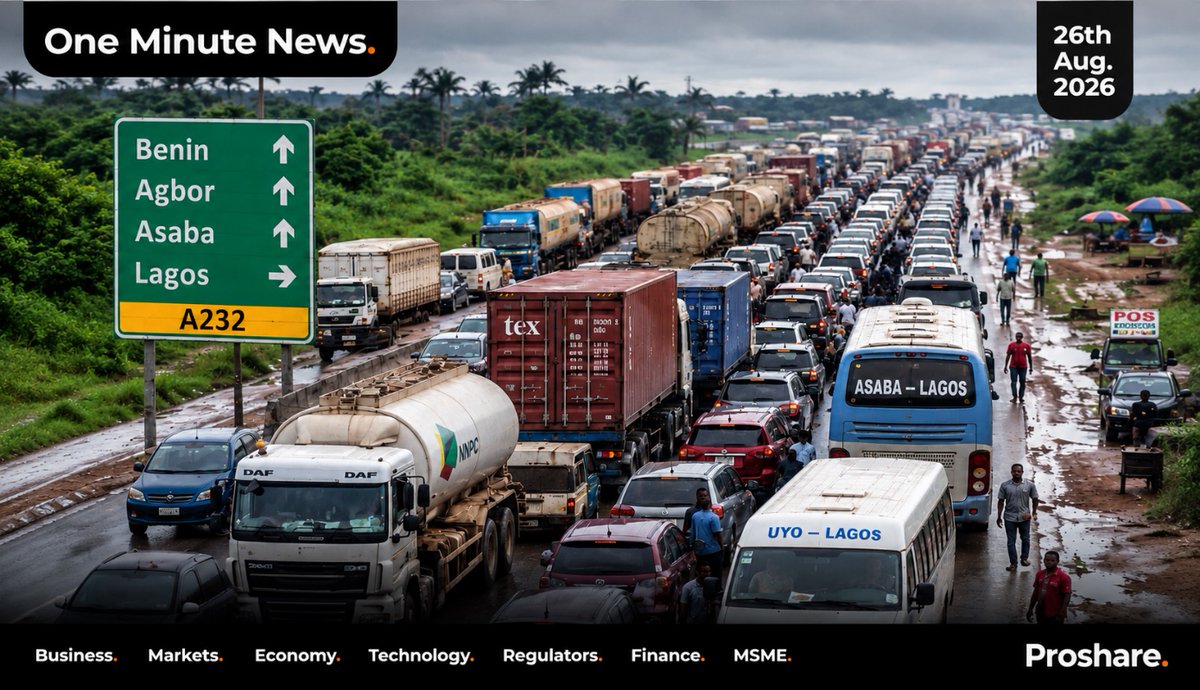
Downstream trade has turned. Shipping data show refined-product exports to Europe averaging about 130,000 barrels a day in the second quarter against 15,000 in 2023, while seaborne imports fell below 130,000 from nearly 400,000. A five-day road gridlock across the South-South has meanwhile halted factory and distribution operations, with manufacturers reporting losses exceeding N500bn, as the transport constraint offsets the refining gain.
Brent settled 3.9% lower at US$88.58 on Tuesday, and West Texas Intermediate fell 3.1% to US$82.36, as markets judged the new United States sanctions on Iran to be less disruptive to physical supply than a military escalation would be. Global equities rose, and United States Treasury yields fell for a second session, while Iran-Oman contacts revived expectations of easing pressure around the Strait of Hormuz. Lower crude reduces the imported-inflation premium and narrows the fiscal and foreign-exchange upside.
Decision-makers should monitor breadth and turnover at today’s reopening, the stop rates and bid-cover at the N700bn Treasury-bill auction, the transmission of sub-US$90 Brent into fiscal and foreign-exchange expectations, progress toward the Bonga South-West/Aparo final investment decision, the duration of the South-South logistics disruption, and the still-outstanding Q2 2026 GDP release
Cc: @business, @Reuters, @thesunnigeria, @Nairametrics, @vanguardngrnews, @GuardianNigeria, @MobilePunch, @technextdotng, @FT, @CNBC, @webtvnigeria, @LeadershipNGA, @BusinessPostNG
Read more: https://t.co/N8YJjbYenk
Presco Plc’s successful appeal at the Court of Appeal has removed a significant legal uncertainty surrounding its 2025 AGM, rights issue and related corporate actions. The August 21, 2026 judgment, which set aside the Federal High Court’s earlier ruling, reaffirms the validity of the AGM resolutions and @SECNigeria-approved capital-raising exercise.
https://t.co/tLOH03bTpG
Global oil markets enter the week with geopolitical risk continuing to dominate price formation, although renewed expectations of diplomatic engagement have moderated the immediate bullish impulse. Brent eased toward US$89 per barrel after touching significantly higher levels in recent sessions, reflecting a market balancing tightening physical supply risks against the prospect of negotiated de-escalation.
Iran's crude exports have fallen sharply to about 0.3 million barrels per day in August, compared with its 2025 average of 1.7 million barrels per day, while constrained shipping activity through the Strait of Hormuz, declining Iranian floating storage, and continued pressure on Russian diesel exports reinforce concerns about near-term supply availability. At the same time, the International Energy Agency's decision to retain most of its strategic reserves and China's continued drawdown of Iranian inventories suggest that physical market conditions remain sensitive rather than structurally resolved.
For Nigeria, elevated crude prices remain directionally supportive of fiscal revenue, export receipts, and foreign exchange inflows, particularly if prices remain above the levels underpinning budget assumptions. Sustained oil strength could improve government revenue collections and support external reserve accumulation through stronger petroleum earnings, while also improving investor sentiment toward oil-linked equities and sovereign risk assets. However, higher global energy prices also pose inflation transmission risks through imported fuel costs, transportation expenses, and broader production costs, potentially sustaining pressure on domestic consumer prices and limiting the pace of monetary easing. The net effect remains dependent on production performance, export volumes and the stability of domestic energy pricing.
Looking ahead, investors and policy watchers should monitor Brent's directional movement, developments surrounding US-Iran negotiations, @OPECSecretariat communication on supply discipline, weekly inventory trends, and Nigeria's crude production and revenue sensitivity as the principal indicators shaping oil market expectations in the coming week.
https://t.co/05rQVZ1JR7
Can JAMB turn a reform agenda into measurable institutional change?
In an open letter to @jamb_hq's new Registrar, @profsegunaina, columnist @Thowsyne examines the Board’s five-year “JAMB 2031: Building Trust, Reducing Trauma” agenda through five pillars: integrity, service, governance, technology and partnership.
Drawing lessons from India, Rwanda, the UK’s Ofqual and UCAS, the article argues that technology alone will not be enough. Stronger identity verification, transparent governance, credible appeals processes and meaningful institutional partnerships will be critical to rebuilding trust at scale.
Read more: https://t.co/KnporWbQzi
The CBN, on behalf of the DMO, is scheduled to conduct its second T-Bills Primary Market Auction (PMA) for August tomorrow, August 26, 2026, offering N700.00bn across the 91-day, 182-day and 364-day tenors.
The offer comprises N100.00bn, N100.00bn and N500.00bn, respectively. With no T-Bill maturities falling due during the week, the auction represents a full N700.00bn net liquidity mop-up from the financial
Read more: https://t.co/4gTx3eL3iw
Nigeria’s fuel subsidy savings improved fiscal space, but expenditure pressures are rising even faster.
According to @Quest_MB, the ₦15.8trn estimated subsidy savings were shared across the Federation, with the Federal Government retaining about ₦5.4trn. Combined with additional revenues and ₦11.9trn in borrowing, total incremental resources reached about ₦20.4trn.
Yet spending commitments rose to ₦30.6trn, driven largely by wages, external debt service and infrastructure.
https://t.co/w3oZkRZ5lN
Being a Guest Speaker Address delivered by @OlufemiAwoyemi, Founder and Chairman, Proshare Nigeria Limited, at the CEO Afternoon convened by the Rotary Club of Ikeja, on Tuesday, August 25, 2026, at the Marriott Hotel, Joel Ogunnaike Street, Ikeja GRA, Lagos. Theme: “The Nigerian Economy Transformation: An X-Ray of Reforms as an Impetus for National Development”.
Read more: https://t.co/YL9RvHfdeR
The 6th Annual MSME Startup Economic Summit, hosted by the Africa Global Economic Forum @TEFSeries in Lagos, has renewed the conversation about the role of digitalisation in unlocking the productivity, competitiveness, and growth potential of Nigeria’s Micro, Small, and Medium Enterprises.
Watch full video: https://t.co/wdNrCL8Wjx
As Muslims across Nigeria and around the world commemorate Mawlid an-Nabi, Proshare extends warm wishes to the Muslim faithful on this special occasion marking the birth of Prophet Muhammad (PBUH).
May the values of peace, compassion, humility, tolerance and service to humanity that his life exemplified continue to inspire stronger communities and a more harmonious society.
We wish you and your loved ones a peaceful and blessed celebration.
Happy Mawlid an-Nabi.
#MawlidAnNabi #EidElMawlid
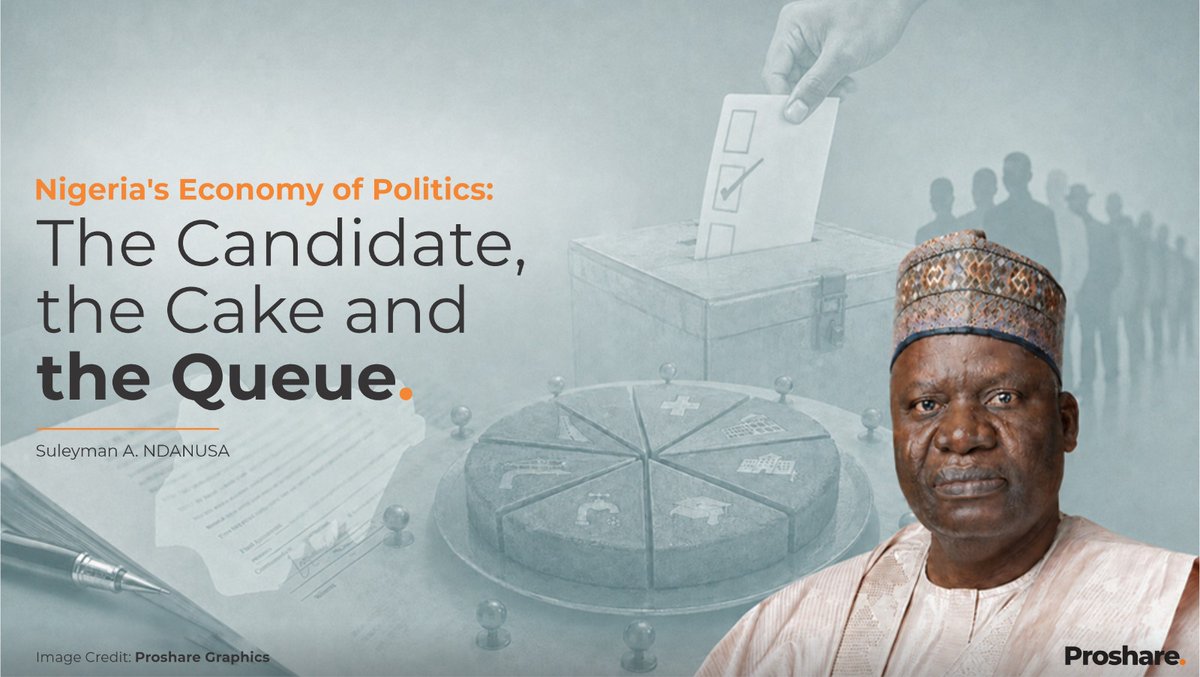
Nigeria’s political economy is shaped not only by formal policy choices but also by the financing, coalitions and expectations that surround the acquisition of public office. For investors and businesses, this relationship matters because expensive political competition can influence appointments, procurement, project selection, regulatory access and the allocation of public resources. Where political support is treated as recoverable capital, the resulting obligations may weaken competitive neutrality, raise transaction costs and divert economic decisions from productivity and public value.
Dr Suleyman A. Ndanusa (@sandanusa) distinguishes between the political economy, through which power distributes wealth, and the economy of politics, through which wealth acquires power and seeks a return. His argument traces the cycle from campaign financing and coalition-building to patronage, political access and the financing of the next electoral contest. It also recognises why the system persists: weak public institutions and limited social protection make political relationships a substitute for rights, services and economic security. Patronage therefore survives not only because politicians supply it, but because citizens and communities often depend on it.
The reform implication extends beyond changing leaders or adopting a different constitutional model. Nigeria’s execution test lies in reducing the lawful cost of political participation, enforcing transparent campaign-finance rules, publishing credible party accounts, protecting open procurement, applying evidence to public appointments and projects, and making institutions more dependable than personal access. Stronger rules would reduce the private value attached to controlling government and improve the credibility of economic policy. The investable signal is institutional: political victory should confer a temporary mandate to govern, not control of a distribution network whose obligations distort markets and public finance.
Read more: https://t.co/6O96EaGVPO
Extract:
Economic D-Day and Unintended Consequences: Power Used and Power Dispersed
The clearest unintended consequence is adaptation. Correspondent account threats strengthen the case for payment rails that avoid US exposure; vessel designations encourage reflagging, opaque ownership, and non-Western insurance; sovereign pressure adds political value to #BRICS, local-currency settlement, and bilateral swaps, even where those mechanisms remain inferior to the dollar system. Enforcement can therefore reduce visible formal trade while making the remainder more opaque.
A second consequence is bloc formation. States need not become anti-American to seek insurance against American leverage. India, Gulf states, South Africa and other middle powers can value US capital and security ties while supporting alternative settlement infrastructure. This is the credible BRICS pull: a wider constituency for optionality rather than a unified anti-dollar currency project. Where the international order is perceived as conditional, parallel institutions can gain political legitimacy before their technical capacity matches the incumbent system.
The third consequence is humanitarian and domestic-political spillover within Iran. Sanctions that weaken household purchasing power, imports and employment can increase social pressure, while also strengthening illicit networks and giving hardliners an external explanation for economic failure. A strategy designed to isolate the state can therefore shift economic power toward actors best equipped to operate in the shadow economy.
Nigeria: Political, Economic and Financial Takeaways
Nigeria should read the episode as a lesson in strategic optionality rather than a demand to choose between Washington and BRICS. The banking system, reserves, trade finance and external borrowing remain deeply connected to dollar markets, so preserving correspondent relationships and sanctions credibility is a first-order financial interest.
Nigeria also benefits from building fiscal buffers, reducing avoidable hard-currency dependence in intra-African trade, deepening domestic capital markets, and retaining multiple external relationships with the US, Europe, China, India, the Gulf, and Africa.
The immediate macroeconomic transmission is two-sided. Nigeria’s 2026 budget is built around a US$64.85/bbl oil benchmark and a 1.84 million barrels per day production assumption. Brent above the benchmark creates revenue and FX upside only to the extent that production and fiscal capture are sufficient. Proshare reported crude production at about 1.51 million barrels per day in July 2026, materially below the budget assumption. Higher oil prices, therefore, improve export receipts while raising feedstock, transport, and household energy costs. Domestic refining changes the pass-through structure without eliminating crude as an input.
The financial-market channel runs through inflation, monetary policy, foreign portfolio appetite and sovereign yields. A sustained global oil shock can exacerbate imported inflation and complicate the CBN’s rate path, even when FX reserves initially benefit from stronger hydrocarbon receipts. Higher global yields raise the hurdle rate for Nigerian Eurobonds and can widen emerging-market spreads.
NGX effects are sectorally differentiated, with oil and gas exposures benefiting from price strength, while consumer, industrial, and transport-sensitive sectors absorb higher energy and financing costs.
The compliance channel is less visible and potentially more immediate for financial institutions. @SecScottBessent's enabler doctrine applies to any institution that finances, insures, ships, or clears a transaction with an Iranian nexus. Nigerian banks, freight forwarders, free-zone operators, bunkering companies and oil-services firms should treat sanctions screening as a board-level counterparty and correspondent-banking risk. @papss_africa is relevant here as a practical way to settle more intra-African trade in local currencies while maintaining sanctions and compliance checks, rather than as an anti-dollar instrument."
READ MORE>>> https://t.co/ZcXt10WerV via @ecopoliticsNG@proshare
Nigeria’s street-begging crisis is a visible expression of a deeper failure in education, child protection, social welfare and public-sector coordination. For policymakers, investors and development institutions, the children moving between vehicles and gathering around markets, transport hubs and places of worship represent more than a humanitarian concern. Their exclusion weakens human-capital formation, raises future welfare and security costs, and constrains the productivity of a country whose economic prospects depend heavily on the capabilities of its young population.
Dr Suleyman A. Ndanusa (@sandanusa) argues for a National Child Street Exit Framework that begins with identification and assessment, assigns each child an appropriate route into education, family support, healthcare, rehabilitation, or safe accommodation, and sequences enforcement only after workable alternatives are in place. Within that wider structure, he proposes an independently governed Almajiri Education and Advancement Waqf to organise zakat, sadaqah, waqf and private contributions around registered children and accountable learning centres. The model would preserve serious Qur’anic education while adding literacy, numeracy, digital exposure and practical skills.
The proposal’s value lies in shifting the policy response from periodic clearance exercises and fragmented charity to an institutionally funded, measurable pathway from the street into learning. Its execution test will be governance: reliable beneficiary data, clear federal and state responsibilities, minimum standards for participating Tsangaya schools, transparent funding, independent audit and sanctions for adults who exploit children. A carefully costed pilot, tied to Nigeria’s existing education and social-protection architecture, would provide the evidence required before national expansion.
Read more: https://t.co/lM0f3wzVvs
#Njikota describes an Igbo philosophy of coming together, acting in concert and combining strength with purpose. @collinsnweke reframes that tradition for contemporary Nigerian statecraft, moving it from solidarity shaped by survival and separation towards reconnection, institutional reform and national coalition-building.
The Op-Ed’s principal contribution is its movement from cultural memory to an operational political programme. “Complaint may produce sympathy. Blueprints produce power,” Nweke writes, arguing that legitimate grievances should be translated into technically credible proposals on devolution, representation, regional infrastructure, security and economic coordination. His three concentric circles of Njikota, reconnection among Ndigbo, renewed Eastern fraternity and coalition across Nigeria; place reciprocal obligations on both Ndigbo and the federation.
https://t.co/yBz7FVPaMx
Nigeria in 1min: Economic, Business and Financial Market Headlines – 25th August 2026
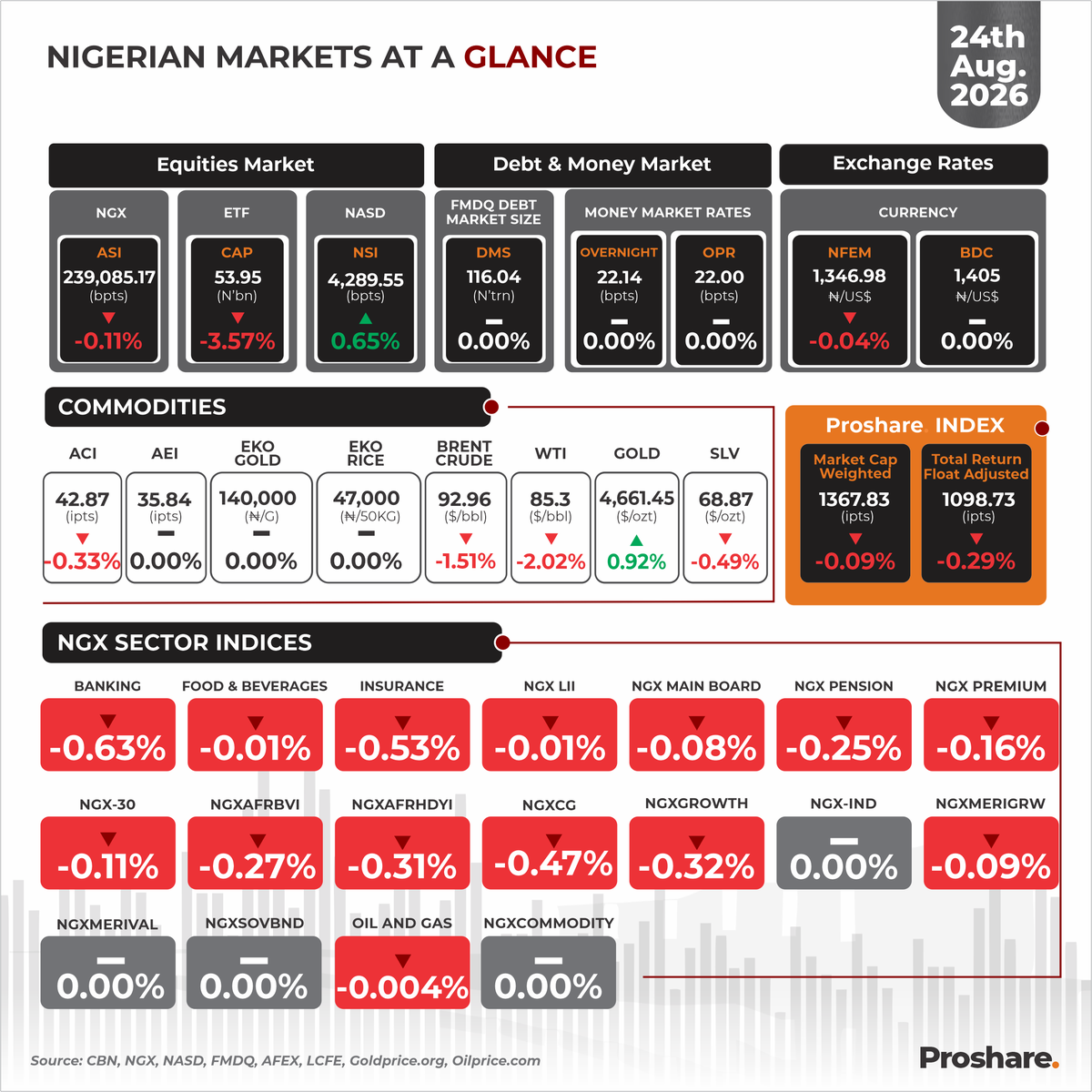
Nigerian equities extended the correction on Monday. The All-Share Index slipped 0.11% to 239,085.17 points and market capitalisation fell about N171.78bn, marking a tenth consecutive losing session, while the BDC rate held at N1,405 per dollar ahead of today’s Eid ul Mawlid holiday.
The composition of that trading matters more than the level. @ngxgrp data put July equity transactions at N2.4trn, with domestic investors accounting for 94.4% of activity and foreign participation at 5.6%. Foreign flows from January to July recorded a net outflow of about N266.07bn, so the 2026 rally now rests on domestic institutional liquidity. Money-market funds reached a record N6.27trn in July, which is the competing use of that same liquidity.
@fidelitybankplc secured an extension to 30 September for its H1 2026 audited results, joining @theaccesscorp on that date and @ZenithBank on 9 October. @realFemiOtedola added 95.7m First HoldCo shares for N12.58bn, deepening the exposure through the share-price decline rather than against it. @NITDANigeria inaugurated a sovereign cloud implementation task force as banks work toward the @cenbank’s 1 January 2027 data-residency deadline.
The United States broadened secondary sanctions against Iran, threatening to exclude entities holding specified commercial ties with Tehran from the dollar-based financial system. Brent fell 1.38% to US$93.09 and West Texas Intermediate 1.62% to US$85.65 after recent gains. Asian equities closed broadly lower, the Kospi down 3.12%, and the Canadian dollar fell 0.44% after the failure of trade talks with Washington.
Markets and banks are closed today for Eid ul Mawlid. Decision-makers should monitor whether the correction extends when trading resumes on Wednesday, the audited-accounts filings now clustered on 30 September and 9 October, the direction of foreign flows against domestic institutional demand, the implementation of the sovereign cloud and data-residency rules, the reach of the Iran sanctions package into Nigerian cargo and freight costs, and the still-pending Q2 2026 GDP release from the National Bureau of Statistics. Happy Holiday.
Cc: @FirstBankngr, @Reuters, @CNBC, @webtvnigeria, @BusinessDayNg, @GuardianNigeria, @voiceofnigeria, @blueprintmag, @nigeriantribune, @Moneycentral4, @BizWatchNigeria, @MobilePunch, @thecableng, @vanguardngrnews, @OilandEnergy, @THISDAYLIVE, @LeadershipNGA, @business
https://t.co/5Rc30qoNyB
Otedola continues to deepen his exposure to First HoldCo as Calvados Global Services Limited acquired an additional 95.70 million shares for N12.58bn on August 24, 2026.
Notably, the shares were acquired at N131.48 each, above First HoldCo’s N127.90 closing price today, representing an approximately 2.8% premium over the market close. The purchase price also underscores the shareholder’s willingness to accumulate shares at a price above prevailing market levels despite recent market weakness.
Read more: https://t.co/Xd6cFmcbxO
NGX Slips 0.11% as Large-Cap Selloffs Persist Ahead of Eid-Ul-Mawlid Holiday; BDC Rate Closed Flat at N1,405/US$1
The Nigerian equities market extended its bearish run on Monday, August 24, 2026, as sustained profit-taking in selected large-cap stocks continued to weigh on the benchmark index. Trading activity remained cautious ahead of the Eid-Ul-Mawlid public holiday on Tuesday, with investors adopting a measured stance amid the shortened trading week. RTBRISCOE emerged as the session's top gainer, while INTENEGINS recorded the steepest decline.
Read more: https://t.co/BX6QPK20Ic
.@SecScottBessent’s @FT OpEd is best read as a warning to Iran’s economic enablers and a demonstration of the reach of the US-centred financial network. The secretary calls the campaign the “single greatest financial offensive ever marshalled against an adversary”, but the legal authorities and most of the sanctions machinery already exist. The escalation lies in the intensity of enforcement, the explicit threat to third-country institutions and sovereigns, and the pairing of financial exclusion with physical constraints on Iranian oil flows.
The strategy exploits a structural fact of international finance. Banks, traders, insurers and governments outside US territory still rely on dollar clearing, correspondent banking, American capital markets, technology or counterparties that do. The reach is strongest against private institutions with substantial US exposure and weakest against sovereigns that can reroute trade through alternative currencies, banks, and alliances. China is therefore the principal enforcement test and boundary condition.
The consequence extends beyond Iran. Repeated use of financial network power strengthens US coercive authority in the short run while increasing incentives for BRICS members and other states to build alternative payment, reserve, financing and settlement options.
Nigeria’s immediate exposure runs through oil prices, refining economics, inflation, capital flows and sanctions compliance. The longer-term challenge is to preserve access to the dollar system while reducing avoidable dependence on any single external financial rail.
https://t.co/vc1KZrCwf6