Black Africa is united and mobilized in Kinshasa,Democratic Republic of Congo to accompany the Great People of the Democratic Republic of Congo in this new chapter in which we will embark together in the multipolar world order 🌍✅
Tous derrière le Président Felix Tshisekedi ✊🏿🇨🇩
Firstly, Ethiopia is under US sanctions while Vietnam is not. And speaking of former French colonies, Haiti was the first to get independence (1804) and is still one of the poorest countries in the world because of the debt they had to take on to gain independence (it took them until 1947 to fully repay it!). Whereas, New Caledonia is still a French colony and is neither rich nor poor.
"If colonialism were the answer to why Africa is poor..."
This line completely ignores the European powers' (and US) post-colonial control over Africa. Patrice Lumumba, the first democratically elected leader of the DRC, was tortured and killed by Belgium and the US for being a nationalist. His body was dissolved in acid so he wouldn't become a martyr. His legacy is largely unknown even within the continent. Several other such "lessons" were meted out. Google Thomas Sankara (Burkina Faso) and Sylvanus Olympio (Togo).
Once you set the example, you gain obedience. The VietCong, on the other hand, didn't surrender even though 3 million Vietnamese died during the war, and several thousand more continue to die to this day (!) from Agent Orange exposure.
As for former French colonies in Africa, France still controls their currency and holds their central bank reserves in France. As Rothschild purportedly said, "permit me to issue and control the money of a nation, and I care not who makes its laws."
Third, the borders in Africa were drawn in such a way that conflict was inevitable. At the Berlin Conference in 1884-85, the European powers simply carved up the continent by drawing straight line borders. African leaders were conspicuous only by their absence at this historic event which shaped the next century. This is why Cameroon, a French-speaking country, has a minority English-speaking territory, ensuring it remains destabilized. Likewise for West Asia/the Middle East, where the Sykes-Picot legacy lives on.
@magattew conflates formal colonial rule with colonial control. Vietnam managed to fully kick out both France and the US, reunified the North and the South, and kept its sovereignty. All African leaders who attempted the same have been systematically eliminated (see Muammar Gaddafi, Libya's divisive leader, for a recent example), ensuring Africa forever bears the open wounds of its colonial legacy.
But Ms. Wade is right on one thing: Vietnam owes its prosperity to overcoming colonial rule. Maybe Africa can become prosperous if Africans do the same.
#DRC#M23: I'm uploading a very revealing portion of @SecRubio comments to @RepChrisSmith (R-NJ) re: @PaulKagame's war (via DRC-designated terrorist group #M23) in eastern Congo.
Why is it revealing? Because Rubio reveals 3 key things about what he thinks abt this conflict:
1. Rubio clearly says the primary party not abiding by the Accords is #Rwanda, not #DRC.
2. Rubio also implies he thinks the RDF and M23 are, effectively, one in the same and says that the US will be monitoring if RDF pulls out and then re-suits as M23.
3. Rubio also dismisses critics who believe the US is showing favoritism to Kinshasa.
Here's a link to the YouTube video of the entire hearing before Congress, which occurred on June 4th, 2026.
Link: https://t.co/scwb8C032k
These particular remarks start at 36.21.
Building on ongoing efforts to advance peace, security and prosperity in eastern DRC and the Great Lakes region, the United States has now sanctioned senior commanders of both M23 and FDLR for atrocities committed against civilians and for undermining the peace process in eastern DRC. The United States stands ready to take additional measures against any state, individual, or group that threatens the prospects for peace in the region, and especially for any actor that undermines implementation of the Washington Accords and obligations for peace. To that end, the Rwandan Defense Forces must complete their withdrawal from the DRC without further delay, and the DRC must decisively neutralize the FDLR. Accountability, compliance, and implementation are essential to securing lasting peace.
The fact that Marco Rubio has referred to a specific timeline for the withdrawal of Rwandan forces from eastern DRC is not a minor diplomatic remark. It is a clear political signal.
Even if framed as an “expectation” rather than a strict ultimatum, it fundamentally changes the nature of the issue: the conflict is no longer being addressed through broad diplomatic statements, but through a publicly referenced time-bound framework that is being closely watched at the highest levels of U.S. foreign policy.
In international relations, this kind of positioning has three immediate implications:
First, it reduces the room for manoeuvre of the parties involved. Once a timeframe is publicly mentioned, diplomacy becomes less abstract and more accountable. Actions are now measured against a visible benchmark.
Second, it introduces a logic of responsibility and consequence. If the expected timeline is not respected, the issue is no longer purely rhetorical. It can translate into increased diplomatic, political, or economic pressure depending on how the situation evolves.
Third, it reshapes the regional balance of perception. It signals that the situation in eastern DRC is no longer treated as a peripheral instability, but as a strategically monitored file within U.S. foreign policy priorities.
In short, even with cautious wording, the political effect is significant: the framework of engagement is shifting, and all actors are now operating under a visible time constraint that changes the dynamics of the conflict going forward.
#DRC: To be clear, Rubio did not say Rwanda will remove all its troops from DRC by July. He said he "expects" Rwanda to do so by July. That is a major difference and Rubio used the word "expects" for very strategic reasons.
Also, to my friends in the Congolese opposition, Rubio did NOT publicly address the constitutional revision debate in #Congo in this hearing before the US Senate's Foreign Relations Committee.
Why? Because Africans do not want Westerners interfering in their internal affairs and the @realDonaldTrump Adminstration fully agrees. 😏
#RDC #Minerals4Security
COUP DURE POUR LE M23 et LE RWANDA.
🇺🇸 Marco Rubio a évoqué la mise en œuvre de l’accord de paix RDC–Rwanda devant le Congrès.
Il a reconnu que les choses avancent, mais très lentement, avec des progrès limités sur le terrain.
Des sanctions ont déjà été prises pour tenter de faire respecter les engagements.
Il espère également voir un retrait des troupes rwandaises d’ici le milieu du mois prochain.
“Conflict in DRC has made life a nightmare for those living there. And with the outbreak of Ebola, it has severe consequences for the health and safety of the entire region. @StateDept must continue to hold those contributing to the instability accountable.” -@SenatorShaheen
«Nous avons dû imposer quelques sanctions.Du côté rwandais, nous commençons à observer un certain respect de l’accord.Les choses avancent pas assez vite, certes, mais nous espérons que le retrait des troupes rwandaises de la région sera effectif d’ici le milieu du mois prochain.»
🔴 #RDC Vers un retrait des troupes #rwandaises cet été ? « Du côté rwandais, nous commençons à observer un certain respect de l’accord » annonce Marco #Rubio. « Nous espérons que le retrait des troupes rwandaises de la région sera effectif d’ici le milieu du mois prochain ».
🇨🇩🇷🇼 « En ce qui concerne la RDC et le Rwanda, ils ont signé un accord de paix. Malheureusement, celui-ci n’est pas bien respecté. Nous avons dû imposer quelques sanctions. Du côté rwandais, nous commençons à observer un certain respect de l’accord. Les choses avancent – pas assez vite, certes, mais nous espérons que le retrait des troupes rwandaises de la région sera effectif d’ici le milieu du mois prochain. Bien sûr, il reste le problème du M23 à régler. » - Le @SecRubio à la commission des Affaires étrangères de la Chambre des représentants des États-Unis
Strengthening governance in the DRC’s critical minerals sector is key to boosting U.S. investment & pushing back against the Chinese Communist Party’s economic coercion & opaque investment practices in Africa. Our new issue brief outlines existing governance challenges & offers practical steps to overcome them: https://t.co/mTP8yp7Fgt
Vous avez le droit de savoir pourquoi monsieur ne dort plus.
Il a été aperçu hier au Qatar. Monsieur chercherait déjà le dialogue après avoir refusé la main tendue de Félix.
Mais comme on le dit en français : après l’heure, ce n’est plus l’heure.
UVIRA, SUD-KIVU, 25 mai 2026.
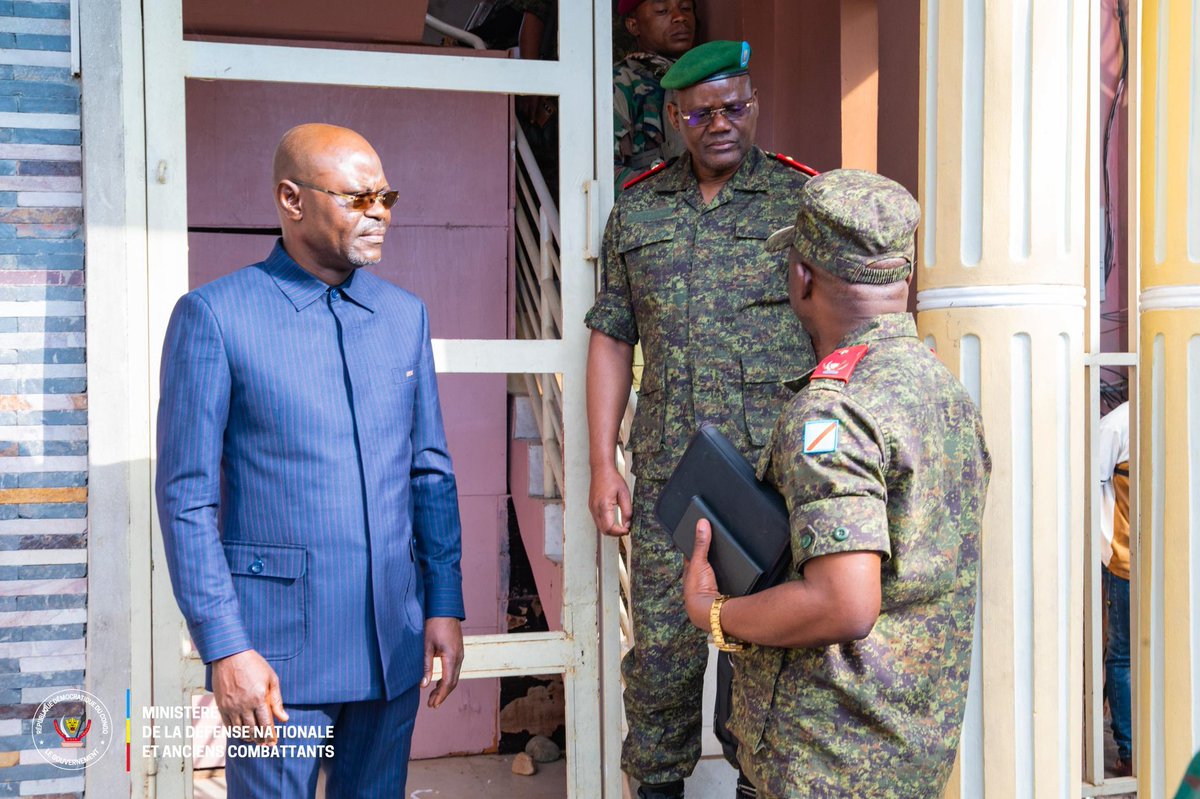
Après sa première nuit à UVIRA, en dépit des quelques poches de tensions signalées aux abords du Sud-Kivu, le Vice-Premier ministre, Ministre de la Défense nationale et anciens combattants S.E Me Guy Kabombo Muadiamvita est attendu à Bujumbura, capitale de la République du Burundi, pour un échange bilatéral avec son homologue burundaise S.E Marie Chantal Nijimbere.
Les échanges porteront principalement sur les questions de la coopération militaire entre les deux pays, dans un contexte régional marqué par des défis sécuritaires persistants.
Il est également prévu des travaux des experts de deux parties sur l'évaluation et le renforcement de la collaboration militaire des forces burundaises engagées aux côtés des forces armées de la République démocratique du Congo.
Met today with Turkish Foreign Minister @HakanFidan to talk about the continued strategic necessity for all Allies to meet their defense commitments and plans for the upcoming NATO Summit in Turkiye. We also discussed opening the Strait of Hormuz and working toward greater regional stability.
Coopération sécuritaire régionale : Guy Kabombo attendu à Bujumbura pour des échanges avec son homologue burundaise
Le Vice-Premier ministre, ministre de la @VPMDefenseRdc nationale et Anciens combattants de la République démocratique du Congo, @GuyKabombo Muadiamvita, est attendu ce lundi 25 mai à Bujumbura, au lendemain de sa première nuit passée à Uvira, dans le cadre de sa mission d’évaluation sécuritaire dans l’est du pays.
Selon des sources proches de la délégation congolaise, cette visite de travail intervient malgré quelques poches de tensions encore signalées aux abords du Sud-Kivu. À Bujumbura, le ministre congolais de la Défense doit s’entretenir avec son homologue burundaise, Marie Chantal Nijimbere, autour des enjeux liés à la coopération militaire entre les deux pays.
Les discussions porteront principalement sur le renforcement du partenariat sécuritaire entre République démocratique du Congo et Burundi, dans un contexte régional toujours marqué par l’activisme des groupes armés et les défis sécuritaires persistants dans la région des Grands Lacs.
Des travaux techniques réunissant des experts militaires des deux pays sont également annoncés. Ces assises devraient permettre d’évaluer le dispositif de collaboration entre les forces burundaises engagées aux côtés des Forces armées de la République démocratique du Congo et l’armée congolaise, avec pour objectif de renforcer la coordination opérationnelle sur le terrain.
Cette rencontre bilatérale s’inscrit dans la dynamique de coopération sécuritaire régionale engagée par Kinshasa afin de consolider les efforts militaires contre les groupes armés opérant dans l’est de la RDC.
CONGO-DRC | On the sidelines of the AfDB annual meetings, Brazzaville and Kinshasa are preparing to launch a call for proposals for the construction of a civil engineering structure financed with support from Africa50.
➡️ https://t.co/Vx4cA7MIAy
Rwandan soldiers trying to regroup are being hit with precision strikes by Congolese forces. Between Friday and Sunday, at least 1,000 Rwandan soldiers were reportedly killed. Today, the situation is getting worse for Rwanda’s troops they are losing soldiers in huge numbers.