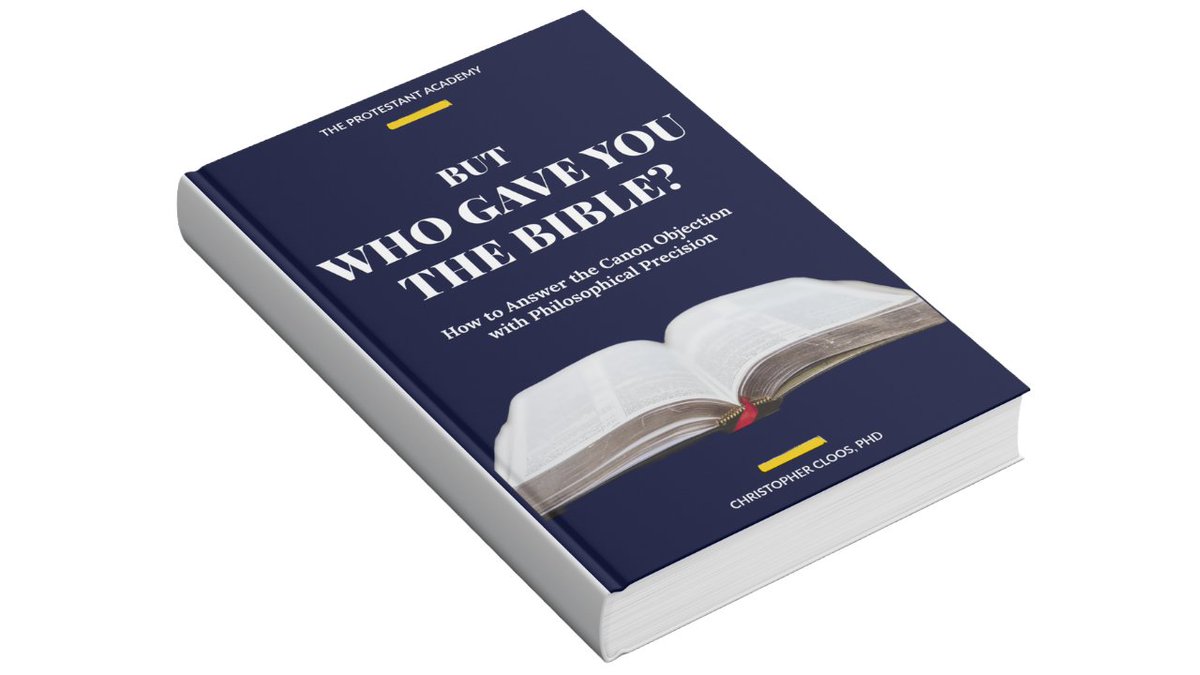
"But who gave you the Bible?" Most Protestants freeze when they hear this. I wrote a free guide that shows you how to answer the Canon Objection to Sola Scriptura with philosophical precision. Get your free guide now: https://t.co/vxowuS4Nq6
"Wisdom rejoices in turning the present upside-down world rightside up, when wisdom overturns folly, righteousness ousts wickedness, knowledge overcomes ignorance, humility topples pride, and life swallows up death."
(Bruce Waltke, The Book Of Proverbs: Chs. 1-15. New International Commentary on the Old Testament)
One Answer to The Canon Conundrum is this:
The external marks of Scripture provide objective grounds and motives of credibility, while the internal testimony of the Holy Spirit is the efficient cause of the believer’s divine faith in the inspiration and canonicity of Scripture.
Turretin sums it up this way:
“Hence if the question is why, or on account of what, do I believe the Bible to be divine, I will answer that I do so on account of the Scripture itself which by its marks proves itself to be such. If it is asked whence or from what I believe, I will answer from the Holy Spirit who produces that belief in me. Finally, if I am asked by what means or instrument I believe it, I will answer through the church which God uses in delivering the Scriptures to me.”
Turretin, Institutes, Second Topic, Q. VI, Sec 6.
I am not an expert in Mariology. But I can tell you this much, the Scripture has no clear attestation to Mary's sinlessness for someone who is looking for such clarity as to tap out the vicious skeptic. Perhaps the strongest text would be the promise of God in Genesis that there would be enmity between the Woman and the Serpent. Obviously, that woman is Woman par excellence, the Virgin Mary. This "enmity" is not simply that one is opposed to the other. Rather, the enmity is one in where one side completely overthrows the other. For Mary and Jesus, it means a total victory over sin and death, and if Mary herself was a sinner, it would depreciate this vision laid out in the Gospel of Genesis.
Does that prove anything beyond all shadow of doubt? Not for the intellectually rigorous skeptic.
In the early Church Fathers, we have concerning witnesses. Tertullian, Origen, Basil, and John Chrysostom, who all seem to either explicitly say Mary sinned or that she struggled with sin.
On the other hand, you have Ambrose who might suggest that Mary is sinless. Augustine speculates that Mary might have been given grace to overcome all actual sins in her life and wished not to include her in the debates about hereditary sin w/ the Pelagians. Nothing explicit that goes as far as the Immaculate Conception, but an interesting reservation by the 4th/5th centuries.
All of these men were well aware of the Marian typology of the ark, the 2nd eve, etc, etc. And yet some were not hesitant to say she sinned. That's not a mixture you see in contemporary Catholics and Orthodox. The latter accepts doctrinal development. Or, for the Orthodox, they might reject all development and just say these Church Fathers were in error and that we simply don't have a documentary record of what WAS the oral consensus from the beginning.
The early Church also isn't explicit on Mary's ongoing, present-active distribution of all graces for salvation. There is a clear indication that she, by bearing God in the flesh, is the instrument of salvation for all. However, that is much different than a present-active distributor of each and every grace within time for each individual.
Ultimately, the evidence for the sinlessness of Mary and the other dogmas is in the Church's authoritative decree that it is so.
And because of that, the rigorous skeptic isn't going to become Catholic by looking for early evidence for Catholic Mariology. Almost always, such a skeptic will have to find the rational merits in some other article of Catholic faith, which then immediately builds a tentacle of rational acceptance for the Mariology of the church. For example, once someone is convinced of the historic ecclesiology, then this makes for an avenue whereby one can have rational grounds to accept the immaculate conception, her sinlessness, her assumption into heaven, her heavenly coronation, and her mediation of all graces.
You've offered half of their case as if it's their whole case, and the weaker of the two at that.
As I understand it, they run two independent arguments. They do have a fallback argument, which runs as you suggest. They cite canon law in making an affirmative defense. That does presuppose a violation occurred and only seeks an exemption from the penalty.
But their core argument denies the act was unlawful. See their canonical study of the 1988 consecrations (https://t.co/8f8CzAUKll). It offers a justification and concludes their disobedience is legitimate because necessitated and thus not schismatic. Whether either argument succeeds is a separate question. My point is that you've described only one of them.
Matt Fradd's claim seems misguided. As I understand it, the SSPX is contesting the claim that papal directives binds the conscience regardless of content. Matt's "burden of proof" claim only works if you've already settled that affirmatively. But, that's the thing at issue. If so, Matt can't use that to decide who bears the burden of proof.
If the consecrations go forward, rejecting the SSPX's position is clearly the safer course. The burden of proof rests entirely on those who claim that fidelity to Christ requires defying the explicit directives of the Roman Pontiff and receiving the sacraments from ministers who lack ordinary jurisdiction.
Yes, I grant that a competent authority can declare whether the person is in schism. But, the fact the authority searches for to make that determination is the internal one, which is the focus of the article. It's whether that person freely and knowingly agrees that Rome's authority is no longer binding for him. Obviously, the "competent authority" cannot read minds, so the object of that authority's inquiry is the person's own verdict about papal authority. So, the authority is certifying the verdict, but it doesn't replaces it. And that private judgment by the person is evidence that constitutes his verdict. If there is interior agreement, he's schismatic. If there's not, then he's not. And that's quite apart from any preferences of the authority concerning the person. The person's private judgment creates the status concerning their membership in the church. That's all the dependence my argument needs to work.
I can see what you're suggesting, but that's not how the Catholic objection works. That is, you're saying Rome's claim involves only private judgment that determines the individual's formal adherence. But, then you're saying the SS objection is about private judgment determining the articles of faith for the Church. But, no Protestant I'm aware of thinks his own interpretation of Scripture determines the articles of faith for his congregation, denomination, or someone else. It just determines what he thinks is binding on himself. And that's what the objection to SS targets. So, there's no equivocation. I'm using one sense of private judgment, namely the individual's own judgment about whether a religious authority binds him, and that applies to a person's standing under the rule of faith and the formal issue regarding the SSPX.
New video: If private judgment about religious authority disqualifies a rule of faith, Rome's own membership test disqualifies itself. If it doesn't, the objection was never an objection to #solascriptura.
https://t.co/T5j2WwSw5U
The only thing that functionally makes the Roman Catholic Church “one” is submission to the juridical authority of the pope. The excommunication of SSPX clergy and lay faithful exposes that reality. Here are Catholics who believe they are preserving the tradition Rome itself once handed down, yet when they persist against papal decree, they are treated as schismatics. That is how Rome views unity: not unity of apostolic truth, but a unity of institutional obedience.
And in that sense, this is a small picture of what happened five hundred years ago. The Reformers were not innovators trying to invent a new church. They were seeking to recover the ancient gospel after centuries of ecclesiastical accretions, sacerdotalism, and sacramental machinery had obscured the simplicity of salvation by grace through faith in Christ.
@barob05 I'll look into that Oxford Handbook article. There's more I could say and I'm not sure reception theory helps your case, but I'll leave it here for now. I always enjoy chatting with you. Thanks for the dialogue, Brooks.
I don't think this helps. "Rejections of the authority structure" still presupposes the current office holders are exercising that authority faithfully. That's the thing the SSPX contests. So, the move to "clear and objective" is question-begging like your earlier "clear cut." And the Korah move doesn't help. That was the claim Moses had no special authority at all. Lefebvre allows that the papacy has authority. He just argues the current exercise of it isn't faithful to the deposit.
The SSPX controversy casts doubt on a key claim Catholic apologists use against Protestants. They often say that Protestants ultimately rely on private judgment to settle doctrine whereas Catholics submit to a living authority that definitively settles it for them. But, no one is the SSPX controversy is doing that. They're not just saying "obey the office holder because he holds the office." Rather, both sides are arguing "obey the office holder when what he teaches matches the tradition he's supposed to be passing on." Someone still has to judge that. Rome and the SSPX are doing just that, and they're reaching different verdicts. So, when you add the Magisterium to Scripture and Tradition, the burden to judge doctrinal content yourself doesn't disappear. It just gets relocated to the question of which claim to the Magestrium is the real one. And that gets answered by checking the claims against the deposit. And that's the same way every doctrinal question gets answered, as Protestants urge.
SSPX Consecrations: Asked if the four bishops have the apostolic mandate, the notary replies --
“It is the Catholic & Roman church, always faithful to the traditions received from the apostles, who in entirely exceptional circumstances demands that we provide for the upholding of these traditions, that is the deposit of faith & that we take the means necessary to transmit them faithfully to all men for the salvation of their souls.
Since the Second Vatican Council up to the present day the authorities in the church have been animated by a spirit that is contrary to the faith & have been acting against holy tradition. They will no longer endure sound doctrine”
Schreiber then makes the episcopal oath.
But "obey the office holder, full stop" isn't the Catholic view. And when you allow that exceptions exist, then "recognizing authority" gives way to "judging doctrine." Someone has to judge whether the exception applies. And saying SSPX "only reveals an individual's ability to misjudge" assumes the thing at issue. It isn't a response to it.
Even if I agree the Rome v. SSPX controversy isn't strictly identical to the Hodge quote, which is specifically about perspicuity and is out of context anyway, this still affords the point at issue. Why? Hodge's target is Scripture, which has no office to begin with. And Lefebvre isn't claiming to create magisterial authority in the same way Protestants are accused of doing. Rather, he's contesting the continuation of an existing office under emergency conditions. But even that's a private judgment. It's just one made by a bishop. He still had to decide that emergency conditions obtained. So we have a higher office but the same structure.
Believing V2 contradicts the deposit and defining the deposit are two different things. Only the first thing is needed to make sense of his resistance. And that's the same distinction you rely regarding a lay person being able to recognize heresy. When someone does that they don't thereby become the pope. Lol.